Key takeaways
- Nobody can promise a date. Even Soar Agency, whose own snippet floats "one to four weeks" for live-retrieval surfaces, says in the article body that source edits have no fixed timeline for changing generated answers.
- Fixing your page is only step one. Old versions, third-party copies and cached sources can keep feeding the wrong claim for weeks or months.
- Promptwatch Data shows stable page types like docs and landing pages stay cited in ChatGPT for a long time, so a wrong claim on one can linger in the citation pool.
- A blocked AI crawler cannot see your fix at all. Check access before you wait.
- Record "page corrected" and "AI answer improved" as two separate events, and re-ask the same questions on a schedule.
The honest answer: it depends on where the claim lives
People want a number. Three days, two weeks, a quarter. I would love to give you one, but the research doesn't support it, and anyone who gives you a confident figure is guessing.
What I can tell you is what the delay depends on. An AI answer about your brand comes from one of two places: what the model absorbed during training, or what it retrieved from the web at the moment someone asked. Live-retrieval surfaces like ChatGPT Search, Perplexity and Google AI Mode can change quickly once the source they read changes. Answers that come mostly from training data change only when the model itself is updated, and you don't control that schedule.
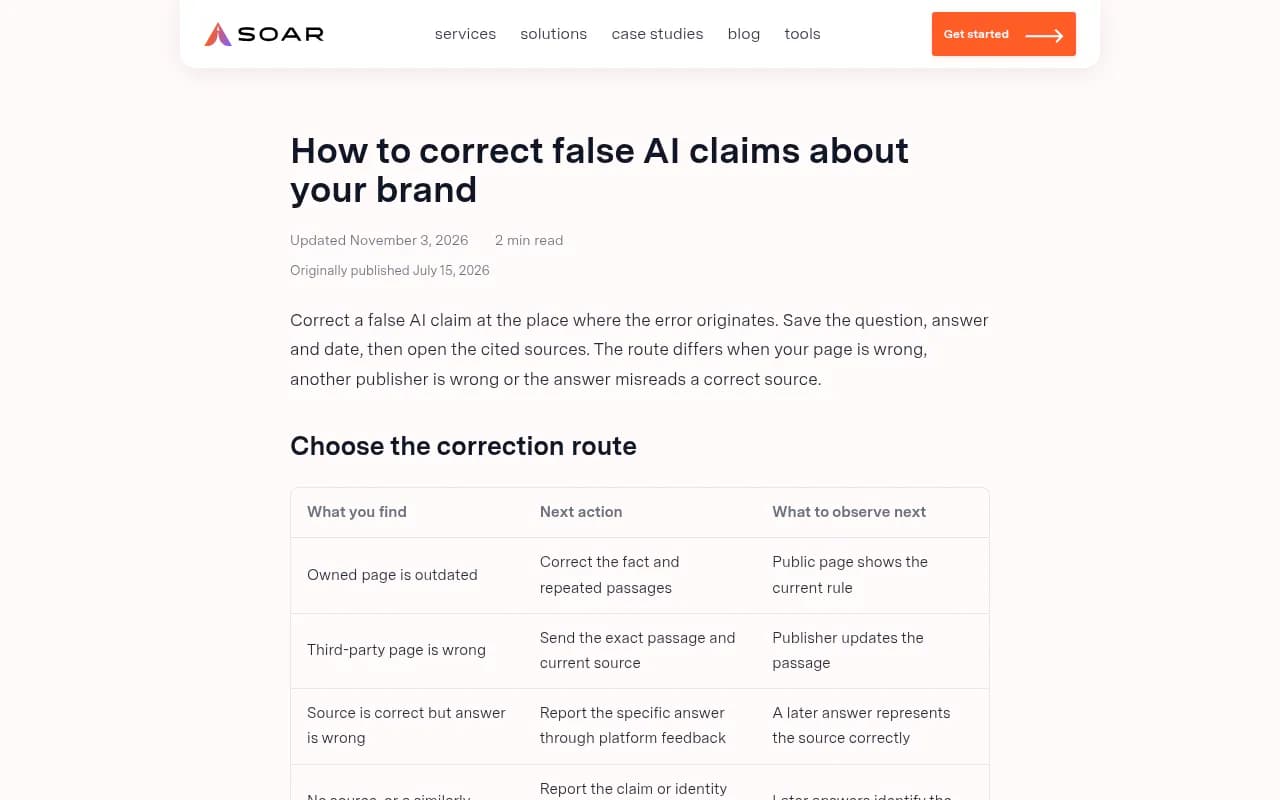
The Soar Agency guide on correcting false AI claims was updated November 3, 2026. A snippet from it suggests roughly one to four weeks on live-retrieval surfaces after you fix and re-index the source. But the article itself states that source edits have no fixed timeline for changing generated answers. I'd treat the one-to-four-week figure as an optimistic best case, not a promise.
Why the wrong claim sticks around
Your fixed page is not the only source
AI engines rarely rely on one page. A wrong pricing claim might sit on your old pricing page, a comparison article from a publisher, a Reddit thread, and a review site. Fix one and the other three keep voting for the old version.
Pages stay cited for a long time
Promptwatch Data tracked every page ChatGPT cited on July 6, 2026 for roughly 90 days, through October 4, 2026. The ChatGPT content half-life report found:
| Page type | Still cited after 30 days | Still cited after 60 days |
|---|---|---|
| Landing pages | 78% | 69% |
| Docs | 76% | 67% |
| Comparison pages | 72% | 63% |
| Listicles | n/a | 60% |
| Product pages, reviews, how-tos | n/a | 55% |
| News | Half gone by day 36 | 41% |
Product pages, reviews and how-to guides hit their half-life after 74 to 77 days. Landing pages, docs, comparisons and listicles only crossed 50% in the final week of the window, so their real half-life is probably near or beyond 90 days. Pricing pages count as landing or product pages in this classification.
A caveat I want to be clear about: this report measures how long pages stay cited. It does not measure how long a wrong claim persists after a fix. But the implication is practical. A wrong claim on a stable page type can stay in ChatGPT's citation pool for months, and old versions or third-party copies can keep getting cited even after your own page is corrected.
The crawler may never have seen your fix
If GPTBot, OAI-SearchBot, ClaudeBot or PerplexityBot are blocked by robots.txt, a CDN rule or a WAF, your updated page is invisible to them. Promptwatch's AI crawler traffic data (verified requests from June 8 to September 6, 2026) shows OpenAI made up 79.8% of requests in the week of Aug 31 to Sep 6, down from 94.8% in early June. The mix is shifting, so a rule written for last year's crawlers may not cover today's.
The report's practical advice: compare your own logs against that mix. A provider that is large overall but near zero in your logs suggests you are blocked or unreachable. The free AI Crawler URL Inspector and Agentic Readiness Check are quick ways to test access.
A realistic timeline by surface
Treat these as ranges of expectation, not guarantees. The only hard numbers in the research are the half-life figures above.
| Where the claim comes from | What has to change | Likely pace |
|---|---|---|
| Your own page, retrieved live | Page updated, crawler can access it, engine re-reads it | Days to a few weeks, if crawled |
| Third-party page, retrieved live | Publisher edits the passage | Depends on the publisher; often the slowest step |
| Cached or stale copies | Old versions drop out of the citation pool | Weeks to months for stable page types |
| Training data memory | A new model version is released | Outside your control |
| Answer misreads a correct source | Platform feedback is processed | No published timeline |
I did not find verified data on Google AI Overviews refresh timing or model training cutoffs, so I won't invent any.
Step by step: fix it and shorten the wait
1. Capture the evidence first
Save the exact question, the full answer, the sources shown and the date. Soar's advice here is right: without a before snapshot you can't prove anything changed later. Screenshots work, but a monitoring tool does this on a schedule.
2. Identify which route you are on
Soar lays out four cases, and the fix differs for each:
- Your own page is outdated: correct the fact everywhere it repeats, including the intro, tables and recommendations, not just one spot.
- A third-party page is wrong: send the publisher the exact passage plus a link to the current source. Make the edit easy.
- The source is correct but the answer is wrong: report that specific answer through the platform's feedback.
- There is no source, or a similarly named company is being confused with yours: report the mix-up and make your public identity unambiguous.
A message to a publisher can be as simple as: "Your comparison says our Starter plan includes single sign-on. SSO is on Enterprise. Current plan details are at [pricing page]. Could you update that sentence and the comparison row?"
3. Make sure AI crawlers can reach the fix
Check robots.txt, CDN and WAF rules for every provider, not just the biggest one. If you use a CDN like Cloudflare, confirm that bot-protection settings aren't silently challenging AI user agents. Server logs with IP verification tell you whether the bots actually fetched the corrected page.
4. Remove the contradicting versions
Redirect or update old pricing pages, old docs versions and archived press pages. If an outdated PDF still ranks, replace it. A page that states the old fact cleanly is a better citation candidate than you want it to be.
5. Re-ask the same questions, repeatedly
Re-run the original question and inspect the new answer and its sources. If the error remains, look for another outdated source or an identity mismatch. Do it weekly, not daily. Answers vary run to run, so one clean answer proves little and one wrong answer proves little too. You want a pattern across many runs.
6. Assign an owner
One marketing or communications person coordinates the correction. Product or support confirms feature and plan facts. Anything that looks like a serious allegation goes to legal or communications.
What to measure so you know it worked
Track these separately:
- Page corrected: the public page shows the current fact.
- Crawled: AI bots fetched the new version.
- Cited: the engine now cites the corrected page rather than the old one.
- Answer improved: the claim itself is gone or stated correctly across repeated runs.
Most teams stop at the first one and then wonder why nothing happened. The gap between the first and fourth is the entire delay you are asking about.
Tools that help you verify
For spot checks, you can re-ask questions manually in ChatGPT or Claude and log the results in a spreadsheet. That works for one claim. It stops working at twenty claims across five engines and several countries.
For ongoing tracking, Promptwatch is built for exactly this loop. Brand Narrative pulls out the individual claims AI makes about you and shows how often and in which models each one appears, and Fact Check (Business plans and up) lets you mark a claim inaccurate and then finds the pages on your site that state it. IP-verified crawler logs show whether bots read your corrected page, and Page Tracker shows whether AI now cites it.

Other options in the same space include LLMClicks, which advertises hallucination detection, and monitoring-focused trackers like Otterly.AI and Peec AI. These mainly tell you whether a claim is still showing up, with less help on finding the source or confirming crawler access.

Otterly.AI


For detecting when a third-party page or your own page changes, a change monitor like Visualping or Page Modified can alert you when a publisher finally edits that passage.
More options are listed in the GEO software directory at bestgeosoftware.com.
| Need | Approach |
|---|---|
| One-off check of a claim | Manual re-asking, logged with date |
| Ongoing claim tracking across models | AI visibility platform with claim-level analysis |
| Proof the bots saw the fix | IP-verified AI crawler logs |
| Notice when a publisher edits | Page change monitor |
Common mistakes
- Fixing the homepage but not the repeated passages. AI engines quote the table, the FAQ and the footer, too.
- Judging after one query. Run the same prompt many times and compare.
- Ignoring the third-party source. If a comparison article is wrong, your own page can be perfect and the answer will still be wrong.
- Assuming the fix failed after a week. For stable page types, Promptwatch Data suggests citation pools turn over in months, not days.
- Forgetting that markdown or llms.txt files won't rescue you. Promptwatch's markdown data shows markdown files are just 0.05% of AI search citations.
When to escalate
If a claim is defamatory, safety-related or legally risky, don't wait for the model to catch up. Use platform feedback channels, contact the publisher directly, and loop in legal. Soar's guidance is to route serious allegations to the company's legal or communications lead, and I agree: a slow-fading wrong price is an annoyance, but a wrong safety claim is a different category.
Bottom line
Expect the wrong claim to fade over weeks on live-retrieval surfaces if your page is crawlable and every other source agrees, and over months if stable pages or third-party copies keep repeating it. Training-data memory is the slowest and least controllable. Your job is to remove every contradicting source, prove the bots can read the fix, and measure the answer on a schedule until it holds across many runs.