Key takeaways
- Most startups should begin with 30 to 60 prompts. Complex SaaS, ecommerce and marketplace brands need 100 to 500, grouped by topic, persona and market.
- Plan roughly 5 prompts per topic, or about 15 per persona. Total count follows from the number of topics and personas you care about.
- A smaller, structured set beats a big random one. Coverage of intents and topics matters more than phrasing variants.
- Keep branded and non-branded prompts in separate sets, and run each market as its own library.
- Run prompts daily or at least weekly across 2 to 3 models, and wait 30 days before drawing conclusions.
Why there is no single right number
Every team asking this question wants a number. I understand the instinct, but the honest answer is that prompt tracking is not keyword tracking. With keywords you have volume, a rank position and a stable result page. With prompts you have none of that in a reliable form. The same question can return a different brand list depending on session context, location and sheer randomness.
That randomness is the real reason sizing is tricky. In January 2026, Rand Fishkin of SparkToro and Patrick O'Donnell of Gumshoe.ai had volunteers run 12 prompts nearly 3,000 times through ChatGPT, Claude and Google's AI. Search Engine Land reported the odds of getting the same brand list twice were under 1 in 100. So a single run of a single prompt tells you almost nothing. A rate over many runs tells you something.
This changes how you should think about sizing. You are not buying coverage of every possible question. You are buying a statistically useful sample of the journeys that matter to your business. Aleyda Solis puts it well in her guide on building a representative prompt library: the goal is not to track every possible prompt but to build a representative sample of the AI-assisted journeys that matter.
The sizing ranges that experts converge on
Nobody has first-party data that proves an ideal count, and I should say so plainly. Promptwatch Data does not publish a study answering this exact question. What exists are practitioner ranges, and they are surprisingly consistent when you line them up.
| Source | Suggested range | How they frame it |
|---|---|---|
| SE Ranking | 20 to 40 prompts to start | Spread across awareness, consideration and brand evaluation stages |
| Aleyda Solis | 30 to 60 for a single product and market, up to 500+ for marketplaces | Sized by business complexity |
| Uberall | About 35 to 130 per market | 7 to 11 intent types with 5 to 12 phrasings each |
| Mavlers Agency | 30 to 60 per client | 5 prompts per topic, 6 to 12 priority topics |
| Kevin Indig (via SE Ranking) | About 15 per persona | As many personas as are distinct and useful |
The low end of every range sits around 20 to 40. The high end only appears when the business has many products, personas or markets. That pattern is the useful part. Count is a function of complexity, not ambition.
Sizing by business type
Aleyda Solis offers the clearest breakdown I have seen, and it maps well to how real teams are structured.
| Business complexity | Suggested starting point |
|---|---|
| Single product, single market, limited audience | 30 to 60 prompts |
| Multi-product site, one main market | 60 to 150 prompts |
| SaaS or services with multiple personas and competitors | 100 to 250 prompts |
| Ecommerce with multiple categories | 150 to 500 prompts, sampled by category |
| Marketplace with many supply and demand sides | 200 to 500+ prompts, grouped by category, user type and market |
| International site with several priority markets | Separate libraries, 30 to 100 prompts per market |
Notice the last row. Markets do not mix. A prompt in German from Germany is a different measurement than the same intent in English from the US, so each market gets its own library rather than a bigger shared one.
A formula you can actually use
Ranges are fine, but a formula is easier to defend in a budget meeting. Two approaches work well and you can combine them.
Topics times five
Mavlers recommends 5 prompts per topic. A client with 6 priority topics lands at 30 prompts, and one with 12 topics lands at 60. This is easy to explain and easy to audit, because each topic has a small, fixed cluster of prompts.
Helen Pollitt, quoted by SE Ranking, adds a useful reframe: track topics, not individual prompts. Your category keyword is the variable that plugs into any prompt structure. You are measuring how often the topic gets queried and how often you appear.
Personas times fifteen
Kevin Indig suggests around 15 prompts per persona, with each persona distinct and useful. If you sell to a CFO, a head of IT and an ops manager, that is 45 prompts before you add any brand evaluation or comparison prompts.
Add intent coverage
Uberall's research is the cautionary tale here. In one study, 7 intents captured just 46% of the businesses AI recommended, and it took about 11 intents to reach 80%. If your prompts only ask "best X for Y," the visibility number you give leadership may rest on under half the market. Track intent coverage next to mentions. A brand mentioned 100 times across 2 intents is visible to fewer customers than one mentioned 50 times across 8.
Why more prompts is not always better data
There is a temptation to treat prompt count like a vanity metric. It is not. Each extra prompt adds cost, analyst review time and noise.
Promptwatch Data on ChatGPT query fanouts gives a useful angle. The report's own charts show ChatGPT running about 2.15 distinct web searches per response in early December, easing to about 1.84 by early March, and 1.0 per response when fanouts returned in April. The page's intro says a prompt can trigger 3 to 8 or more searches, but the chart data shows far fewer. Either way, one tracked prompt maps to only a handful of retrieval queries at most.
What that means for sizing: you do not gain coverage by adding ten phrasings of the same question. You gain coverage by adding sub-questions, such as comparisons, pricing, alternatives and how-tos. Phrase variants mostly measure noise.
Mavlers makes the arithmetic concrete. Five prompts on four platforms, run daily, produce roughly 600 responses per topic each month. That volume turns a noisy answer into a usable rate. Prompts beyond it mostly add tool cost and review time. Uberall says the same thing in a different way: if budget is tight, fewer prompts run more often beats more prompts run rarely.
Recommendations by team type
Startups
Start with 30 to 60 prompts. SE Ranking suggests 20 to 40 split across journey stages: 10 to 20 awareness, 20 to 30 consideration, and 5 to 10 brand evaluation prompts tracked separately. Run across 2 to 3 models and track at least 30 days before drawing conclusions.
If you are cash-constrained, resist the urge to track 200 prompts on day one. Spend the saved budget on fixing the gaps you find. SE Ranking makes this exact point: budget is better spent on content optimization once you know where the gaps are.
Agencies
Agencies have a different problem. The prompt count is a process decision because it multiplies across clients. Mavlers points out it sets your tool spend, analyst hours and how well your reports survive a skeptical client.
A workable default is 30 to 60 prompts per client, built from 6 to 12 topics at 5 prompts each. Keep branded prompts in their own set so a strong brand does not hide gaps. Audit prompts manually every 15 days, and flag any prompt with no traction after two months. After a full quarter, re-audit entity and cluster gaps and rebuild the plan for that topic.
Agency pricing matters here too. Look for plans with unlimited projects and prompts rather than per-client caps, which is how Promptwatch's agency plans are structured (Kick-off at $199/mo, Growth at $399/mo, Scale at $799/mo; confirm on promptwatch.com/pricing).
Enterprises
Enterprises usually land in the 100 to 500 range, but the real discipline is structure rather than size. Group by product line, persona, market and journey stage. Run each priority market as a separate library with 30 to 100 prompts. Track at a faster cadence on your most commercial topics, and use local targeting for multi-location brands.
At this scale the main risk is a non-representative library: over-represented generic discovery prompts, ignored product lines, missing local competitors. Solis warns that a dashboard built on such a set can look useful while pointing at the wrong priorities.
How many models and how often
SE Ranking recommends starting with 2 to 3 priority models: ChatGPT for the largest user base, Perplexity for citation-heavy behavior, and Google AI Overviews or AI Mode for ties to traditional search intent. Engines also behave differently. Per Promptwatch Data on average sources per response, ChatGPT cites about 5 sources per web-search answer, Google AI Overviews about 10, and Perplexity almost exactly 10 every day. Microsoft Copilot swung from under 2 to nearly 17 within a few weeks. So Perplexity makes a steady test bench, while Copilot should be judged on monthly trends rather than weekly snapshots.
Citation breadth also varies by prompt. Promptwatch's report on unique domains per ChatGPT response found almost half of responses cite 10 or more domains (Sep 28 to Oct 4, 2026), which is a reminder that a single mention is rarely the only story in an answer.
On cadence, daily is the safe default. Kevin Indig suggests around 5 consecutive runs of each prompt once a week as a minimum. Whatever you choose, report mention rate across many runs, not a single snapshot.
Which prompts deserve a slot
When you have to cut a list down, keep prompts in this order of priority:
- Commercial prompts that map to revenue, such as comparisons, alternatives and pricing.
- Prompts from your real personas and use cases.
- Category discovery prompts that feed awareness.
- A small branded set, kept separate, to monitor what AI says about you.
Good sourcing methods include converting existing SEO keywords, mining People Also Ask and Search Console queries, and reading Reddit and community threads. SE Ranking warns most teams over-index on comparative "best tool" prompts and ignore the rest.
Tools that help you size and run the set
You can start in a spreadsheet, but once you pass roughly 50 prompts a tool pays for itself. Platforms differ mainly in how many prompts each plan includes and what they let you do after tracking.
Promptwatch is the one I would look at first if you want to go past monitoring. Its prompt intelligence shows monthly volumes, difficulty scores and query fan-outs, which helps you decide which prompts earn a slot. Plans scale from Essential (50 prompts) through Professional (150) and Business (350), with daily tracking on every plan and faster cadences on Business. You can also try the 7-day free trial or the free AI visibility report before committing.

For comparison, other trackers worth a look:

Otterly.AI

Profound


| Tool | Strength | Consider if |
|---|---|---|
| Promptwatch | Tracking plus content agents, crawler logs and traffic attribution | You want to fix gaps, not only see them |
| Peec AI | Straightforward tracking for marketing teams | You need a simple dashboard |
| Otterly.AI | Basic brand mention monitoring | Budget is the main constraint |
| Profound | Enterprise monitoring | You have a large team and budget |
| Rankshift | Visibility tracking across AI engines | You want a lightweight tracker |
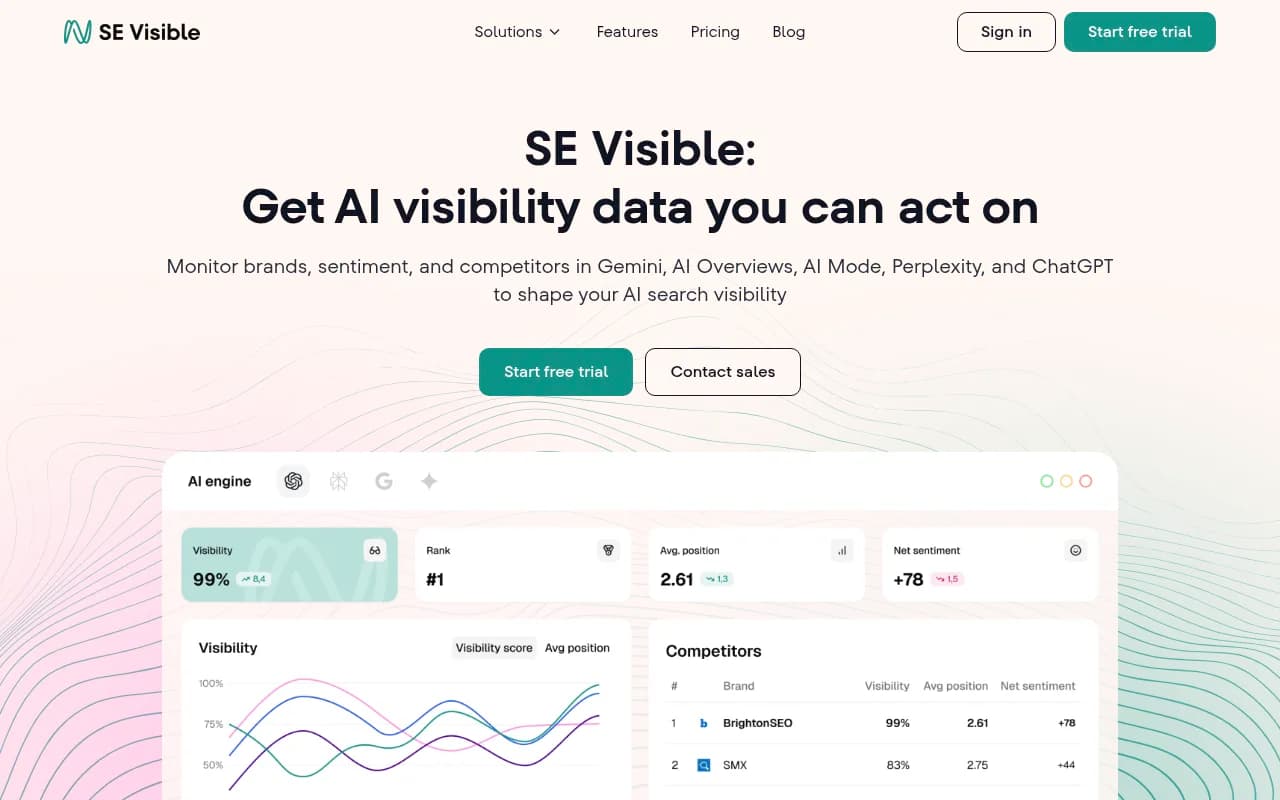
| SE Visible | Tracking from the SE Ranking family | You already use SE Ranking |
For a wider view, the GEO software directory at bestgeosoftware.com lists more options.
A step-by-step way to size your own set
- List your priority topics and personas. Aim for 6 to 12 topics or 2 to 4 personas.
- Multiply: 5 prompts per topic or 15 per persona. That is your base count.
- Add 5 to 10 branded and competitor comparison prompts, tracked in a separate set.
- Check intent coverage. Aim for 7 to 11 intent types, so you are not stuck at 46% of the market.
- If you have more than one market, build a separate library for each.
- Run for 30 days across 2 to 3 models before changing anything.
- Review every two weeks. Cut prompts with no traction after two months and replace them with new sub-questions.
Common sizing mistakes
- Starting too big. 300 prompts you never review are worse than 40 you act on.
- Mixing branded and non-branded prompts, so brand strength hides category gaps.
- Using a tool's default prompt set without checking it against your actual buyers.
- Reading a single run as truth, when under 1 in 100 odds of a repeat list says otherwise.
- Treating phrasing variants as coverage.
Final word
For most teams, the right number is the one you can review. Begin with 30 to 60 prompts, size up by topics and personas rather than gut feel, and let 30 days of data tell you where to add more. If your first month produces a clear gap list and you have actions to take, you are at the right size. If it produces a dashboard nobody opens, trim it.