Key takeaways
- AI search competitive analysis is fundamentally different from traditional SEO — you're not tracking keyword rankings, you're tracking which brands get cited in AI-generated answers.
- 99% of Google AI Overview citations come from the organic top 10, but only 12% of ChatGPT citations appear in Google's top 10, meaning your competitors may be winning in AI search through channels you're not even monitoring.
- The core workflow is: identify which prompts your competitors appear in, find the gaps where you're absent, create content that fills those gaps, and track whether AI models start citing you.
- Specialized GEO tools like Promptwatch go beyond monitoring to help you actually fix visibility gaps with content generation and crawler analytics.
- Reddit threads, YouTube videos, and third-party review sites often drive more AI citations than your own website — competitor analysis needs to include these offsite sources.
Why traditional competitive analysis breaks in AI search
If you've been running competitive analysis for any length of time, you know the drill. Pull competitor rankings from Ahrefs or Semrush, identify keyword gaps, create content to fill them. It works. It's worked for years.
But AI search doesn't work like that.
When someone asks ChatGPT "what's the best project management tool for remote teams?" or asks Perplexity "which CRM should a 10-person B2B startup use?", the answer isn't a list of 10 links ranked by domain authority. It's a synthesized recommendation — and only a handful of brands get named. The ones that don't get named effectively don't exist for that query.
The data makes this stark. According to research from Control Alt Digital, 99% of Google AI Overview citations come from the organic top 10. So for Google's AI, traditional SEO still matters a lot. But ChatGPT is a different story: only 12% of URLs cited by ChatGPT appear in Google's top 10. That means your competitor could be invisible in Google and still dominating ChatGPT recommendations — and you'd never know it from a standard rank tracker.
This is why competitive analysis for AI search requires a completely different approach.
The three dimensions of AI search competitive intelligence
Before jumping into tools and tactics, it helps to understand what you're actually measuring. AI search competitive analysis has three distinct dimensions, and most teams only look at one.
1. Share of voice across prompts
This is the most direct measure: for a given set of prompts relevant to your market, how often does each competitor get mentioned? If you track 100 prompts and your main competitor appears in 67 of them while you appear in 23, that's a concrete visibility gap.
The challenge is that "prompts" in AI search aren't like keywords. They're conversational, context-dependent, and vary by persona. "Best CRM for startups" and "what CRM should I use for a small sales team?" might look similar but pull different answers from different models.
2. Citation source analysis
Where is the AI pulling information from when it mentions a competitor? Is it citing their homepage? A G2 review page? A TechCrunch article from 2024? A Reddit thread?
This matters because it tells you what kind of content is actually driving AI visibility — and where you need to publish to compete. If your competitor is getting cited primarily through third-party review sites and you're only optimizing your own website, you're fighting the wrong battle.
3. Cross-model variation
A competitor might dominate in Perplexity but barely appear in ChatGPT. Google AI Overviews might favor a completely different set of brands than Claude does. Each model has different training data, different retrieval mechanisms, and different citation tendencies.
Mapping these differences tells you which models to prioritize and whether your competitor's AI visibility is broad or concentrated in one place.
Step 1: Build your prompt set
The foundation of any AI search competitive analysis is a well-constructed set of prompts. These are the questions your potential customers are actually asking AI models.
Start with these sources:
- Your own sales call recordings — what questions do prospects ask before buying?
- G2 and Capterra reviews of competitors (especially 3-star reviews, which tend to contain the most specific, honest language about what people were looking for)
- Reddit threads in your industry's subreddits — the exact phrasing people use when asking for recommendations
- "People Also Ask" data from Google for your core topics
- Your existing keyword research, converted into question format
A useful prompt set for a B2B SaaS company might look like:
- "What is the best [category] tool for [use case]?"
- "How does [competitor A] compare to [competitor B]?"
- "What are the alternatives to [market leader]?"
- "Which [category] tool is best for [company size/industry]?"
- "What do people say about [competitor] on Reddit?"
Aim for 50-150 prompts to start. You want enough coverage to spot patterns, but not so many that you can't act on the data.
Step 2: Run the prompts and capture competitor visibility
Now you need to actually run these prompts across multiple AI models and record who gets mentioned. Doing this manually is possible for a small prompt set, but it doesn't scale and it doesn't give you trend data over time.
This is where specialized GEO tools come in. The market has exploded in 2026, with platforms ranging from basic brand monitors to full optimization suites.
Here's how the main options compare:
| Tool | Models tracked | Competitor analysis | Content generation | Crawler logs | Best for |
|---|---|---|---|---|---|
| Promptwatch | 10+ | Yes, with heatmaps | Yes (Content Agents) | Yes | Teams that want to act, not just monitor |
| Profound | 9+ | Yes | No | No | Enterprise monitoring |
| Otterly.AI | 4-5 | Basic | No | No | Simple brand tracking |
| AthenaHQ | 5+ | Yes | No | No | Monitoring-focused teams |
| Peec AI | 4-5 | Basic | No | No | Small teams, basic tracking |
| Semrush | Limited | Limited | Via writing tools | No | Teams already on Semrush |
| Ahrefs | Limited | Limited | No | No | Traditional SEO teams |
Promptwatch stands out here because it doesn't just show you where competitors are winning — it shows you the specific content gaps and helps you create content to fill them. Most of the other platforms stop at the monitoring step.

For teams that want a dedicated monitoring tool with solid competitor tracking, Profound and AthenaHQ are worth evaluating:
Profound


For smaller teams or those just getting started, Otterly.AI and Peec AI offer simpler entry points:

Step 3: Map the competitive landscape
Once you have data from your prompt set, you can start building a real picture of the competitive landscape. Here's what to look for:
Which competitors appear most often?
Rank competitors by share of voice across your full prompt set. This gives you a baseline. But don't stop there — look at which specific prompts each competitor dominates. A competitor might have lower overall share of voice but completely own the high-intent purchase-stage prompts, which matters more.
Which models favor which competitors?
Run a cross-model breakdown. If Competitor A dominates Perplexity but barely appears in ChatGPT, that's a strategic signal. Perplexity tends to cite recent, well-sourced web content. ChatGPT's training data and browsing behavior are different. Understanding these patterns helps you prioritize where to focus.
What's the sentiment?
Being mentioned isn't always good. Some AI models will cite a competitor in a negative context — "users report that X has poor customer support" — or in a comparison where they come out second. Track whether competitor mentions are positive, neutral, or negative.
Where are the prompt gaps?
These are the prompts where no strong competitor is consistently cited. AI models are essentially saying "I don't have a great answer for this." These are your easiest wins — create authoritative content on these topics and you're filling a vacuum rather than displacing an incumbent.
Step 4: Analyze competitor citation sources
This step is where most teams stop too early. Knowing that a competitor appears in AI answers is useful. Knowing why they appear is where the real competitive intelligence lives.
For each competitor that's consistently cited, dig into the source URLs that AI models are pulling from. You'll typically find a mix of:
- Their own website (blog posts, product pages, comparison pages)
- Third-party review platforms (G2, Capterra, Trustpilot, Product Hunt)
- Media coverage (TechCrunch, industry publications, newsletters)
- Reddit threads and community discussions
- YouTube videos
- Listicles and "best of" roundups on other websites
The distribution tells you a lot. If a competitor's AI visibility is heavily driven by third-party review sites, you can compete by improving your own presence there. If it's driven by a specific type of content on their own site (say, detailed comparison pages), you know what to build.
Tools like Promptwatch track offsite citations specifically, showing you which external pages are driving AI visibility for both you and your competitors. This is genuinely hard to replicate manually.
Step 5: Identify your content gaps
Now you have the raw material for a content strategy. The gap analysis works like this:
- List every prompt where a competitor appears but you don't
- For each gap, identify what content the AI is citing when it mentions the competitor
- Determine whether you have equivalent content on your site
- If you don't, that's a content gap. If you do, it's a citation gap (the content exists but isn't being picked up)
Content gaps and citation gaps require different responses.
For content gaps, you need to create new material. The key is to match the format and depth that AI models seem to prefer for that type of query. For comparison queries, that usually means detailed, structured comparison content. For "best of" queries, it means comprehensive roundups that cover the topic thoroughly. For how-to queries, it means step-by-step guides with concrete specifics.
For citation gaps, the content exists but AI models aren't finding or trusting it. This could be a technical issue (crawlability, structured data, page speed), an authority issue (the page doesn't have enough external links or mentions), or a freshness issue (the content is outdated).
Step 6: Track changes over time
AI search competitive analysis isn't a one-time project. Competitor visibility shifts as they publish new content, earn new citations, and as AI models update their training data or retrieval behavior.
Set up ongoing tracking for:
- Your share of voice vs. key competitors across your core prompt set
- New citation sources appearing for competitors (early warning of their content strategy)
- Changes in which models favor which competitors
- Your own visibility scores as you publish new content
The timeline from publishing new content to getting cited by AI models varies. Some pages get picked up within days; others take weeks or months. Tracking this timeline helps you understand what's working and calibrate your expectations.
Promptwatch's agent analytics specifically tracks the crawl-to-citation timeline — when AI crawlers first hit a page, when they return, and when that page starts appearing in citations. This kind of data is rare and genuinely useful for understanding how fast your content investments are paying off.
Step 7: Act on the intelligence
Competitive intelligence is only valuable if it changes what you do. Here's how to translate the analysis into action:
Create content for your prompt gaps
Use your gap analysis to prioritize content creation. Focus first on high-intent prompts (purchase decisions, comparisons, "best for" queries) where you're absent but competitors are present. These have the most direct revenue impact.
When creating this content, write for the questions AI models are trying to answer, not just for keywords. Be specific, cite sources, use structured formatting, and cover the topic more thoroughly than existing content does.
Build your offsite presence
If competitor citations are heavily driven by third-party sources, you need to be present there too. This means:
- Getting listed and reviewed on G2, Capterra, and relevant industry review sites
- Earning coverage in publications that AI models trust
- Participating in Reddit communities where your buyers ask questions (genuinely, not spammily)
- Creating or optimizing YouTube content for your key topics
Fix technical citation barriers
If you have content gaps that should be getting cited but aren't, audit the technical side. Are your key pages crawlable by AI bots? Do you have proper structured data? Are pages loading fast enough? Is your content well-organized with clear headings that make it easy for AI models to extract specific answers?
Tools like Screaming Frog can help with technical audits:
For ongoing monitoring of how AI crawlers are actually interacting with your site, you need crawler log analysis — something most traditional SEO tools don't provide.
Tools worth knowing about
Beyond the primary GEO platforms, a few other tools are useful in a competitive intelligence workflow:
For traditional competitive research that feeds into your GEO strategy, Semrush and Ahrefs still provide valuable data on competitor content and backlink profiles:
For tracking brand mentions across the broader web (which feeds into offsite citation analysis), Brand24 and Brandwatch offer solid coverage:
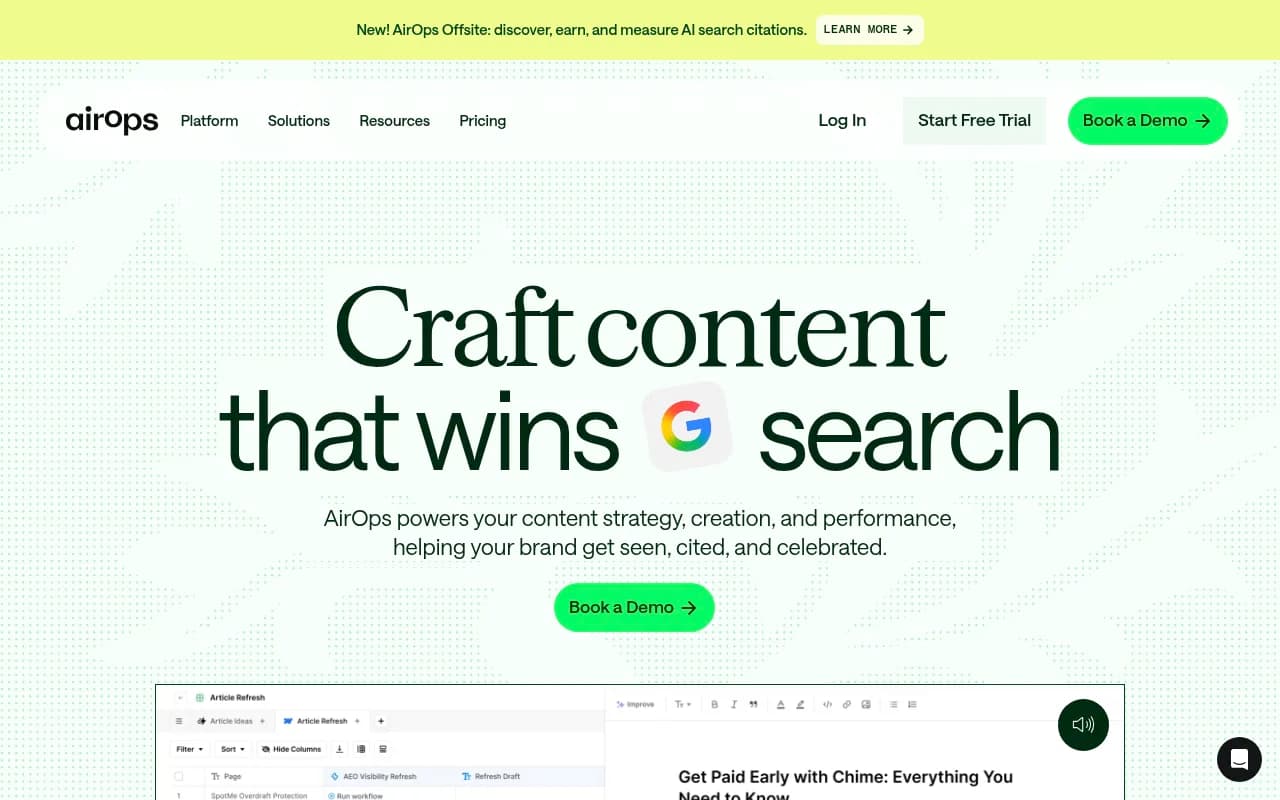
For content creation once you've identified your gaps, platforms like AirOps are built specifically for AI search content:
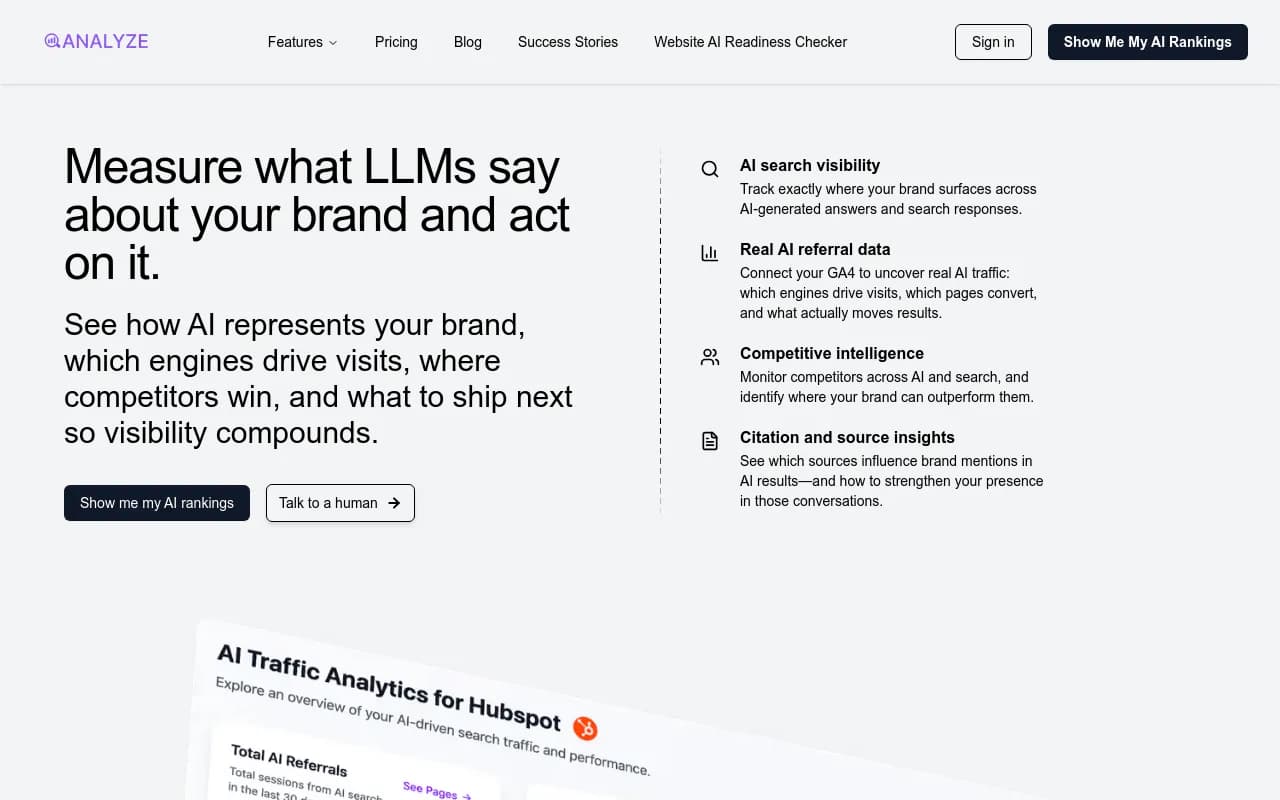
For tracking AI search visibility with a focus on connecting it to actual traffic, Analyze AI is worth a look:
Common mistakes in AI search competitive analysis
A few patterns come up repeatedly when teams first start doing this work:
Tracking too few prompts. With 10-15 prompts, you'll miss most of the picture. Competitor visibility is uneven across prompt types, and you need enough coverage to spot the patterns.
Only monitoring your own brand. The whole point of competitive analysis is understanding relative position. If you're only tracking whether you appear, you don't know whether your improvements are keeping pace with what competitors are doing.
Ignoring offsite sources. A significant portion of AI citations come from Reddit, YouTube, review sites, and media coverage — not just brand websites. If your competitive analysis only looks at what competitors publish on their own sites, you're missing a lot.
Treating all AI models the same. ChatGPT, Perplexity, Google AI Overviews, and Claude behave differently. A strategy optimized for one won't automatically work for the others. Map where your competitors are strongest and weakest across models, and prioritize accordingly.
Measuring visibility without connecting it to revenue. Share of voice in AI answers is a means to an end. The real question is whether AI-driven visibility is sending qualified traffic and converting. Track AI referral traffic separately and watch whether it correlates with pipeline.
Putting it together
AI search competitive analysis in 2026 is genuinely more complex than traditional SEO competitive analysis. You're dealing with multiple models, conversational queries, offsite citation sources, and a landscape that shifts as models update.
But the core logic is simple: find out which prompts your competitors are winning, understand why they're winning them, and create the content and presence needed to compete. The teams doing this systematically are building durable AI search visibility while competitors are still wondering why their traffic from AI referrals is flat.
The tools exist to do this at scale. The methodology is clear. What's left is doing the work.