Key takeaways
- "AI SEO tool" covers at least four different jobs: AI visibility tracking, content optimization, traditional SEO research, and technical auditing. Pick the job first, then the tool.
- Engines behave differently and change fast. A tool that tracks each engine separately and refreshes its data often beats one that gives you a single blended score.
- Ask whether the tool only monitors or also helps you fix what it finds. That is the biggest price-to-value divider in this category.
- Run a trial with your own brand and three to five real competitors before paying. Demo data tells you nothing.
- Check the unit of pricing (prompts, responses, credits, seats) and calculate your real monthly cost, not the headline price.
Why this is harder than it looks
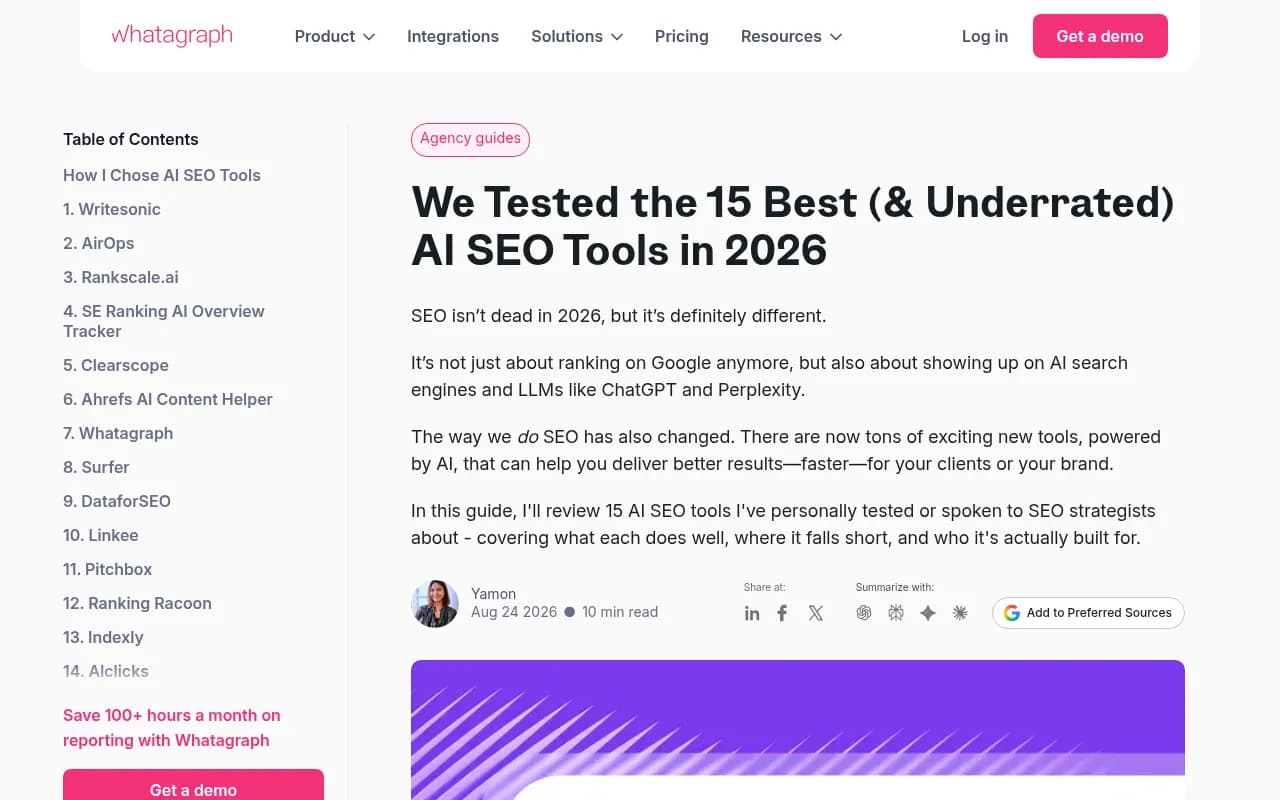
Search "best AI SEO tools 2026" and you get a dozen listicles that rank the same tools in slightly different orders. Some are written by vendors, some by affiliates, and a few by people who actually used the software. Whatagraph's roundup of 15 tools and Tim Soulo's breakdown of seven tools both start from the same observation: ranking on Google is no longer the whole job, and you now need to show up inside ChatGPT, Perplexity and Google AI answers too.
That is true. It also means the category has exploded, and "AI SEO tool" now describes products that have almost nothing in common. A rank tracker with an AI Overviews column, a content editor that scores your draft, a prompt tracker for ChatGPT, and an autopilot that publishes articles all fit the label.
So instead of another ranked list, here are ten questions. Answer them before you open a pricing page. One line from a Quora thread on this topic stuck with me: start with the question you need to answer and choose tools that provide evidence for it. That is the whole method.
Question 1: What job am I actually hiring this tool for?
Write one sentence. "I need to know whether ChatGPT recommends us." "I need to produce 20 briefs a month." "I need to find out why our pages aren't indexed." If you can't finish the sentence, you are shopping for a feeling, not a tool.
Here is roughly how the market splits:
| Job | What it answers | Example tools |
|---|---|---|
| Classic SEO research | Keywords, backlinks, rankings, competitors | Semrush, Ahrefs, Moz Pro |
| Content optimization | Is this draft covering what top pages cover? | Surfer SEO, Clearscope, Frase, MarketMuse |
| AI visibility tracking | Is my brand mentioned or cited in AI answers? | Otterly.AI, Peec AI, Profound |
| AI visibility plus optimization | Why am I missing, and what do I publish to fix it? | Promptwatch |
| Technical auditing | Can crawlers read and index my site? | Screaming Frog, Sitebulb, Lumar |
Most teams need two of these, not five. Buying a tool that does all of them at 60% depth is the common mistake.
Question 2: Does it monitor, or does it help me act?
This is the question I would weight most heavily. A lot of the newer AI visibility tools answer one thing: "Was my brand mentioned?" You get a score, a chart, and a competitor comparison. Then you're on your own.
That is fine if you have a content team and an SEO lead who can translate a dashboard into a plan. It is expensive if you don't, because the dashboard becomes a weekly reminder of a problem you can't fix.
Look for tools that connect the finding to an action: content gap analysis, a prioritized to-do list, content generation grounded in the data, and a way to check whether the fix worked. Promptwatch is built around that loop. Its Action Board prioritizes work, its Content Agent writes and publishes to Webflow, Framer or WordPress, and published pages are then tracked for crawls, citations and AI traffic.

Monitoring-only tools are not useless. Some teams want exactly that, cheaply. Just decide on purpose. If you want a lighter option, browse the AI rank tracking directory at ai-rank-tools.com for a sense of how wide the field is.
Question 3: Which engines does it track, and does it track them separately?
AI engines do not behave alike. Promptwatch Data shows Google AI Overviews citing about 10 sources per answer and Perplexity citing almost exactly 10 every day, while ChatGPT cites about 5 per web-search answer (average sources per response). Microsoft Copilot's average swung from under 2 to nearly 17 within a few weeks before settling low.
Social sources show the same split. In Promptwatch Data for Sep 28 to Oct 4, 2026, ChatGPT drew 0.46% of its citations from social platforms while Google AI Overviews drew 12.2% (social media citations by AI model). Perplexity sat at 2.7%.
The implication for buying: a tool that reports one blended "AI visibility score" can hide the fact that you are strong in Perplexity and invisible in ChatGPT. Ask for per-engine breakdowns. Also ask which engines are covered at your price tier, since some vendors gate the expensive ones.
Question 4: Does it track the real interface or just the API?
This one gets skipped in most buyer guides and it matters. What a model says through its API can differ from what a user sees in the ChatGPT or AI Overviews interface, especially for citations and shopping results. If the vendor only calls APIs, you are measuring a cousin of what your customers see.
Ask directly: "Do you collect answers from the live user interface, per country and language?" Promptwatch does this for ChatGPT, Google AI Overviews, AI Mode, Gemini, Perplexity, Copilot and others, and tracks API models alongside to show what models believe from training data. Many cheaper trackers use APIs only. That can be acceptable for rough direction, but you should know it is happening.
Question 5: Does it show query fan-outs?
When a user asks ChatGPT something, it often runs several web searches behind the scenes. Promptwatch's fan-out report says a single prompt can trigger 3 to 8 or more searches, though the tracked daily average is lower: about 2.15 per response in early December 2025 and about 1.84 by early March 2026 (ChatGPT query fanouts). On Aug 8, 2026, ChatGPT also started using the site: operator at scale, jumping from about 0.4% to about 17% of fan-out queries overnight (report).
Why you care: your content has to match the sub-queries the model generates, not just the prompt the user typed. A tool that shows only the original prompt is hiding half the picture. Ask whether fan-out or sub-query data is included, and whether it updates.
Question 6: Can it tell me why I am or am not cited?
A mention count is a symptom. The cause lives elsewhere: whether AI crawlers can reach your pages, which pages they read, which third-party pages mention you, and whether the pages that rank in Google are the ones getting cited.
Three capabilities separate the diagnostic tools from the scoreboards:
- AI crawler logs, ideally IP-verified so spoofed bots are filtered out. Promptwatch Data tracks this kind of traffic, and one finding is that Meta-WebIndexer grew from about 2% to nearly 38% of tracked AI crawler requests between mid-July and Aug 9, 2026 (report). You can't see shifts like that without logs.
- Citation data at page level, so you can see which of your URLs get cited and where they land in the source list.
- Search Console and Bing data next to AI data, so you can ask "which pages rank but never get cited?"
Most monitoring-only tools skip crawler logs entirely. If your problem is that AI can't read your site, a scoreboard will never tell you.
Question 7: Does it connect to traffic and revenue?
Mentions are not money. If your CFO asks what the tool paid back, "our share of voice went up 4 points" is a weak answer. Look for visitor analytics or attribution that shows actual sessions and conversions from AI platforms.
Promptwatch's case studies give a sense of what is measurable: Crisp reported 2x higher conversion rates from AI traffic than from traditional channels, and TreeHouse (Pararius and Huurwoningen.nl) grew AI search to about 25% of organic conversions. Treat vendor case studies as vendor case studies, but the point stands. A tool that can't connect to your analytics leaves you guessing. Tools like Analyze AI and Siteline AI also lean on the traffic angle, so compare how each defines and captures AI visits.
Question 8: How fresh are its data and its advice?
AI engines change constantly, and advice goes stale quickly. Promptwatch Data recorded reddit.com's share of ChatGPT citations falling from about 4% to about 0.5% on Aug 14, 2026 (report). Any playbook that said "get on Reddit to win ChatGPT" went from useful to wrong in a day. Meanwhile ChatGPT's average citations per response dropped across GPT-5.3, GPT-5.4 and GPT-5-Mini around Mar 4, 2026 (report).
Questions to ask a vendor:
- How often do you refresh prompt responses: daily, weekly, on demand?
- When an engine changes behaviour, how do you tell customers?
- Is your recommendation engine based on live data or on a static best-practices list?
If the answers are vague, the advice inside the product is probably a template.
Question 9: What does pricing really cost at my scale?
Headline prices mislead because the unit differs. One vendor charges per prompt, another per response, another per credit, another per seat or per project. Compare on a common basis: how many prompts do you need, across how many engines, how many countries, how often.
A quick worked example. Say you want to track 100 prompts across 5 engines, daily. That is 15,000 responses a month. A plan with 6,000 responses won't cover it, however cheap the sticker looks. Promptwatch's public tiers run from a free Explore plan to Essential at $95/mo (50 prompts, 6,000 responses), Professional at $245/mo (150 prompts, 18,000 responses) and Business at $579/mo, with agency plans from $199/mo. Confirm current numbers at promptwatch.com/pricing before you budget.
| Check | Why it matters |
|---|---|
| Unit of pricing | Prompts, responses and credits are not comparable |
| Engines included per tier | Some tiers lock the engines you care about |
| Country and language tracking | Often an upsell |
| Seats and projects | Hits agencies first |
| Content or credit allowances | Optimization features usually have caps |
| Annual discount | Often around 17%, but you lock in |
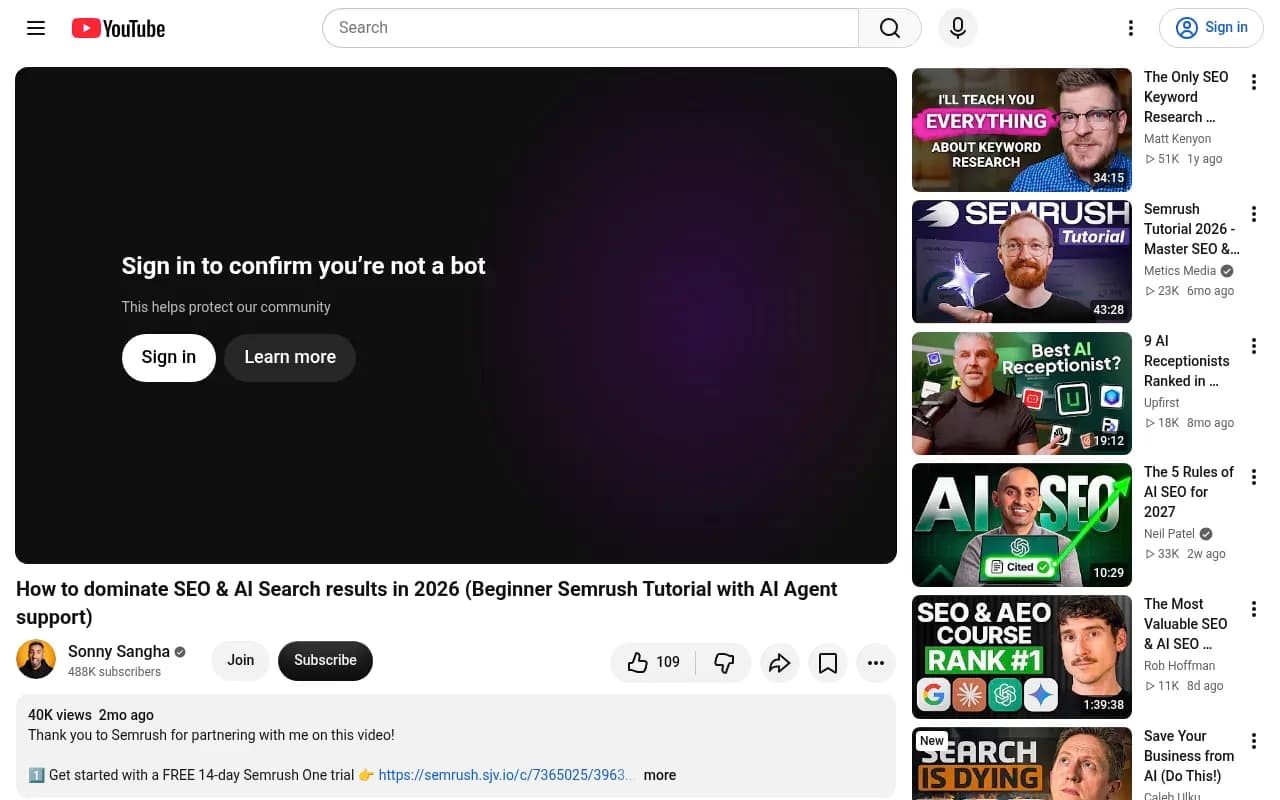
Be careful with suite pricing too. The Semrush One video from Aug 2026 mentions toolkits, API units and usage limits. I haven't verified how those are metered, so check Semrush's pricing page and read the usage section before assuming the base price covers your needs.
Question 10: Does it fit the tools and people I already have?
The best tool is the one your team will open on Tuesday. Check integrations before you buy:
- Can it publish to your CMS, or do you copy and paste?
- Does it connect to Google Search Console and your analytics?
- Does it export to Looker Studio, CSV, or an API, and does it offer an MCP server so your AI assistant can query the data?
- Does it offer white-label reports if you serve clients?
- Is the seat model workable for your team size?
Also be honest about who will run it. If your content team is two people, a tool that generates a long task list will sit unused. If you have an SEO lead who loves data, a lightweight tracker plus your own process might be enough. And if you don't want to run any of this yourself, an agency is a legitimate option; 1001 SEO Media does this work as a service, using Promptwatch as its AI visibility platform.
A comparison to anchor the shortlist
Here is how typical categories stack up against the ten questions. This is a general guide, not a feature audit of every vendor, so verify specifics in a trial.
| Category | Tracks per engine | Crawler logs | Traffic attribution | Helps you fix it | Typical risk |
|---|---|---|---|---|---|
| Basic prompt trackers (Otterly.AI, Peec AI, Rankscale) | Yes | Usually no | Limited | No | You see the gap but can't close it |
| Enterprise monitors (Profound, Scrunch) | Yes | Varies | Varies | Limited | Higher price |
| SEO suites (Semrush, Ahrefs Brand Radar) | Partly | No | Partly | Partly | AI tracking is a add-on with fixed prompt sets |
| Content tools (Surfer SEO, Clearscope, Frase) | No | No | No | Drafts and scores | No visibility data to ground the content |
| End-to-end platforms (Promptwatch) | Yes | Yes | Yes | Yes | More to learn than a simple tracker |
Some names worth knowing in each bucket: Semrush and Ahrefs for suites, plus Peec AI and Otterly.AI for lightweight tracking.
Otterly.AI


Profound

If you want a broader look at the field, the GEO software directory at bestgeosoftware.com lists far more options than any one article can cover.
How to run the trial properly
Don't evaluate on the vendor's demo brand. Use this process instead:
- Pick 20 to 30 prompts your buyers really ask, across informational, comparison and branded intent.
- Add your brand plus three to five competitors. This mirrors advice from Anderson Collaborative's guide, and it is sound.
- Run the same set in two finalist tools for a week.
- Compare results against what you see by hand in ChatGPT and Google. If the numbers differ wildly, find out why (API versus real interface is a frequent cause).
- Ask each tool a hard question: "Why aren't we cited for this prompt?" See whether you get a real answer or a shrug.
- Take one recommendation, act on it, and check whether the tool tracks the result.
Step five is where the difference between a tracker and an optimization platform shows up fast. Promptwatch also has a free AI visibility report, which is a cheap way to get a baseline before you commit to any paid plan.
Red flags
- A single "AI score" with no per-engine breakdown or methodology.
- No explanation of where the data comes from (API, scraped UI, synthetic).
- Content generation with no visibility data behind it. That is just an article writer.
- Claims of guaranteed rankings or citations. Nobody controls these engines.
- Advice that reads like a generic checklist and doesn't change when the data does.
- No way to export your data if you leave.
Quick decision guide
- You only need to know where you stand: start with a lightweight tracker or a free baseline report.
- You have strong traditional SEO and want AI data inside the same suite: look at Semrush or Ahrefs, and check prompt limits carefully.
- You write a lot of content and need drafts scored: Surfer SEO, Clearscope or Frase handle that, but pair them with real visibility data.
- You want to find gaps, fix them, and measure the result in one place: an end-to-end platform like Promptwatch fits.
- You lack the time or team: consider an agency rather than a tool you won't use.
Whichever way you go, write your one-sentence job description first, then test two finalists on your own prompts. A week of real data beats any listicle, including this one.