Key takeaways
- LinkedIn is the most-cited domain for professional queries across major AI search engines, according to research from Profound -- making it a high-leverage channel for B2B AI visibility.
- AI models favor educational, fact-dense content over opinion pieces or promotional posts. Depth beats volume.
- Author credibility matters. Posts from verified experts with complete profiles get cited more often than anonymous or thin-profile accounts.
- Your LinkedIn Company Page setup -- description, specialties, featured content -- directly affects how AI models understand and represent your brand.
- Tracking which LinkedIn content actually gets cited requires dedicated AI visibility tooling, not just LinkedIn's native analytics.
Something shifted in B2B search over the past 18 months that most marketing teams haven't fully processed yet. Buyers are no longer opening twelve browser tabs to research a vendor. They're asking ChatGPT, Perplexity, or Gemini a question and trusting the synthesized answer. If your brand isn't in that answer, you're not in the consideration set.
Here's the part that should get your attention: LinkedIn is the most-cited domain for professional queries in AI search. Profound, which tracks citations across major AI engines, ranked LinkedIn at the top for B2B-relevant prompts. Semrush's own research confirms the same pattern. This isn't a coincidence -- LinkedIn's combination of professional credibility signals, public content, and structured profiles makes it exactly what AI models want to cite.
So the question isn't whether to optimize your LinkedIn Company Page for AI search. It's how to do it properly.
Why LinkedIn gets cited so often by AI engines
Before getting into setup mechanics, it's worth understanding the "why" -- because it shapes every decision you'll make.
AI models build citations based on a few core signals: domain authority, content credibility, content freshness, and how well a piece of content directly answers a specific question. LinkedIn scores well on all four.
The domain itself carries enormous authority. Content on LinkedIn is attributed to real people with verifiable professional histories. Posts and articles are dated, which helps AI models assess freshness. And because LinkedIn's content ecosystem is built around professional expertise, the signal-to-noise ratio for B2B topics is higher than most platforms.
LinkedIn's own VP of Marketing, Davang Shah, put it plainly in a March 2026 post: the B2B buying journey has shifted from visibility to credibility -- what LinkedIn calls "Buyability." AI search is accelerating that shift. The brands that win aren't necessarily the ones with the biggest ad budgets; they're the ones AI models trust enough to cite.
Part 1: Setting up your LinkedIn Company Page for AI discoverability
Complete every field -- seriously, every one
AI models parse your Company Page like a structured document. Incomplete pages leave gaps that models fill in with competitor information or skip entirely.
The fields that matter most for AI citation:
- About section: This is your most important real estate. Write it as a clear, factual description of what your company does, who it serves, and what problems it solves. Avoid marketing fluff. AI models want extractable facts, not brand voice exercises. Aim for 2-3 paragraphs that answer "what does this company do and why does it matter?"
- Specialties: Fill in all available specialty tags. These function as structured metadata that AI models use to categorize your company when answering category-level queries ("what are the best tools for X?").
- Website URL: Obvious, but make sure it's current and resolves correctly. AI models cross-reference your LinkedIn presence with your website.
- Industry and company size: These help AI models surface you for industry-specific queries.
- Founded date and headquarters: Legitimacy signals. Companies with complete factual profiles get cited more readily.
Optimize your About section for answer-first extraction
LinkedIn's own content team shifted from a "keyword-first" to an "answer-first" approach after seeing B2B non-brand keyword traffic drop up to 60% following AI Overview launches. The same principle applies to your Company Page description.
Write your About section so that any sentence in it could stand alone as a useful answer to a question. Instead of "We're a passionate team dedicated to transforming how businesses approach data," write "Acme Analytics helps mid-market B2B companies reduce reporting time by connecting CRM, ad, and revenue data in a single dashboard."
The second version is extractable. An AI model can quote it directly in response to "what does Acme Analytics do?" The first version is useless to a language model.
Use your Featured section strategically
The Featured section lets you pin specific posts, articles, or external links. Treat this as your citation bait -- the content you most want AI models to surface when someone asks about your company or your area of expertise.
Pin your highest-quality educational content here. If you've published a data report, a detailed how-to guide, or a well-cited article, feature it. AI models that crawl your page will encounter this content first.
Part 2: Content strategy that gets cited
Educational content is what AI models want
This is the clearest finding from LinkedIn's own research and from third-party studies: AI models cite educational content at a dramatically higher rate than opinion pieces, promotional updates, or personal anecdotes.
What counts as educational content?
- Original research with specific data points ("Our analysis of 500 B2B deals found that...")
- Step-by-step guides that answer a specific question
- Explainers that define industry concepts with precision
- Case studies with concrete outcomes ("reduced churn by 23% in 90 days")
- Comparison frameworks that help buyers evaluate options
What doesn't get cited:
- "Excited to announce..." posts
- Vague thought leadership ("The future of work is changing")
- Reposts of other people's content without original analysis
- Promotional content about your product features
The gap between these two categories is wider than most marketing teams expect. If your LinkedIn content calendar is mostly announcements and reposts, you're essentially invisible to AI search.
Publish articles, not just posts
LinkedIn articles (the long-form format, not short posts) get indexed and cited differently. They have their own URLs, they're crawlable as standalone documents, and they signal depth in a way that short posts don't.
For AI citation purposes, articles should:
- Have a clear, question-answering headline ("How to reduce SaaS churn in the first 90 days")
- Use descriptive subheadings that function as mini-answers
- Include specific data, statistics, or research
- Be at least 800 words -- enough to demonstrate genuine depth
- Avoid padding. Fact-density matters more than length.
Freshness matters more than you think
AI models weight recency. A well-written article from 18 months ago will lose citation share to a newer piece on the same topic. This doesn't mean you need to publish daily -- it means you need a consistent cadence that keeps your content fresh.
For most B2B companies, publishing 2-4 substantive LinkedIn articles per month is more effective than posting short updates daily. Quality and freshness together beat either one alone.
Structure content for extractability
ROI Revolution's 2026 guide on AI search optimization makes a point that applies directly to LinkedIn content: AI models don't read like humans. They ingest content in chunks. If your key insights are buried in long paragraphs, they get skipped.
For LinkedIn articles specifically:
- Lead with the answer, then explain it (inverted pyramid)
- Use numbered lists for processes and steps
- Use bullet points for comparisons and options
- Bold key facts and data points (sparingly -- not every sentence)
- Keep paragraphs short. Three to four sentences maximum.
Part 3: Author credibility and employee advocacy
Why author profiles matter for AI citations
Here's something most companies miss: AI models don't just evaluate the content, they evaluate the source. A post from a LinkedIn member with a complete profile, verified employment history, and a track record of engagement carries more citation weight than the same post from a thin or incomplete profile.
This has real implications for your content strategy. Content published by your company page gets some credibility from the domain. Content published by individual employees with strong profiles -- and then shared or reshared by the company -- can get significantly more.
The three signals that matter most for author credibility:
- Complete profile (photo, headline, summary, work history, skills)
- Relevant expertise signals (endorsements, recommendations, published articles)
- Engagement history (consistent posting in a specific topic area)
Build an employee advocacy program with AI visibility in mind
If your subject matter experts are publishing educational content on their personal profiles and tagging or mentioning your company, you're building a distributed citation network. Each credible author who writes about topics adjacent to your business is another entry point for AI models to discover and cite your brand.
This isn't about getting employees to repost company announcements. It's about enabling them to publish genuine expertise -- and making sure their profiles are complete enough that AI models treat them as credible sources.
Part 4: Technical considerations
Keep your page public
This sounds obvious, but it's worth stating: AI crawlers can only index public content. Make sure your Company Page and all associated articles are set to public visibility.
Cross-link your LinkedIn presence with your website
AI models build entity graphs -- they connect your LinkedIn page, your website, your mentions in other sources, and your published content into a coherent picture of who you are. The stronger those connections, the more confidently a model can cite you.
Practical steps:
- Link to your LinkedIn Company Page from your website's footer and About page
- Include your LinkedIn URL in your website's structured data (Organization schema)
- Reference your LinkedIn articles from your website blog when relevant
- Make sure your company name is consistent across both properties
Don't ignore your LinkedIn newsletter
LinkedIn newsletters are a relatively underused format that gets treated differently by the algorithm and by AI crawlers. Newsletters have subscriber lists, they generate notifications, and they're indexed as a distinct content type. If you're publishing regular educational content, a LinkedIn newsletter is worth considering -- it creates a persistent, crawlable archive of your expertise.
Part 5: Tracking your LinkedIn AI citation performance
Setting up your page and publishing great content is only half the job. You need to know whether it's actually working -- which LinkedIn's native analytics won't tell you. LinkedIn shows you impressions and engagement, but not whether your content is being cited in AI search responses.
This is where dedicated AI visibility tracking becomes necessary. Tools like Promptwatch track which pages and domains AI models cite when answering specific prompts, so you can see whether your LinkedIn articles are showing up in ChatGPT, Perplexity, or Google AI Overviews responses.

The workflow looks like this: identify the prompts your buyers are likely asking AI engines, track which sources get cited in the responses, and then compare your LinkedIn content against those citations. If competitors' LinkedIn articles are getting cited for prompts you should own, that's a content gap you can close.
For teams that want a broader picture of AI search visibility across their owned and earned channels, here's how some of the main tracking tools compare:
| Tool | LinkedIn citation tracking | Content gap analysis | AI crawler logs | Pricing |
|---|---|---|---|---|
| Promptwatch | Yes | Yes (Answer Gap Analysis) | Yes | From $99/mo |
| Profound | Yes | Limited | No | Higher price point |
| Otterly.AI | Partial | No | No | Lower price point |
| Peec.ai | Partial | No | No | Lower price point |
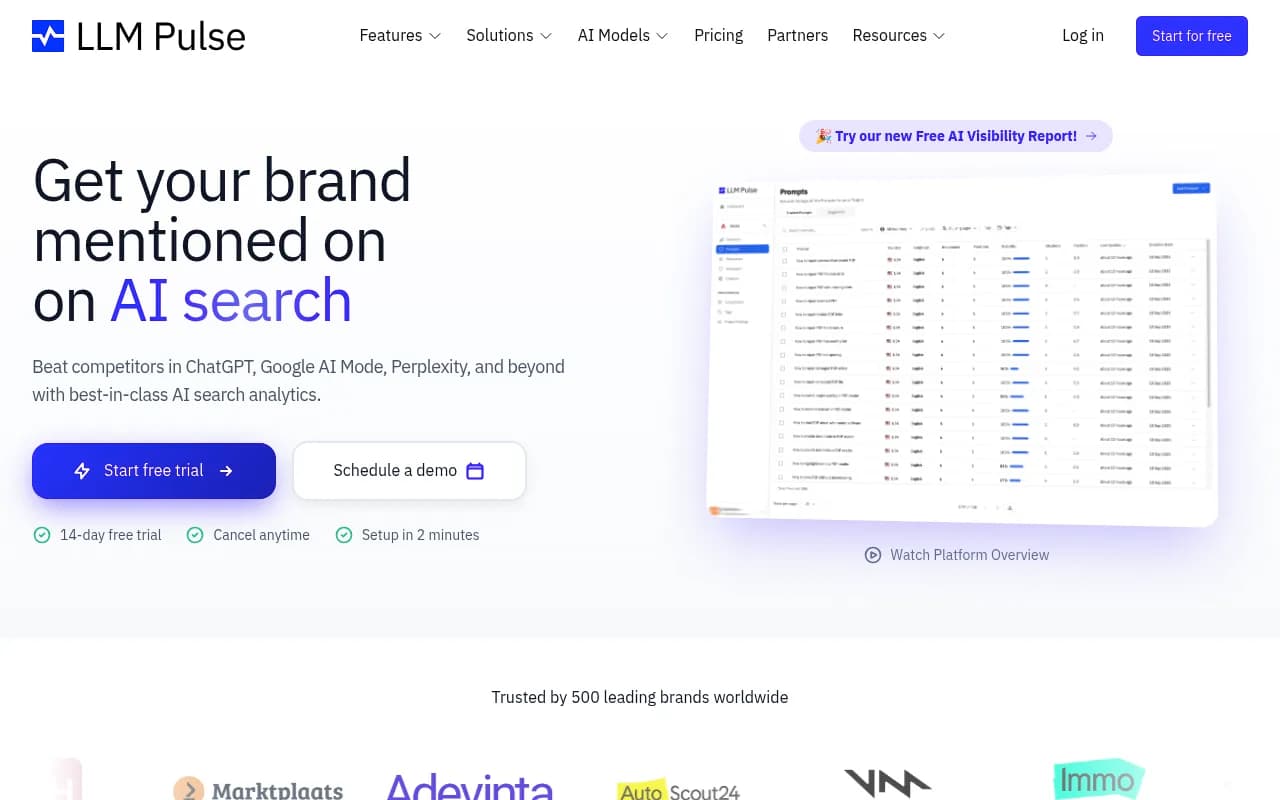
| LLM Pulse | Basic | No | No | Varies |
Profound

Otterly.AI

Most monitoring-only tools will show you that your LinkedIn content isn't being cited, but won't help you understand why or what to do about it. The more useful platforms connect citation data to content recommendations.
Part 6: Common mistakes that kill LinkedIn AI citations
Publishing for the algorithm, not for AI models
LinkedIn's engagement algorithm rewards posts that generate comments quickly. AI citation algorithms reward posts that answer questions clearly. These are not the same thing.
A post that asks "What's your biggest challenge with remote work? Comment below!" might get 200 comments and zero AI citations. An article titled "How to reduce remote team turnover: 5 practices from 50 companies" might get modest engagement but get cited repeatedly in AI responses to related queries.
Optimize for citation, not for likes.
Inconsistent publishing
AI models weight freshness. A company page that publishes a burst of content and then goes quiet for three months will lose citation share to competitors with consistent output. Better to publish one solid article every two weeks than ten articles in January and nothing until April.
Over-promoting, under-educating
If 80% of your LinkedIn content is about your product, your company news, or your awards, you're not building the kind of educational authority that AI models cite. Flip the ratio: 80% educational content that your audience would find useful even if they never bought from you, 20% company-specific content.
Ignoring the company page in favor of personal profiles only
Personal profiles get cited, but your Company Page is the canonical representation of your brand on LinkedIn. Neglecting it means AI models have less structured information to work with when building an entity profile of your company. Both matter -- they work together.
Putting it all together
The setup isn't complicated, but it does require a genuine shift in how you think about LinkedIn. Stop treating it as a social platform where you broadcast company news. Start treating it as an authoritative publishing platform where you build a body of educational content that AI models can cite.
The companies that will win AI search citations on LinkedIn in 2026 are the ones publishing specific, fact-dense, question-answering content from credible authors, on a consistent schedule, with a fully optimized Company Page that gives AI models every signal they need to understand and trust the brand.
That's a content strategy problem, not a technical one. The technical setup takes an afternoon. The content strategy takes months to build -- which is exactly why starting now matters.