Key takeaways
- The AI visibility tool market has exploded to 50+ platforms in 2026, but most of them only monitor -- they show you data and leave you to figure out what to do with it
- The most important question to ask any vendor is: "What happens after I see the data?" If the answer is "you export it and go fix things yourself," that's a monitoring tool, not an optimization platform
- Coverage matters more than you think -- a tool that tracks 3 AI engines misses most of where your customers are actually searching
- Prompt volume and difficulty scoring separate tools that help you prioritize from tools that dump raw data on you
- Traffic attribution (connecting AI visibility to actual revenue) is the feature most tools skip, and it's the one that justifies your budget to leadership
The AI visibility tool market didn't exist two years ago. Now there are more than 50 platforms claiming to help you track and improve how your brand appears in ChatGPT, Perplexity, Gemini, and the rest. Some are genuinely useful. Some are dashboards dressed up as strategy tools. A few are barely functional.
The problem isn't finding a tool. It's figuring out which one actually fits what you need -- without spending three months trialing everything and burning your Q3 budget in the process.
This framework gives you five questions to ask before you commit. Answer them honestly, and the right choice becomes obvious.
Why most AI visibility tools disappoint
Before the framework, it's worth understanding why so many teams end up frustrated with their first AI visibility tool purchase.
The core issue: most tools were built to answer one question -- "Is my brand showing up?" That's a fine starting point. But it's not a strategy. Knowing you're invisible in ChatGPT for "best project management software" is only useful if you know why you're invisible and what to do about it.
A Reddit thread in r/b2bmarketing from early 2026 put it well: "What really moves AI visibility is clarity. Clear positioning, strong comparison pages, direct answers, tight FAQs, and consistent mentions." The tools that help you build those things are worth paying for. The ones that just tell you you're missing them are less useful than they look.
There's also the non-determinism problem. As one practitioner noted on Medium: "A keyword ranked at position 4 on Tuesday probably ranked at position 4 on Wednesday. You could screenshot it. You could trust it. AI search broke that contract." Language models are probabilistic -- the same prompt can produce different answers minutes apart. A tool that ran your prompt once and called it a day is giving you noise, not signal. You need statistical averaging across multiple runs, multiple models, and multiple time periods.
With that context, here are the five questions.
Question 1: Does it cover the AI engines your customers actually use?
This sounds obvious, but it's where a lot of teams get burned. They sign up for a tool, get excited about the dashboard, and then realize it only tracks ChatGPT and Perplexity -- while their audience is increasingly using Google AI Overviews, Gemini, and Copilot.
In 2026, the meaningful AI search engines include:
- ChatGPT (OpenAI)
- Perplexity
- Google AI Overviews
- Google AI Mode
- Gemini
- Claude
- Meta AI / Llama
- DeepSeek
- Grok
- Copilot
- Mistral
If a tool covers 3-4 of these, you're getting a partial picture. That might be fine for a small brand just starting out. For anyone doing serious competitive analysis, partial coverage means you're making decisions based on incomplete data.
Ask vendors for their exact model list, not their marketing copy. "All major AI engines" can mean very different things.

Otterly.AI

Profound

Question 2: What happens after you see the data?
This is the question that separates monitoring tools from optimization platforms. And it's the one most vendors don't want you to ask directly.
Here's the honest breakdown of what most tools do: they show you a visibility score, a list of prompts where you appear or don't appear, and maybe a competitor comparison. Then they stop. What you do with that information is your problem.
That's not worthless -- having the data is better than not having it. But if your team doesn't have the bandwidth to analyze gaps, research what content to create, write that content, and then track whether it worked, you're going to end up with an expensive dashboard that nobody checks after month two.
The tools worth paying for in 2026 close this loop. Specifically, look for:
- Answer gap analysis: Which prompts are your competitors visible for that you're not? Not just a list -- the actual content gaps on your site that explain why.
- Content generation grounded in citation data: Not generic AI writing, but articles and pages built around what AI models actually cite when answering relevant questions.
- Page-level tracking: Which specific pages on your site are being cited, by which models, and how often?
- Traffic attribution: Does AI visibility actually drive traffic and revenue? You need a code snippet, GSC integration, or server log analysis to answer this.
Promptwatch is one of the few platforms that runs this full loop -- find gaps, generate content, track results. Most competitors stop at step one.
Question 3: How does it handle prompt volume and prioritization?
Here's a scenario that plays out constantly: a team sets up their AI visibility tool, adds 200 prompts to track, and gets back a wall of data. Some prompts show 0% visibility. Some show 40%. But which ones actually matter? Which ones have enough search volume to move the needle if you improve them?
Without prompt volume estimates and difficulty scoring, you're flying blind on prioritization. You might spend three months optimizing for a prompt that 50 people ask per month while ignoring a high-volume query where you're one good article away from being cited consistently.
Good tools give you:
- Volume estimates for each prompt (how often is this question actually being asked across AI engines?)
- Difficulty scores (how hard is it to break into the top citations for this prompt?)
- Query fan-outs (how does one prompt branch into related sub-queries you should also be targeting?)
This is the difference between a tool that helps you build a strategy and a tool that generates reports.

Question 4: Can it tell you why AI models cite certain sources?
Understanding your own visibility is useful. Understanding why certain sources get cited -- and why yours doesn't -- is where you actually learn something actionable.
The best tools in 2026 go beyond "your brand appeared in 23% of responses" to show you the citation ecosystem: which domains, Reddit threads, YouTube videos, and specific pages AI models pull from when answering questions in your category.
This matters for two reasons. First, it tells you where to publish content beyond your own site -- if Reddit discussions and YouTube explainers are consistently cited in your category, that's a signal about where to invest. Second, it shows you what format and depth of content AI models prefer, which is often different from what ranks well in traditional Google search.
Some tools also surface Reddit and YouTube insights specifically, which most platforms ignore entirely. If you're in a category where community discussions drive AI recommendations, this is a significant blind spot.
Ask vendors: "Can I see which specific pages and domains are being cited in responses to my target prompts?" If they can only show you aggregate visibility scores, you're missing the diagnostic layer.
Question 5: Does it show you how AI crawlers interact with your site?
This one is almost always skipped in tool evaluations, and it's a mistake.
AI search engines don't just use training data -- they actively crawl the web. GPTBot, ClaudeBot, PerplexityBot, and others visit your pages, read your content, and decide what's worth including in their responses. If these crawlers are hitting error pages, getting blocked by your robots.txt, or struggling with JavaScript rendering, your content might be invisible to AI models regardless of how good it is.
AI crawler logs tell you:
- Which pages AI bots are visiting and how often
- Which pages they're ignoring
- Errors they're encountering (404s, slow load times, rendering failures)
- Whether your most important pages are actually being read
Most AI visibility tools don't offer this at all. It's a technical feature that requires infrastructure to collect and process, so many vendors skip it. But if you're investing in content creation to improve AI visibility, you need to know that content is actually being crawled.
The comparison table
Here's how the major platforms stack up across these five dimensions:
| Tool | AI engine coverage | Post-data action tools | Prompt volume/difficulty | Citation source analysis | Crawler logs |
|---|---|---|---|---|---|
| Promptwatch | 10+ engines | Full (gap analysis + content gen + attribution) | Yes (volume + difficulty + fan-outs) | Yes (incl. Reddit + YouTube) | Yes |
| Profound | 9+ engines | Partial (monitoring + some recommendations) | Partial | Partial | No |
| Otterly.AI | 4-5 engines | Monitoring only | Limited | Limited | No |
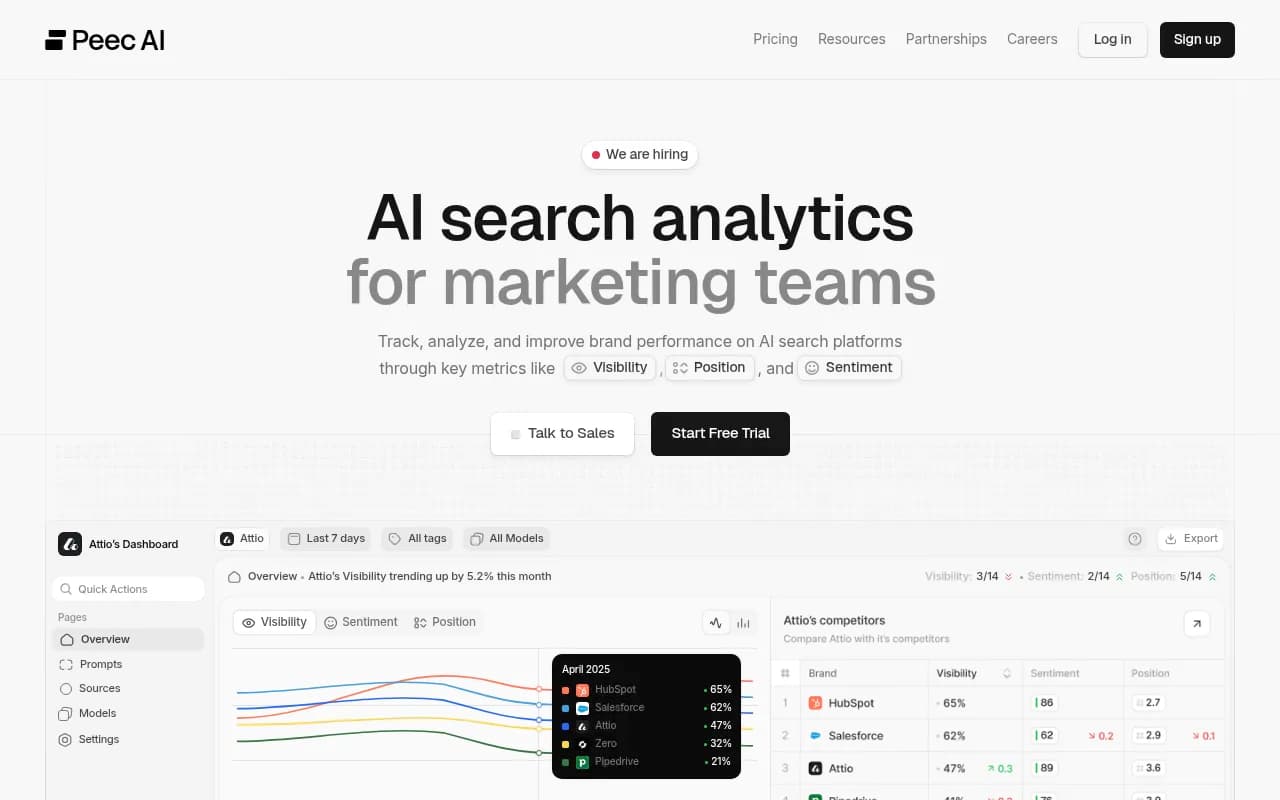
| Peec AI | 4-5 engines | Monitoring only | Limited | No | No |
| AthenaHQ | 5-6 engines | Monitoring-focused | Partial | Partial | No |
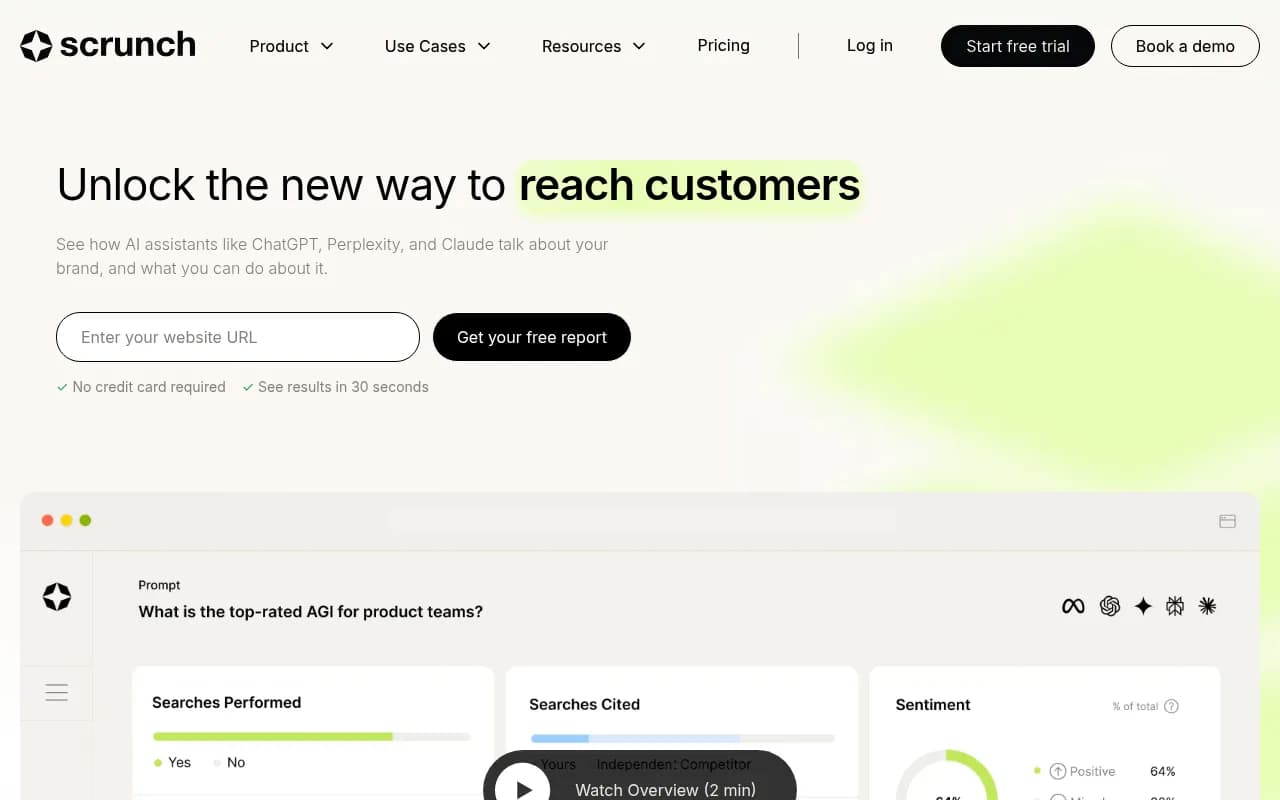
| Scrunch AI | 5+ engines | Partial | Limited | Limited | No |
| Semrush | 3-4 engines | Traditional SEO tools only | Fixed prompts | No | No |
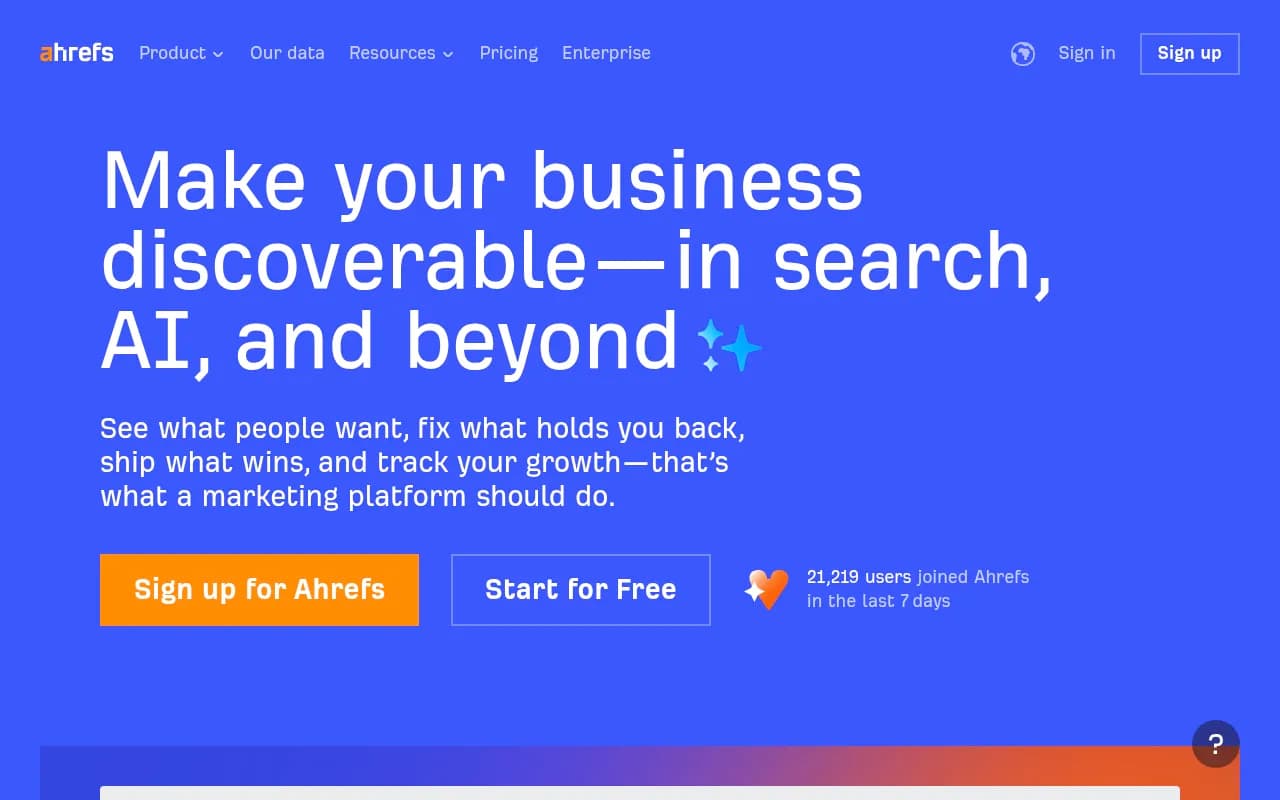
| Ahrefs Brand Radar | 3-4 engines | Traditional SEO tools only | Fixed prompts | No | No |
A few notes on this table: coverage numbers shift as vendors add integrations, so verify current model lists directly. "Monitoring only" doesn't mean useless -- for teams that just need visibility data to feed into their own content workflows, a monitoring tool might be exactly right. The question is whether that matches your actual situation.
How to apply the framework
Run through the five questions in order. They're roughly in priority sequence -- coverage and post-data action tools matter more than crawler logs for most teams.
A few practical notes:
Start with your use case, not the feature list. A solo marketer at a 20-person SaaS company has different needs than a 10-person agency managing 40 client accounts. The right tool for one is probably wrong for the other. Be honest about your team's capacity to act on data before you pay for a platform that generates more of it.
Ask for a trial with your actual prompts. Generic demos use favorable examples. Run your real target queries -- the ones where you suspect you're losing to competitors -- and see what the tool actually shows you. If the data looks thin or the coverage misses the AI engines your audience uses, that's your answer.
Check the pricing against your prompt volume. Most tools price by number of prompts tracked. If you need to track 300 prompts across 3 sites, the entry-level tier of most platforms won't cover you. Do the math before you commit.
Don't ignore the attribution question. At some point, your CMO or CFO will ask whether AI visibility is actually driving revenue. If your tool can't connect visibility to traffic and conversions, you'll be in an awkward position. Tools that offer code snippet tracking, GSC integration, or server log analysis give you a defensible answer to that question.
The bottom line
The AI visibility tool market in 2026 has a lot of options that look similar until you ask the right questions. Most are monitoring dashboards. A smaller number are genuine optimization platforms that help you find gaps, create content that gets cited, and track whether it's working.
The five questions above cut through the feature marketing quickly. Coverage, post-data action, prompt prioritization, citation source analysis, and crawler logs -- a tool that scores well on all five is worth paying for. A tool that scores well on one or two might still be useful, but know what you're buying.
If you want a platform that covers the full loop, Promptwatch is worth a serious look -- it's one of the few tools built around optimization rather than just observation.
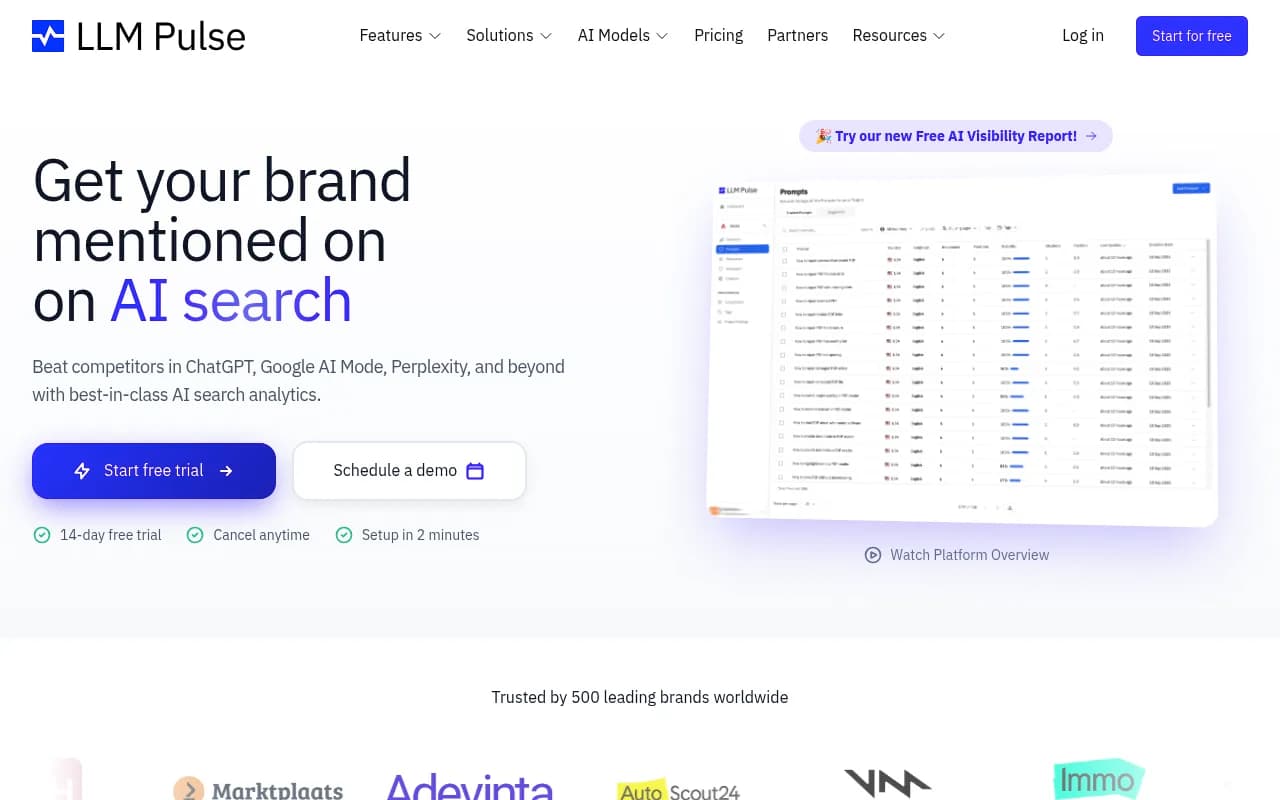
For teams that need lighter-weight monitoring to start, tools like Otterly.AI, Peec AI, or LLM Pulse are reasonable entry points -- just go in knowing you'll eventually need more than a dashboard.
Otterly.AI
The market will keep evolving. But the five questions above won't become irrelevant -- if anything, they'll matter more as the category matures and the gap between monitoring tools and optimization platforms widens further.