Key takeaways
- Google confirmed in May 2026 that AI Overviews are grounded in regular search rankings -- if you don't rank in traditional search, you won't appear in AI answers either
- Optimizing existing pages for AI citation is often faster and cheaper than publishing new content
- The biggest wins come from fixing answer structure, adding entity clarity, improving internal linking, and making your content unambiguous for AI models to parse
- Structured data is not required for AI features -- Google explicitly said so -- but clear, direct prose is
- Tracking which pages AI models actually cite (and which they ignore) is the only way to know if your optimizations are working
There's a common assumption in the GEO and AI SEO world right now: if you want to appear in AI search results, you need to keep publishing. More articles, more content, more pages. The content treadmill, but faster.
That assumption is wrong -- or at least, it's incomplete.
Your existing pages are often sitting on untapped AI citation potential. They already have some authority. They're already indexed. They may already rank for relevant queries. The problem isn't that they don't exist -- it's that they're not structured in a way that makes it easy for AI models to extract and cite them.
This guide is about fixing that. Specifically, how to take what you already have and make it more likely to appear in ChatGPT responses, Perplexity citations, Google AI Overviews, and other AI-generated answers.
Why existing pages are your fastest path to AI visibility
In May 2026, Google published its clearest official guidance yet on optimizing for AI search. The most important line in that document: AI Overviews are built on top of regular search rankings through a technique called Retrieval-Augmented Generation (RAG). The model doesn't pull from its training data -- it runs live searches and synthesizes results from pages that already rank.
That changes the math considerably. If your page already ranks on page one for a relevant query, it's already in the pool that Google's AI draws from. The question is whether the content on that page is structured in a way that makes it easy to cite.
For Perplexity and ChatGPT, the mechanism is slightly different -- they crawl the web independently and use their own citation logic -- but the principle holds. Pages that are clear, authoritative, and well-structured get cited. Pages that are vague, thin, or hard to parse don't.
Publishing new content takes weeks to rank. Optimizing an existing page that already ranks can show results in days.
Step 1: Find which pages are worth optimizing
Not every page deserves your attention. Start by identifying the ones with the highest ceiling.
The pages worth optimizing share a few characteristics:
- They already rank on page one or two for queries with real AI search volume
- The topic is something AI models are actively asked about (how-to questions, comparisons, definitions, recommendations)
- The page has some backlink authority but hasn't been updated recently
- The content is correct but structured poorly -- long paragraphs, buried answers, no clear headings
A quick way to find these: pull your top 20-30 organic landing pages from Google Search Console, then cross-reference them with the prompts AI models are answering in your category. If a page ranks for "best project management tools for remote teams" but your content buries the actual recommendations in paragraph four, that's a fixable problem.
Tools like Promptwatch can show you exactly which prompts competitors are being cited for that you're not -- which tells you which existing pages to prioritize.

Step 2: Fix your answer structure
This is the single highest-leverage change you can make to an existing page.
AI models are extracting answers. They're not reading your page the way a human does -- they're scanning for the clearest, most direct response to a specific question. If your answer is buried, qualified to death, or spread across multiple sections, the model either skips your page or cites someone else.
The fix is to lead with the answer, then support it.
Traditional SEO content often does the opposite: it builds up context, explains the problem, then eventually gets to the answer. That structure made sense when you were trying to keep someone on the page. For AI citation, it works against you.
What to change:
- Add a direct answer in the first 100 words of any section that corresponds to a likely query
- Use H2 and H3 headings that match the actual question someone would ask (not just keyword-stuffed labels)
- Break long paragraphs into shorter ones -- AI models parse shorter text blocks more reliably
- Add a brief "quick answer" or summary box at the top of long guides
Here's a concrete example. If your page is about "how to calculate customer lifetime value," don't open with three paragraphs about why CLV matters. Open with: "Customer lifetime value (CLV) is calculated by multiplying average purchase value by purchase frequency, then multiplying by the average customer lifespan." Then explain it.
Step 3: Add entity clarity
AI models understand content through entities -- named things, concepts, relationships. A page that clearly establishes what it's about, who it's for, and how it relates to adjacent concepts is easier for a model to use as a citation source.
"Entity clarity" isn't a technical term from Google's documentation -- it's a practical concept. It means your page should unambiguously answer: what is this about, who wrote it, what are the key facts, and what related concepts does it connect to?
Specific things to add or improve on existing pages:
- Make sure your brand/author name appears clearly and is associated with expertise signals (author bios, credentials, publication dates)
- Define key terms explicitly, even if they seem obvious -- AI models use these definitions
- Add specific data points, statistics, or examples. Vague claims ("many companies struggle with X") get ignored. Specific ones ("in a 2025 survey of 500 B2B marketers, 67% reported X") get cited
- Mention related entities naturally -- tools, people, organizations, standards that are relevant to your topic
This isn't about keyword stuffing. It's about giving the model enough context to understand what your page is actually about and trust it as a source.
Step 4: Improve internal linking (seriously)
Internal linking is one of the most underrated levers for AI visibility, and it's almost entirely about existing pages.
When AI crawlers visit your site, they follow links. A page that's well-linked from other authoritative pages on your site gets crawled more frequently and is treated as more important. More importantly, internal links help AI models understand the topical relationships between your pages.
The goal is to build what's sometimes called a "topic cluster" -- a hub page that covers a topic broadly, with supporting pages that go deep on subtopics, all linked together.
If you have a hub page on "email marketing" and five supporting pages on specific tactics, they should all link to each other in a way that makes the relationships obvious. The hub links to the subtopics. The subtopics link back to the hub. When a model is answering a question about email marketing, it can follow that web of links and understand that your site has depth on the topic.
Practically, this means auditing your existing pages for orphaned content (pages with few or no internal links pointing to them) and fixing those gaps. A tool like Screaming Frog SEO Spider can map your internal link structure quickly.
Step 5: Optimize for the actual prompts people use in AI search
Traditional SEO keyword research and AI prompt research are related but not identical. People ask AI models in full sentences, with context, often in a conversational way. "What's the best CRM for a 10-person sales team that doesn't want to pay for Salesforce" is a real prompt. Nobody types that into Google.
Your existing pages may rank for the keyword version of a query but miss the conversational version entirely.
The fix is to add FAQ sections, conversational subheadings, and "people also ask" style content to existing pages. You're not rewriting the page -- you're adding a section at the bottom (or middle) that directly addresses the natural language variations of the query your page already covers.
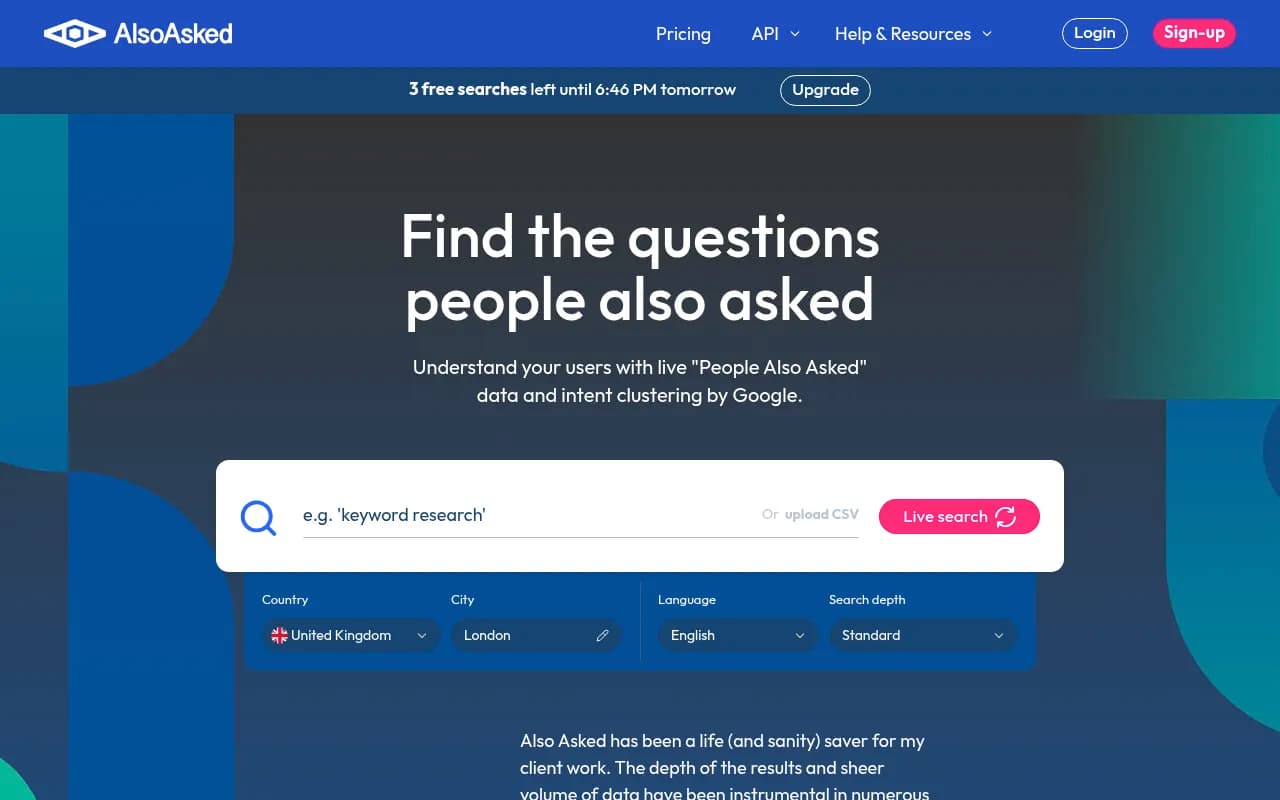
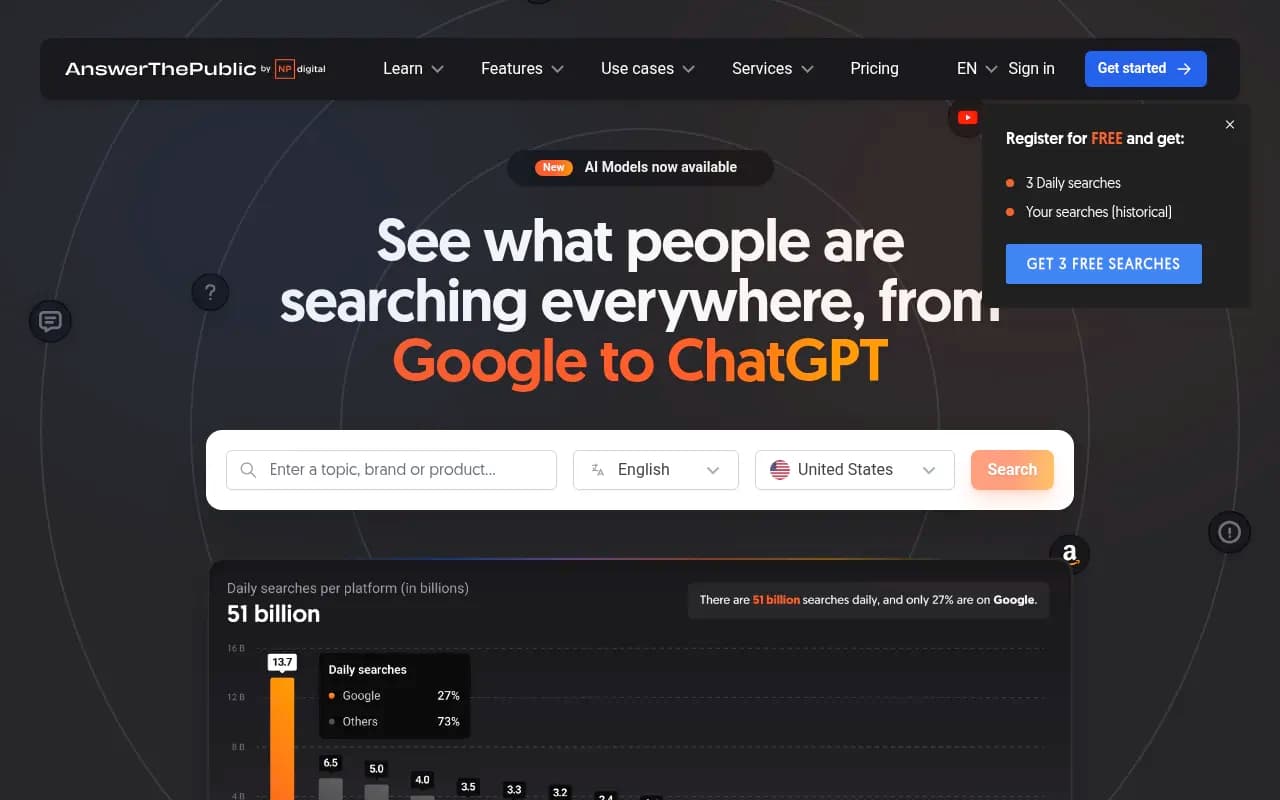
Tools like AlsoAsked and AnswerThePublic can surface the question variations that real people ask around any topic.
Step 6: Make your content crawlable by AI agents
This is the technical side, and it's often overlooked.
AI crawlers (GPTBot, ClaudeBot, PerplexityBot, etc.) behave differently from Googlebot. Some crawlers have trouble with JavaScript-heavy pages. Some are blocked by robots.txt rules that were set years ago and never revisited. Some pages load slowly enough that crawlers time out before reading the full content.
Check your robots.txt file. If you're blocking AI crawlers unintentionally, you're invisible to those models regardless of how good your content is. The major AI crawlers use specific user-agent strings -- GPTBot for ChatGPT, ClaudeBot for Claude, PerplexityBot for Perplexity -- and you can allow or block them individually.
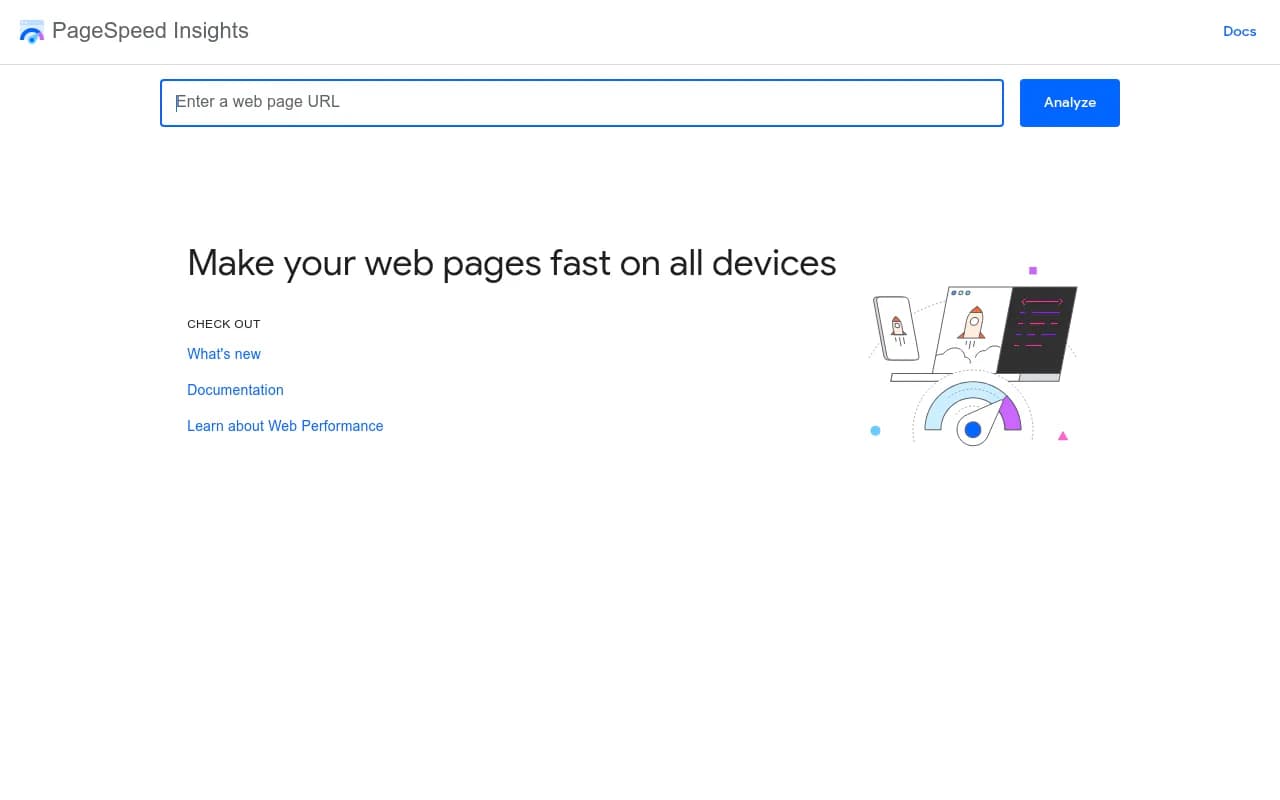
Also check your page speed. A page that takes 8 seconds to load on a slow connection may not be fully crawled. Google's own guidance emphasizes that crawlability is foundational -- if the page can't be read, it can't be cited.
Google PageSpeed Insights is free and takes 30 seconds to run.
Step 7: Track what's actually getting cited
None of this matters if you can't measure it. The gap between "I optimized this page" and "this page is now being cited in AI answers" can be days or weeks, and without tracking, you're flying blind.
What you want to know:
- Which of your pages are currently being cited in AI responses, and for which prompts?
- Which pages did AI crawlers visit recently, and did they encounter any errors?
- Are your optimizations moving the needle on citation frequency?
This is where most teams get stuck. They can see their Google rankings in Search Console, but AI citation data isn't surfaced there. You need a separate tool for this.
Platforms like Promptwatch track AI crawler activity at the page level -- showing you which pages GPTBot, ClaudeBot, and PerplexityBot have visited, when they visited, and whether those visits led to citations. That feedback loop is what turns optimization into a repeatable process rather than a guessing game.
| What to track | Where to find it |
|---|---|
| Google organic rankings | Google Search Console |
| AI crawler visits per page | Promptwatch AI Crawler Logs |
| Which prompts cite your pages | Promptwatch Citation Tracking |
| Page speed / crawlability | Google PageSpeed Insights |
| Internal link gaps | Screaming Frog |
| Question variations for existing topics | AlsoAsked, AnswerThePublic |
What doesn't work (and what to ignore)
Google's May 2026 guidance specifically called out several popular "AI optimization" tactics that don't actually help:
- llms.txt files: No evidence they influence AI citations
- Rewriting every page in Q&A format: Helpful in moderation, not a wholesale strategy
- Structured data for AI features: Google explicitly said it's not required for AI Overviews
- "AEO specialist" rewrites: If someone is charging you to rewrite pages in a proprietary "AI-optimized" format without showing you citation data, be skeptical
The fundamentals haven't changed as much as the hype suggests. Good content that's clear, accurate, well-structured, and crawlable gets cited. Thin content with clever formatting doesn't.
A practical prioritization framework
If you have 20 existing pages and limited time, here's how to triage:
- Pages that already rank in positions 1-5 for high-volume queries -- optimize these first, they're closest to AI citation
- Pages that rank 6-15 for queries with strong AI search intent (how-to, comparison, definition queries) -- fix the answer structure and add FAQ sections
- Pages that are orphaned (few internal links) but cover topics AI models frequently answer -- fix the internal linking first, then the content structure
- Pages that are technically broken (slow, JavaScript-heavy, blocked by robots.txt) -- fix the technical issues before touching the content
The goal is to work down the list systematically, track citation changes as you go, and double down on what's working.
Tools that help with optimization-first strategies
| Tool | Best for | Price range |
|---|---|---|
| Promptwatch | AI citation tracking, crawler logs, gap analysis | $99-$579/mo |
| Screaming Frog SEO Spider | Internal link audits, technical crawl issues | Free / £259/yr |
| Google Search Console | Identifying pages with existing rankings | Free |
| AlsoAsked | Finding question variations for existing topics | Free / paid |
| Surfer SEO | Content scoring and on-page optimization | Paid |
| Google PageSpeed Insights | Page speed and crawlability | Free |
The bottom line
Publishing new content is a long game. Optimizing existing pages is a shorter one -- and for most sites, it's the right place to start.
The pages you already have are your best asset. They have history, authority, and indexing. What they often lack is the structural clarity that makes AI models confident enough to cite them. Fix the answer structure, add entity signals, clean up the internal linking, check your crawlability, and track the results.
That cycle -- audit, fix, measure -- is more likely to move your AI visibility in the next 90 days than a content calendar full of new articles.