Key takeaways
- Each metric answers a different question. Mentions tell you about coverage, position about prominence, citations about sources, and sentiment about how AI describes you.
- AI answers are samples, not fixed results. Identical prompts disagree on whether a brand is mentioned in roughly 1 in 20 same-day repeats, so one run proves little.
- Branded and negatively framed prompts distort your headline numbers. Report non-branded prompts first and keep framing balanced.
- The score tells you that you lost. The answer text and the cited sources tell you why.
- Every weak metric points at a specific fix: content, crawlability, third-party sources or reputation.
Why prompt tracking results confuse people
Open any AI visibility dashboard and you get a pile of numbers: a visibility percentage, an average position, a sentiment score, a list of cited domains. Teams stare at them, put one into a slide, and move on. The number often goes up or down for reasons nobody can explain.
The reason is that prompt tracking is sampling, not ranking. A keyword has one results page you can screenshot. A prompt has a distribution of answers. As LLM Pulse puts it, a prompt set is a fixed list of questions run against AI assistants on a schedule, and each answer is parsed for mentions, competitors, tone and cited URLs. You are sampling a generator, which is why a spot check in a chat window rarely matches your tracker.
So before reading any single metric, hold two ideas. First, the data is directional, not definitive. Second, the metrics only make sense read together. This guide walks through each one, what it really measures, and what to do when it looks bad.
Mentions: the coverage question
A mention means your brand name appears inside the AI-generated answer. Semrush's Prompt Tracking documentation defines it the same way: a count of how many times your brand name shows up directly in answers for tracked prompts, based on the brand name configured in the campaign.
Mentions get rolled up into a few related numbers:
- Mention rate or visibility: the share of answers that include you.
- Share of voice: your slice of all brand mentions across the answers, compared with competitors.
- Mention status per prompt: present, absent, or newly lost.
In Promptwatch, for example, the Visibility Score runs 0 to 100, scores each response on placement, share of attention and depth, and counts responses that do not mention you as zero. Share of Voice counts one mention per response per brand. Those details matter because tools define these metrics differently, so never compare a number from one platform with a number from another.
The branded prompt trap
This is the biggest source of flattering, meaningless numbers. Ask an assistant about Acme and it will mention Acme. LLM Pulse points out that visibility on branded prompts sits near the ceiling and stays there, so averaging branded and non-branded prompts inflates the headline and makes it move whenever the prompt mix changes. Similarweb makes the same point: branded prompts can inflate visibility metrics but do not reflect real discovery.
The fix is simple. Split prompts into three buckets (own brand, competitor brand, non-brand or generic) and put non-branded results at the top of the report. Use branded as an accuracy check, not a score.
What a low mention rate usually means
Low share of voice is a coverage problem. The model does not know to include you for that topic. Check whether you have a page that answers the prompt at all. If not, the prompt becomes a content brief. Similarweb frames it well: a prompt where you are absent is a direct instruction to create a page that answers that question with authority, ideally in the first paragraph.
Position: the prominence question
Position is where you land. It sounds like a traditional rank, but it means different things in different places, and this is where people misread dashboards most.
There are two meanings:
- Position of the brand in the answer: the order in which brands are named in the text. Lower is better, and first mentioned usually carries more weight.
- Position of your domain in the source list: where your URL lands among the cited sources.
Semrush measures the second kind. In ChatGPT Search it ranks each domain in the citation area from top to bottom. In Google AI Mode the response area itself counts as position 1 and citations follow as 2, 3 and so on. In Gemini the first cited source acts as position 1. So an "average position of 3" in one engine is not the same experience as in another.
Two cautions when reading position:
- It is volatile per prompt. With only a handful of answers per prompt per model per week, position at prompt level is noisy. Read it monthly and at aggregate level.
- Late position with decent mention rate is a prominence problem. The model knows you but lists you after competitors. That usually points to weaker authority signals or thin content on the specific attribute the prompt asks about.
Citations: the source question
Citations are the URLs the AI lists or links as sources. They are the most actionable metric in the set, because they tell you which pages are shaping the answer.
How many citations to expect varies a lot by engine. Promptwatch Data's average sources per response report shows ChatGPT citing about 5 sources per web-search answer, Google AI Overviews about 10, and Perplexity almost exactly 10 every day. Copilot swung from under 2 to nearly 17 sources within a few weeks. The practical reading: Perplexity's count is so steady that a change in your citation pickup there probably reflects your content, while Copilot should be judged on monthly trends, not weekly snapshots.
And the citation list is crowded. According to Promptwatch's data on unique domains per ChatGPT response for Sep 28 to Oct 4, 2026, 47.6% of responses cite 10 or more domains, and for organic prompts with no brand named that rises to 52.5%. For brand-specific prompts the picture flips: the most common count is 5 domains, so the few review sites and forums cited there shape how ChatGPT describes you.
Mentioned but not cited, cited but not mentioned
These two combinations are worth separating:
| Pattern | What it usually means | First thing to check |
|---|---|---|
| Mentioned and cited | You are a primary source for the answer | Protect and refresh the cited page |
| Mentioned, not cited | The model knows you from third-party content or training data | Whether your own pages are crawlable and answer the prompt |
| Cited, not mentioned | Your page is used as evidence but the brand is not named | Page wording: does it state your brand and claim clearly? |
| Neither | Coverage gap | Content gap for that prompt, and who is cited instead |
The Promptwatch academy page on citations vs mentions goes deeper on why the two diverge.
Read who gets cited, not only whether you do
When the citation list is third-party pages (comparison posts, forum threads, review roundups), those are your targets. Profound's workflow flags cited pages where your brand is not mentioned as an actionable opportunity, and Semrush's cited-page panel shows each prompt a page was cited for along with your mention status, including lost mentions. Similarweb makes the same argument: the cited domain becomes a PR or outreach target, which is far more precise than chasing general domain authority.
Be realistic about influenceability, though. If a prompt's citations are dominated by government sites or Wikipedia, you probably cannot outrank them, so deprioritize it. SE Ranking's guidance on choosing prompts says the same.
Citations drift
SE Ranking's AI Mode volatility test found only 35% of domains repeat in answers between runs, with two-thirds vanishing. That is why one week of citation data is a snapshot, not a verdict. Look for pages cited repeatedly over several weeks.
For content-type context, Promptwatch Data's report on ChatGPT citation share by content type found product pages were the most cited type at 22.4% (Sep 28 to Oct 4, 2026), followed by landing pages and listicles. If your cited pages are all blog posts, that is worth noticing.
Sentiment: the description question
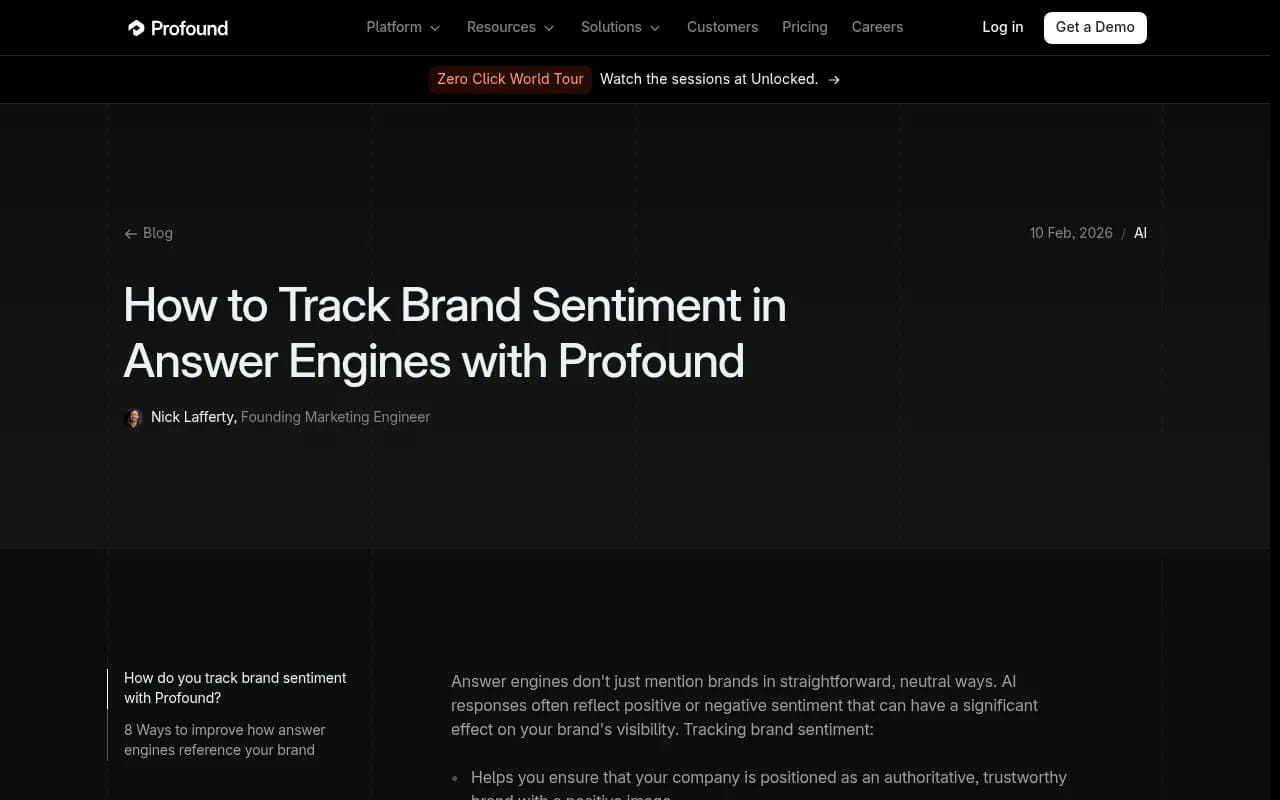
Sentiment measures the tone of how AI talks about you. Most tools classify each response as positive, neutral or negative and roll it up into a percentage or 0 to 100 score. Profound shows positive versus negative sentiment with a daily breakdown, then groups the claims into themes with an occurrence count for each, such as AI praising ease of use but criticizing the learning curve.
How to read it without fooling yourself:
- Check the framing of the prompts. Momentic scored 145,000 AI answers and found that negatively framed brand prompts ("Is X a scam?", "Are there hidden fees?") produced a caveat 67.1% of the time versus 32.0% for other brand prompts, and flipped average sentiment from clearly positive to slightly negative. A set weighted toward negative prompts will show roughly double the caveat rate for any brand. Balance framing before comparing brands.
- Focus on themes, not the single number. Themes can number in the thousands. Profound recommends acting on the ones that occur most often, and watching the trending tab for what is rising right now.
- Read the first lines. Profound's advice is to notice what the answer says first versus later, since the opening claim carries the most weight.
- Sentiment is separate from visibility. You can be mentioned constantly with a weak reputation, or be rarely mentioned and well liked. In Promptwatch, sentiment is scored independently (about 50 is neutral), and Brand Narrative extracts the individual claims AI makes about you, grouped under themes like pricing, features and support.
Some caveats are accurate. A venue that really does charge itemized surcharges will get them listed. The question is whether the claim is true, current and fixable. Tools with a fact-check step let you mark a claim inaccurate and find the page that is teaching the model the wrong thing.
Reading the four metrics together
The metrics work as a diagnostic. Each weak pattern points at a different kind of problem:
| What you see | Likely problem | Where to look |
|---|---|---|
| Low mention rate, low share of voice | Coverage | Content gap analysis, prompt-to-page mapping |
| Mentioned, but listed late | Prominence | Page depth on the prompt's attributes, authority |
| Mentioned, but never cited from your domain | Content or crawlability | AI crawler access, page structure, wording |
| Citations dominated by competitors' third-party mentions | Off-site presence | Outreach to the cited pages |
| Positive visibility, weak tone | Reputation | Sentiment themes, review sites, inaccurate claims |
That mapping is how Promptwatch's own metrics guide frames it: low share of voice is coverage, late position is prominence, mentions without self-citations is a content or crawlability issue, and weak sentiment is reputation. The metrics overview in its academy covers the definitions.
Separating signal from noise
This is the part most dashboards hide. Before you celebrate or panic about a change, run through these checks.
Check for same-day variation
Momentic ran identical prompts several times per platform on the same day across 29,344 repeat groups. Answers disagreed on whether the brand was mentioned 4.5% of the time for non-brand prompts and 5.1% for brand prompts. In one example, the same Perplexity prompt run three times in one run skipped the brand once and included it twice. A brand that vanishes from one weekly report may simply be showing that variation.
Check whether your prompt set changed
LLM Pulse's warning is blunt: swap prompts in and out and your line moves for two reasons at once, because the models changed and you changed the exam. A reworded prompt is a new prompt. Annotate additions and removals and compare from that date.
Check the prompt's type
Momentic found that non-brand prompts asking for a pick ("best X for Y", "which should I choose") produced answers mentioning 4.55 options on average, against 1.25 for prompts that only ask about the topic. Brand recommendation rates were 22.8% versus 8.0%. A prompt that returns no options cannot tell you whether you are the recommendation, so a permanent zero there is a prompt problem, not a brand problem.
Check the engine
Engines behave differently. The ChatGPT citation drop around the GPT-5.3 rollout on March 4, 2026 shows that a model update can move citations across the board. You can see it in Promptwatch's ChatGPT citation drop report. Similarly, ChatGPT's share of citations from social platforms was 0.46% in Sep 28 to Oct 4, 2026, while Google AI Overviews got 12.2%, per Promptwatch's social citations report. If your Reddit-heavy strategy stopped working in ChatGPT, that is an engine change, not your content.
Judge at topic level, not string level
In Momentic's Gemini test, no single search string appeared in all ten runs and 86.8% appeared in only one, yet the topics covered were the same each time. Promptwatch's query fanout data tells a similar story: your content only has to match one of the generated queries, not the user's exact prompt. Write headings that read like search queries and review at topic level.
How many prompts and how long before trends are real
There is no statistical rule. Similarweb suggests most teams see stable patterns with 50 to 150 well-structured prompts per topic, and trend reliability that builds over 3 to 4 weeks of consistent tracking. LLM Pulse notes that locales multiply: 50 prompts in 3 markets is 150 prompts. Volume adds up faster than expected too: 50 prompts across five models weekly is over a thousand answers a month, a real sample at bucket level, but only a handful per prompt per model.
So read prompt-level movement monthly, keep weekly for the aggregate, and collect one to two weeks of baseline before the first report.
A reading routine that works
Here is the order I would use every month:
- Start with non-branded visibility and share of voice. Ignore the blended number.
- Look at position, but only in aggregate and by engine.
- Open the citations report. Sort by pages cited most often and check whether your brand appears on them.
- Scan sentiment themes by occurrence. Pick the two or three that repeat.
- Open ten raw answers where you were not mentioned. LLM Pulse calls what you find a competitive brief you did not have to commission: a competitor named with a reason attached, like cheaper for small teams or easier to migrate to.
- Write down actions, one per gap, with the page or source it involves.
Budget an hour for step 5. It is the first thing teams skip when the dashboard looks fine, and it is where the useful insight lives.
Tools that report these metrics
Most AI visibility platforms report some version of mentions, position, citations and sentiment. The differences are in definitions, depth and what happens after the report.
Promptwatch pulls the four metrics into one loop: it tracks visibility, position and sentiment from the real interfaces of ChatGPT, AI Overviews, Gemini, Perplexity and others, shows which pages and third-party sources get cited, and then connects findings to an Action Board and a Content Agent for the gaps. IP-verified crawler logs help separate an access problem from a content problem, which matters when you see mentions without self-citations. You can try the free AI visibility report before committing, and plan details are at promptwatch.com/pricing.

Profound is strong on sentiment themes, with theme occurrence counts, positive and negative tabs and a trending view.
Profound

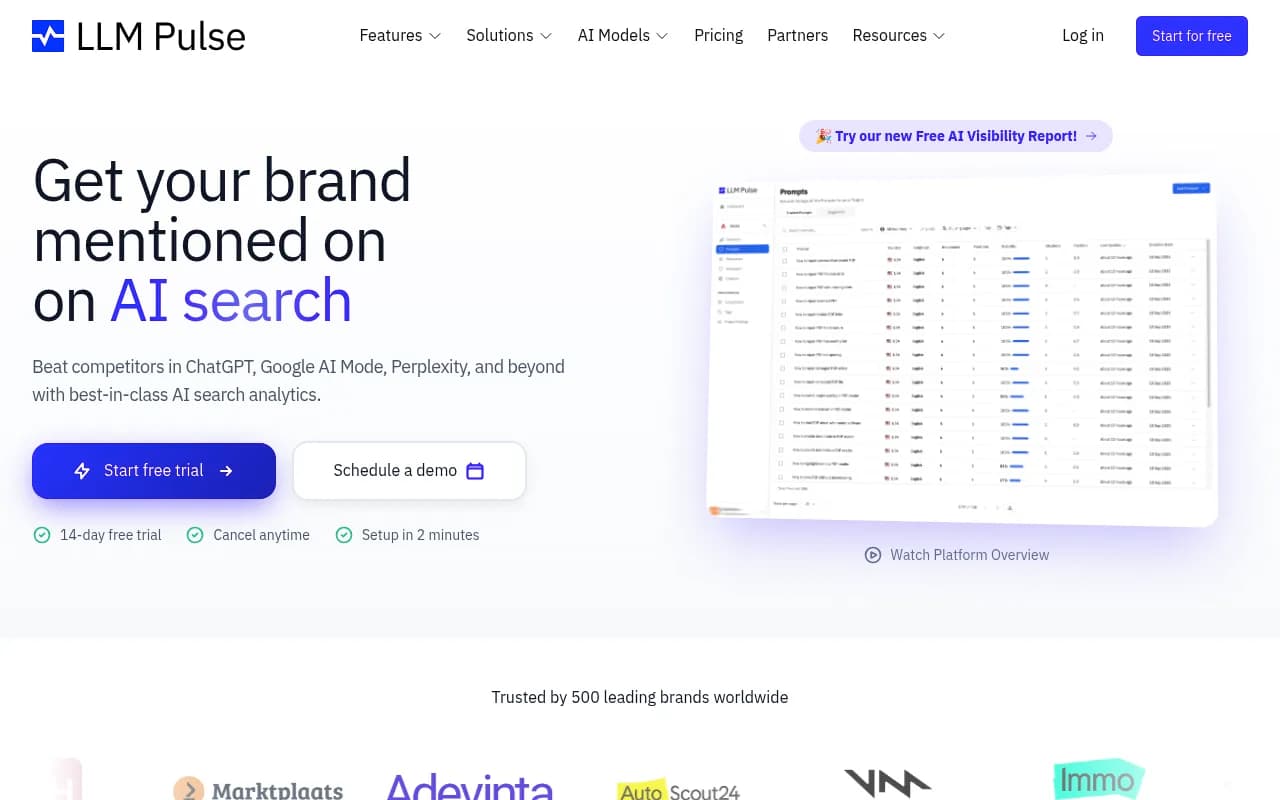
LLM Pulse sorts prompts into own brand, competitor and non-brand buckets automatically, and annotates prompt and model changes on charts, which helps with the trend-break problem.
Semrush adds AI visibility, mentions and average position inside a familiar SEO interface, plus a cited-page panel showing your mention status per prompt.
Similarweb pairs prompt analysis with citation analysis, useful for turning cited domains into outreach targets.
SE Ranking pairs an AI results tracker with SE Visible for category-level views.
| Tool | Strong point for reading results | Best for |
|---|---|---|
| Promptwatch | Tracking tied to actions, crawler logs and content creation | Teams that want to fix gaps, not just report them |
| Profound | Sentiment themes and trending themes | Enterprise brand monitoring |
| LLM Pulse | Brand-type buckets and chart annotations | Clean trend analysis |
| Semrush | AI position tracking inside an SEO suite | Teams already on Semrush |
| Similarweb | Citation analysis tied to real user data | Citation outreach |
| SE Ranking | Prompt research plus visibility views | Budget-conscious SEO teams |
If you want to compare more options, the GEO software directory lists a lot of them.
Common misreadings to avoid
- Treating a one-week dip as a trend. Use at least 3 to 4 weeks.
- Averaging branded and non-branded results into one score.
- Comparing a negative-leaning prompt set for your brand against a balanced set for a competitor.
- Reading position the same way across engines.
- Chasing prompts whose citations are all ultra-authoritative sources you cannot displace.
- Reporting visibility without ever opening an answer.
Where to go from here
Pick one metric that looks worst this month, find which of the five problem types it maps to, and open ten raw answers behind it. Then name one page to write or refresh and one third-party source to pursue. Re-check after four weeks, comparing from the date you made the change. That is the whole loop: read, diagnose, act, and measure again.