Key takeaways
- Brand mentions in ChatGPT and Claude happen in a "black box" -- you won't know what's being said unless you actively track it
- Start with a manual baseline (15-20 prompts) before investing in any tool; it takes under an hour and tells you where you actually stand
- Claude mentions brands in 97.3% of responses, ChatGPT considerably less -- the two models behave very differently and need separate tracking strategies
- Automated platforms save significant time but vary wildly in what they actually do; most only monitor, they don't help you fix anything
- The goal isn't just to see your brand mentioned -- it's to understand why competitors get cited when you don't, then close that gap
Every day, millions of people ask ChatGPT and Claude questions like "what's the best project management tool for a remote team?" or "which CRM should a B2B startup use?" Those AI models give answers. They name brands. And most of those brands have no idea it's happening.
That's the problem this guide solves.
Unlike traditional search, where you can check your Google rankings anytime, AI conversations are invisible by default. There's no "position 1" to track. There's no dashboard that shows up in your Google Search Console. You're either being mentioned or you're not -- and you won't know which without a deliberate monitoring setup.
This guide walks you through the full process: establishing a baseline, building a prompt library, choosing the right tracking approach, and turning monitoring data into actual improvements.
Why ChatGPT and Claude behave differently (and why it matters)
Before setting anything up, it helps to understand that ChatGPT and Claude are not interchangeable for brand monitoring purposes. They have meaningfully different mention patterns.
According to data from Spotlight's analysis of over 1.8 million AI responses, Claude mentions brands in 97.3% of relevant responses, while some other models mention brands far less frequently. Claude also tends to be the preferred tool for professional and research-oriented queries -- the kind where someone is genuinely evaluating vendors or solutions. ChatGPT, with its massive user base, handles a broader range of query types, from casual questions to deep research.
What this means practically: your brand might appear consistently in Claude responses but be invisible in ChatGPT, or vice versa. Monitoring only one gives you an incomplete picture. And the reasons for the discrepancy -- different training data, different retrieval approaches, different tendencies to hedge or recommend -- affect what you need to do to improve your visibility on each.
Step 1: Build your baseline before touching any tool
The biggest mistake brands make is jumping straight into a monitoring platform without knowing where they stand. You need a snapshot first -- something to measure against.
Set aside 60-90 minutes. Open ChatGPT and Claude in separate browser tabs. Then work through 15-20 prompts that real customers might actually use when researching your category.
The best prompts come from three places: your customer support tickets (what questions do people ask before buying?), your sales call transcripts (what comparisons do prospects bring up?), and your existing search console data (what queries are already driving traffic?). Don't make up hypothetical prompts -- use real ones.
Structure your prompt library across three types:
Awareness prompts -- "What are the best [your category] tools for [use case]?" These tell you whether the AI knows your brand exists in the space.
Comparison prompts -- "Compare [your brand] vs [competitor] for [specific need]." These reveal how the AI positions you relative to alternatives.
Recommendation prompts -- "What [category] tool should I use for [specific scenario]?" These are the most valuable. An unprompted recommendation means the AI genuinely associates your brand with that use case.
For each prompt, record: whether your brand appears at all, where in the response it appears (first mention vs. buried in a list), what context surrounds it (leader, alternative, niche option), and what sources or reasons the AI gives for mentioning you.
Do this for both ChatGPT and Claude separately. The results will probably surprise you.
Step 2: Identify the gaps your competitors are filling
Once you have your baseline, run the same prompts with your top three competitors in mind. Note every time a competitor appears in a response where you don't.
This is the core of what's sometimes called "answer gap analysis" -- finding the specific questions where competitors are visible and you're not. It's more useful than just knowing your overall mention rate, because it points directly at what content you're missing.
If Claude consistently recommends Competitor A for "enterprise security compliance" use cases but never mentions you, that's a content gap. You either don't have authoritative content on that topic, or the content you have isn't structured in a way that AI models can easily extract and cite.
Keep a simple spreadsheet: prompt, your brand mentioned (yes/no), competitors mentioned, context, and notes. After 20 prompts across two models, patterns become obvious.
Step 3: Choose your monitoring approach
There are three realistic approaches, and the right one depends on your budget and how seriously you need to track this.
Manual monitoring (free, works for smaller brands)
You run prompts yourself, on a schedule, and log the results. This is viable if you have 5-10 core prompts and check them weekly. The main limitation is time and consistency -- it's easy to skip weeks, and human-run queries introduce variability (different phrasings, different sessions).
For manual monitoring, create a Google Sheet with your prompt library, run each prompt in a fresh browser session (to avoid personalization effects), and paste the full response. Use a simple scoring system: 0 = not mentioned, 1 = mentioned in passing, 2 = recommended, 3 = recommended first.
Automated tracking platforms
This is where most brands eventually land. Platforms in this space query AI models systematically, on a schedule, and track your mention rate over time. The quality varies enormously.
Some tools just show you a dashboard of mentions. Others go further and help you understand why you're not being mentioned and what to do about it. That distinction matters a lot -- monitoring without optimization is like checking your weight without changing your diet.
Promptwatch sits at the more capable end of this spectrum. Beyond tracking mentions across 10 AI models including ChatGPT and Claude, it shows you which specific prompts competitors rank for that you don't, generates content designed to close those gaps, and tracks whether your visibility actually improves after you publish. It also logs AI crawler activity on your site -- which pages ChatGPT's crawler has read, how often, and whether it's hitting errors.

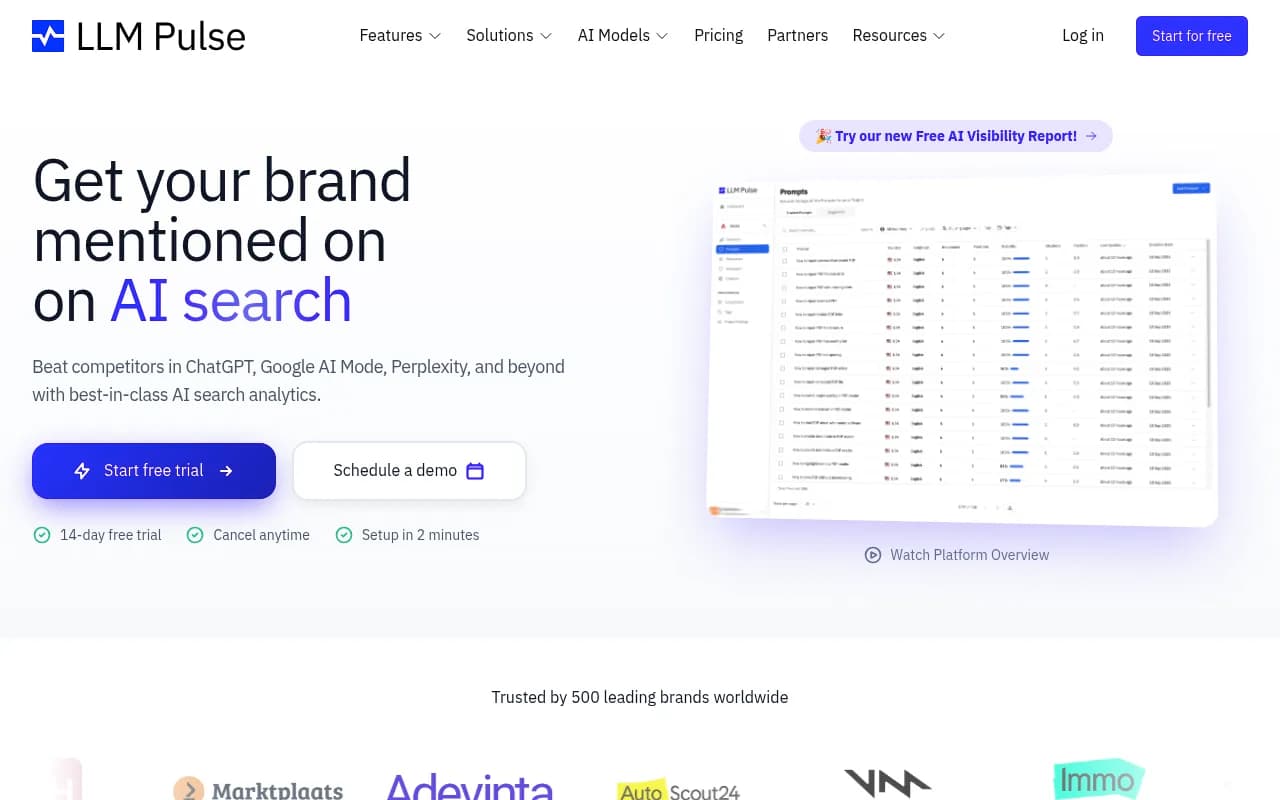
For brands that want solid tracking without the content optimization layer, there are several monitoring-focused options:
Otterly.AI



Building your own monitoring system
If you have engineering resources, you can query the ChatGPT and Claude APIs directly, log responses, and build your own analysis layer. This gives you maximum flexibility but requires ongoing maintenance. Most marketing teams find it's not worth the overhead once a good platform exists.
Step 4: Set up your prompt library in your chosen tool
Whether you're monitoring manually or using a platform, your prompt library is the foundation. Here's how to structure it properly.
Start narrow, then expand. Don't try to track 100 prompts on day one. Start with 10-15 high-intent prompts -- the ones closest to a buying decision. "Best [category] software for [specific use case]" is more valuable than "what is [category] software."
Use real customer language. The way your customers phrase questions is often different from how your marketing team talks about your product. "What tool helps me send personalized cold emails at scale?" is how a user asks. "What is the best B2B email automation platform?" is how a marketer writes. Track both, but prioritize the former.
Include your brand name explicitly in some prompts. "Tell me about [your brand]" and "What do you know about [your brand]?" reveal what the AI actually has in its training data about you -- which is different from whether it recommends you unprompted.
Vary the persona. "What CRM should a startup use?" hits differently than "What CRM should a 500-person enterprise use?" If your product serves multiple segments, track prompts for each.
Step 5: Interpret what you're seeing
Raw mention data is only useful if you know what to do with it. Here's how to read the signals.
Mention rate is the percentage of relevant prompts where your brand appears. A baseline below 20% in your core category is a red flag. Above 60% suggests strong AI visibility.
Position in response matters almost as much as whether you're mentioned. Being the first brand named in a recommendation carries more weight than being fifth in a list of alternatives.
Sentiment context tells you how the AI frames your brand. "X is a good option for teams that need Y" is positive. "X is sometimes mentioned but has mixed reviews" is a problem worth investigating.
Consistency across models reveals whether your visibility is broad or narrow. If Claude mentions you consistently but ChatGPT rarely does, your content is probably being indexed by Anthropic's training data but not surfacing well in OpenAI's retrieval. Different models weight different sources.
Competitor comparison is the most actionable signal. If Competitor B appears in 80% of prompts where you appear in 20%, the gap is real and closeable -- but you need to understand what content they have that you don't.
Step 6: Connect monitoring to content action
Monitoring without action is just anxiety. The point of knowing where you're invisible is to fix it.
When you identify a prompt where competitors appear and you don't, ask: does my website have content that directly answers this question? If not, that's your first move. Create a dedicated page, article, or FAQ that addresses the exact question the prompt represents.
AI models tend to cite content that is:
- Specific and factual (not vague marketing copy)
- Structured clearly (headers, lists, defined terms)
- Authoritative (cited by other sources, linked to from relevant sites)
- Fresh (recently updated content tends to get more AI attention)
If you already have relevant content but aren't being cited, the issue might be technical. AI crawlers need to be able to access and read your pages. Checking your crawler logs -- which pages AI bots are visiting, how often, and whether they're hitting errors -- can reveal indexing problems you'd never find otherwise.
Tool comparison: what to look for
Not all monitoring tools are built the same. Here's a quick comparison of what matters:
| Feature | What to look for | Why it matters |
|---|---|---|
| Models covered | ChatGPT, Claude, Perplexity, Gemini at minimum | Each model has different mention patterns |
| Prompt flexibility | Custom prompts, not just fixed templates | Your category is unique; fixed prompts miss nuance |
| Competitor tracking | Side-by-side visibility comparison | Gaps only make sense relative to competitors |
| Content gap analysis | Shows which prompts you're losing and why | Turns monitoring into action |
| Crawler log access | Logs of AI bot visits to your site | Reveals indexing issues before they become visibility problems |
| Traffic attribution | Connects AI visibility to actual site visits | Proves ROI of your GEO efforts |
| Frequency | Weekly or daily queries | Monthly is too slow to catch changes |
Most tools cover the basics. The differentiators are content gap analysis and traffic attribution -- features that turn a monitoring dashboard into an optimization workflow.
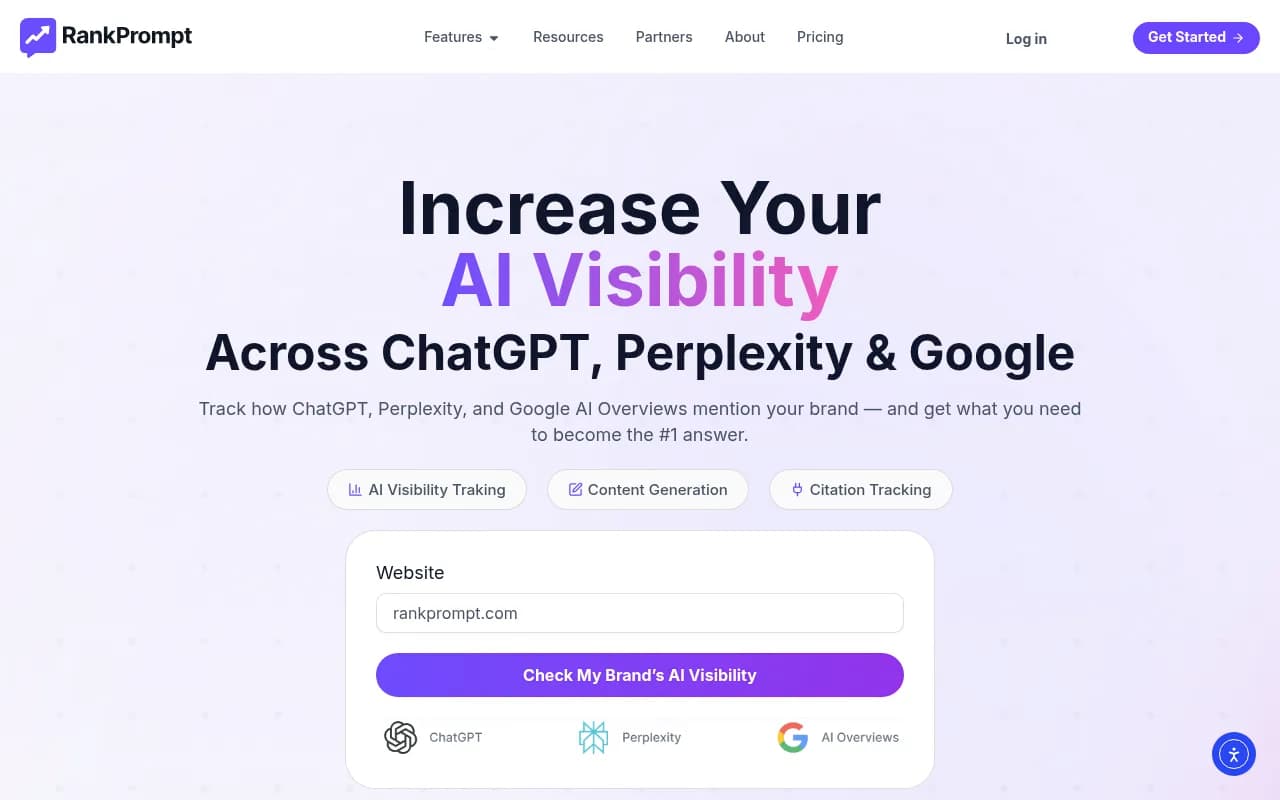
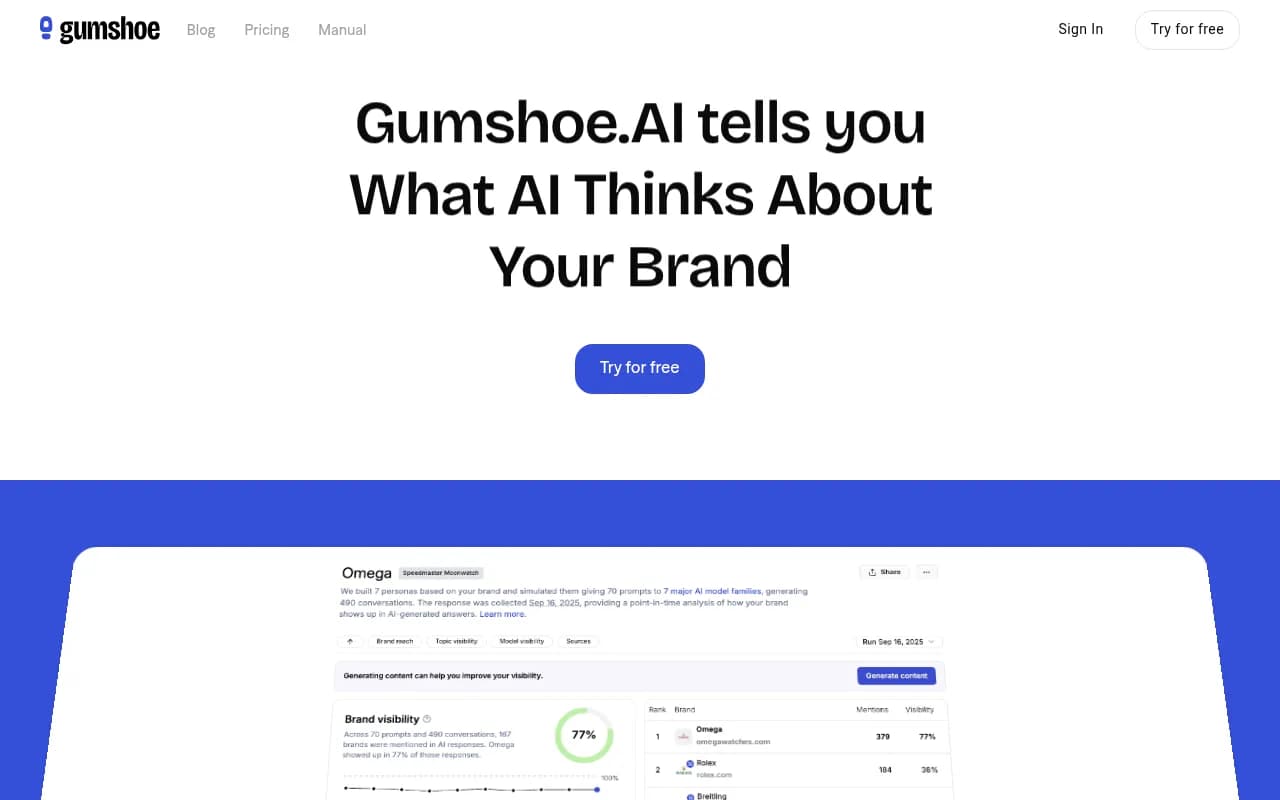
A few tools worth evaluating depending on your needs:
Profound


Step 7: Build a recurring monitoring workflow
One-time monitoring tells you where you stand. Recurring monitoring tells you whether things are improving.
Set a weekly or bi-weekly cadence for reviewing your tracking data. The key questions each cycle:
- Did my mention rate change since last week?
- Are there new prompts where competitors appeared that I should add to my library?
- Did any new content I published start generating citations?
- Are AI crawlers successfully accessing my new pages?
Monthly, do a deeper review: compare your mention rate against the previous month, look for sentiment shifts, and identify any new competitors appearing in your tracked prompts.
Quarterly, revisit your prompt library. Search behavior evolves, new use cases emerge, and your product probably changed too. Prompts that were relevant six months ago might not reflect how customers are searching now.
Common mistakes to avoid
Tracking only your brand name. If someone asks "what's the best [category] tool?" and you're not mentioned, that's a miss -- even though your brand name never appeared in the prompt. Track category-level queries, not just branded ones.
Ignoring the "why." A drop in mention rate is a symptom. The cause might be a competitor publishing strong new content, a change in how an AI model weights certain sources, or a technical issue with your site's crawlability. Don't just watch the number -- investigate the reason.
Treating all models the same. Claude and ChatGPT have different mention patterns, different user bases, and respond to different optimization tactics. What works for one won't necessarily work for the other.
Skipping the baseline. Without a starting point, you can't measure progress. Even if you're implementing a platform today, manually run your core prompts first and record the results.
Monitoring without publishing. The brands winning in AI search are creating content specifically designed to answer the questions AI models get asked. Monitoring tells you what to write. You still have to write it.
AI search visibility is still early enough that most brands haven't figured this out yet. The ones who set up systematic monitoring now -- and actually use the data to improve their content -- will have a meaningful head start by the time this channel matures. The setup isn't complicated. The hard part is the discipline to keep doing it.