Key takeaways
- LinkedIn content is increasingly cited by AI search engines like ChatGPT, Perplexity, and Google AI Overviews -- making it a genuine channel for building AI search authority, not just professional networking.
- Content structure matters more than volume: leading with a citable claim, using clear heading hierarchy, and writing in sections of roughly 120-180 words significantly improves how AI models parse and reference your posts.
- Authentic, experience-driven content outperforms generic takes -- AI models favor sources that demonstrate genuine expertise and specificity.
- Multiple voices across your organization (executives, SMEs, practitioners) build broader topical authority than a single account posting frequently.
- Tracking which LinkedIn content actually gets cited in AI responses requires dedicated tooling -- guessing doesn't work.
Something shifted in early 2025 that most marketers still haven't fully processed. LinkedIn content started showing up in AI search citations at a meaningful rate. Not just LinkedIn articles -- regular posts, Pulse pieces, and company page updates began appearing as sources in ChatGPT responses, Perplexity citations, and Google AI Overviews.
This isn't a coincidence. AI models are trained on and retrieve from high-authority domains, and LinkedIn's domain authority is enormous. More importantly, LinkedIn content tends to be written by real practitioners with real opinions -- exactly the kind of signal AI models are looking for when they want to cite a credible source.
If you're doing B2B marketing in 2026 and you're not thinking about LinkedIn as an AI search channel, you're leaving a significant visibility opportunity on the table.
Why LinkedIn content gets cited in AI search
AI search engines don't just pull from your website. They pull from wherever authoritative, relevant content lives -- and LinkedIn has several properties that make it attractive to AI crawlers.
The platform has extremely high domain authority. Content is associated with named, credentialed individuals. Posts often contain specific claims, data points, and first-person experience -- the kind of content AI models can actually cite rather than just reference vaguely.
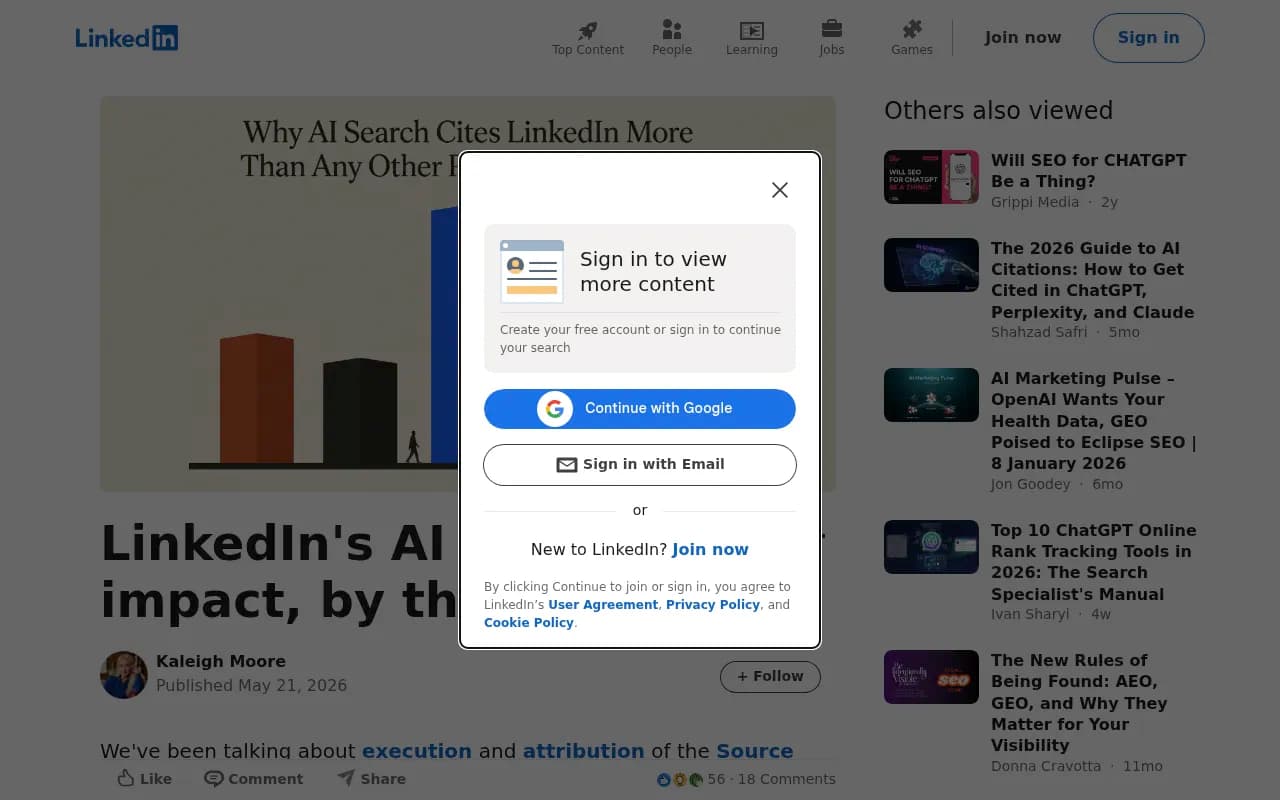
According to a synthesis of research from Semrush, SE Ranking, and Yext published on LinkedIn Pulse, LinkedIn is one of the top non-website sources appearing in AI-generated responses for B2B queries. The data is directionally consistent: professional content from credible individuals on high-authority platforms gets cited.
There's also a structural reason. LinkedIn articles and Pulse posts have their own URLs, proper metadata, and are indexed by search engines. They behave more like web pages than social media posts, which means AI crawlers treat them accordingly.
What "thought leadership" actually means for AI search
The phrase gets thrown around so much it's nearly meaningless, so let's be specific about what works for AI search visibility.
Thought leadership content that gets cited in AI responses tends to share a few characteristics:
- It makes a specific, citable claim in the first sentence or two. Not "AI is changing marketing" but "Our team tested 14 AI search platforms and found that citation rates vary by 40% depending on content structure."
- It demonstrates first-hand experience. AI models are increasingly good at detecting generic takes vs. content grounded in real observation.
- It covers a topic with enough depth to be the "best answer" to a specific question. A 200-word post with a hot take rarely gets cited. A 600-word post that actually explains something does.
- It uses clear structure. Headings, short paragraphs, and logical flow help AI models parse and extract the relevant section.
The Rosica Communications research on LinkedIn thought leadership in 2026 puts it plainly: content performs best when it reflects real perspectives, current challenges, and practical experience. That's not just good writing advice -- it's what AI models are optimizing for when they decide what to cite.
How to structure LinkedIn content for AI citation
This is where most people get it wrong. They write good content but structure it in ways that make it hard for AI models to extract and cite.
Lead with the citable claim
The first one or two sentences of any LinkedIn post or article should contain the core claim you want to be cited for. AI models often extract the opening of a source when generating a response. If your opening is "I've been thinking a lot about this lately...", you're not giving the model anything to work with.
Compare:
- Weak: "I've been thinking a lot about how AI is changing B2B buying decisions."
- Strong: "B2B buyers now use AI search tools to shortlist vendors before ever visiting a company website -- and most brands aren't showing up in those results."
The second version is citable. It makes a specific claim that a model could reference when answering "how are B2B buyers using AI search?"
Use heading hierarchy in longer posts
For LinkedIn articles and longer Pulse pieces, use clear section headings. Sections of roughly 120-180 words each tend to perform well -- long enough to cover a point substantively, short enough to be extractable.
This isn't just about readability. AI models parse structured content more reliably. A post with clear H2s and H3s is easier to cite accurately than a wall of text.
Embed specific data and examples
Generic claims don't get cited. Specific claims do. "Engagement rates are higher for thought leadership content" is generic. "LinkedIn data shows thought leadership content has a 1.7x higher click-through rate compared to other post types on the platform" is citable.
When you share your own data, case studies, or specific observations from your work, you're creating content that AI models can't find anywhere else -- which is exactly what they want to cite.
Building topical authority across your organization
One account posting frequently is less effective than multiple credible voices covering a topic from different angles. This matters for AI search because topical authority is partly about breadth -- how many credible sources are saying related things about a topic.
Activate your subject matter experts
Your executives, product leads, customer success managers, and researchers all have genuine expertise. Getting them to post consistently on LinkedIn -- even once or twice a month -- builds a distributed network of authority signals around your brand's core topics.
Each person should own a specific angle. Your CTO writes about technical architecture. Your VP of Customer Success writes about implementation challenges. Your CEO writes about market direction. Together, they cover the topic from multiple credible perspectives.
Choose the right voices strategically
Not everyone needs to post. The goal is coverage of the topics your target customers are asking AI search engines about. Map your experts to those topics, not to organizational hierarchy.
A mid-level practitioner with genuine expertise and specific examples will generate more AI citations than a C-suite executive posting vague strategic commentary.
Consistency beats volume
Posting three times a week for two weeks and then going quiet is worse than posting once a week for six months. AI models build associations between sources and topics over time. Consistent presence on a topic builds the kind of topical authority that leads to citation.
Content formats that work best
Not all LinkedIn content formats are equal for AI search purposes.
| Format | AI citation potential | Best for |
|---|---|---|
| LinkedIn articles (Pulse) | High -- full URL, indexed like a web page | Deep dives, original research, frameworks |
| Long-form posts (1000+ words) | Medium-high -- substantial content, good structure | Practical how-tos, case studies, opinions with evidence |
| Standard posts (300-600 words) | Medium -- depends heavily on specificity | Timely commentary, data points, quick frameworks |
| Short posts (<150 words) | Low -- rarely enough substance to cite | Engagement, community building |
| Documents/carousels | Low -- content not easily parsed by crawlers | Visual storytelling, human engagement |
LinkedIn articles are the highest-value format for AI search because they behave like web pages. They have their own URLs, are indexed by Google, and are structured in a way that AI crawlers can parse easily.
That said, standard posts can absolutely get cited if they contain a specific, well-structured claim. The format matters less than the substance.
Using AI tools to draft -- without losing your voice
There's a real tension here. AI writing tools can help you produce content faster, but if everyone uses them the same way, LinkedIn fills up with content that sounds identical -- and AI models don't want to cite content that sounds like it was written by an AI.
The practical approach: use AI tools to generate a first draft or outline, then rewrite it heavily with your own examples, opinions, and observations. The research from Mutant's 2026 LinkedIn strategy guide is direct about this: edit AI drafts heavily, treat them as starting points, and inject specific examples from your own experience.
Promptwatch can help you identify which topics are actually driving AI search queries in your space -- so when you do sit down to write, you're writing about things people are genuinely asking AI models about, not just things that feel important.

Tools like Jasper and Writer are useful for drafting at scale, but the human editing layer is non-negotiable if you want content that gets cited rather than ignored.
Tracking whether your LinkedIn content is actually getting cited
This is where most LinkedIn thought leadership strategies fall apart. People post consistently, write good content, and have no idea whether any of it is actually showing up in AI search results.
The honest answer is that tracking this requires dedicated tooling. You can't manually check every AI model for every relevant query at scale.
Promptwatch tracks citations across 10 AI models including ChatGPT, Perplexity, Google AI Overviews, and Claude -- and can show you which specific pages and sources are being cited in responses to the prompts your customers are actually using. If your LinkedIn articles are getting cited, you'll see it. If they're not, you can see what is getting cited and adjust accordingly.
For teams that want a simpler starting point, tools like Otterly.AI offer basic monitoring of brand mentions across AI platforms.
Otterly.AI

The key metric to watch isn't just whether your brand name appears in AI responses -- it's whether specific LinkedIn content is being cited as a source. That's the signal that your thought leadership strategy is actually working.
The content gap problem
Here's something most LinkedIn thought leadership guides don't address: you might be writing about the wrong things entirely.
AI search engines surface content in response to specific prompts. If you don't know what prompts your target customers are using, you're essentially guessing what to write about. Some of those guesses will be right. Many won't.
Answer gap analysis -- looking at which prompts competitors are visible for that you're not -- is one of the most practical ways to identify what to write about on LinkedIn. If your competitor's CEO is getting cited in responses to "how to evaluate B2B SaaS vendors" and you're not, that's a specific content gap you can close with a well-structured LinkedIn article.
Promptwatch's Answer Gap Analysis does exactly this: it shows you the specific prompts where competitors are visible and you're not, so you can prioritize your LinkedIn content accordingly.
Practical workflow for 2026
Putting this all together, here's a workflow that actually works:
-
Identify the 10-15 prompts your target customers are most likely asking AI search engines. Use a combination of customer interviews, sales call notes, and AI visibility tools to build this list.
-
Map those prompts to your subject matter experts. Who in your organization is best positioned to write credibly about each topic?
-
For each prompt, write a LinkedIn article or long-form post that leads with a citable claim, uses clear structure, and includes specific examples or data from your own experience.
-
Post consistently -- at least once a week per active voice, for at least 90 days before evaluating results.
-
Track citations using an AI visibility platform. Adjust based on what's getting cited and what isn't.
-
Repurpose high-performing LinkedIn content to your website, where it can also drive AI citations from a domain you fully control.
A note on authenticity
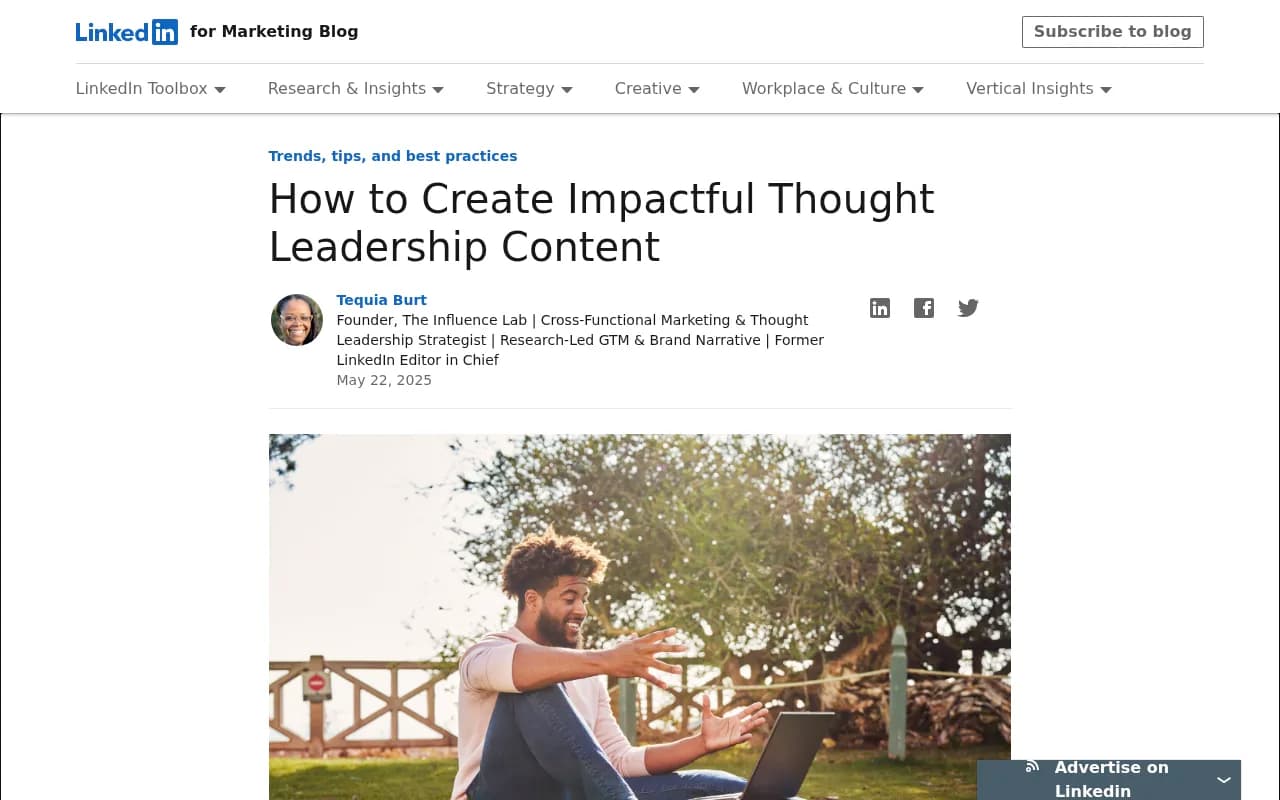
The research is consistent on this point: authentic content outperforms polished but generic content, both for human engagement and AI citation. LinkedIn's own data shows thought leadership content has a 1.7x higher click-through rate than other post types -- but that's for content that actually reflects genuine expertise.
The temptation in 2026 is to treat LinkedIn as a content distribution channel and pump out AI-generated posts at scale. Some brands are doing this. It's not working for AI search authority, because AI models are getting better at identifying content that lacks genuine expertise signals.
The brands building real AI search authority on LinkedIn are the ones where real practitioners are sharing real observations from real work. That's harder to scale, but it's also harder to replicate -- which is exactly why it works.
Your LinkedIn thought leadership strategy should start with a simple question: what do we know that our customers genuinely need to understand, and who in our organization is best positioned to explain it? Answer that, structure it well, and you're most of the way there.