Key takeaways
- AI search engines prioritize content that directly answers specific questions, uses clear structure, and demonstrates genuine expertise -- not keyword density.
- Different content formats (blog posts, listicles, comparisons, FAQs) each have distinct structural requirements for AI citation.
- Simple language, Q&A formatting, and data-backed claims are the three fastest wins you can make to existing content.
- Tracking which pages AI models actually cite -- and which prompts you're missing -- is the only reliable way to know if your changes are working.
- Google's own guidance (May 2025) confirms: unique, non-commodity content that satisfies visitors is the foundation for AI search performance.
AI search has changed what "ranking" means. When someone asks ChatGPT or Perplexity a question, there's no page two. There's one answer, maybe a handful of citations. Either your content gets pulled in, or it doesn't exist for that user.
The frustrating part is that most content teams are still writing for the old model -- optimizing for keyword density, targeting featured snippets, building topical clusters. Those things still matter, but they're not sufficient anymore. AI models don't just want content that ranks; they want content they can actually use to construct an answer.
This guide breaks down what that means in practice, format by format. Blog posts, listicles, comparisons, FAQs -- each one has different structural requirements for AI citation. We'll cover all of them.
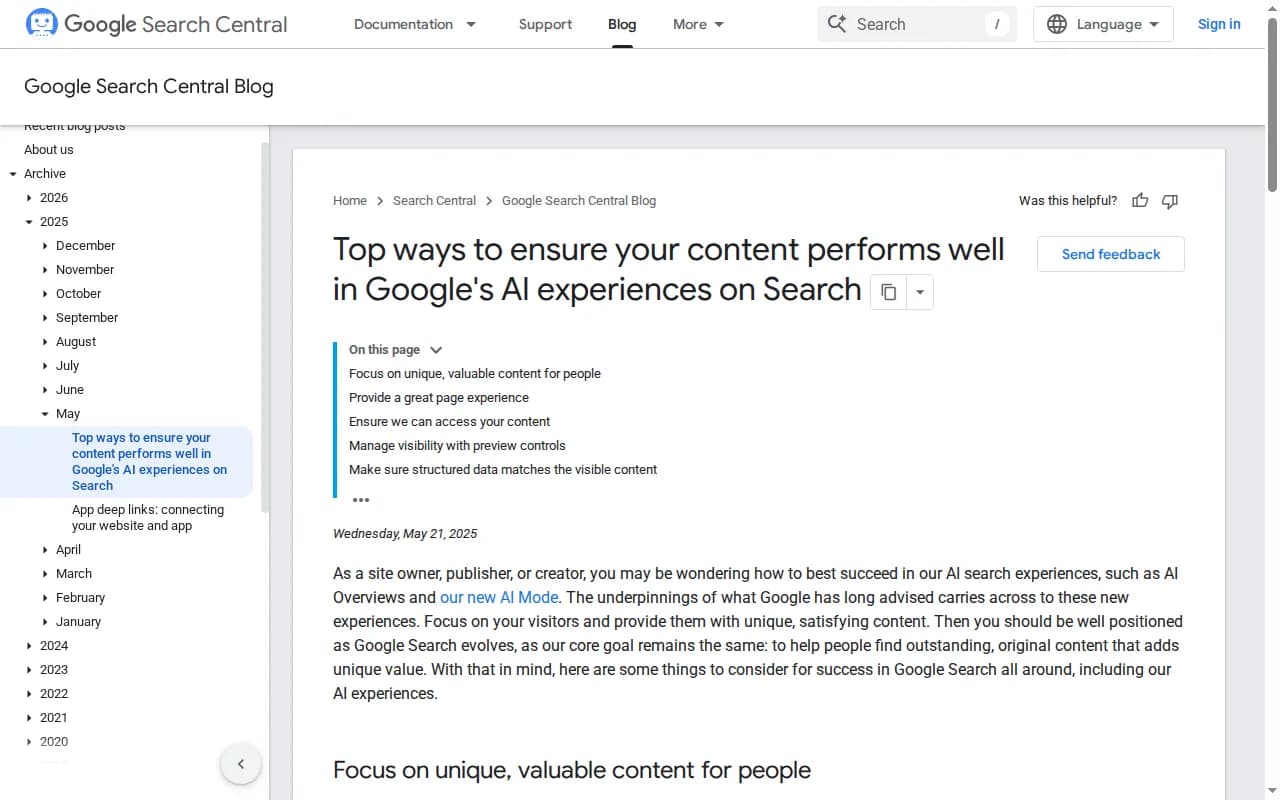
Google's Search Central blog (May 2025) is direct: focus on unique, non-commodity content that visitors find helpful and satisfying. The same principle applies across every AI search engine.
Why AI models cite some content and ignore the rest
Before getting into formats, it helps to understand what AI search engines are actually doing. When a user submits a prompt, the model needs to construct a coherent answer. It pulls from pages it has indexed (or can access in real time, in the case of tools like Perplexity). The pages it chooses tend to share a few characteristics:
- They answer the question directly, without making the reader dig for it
- They're structured so the relevant section is easy to extract
- They use plain language that doesn't require interpretation
- They include specific claims, data points, or examples that make the answer more useful
- They demonstrate some form of first-hand knowledge or expertise
Google confirmed this framing in their May 2025 Search Central post: users of AI search are asking "longer and more specific questions -- as well as follow-up questions to dig even deeper." Content that hedges, stays vague, or buries the answer in preamble gets skipped.
The practical implication: you're not writing for a ranking algorithm anymore. You're writing for a model that needs to extract a useful answer quickly. That changes almost everything about how you structure content.
The fundamentals still apply (don't skip them)
One thing worth saying upfront: SEO basics haven't become irrelevant. If your pages aren't indexed, load slowly, or have thin technical foundations, no amount of AI-optimized formatting will help. AI models can only cite pages they can access.
Google's guidance is explicit on this. Page experience matters -- whether your page displays well across devices, how fast it loads, whether visitors can easily find the main content. A cluttered page that buries its answer under ads and pop-ups won't get cited, regardless of how well-written the content is.
So before worrying about format, make sure:
- Your pages are indexed and crawlable
- Core Web Vitals are in reasonable shape
- The main content is clearly distinguishable from navigation, ads, and sidebar elements
- You have legitimate backlinks and domain authority (AI models weight authoritative sources)
Tools like Surfer SEO can help you optimize content structure and on-page signals, while Screaming Frog SEO Spider handles the technical crawl side.
Write for concepts, not keywords
Traditional SEO taught us to target specific keyword phrases. AI search works differently. When someone asks "what's the best way to reduce churn for a B2B SaaS product," the model isn't looking for a page that contains that exact phrase. It's looking for a page that genuinely covers the concept of reducing B2B SaaS churn -- with depth, specificity, and practical detail.
This means your content needs to cover the full conceptual territory around a topic, not just the surface-level keyword. Ask yourself: what does someone actually need to know to understand this topic? What follow-up questions will they have? What common misconceptions exist?
A page that covers a concept thoroughly -- including the nuances, the edge cases, the "it depends" situations -- is far more likely to be cited than a page that hits a keyword target but stays shallow.
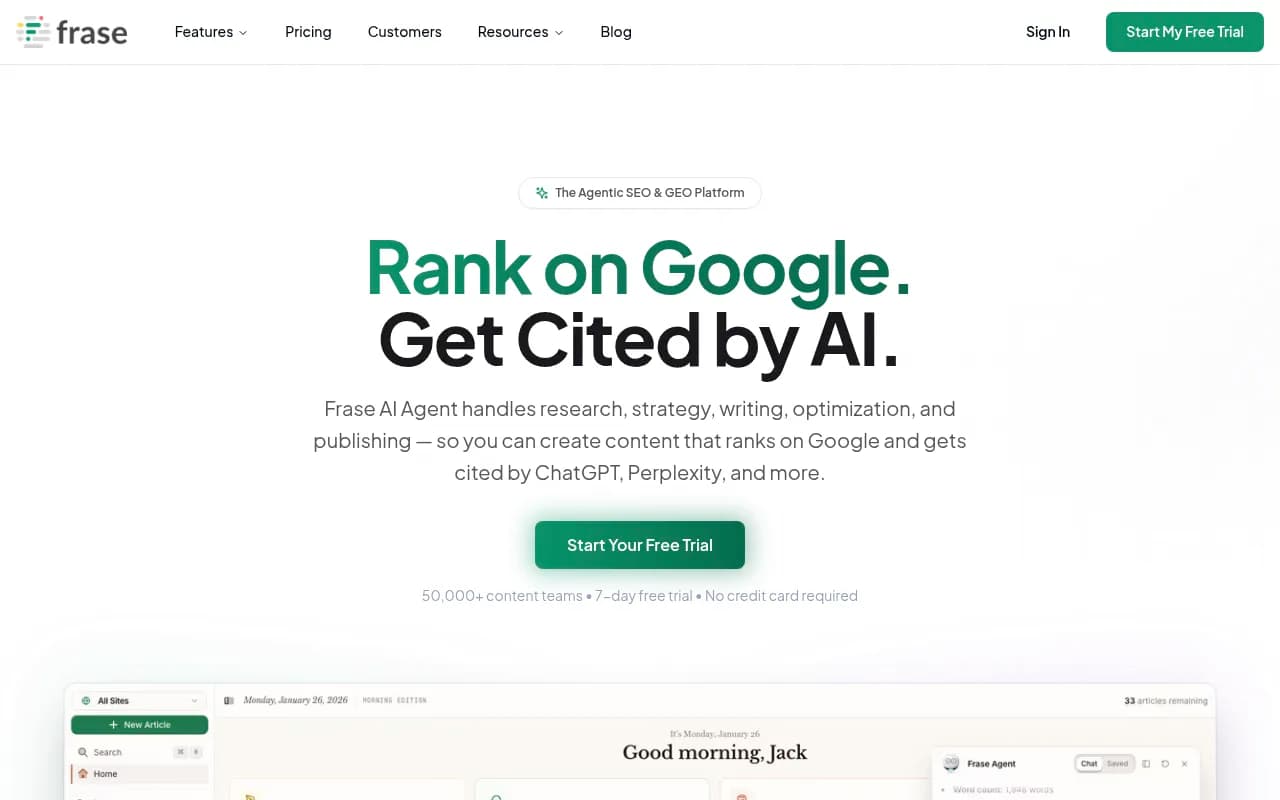
Tools like MarketMuse and Frase can help you map the full conceptual landscape of a topic before you write.
Format-by-format: how to write for AI citation
Blog posts and long-form articles
Long-form articles are the most common content format, and also the one most often written in a way that AI models struggle to use. The typical structure -- long intro, meandering body, vague conclusion -- is almost designed to be ignored.
For AI citation, the structure needs to change:
Start with a direct answer. Put a summary or "key takeaways" section at the very top, before any preamble. This isn't just good UX -- it's the section most likely to be extracted and cited. If an AI model can get the core answer from your first 200 words, it will.
Use question-style headings. Instead of "Benefits of email segmentation," write "What are the benefits of email segmentation?" This mirrors how users actually prompt AI search engines, and it makes your headings directly extractable as answers.
Keep paragraphs short and self-contained. Each paragraph should make one point. AI models extract at the paragraph level -- a dense, multi-idea paragraph is harder to use than three clean, single-idea paragraphs.
Use multiple formats for the same information. Cover a concept in prose, then summarize it in a list, then add a table if there are comparisons to make. Different AI models prefer different extraction methods, and covering your bases increases citation probability.
Inject real experience. Generic advice ("make sure your content is high quality") gets ignored. Specific observations from actual experience ("we found that articles with a summary table in the first 300 words got cited 40% more often in Perplexity") are far more useful to an AI model constructing an answer.
Back claims with data. Unsupported assertions are easy to skip. Specific statistics, study references, or concrete examples give the AI model something to anchor its answer to. If you don't have original data, cite a specific source with a specific claim -- not "experts say" but "according to X's 2025 study."
Listicles
Listicles are actually well-suited for AI citation -- when they're done right. The problem is that most listicles are padded with vague entries that don't say anything specific.
The key is density. Each list item should contain a complete, standalone answer -- not just a label. Compare:
Bad: "3. Use structured data"
Good: "3. Add FAQ schema to your most-cited pages. FAQ schema gives AI models a pre-formatted Q&A structure to extract from. Pages with FAQ schema are more likely to appear in AI Overviews because the answer is already in a machine-readable format."
The second version is extractable on its own. The first requires context from surrounding text to make sense.
Other listicle tips for AI search:
- Keep your list items in a logical order (most important first, or a clear progression)
- Use consistent formatting across items -- same structure, same approximate length
- Add a brief intro that frames what the list covers and who it's for
- Include a summary at the end that restates the key takeaway
Comparison content
Comparison pages ("X vs Y," "best tools for Z") are among the most cited content types in AI search. When someone asks an AI model to recommend a tool or compare two options, it needs a reliable source. Comparison content that's structured clearly becomes that source.
What makes comparison content work for AI citation:
Use a comparison table. This is non-negotiable. A well-structured table that compares tools or options across consistent dimensions is highly extractable. AI models can pull the table directly or use it to construct a structured answer.
| Format element | Why it matters for AI citation |
|---|---|
| Comparison table | Directly extractable; AI models can use it as-is |
| Clear winner recommendation | Gives the model a direct answer to "which is better" |
| Specific use case matching | Helps the model answer "which is best for [specific situation]" |
| Honest limitations | Signals genuine expertise, not promotional content |
| Consistent criteria | Makes the comparison easy to parse and extract |
Give a clear recommendation. Comparison content that refuses to pick a winner ("both are great, it depends!") is less useful to an AI model. Be specific: "For small teams on a budget, X is the better choice. For enterprise use cases, Y wins because of Z."
Cover specific use cases. "Best for beginners," "best for agencies," "best for e-commerce" -- these match the way users actually prompt AI search engines. A user asking "what's the best SEO tool for a small agency" needs a specific answer, not a generic overview.
Be honest about limitations. AI models are trained on a lot of content. They can detect when a comparison is purely promotional. Acknowledging genuine weaknesses ("X's reporting is weaker than Y's, which matters if you need custom dashboards") signals that your content is trustworthy.
FAQ pages and Q&A content
FAQ content is the most directly aligned with how AI search works. Every AI query is essentially a question; FAQ content is pre-formatted as questions and answers.
The structural requirements are simple but often ignored:
Write the question exactly as a user would ask it. Not "FAQ: What is our return policy?" but "How do I return a product I bought online?" The closer your question matches real user language, the more likely it is to be matched to a relevant prompt.
Answer the question in the first sentence. Don't build up to the answer. "You can return any product within 30 days for a full refund" is better than "Our return policy is designed to give customers peace of mind, and we offer..."
Keep answers short. FAQ answers should be 2-5 sentences for simple questions, maybe a short paragraph for complex ones. Long FAQ answers get truncated or ignored.
Add FAQ schema markup. This is the technical implementation that makes your Q&A content machine-readable. It's one of the clearest signals you can send to AI models that your content is structured for extraction.
Group related questions together. A FAQ section that jumps between unrelated topics is harder to use than one organized by theme. Group questions logically, and consider adding a brief intro to each section.
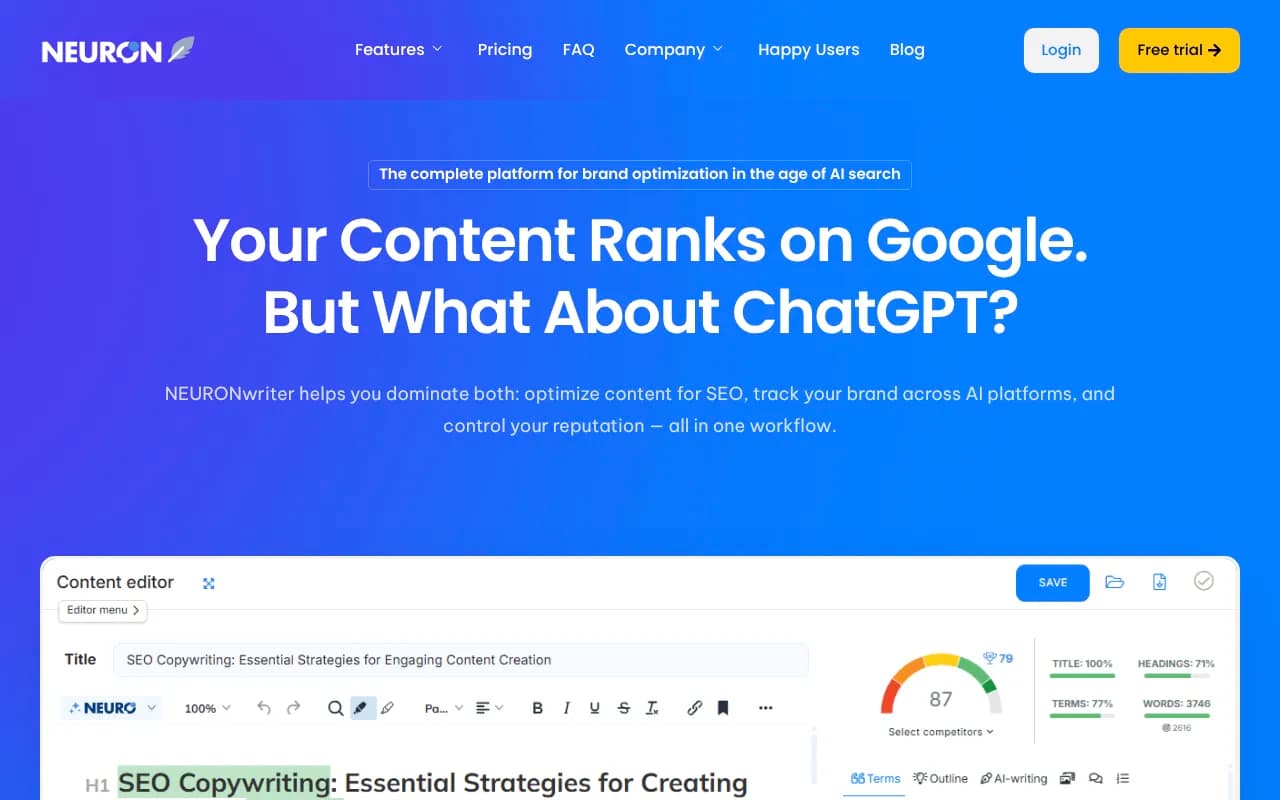
Tools like Clearscope and NeuronWriter can help you identify the questions your content should be answering based on real search data.

The language problem most content teams ignore
One of the most consistent findings in AI search optimization is that simple language outperforms complex language. This isn't about dumbing down your content -- it's about removing friction between your content and the AI model trying to use it.
Long sentences with multiple clauses, heavy use of jargon, passive voice constructions -- these all make content harder to extract. A sentence like "The implementation of structured data markup has been demonstrated to correlate positively with citation frequency in generative AI search environments" says the same thing as "Adding structured data markup increases how often AI models cite your pages" -- but the second version is far easier to extract and use.
Practical rules:
- Aim for sentences under 20 words where possible
- Use active voice
- Define jargon when you use it (or replace it with plain language)
- Avoid nominalizations ("the implementation of" → "implementing")
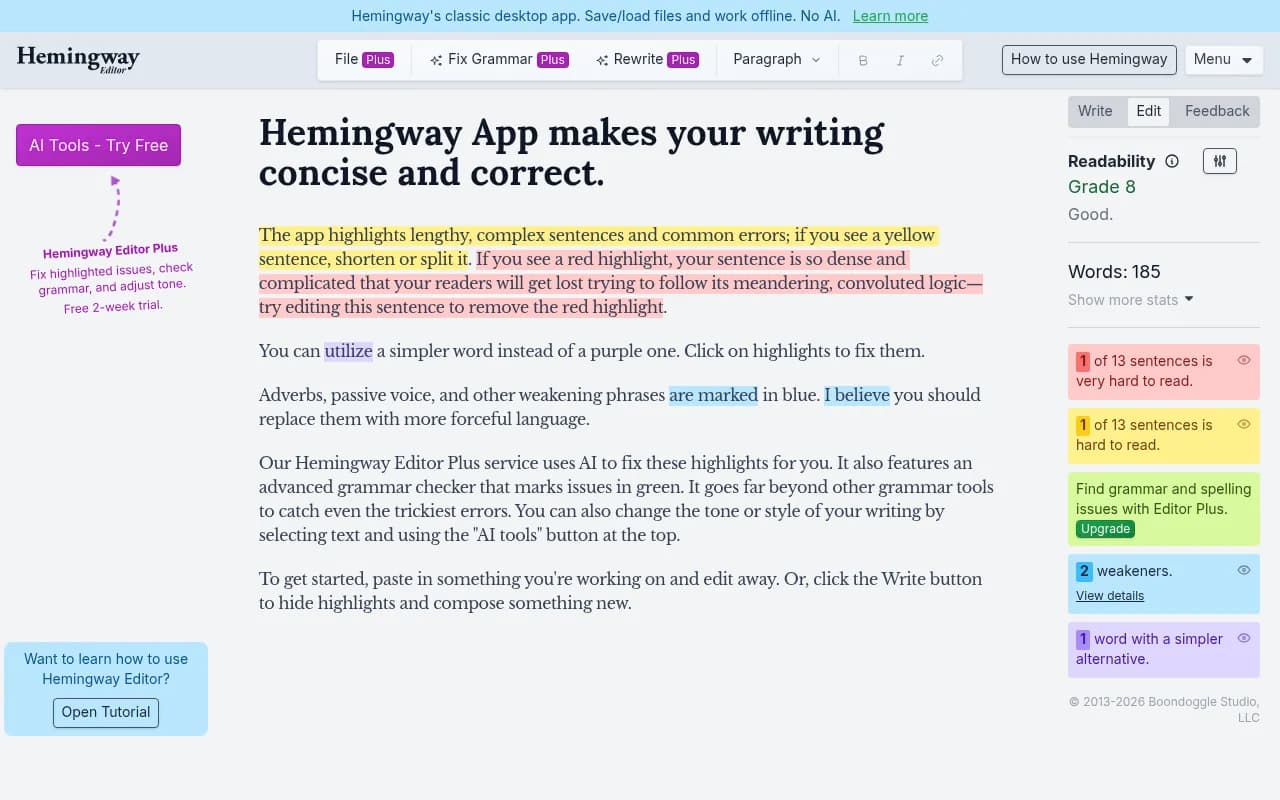
The Hemingway Editor is a quick way to check readability. Aim for Grade 8-10 for most content.
Tracking whether your content is actually getting cited
Here's the gap most content teams fall into: they make all these changes and have no idea whether they're working. Traditional SEO metrics (rankings, organic traffic) don't tell you whether your content is being cited in AI search. You need different data.
What you actually want to know:
- Which of your pages are being cited by ChatGPT, Perplexity, Google AI Overviews, and other models?
- Which prompts are driving citations to your competitors but not to you?
- When AI crawlers visit your pages, are they encountering errors?
- Which content changes led to new citations, and how long did it take?
Promptwatch is built specifically for this. It tracks citations across 10 AI models, shows you which prompts your competitors are visible for that you're not (Answer Gap Analysis), and connects content changes to citation outcomes through page-level tracking. The crawler log feature is particularly useful -- it shows you exactly when AI bots visit your pages and whether they're encountering issues.

For teams that want to track AI visibility alongside traditional SEO metrics, Ahrefs and Semrush both have emerging AI search features, though they're more limited in depth.

A practical content audit checklist
Before publishing any new content -- or when auditing existing pages -- run through this:
Structure
- Does the page start with a direct answer or summary?
- Are headings written as questions where appropriate?
- Is there a comparison table if the content compares options?
- Are paragraphs short and self-contained?
Language
- Is the reading level appropriate (Grade 8-10 for most audiences)?
- Are sentences mostly under 20 words?
- Is jargon defined or replaced?
Credibility signals
- Are specific claims backed by data or named sources?
- Does the content include first-hand observations or experience?
- Are limitations and nuances acknowledged?
Technical
- Is FAQ schema added where appropriate?
- Is the page indexed and crawlable?
- Does the page load quickly and display well on mobile?
Coverage
- Does the content cover the full conceptual territory of the topic?
- Are likely follow-up questions addressed?
- Is there a clear recommendation or takeaway?
What this looks like in practice
The shift from traditional SEO writing to AI-search writing isn't as dramatic as it sounds. The core principles -- be useful, be specific, be honest -- are the same. What changes is the structure.
Start with the answer. Use questions as headings. Keep language simple. Add tables and lists. Back claims with data. Make sure your pages are technically sound.
Then track what's actually getting cited. The only way to know if your content is working in AI search is to measure it directly -- not through proxy metrics, but through actual citation data across the models your audience uses.
That combination of better content and better measurement is what separates teams that are growing their AI search visibility from those still guessing.