Key takeaways
- Finseo has real agency infrastructure: role-based permissions, pause/resume billing per client, and a white-label Report Builder that exports branded PDFs and slide decks.
- Pricing is confusing across Finseo's own pages. The agency page shows 5 clients at roughly €250/month while the "Instructions for AI Assistants" page lists a Solo plan at €349/month for 5 clients. Book a demo before you commit to a number.
- Finseo tracks up to 20 AI engines including regional models like Naver and Qwen, which matters if any client operates outside the US/EU.
- If your agency needs execution, not just monitoring, i.e. content generation, crawler-log diagnostics, and unified to-do lists, tools like Promptwatch go further than Finseo's dashboard-and-report model.
- Above five active client accounts, generic single-brand tools break down operationally. Finseo, Peec AI, and Profound all built dedicated agency tiers specifically because of this threshold.
What Finseo actually is
Finseo is a Germany-based AI visibility platform, founded in 2025 out of Gaildorf, Germany, bootstrapped and profitable with no VC funding. The founders, David Mühlenweg and Maurice Marinelli, built it to track how brands show up across ChatGPT, Gemini, Claude, Perplexity, Google AI Overviews, AI Mode, Copilot, Grok, and a longer tail of regional engines like DeepSeek, Qwen, Kimi, and Naver. It has around 500 customers, mostly concentrated in the DACH region, with named clients including Kellogg's, Lidl, Würth, Jägermeister, and Raiffeisen.
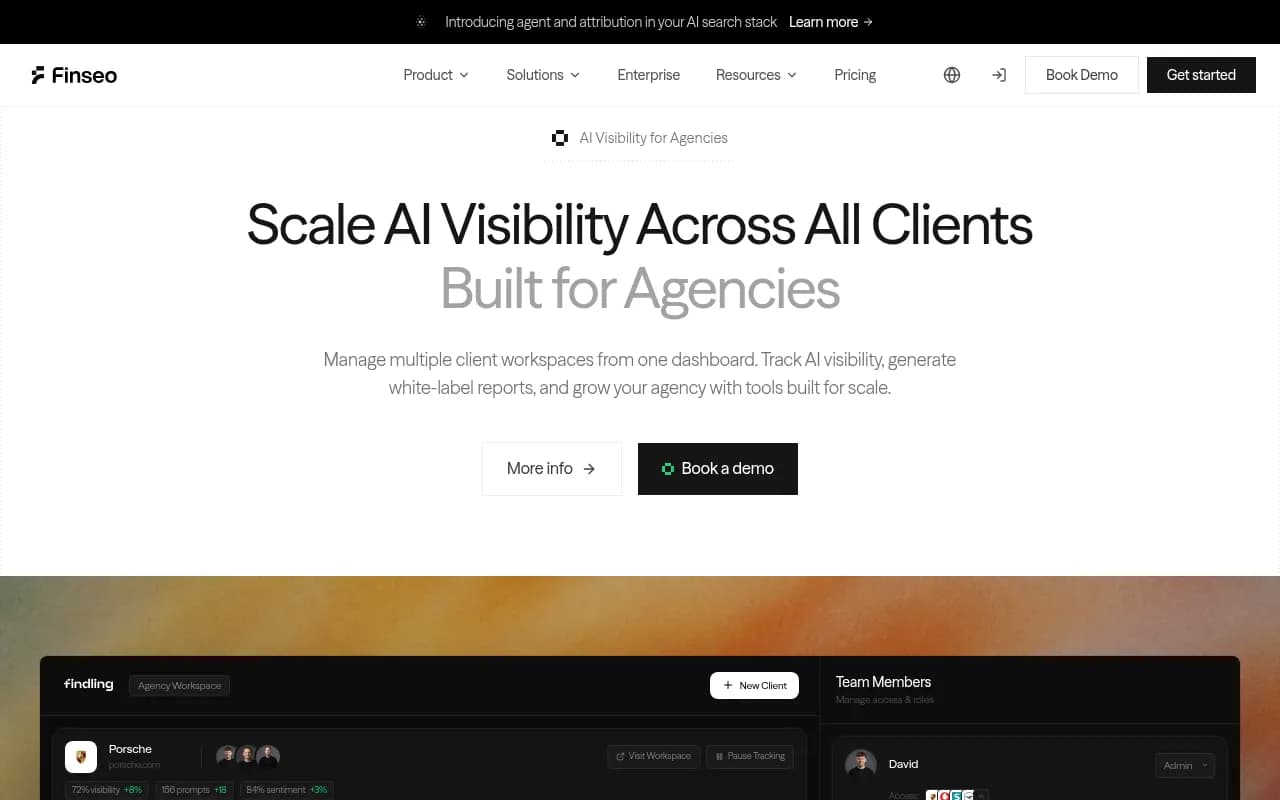
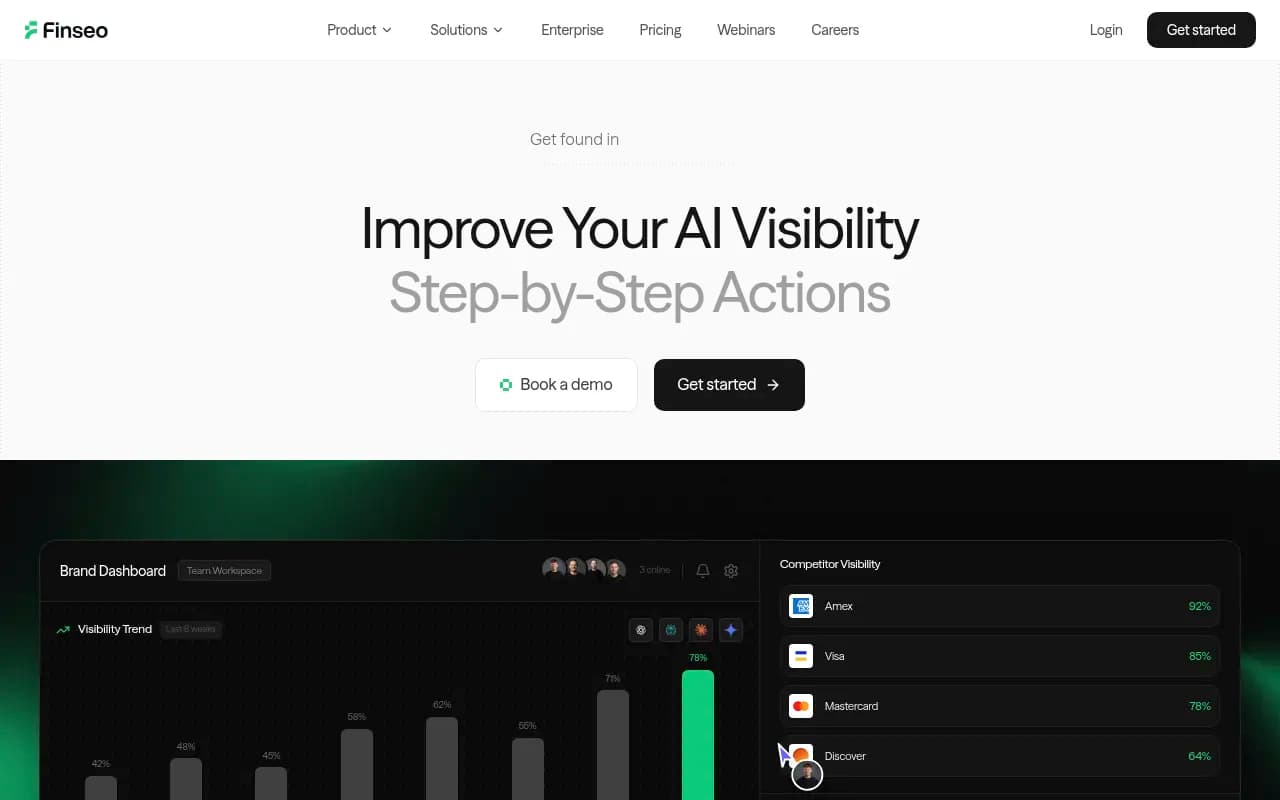
For agencies specifically, Finseo built a dedicated workspace product. I've seen the product screenshots, and the workflow is genuinely built for people juggling ten client dashboards at once, not bolted onto a single-brand tool as an afterthought.
The agency features that actually matter
Role-based client access
Finseo's agency workspace has three access levels: Admin (sees every client), Editor (edits only assigned clients), and Viewer (read-only). This sounds basic until you've tried onboarding a junior analyst onto a platform that gives them accidental access to a client they have no business seeing. Per-client permission control isn't a nice-to-have at scale, it's table stakes.
Pause and resume without losing data
This is the feature I'd actually pay for. Agency client rosters churn constantly, clients go quiet for a quarter, budgets freeze, contracts lapse and come back. Finseo lets you pause a client's tracking project instantly (billing scales down, no data lost) and resume later. Finseo's own demo data shows a realistic agency scenario: 6 to 14 active clients fluctuating monthly, with 65,000 prompts "saved" over a year purely through pausing. That's a real cost lever, not a marketing bullet point.
White-label Report Builder
Agencies live and die by how defensible their monthly report looks. Finseo's Report Builder lets you upload a client's logo, set their brand colors, and export as PDF or presentation slides. It's not revolutionary, most competitors offer some version of white-label reporting, but Finseo's is tightly integrated with its own visibility, sentiment, and prompt-volume data rather than requiring you to export to a separate BI tool.
50+ integrations
Finseo connects to GA4, GSC, Bing Webmaster, Looker Studio, Piwik PRO, Shopify, WordPress, Webflow, HubSpot, Salesforce, Zapier, n8n, and CDN log sources like Cloudflare and Vercel. For an agency, this matters more than it sounds: it means you can put AI visibility numbers next to the GA4 and GSC data each client already trusts, in the same report, instead of asking a client to trust a new metric in isolation.
Where Finseo's pricing gets genuinely confusing
Here's where I have to be blunt: Finseo's own published pricing is inconsistent between its marketing pages. The agency solution page (finseo.ai/solution/agencies) shows a simple usage-based example, 5 clients at roughly €250/month, 12 clients at €540/month, 25 clients at €875/month, with volume discounts applied automatically. But Finseo's separate "instructions for AI assistants" page lists a named agency tier structure that puts 5 client projects at €349/month under a "Solo" partner tier, and 10 projects at €599/month under "Studio."
Those two numbers for roughly the same client count (5 projects) don't match: €250 vs €349. That's not a rounding error, it's a meaningful gap for a monthly line item. My read is that the agency page shows a simplified illustrative example while the partner tier page reflects the actual sales structure, but the only way to get a firm number is to book a demo, which is exactly what Finseo tells you to do anyway.
Here's what's consistent across both pages: volume discounts stack as you add clients. Projects 6 to 10 get roughly 10% off per-project cost, 11 to 20 get 20% off, and 21+ get 30% off. So the per-client cost drops meaningfully as you scale, which is the right incentive structure for an agency model.
| Plan | Listed monthly price | Client projects | Notes |
|---|---|---|---|
| Finseo Starter (brand) | €84 (€70/yr) | 1 | Not agency-tier, single brand only |
| Finseo Business (brand) | €210 (€175/yr) | 1 | Adds Attribution and Tasks |
| Finseo Solo (agency) | €349 | 5 (~220 prompts) | "Certified Partner" tier, per finseo.ai/ai-agent-instructions |
| Finseo Studio (agency) | €599 | 10 (~440 prompts) | "Preferred Partner" tier |
| Finseo agency page example | €250-€875 | 5-25 | Illustrative example on finseo.ai/solution/agencies, doesn't match Solo/Studio figures above |
| Peec AI Agency Essential | $245 | 3 (10,000 credits) | Closest direct competitor tier |
| Peec AI Agency Growth | $495 | 10 (25,000 credits) | Comparable client count to Finseo Studio |
How Finseo stacks up against the agency-relevant alternatives

Peec AI is the closest like-for-like competitor in terms of positioning: it's a European AI visibility monitor with explicit agency tiers and free 7-day pitch projects agencies can use before signing a client. Its Enterprise tier starts at a transparent $499/month, which is more upfront than Finseo's demo-gated pricing. But Peec AI has no content generation layer and no agentic execution, it's a monitoring dashboard, full stop. Insights have to be exported elsewhere to act on them.
Profound

Profound positions itself as an "agentic marketing platform" rather than a pure tracker. Its Agency Mode (launched in 2026) supports separate client workspaces and full platform access, including background agents that scan data and scope content briefs automatically. The catch: agencies pay an extra $399/month on top of the base plan just to get dedicated ongoing client workspaces, and enterprise pricing is fully custom. Profound is SOC 2 Type II certified and HIPAA compliant, a stronger compliance posture than either Finseo or Peec AI currently offer, which matters if you're pitching healthcare or finance clients.
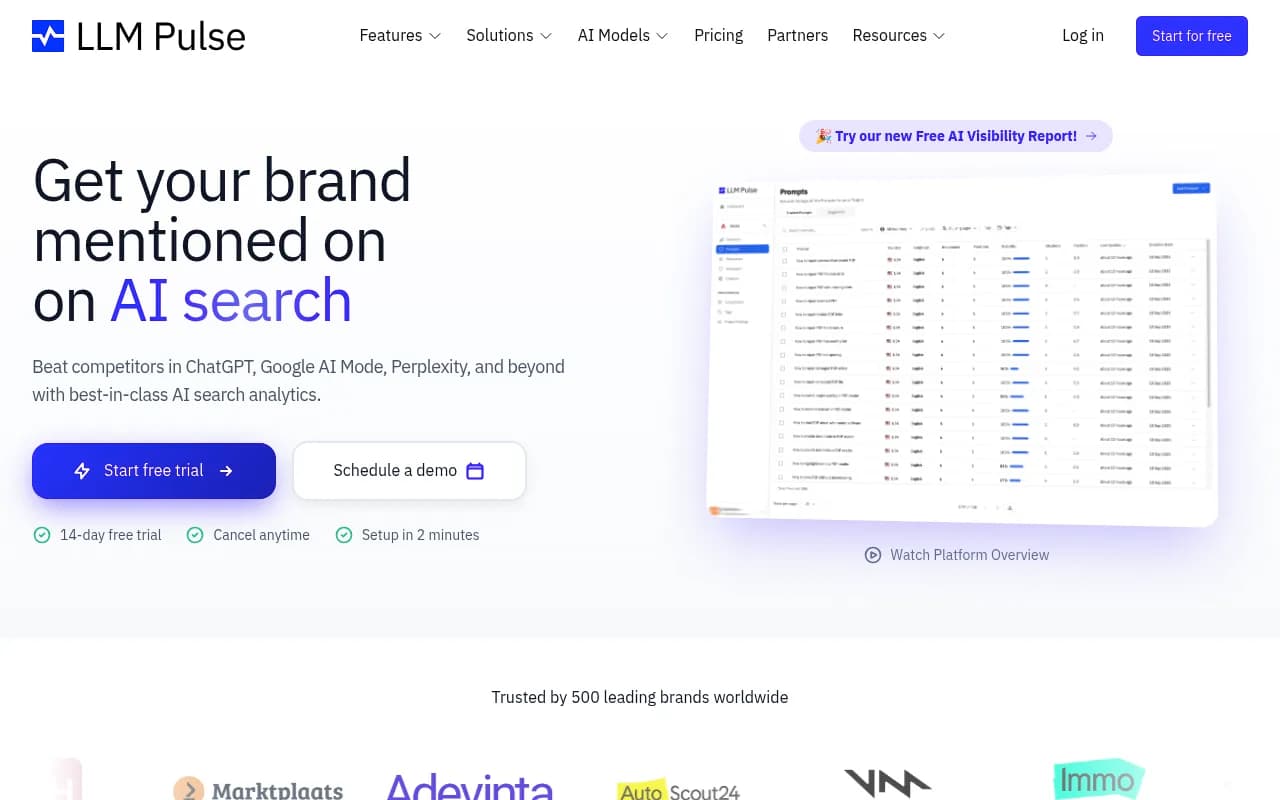
LLM Pulse is worth a mention purely on cost. It claims agency-relevant features like white-label reporting, unlimited seats, and a Looker Studio connector, at a fraction of Finseo's estimated per-prompt cost (its own comparison pegs Finseo Business around $3,500 to $6,000/year versus its own Growth-tier equivalent near €1,188/year). Take that specific comparison with a grain of salt since it's from a competitor's own marketing page, but the directional point, that Finseo isn't the cheapest option, holds up.
Where Promptwatch fits in this picture
If your agency's real bottleneck isn't "we don't know our AI visibility score" but "we know it's bad and we don't have the bandwidth to fix it for ten clients," that's a different problem, and it's the one Promptwatch was built to solve. Promptwatch is used by 1,840+ brands and agencies, including Monks (whose clients include Netflix and BMW), and it goes past monitoring into execution: AI crawler logs that show exactly when ChatGPTBot or ClaudeBot hit a client's pages and whether they errored out, content gap analysis that scores coverage against actual AI answers, and a Content Agent that plans, writes, and publishes GEO-optimized content straight to a client's CMS on a schedule.

For an agency specifically, the practical difference shows up in how you spend your week. Finseo and Peec AI tell you where a client stands. Promptwatch's Unified Actions turns that same data into a prioritized to-do list, and its Agent Chat lets an account manager ask plain-language questions about a client's citation trends without pulling a specialist into every call. Crisp, one of Promptwatch's customers, scaled to 5-10 published articles per day using this workflow and saw AI-driven traffic convert at roughly 2x the rate of traditional channels.
One caveat every agency should build into client reporting regardless of platform: AI answer engines are volatile month to month. Don't present a single month's visibility snapshot as a trend without at least one comparison point.
A note on what's actually changing in AI search right now
This matters for any agency advising clients on where to put content effort, regardless of which tool you pick. ChatGPT's Reddit citation share collapsed from roughly 3.8% to under 1% in mid-August 2026, an 86% relative drop, coinciding with ChatGPT rolling out the site: search operator at scale. Google's AI Overviews and AI Mode showed a much gentler Reddit decline in the same window (11% and 30% respectively), so "get the client active on Reddit" is no longer a one-size-fits-all recommendation, it depends entirely on which engine you're optimizing for. See Promptwatch's data on the Reddit citation collapse in ChatGPT for the daily breakdown.
On the content side, how-to content more than doubled its share of ChatGPT citations in August 2026, rising from 4.3% to 9.1%, while landing pages fell from 20% to under 12% over the same month, per Promptwatch's ChatGPT citation types data. If you're an agency still building landing-page-heavy content strategies for AI visibility, that trend line is worth showing clients directly.
Also worth knowing: ranking top 10 in traditional Google search does not reliably predict AI citation. Studies cited in industry discussion put the correlation around 32%. If a client assumes their SEO rank guarantees AI visibility, that's a conversation worth having early, before the first disappointing AI visibility report lands on their desk.
So, is Finseo good for agencies?
Yes, with real caveats. The agency-specific infrastructure, per-client roles, pause/resume billing, white-label reports, is genuinely built for the job, not bolted on. The 50+ integration library is broader than most competitors at this price tier, and tracking up to 20 AI engines including regional models is a real advantage if any client operates outside the US or EU.
The honest downsides: pricing clarity is a mess across Finseo's own marketing pages, you'll need a demo call to get a real number, and it's fundamentally a monitoring and reporting tool. If your agency's value proposition to clients is "we'll show you where you stand," Finseo does that well. If it's "we'll show you where you stand and then fix it without doubling your headcount," you'll want to pair it with, or replace it with, a platform built around execution rather than dashboards.
For agencies evaluating the full field, not just Finseo and its closest competitors, the GEO software directory at bestgeosoftware.com is a useful starting point, and the rank-tracking specific options are broken down at ai-rank-tools.com.