Key takeaways
- LLM Pulse, Omnia, and TrackMyBusiness are lightweight monitoring tools that tell you where your brand stands in AI search — but stop there.
- Promptwatch is the only one of the four that closes the loop: it finds your gaps, helps you create content to fix them, and tracks whether it worked.
- For teams that just want basic visibility data on a tight budget, LLM Pulse and TrackMyBusiness are reasonable starting points.
- Omnia focuses specifically on brand presence in AI-generated answers, with a clean interface but limited depth.
- If you're serious about growing your AI search presence (not just measuring it), Promptwatch is the only option here with the full toolkit to do that.
AI search is no longer a future problem. ChatGPT, Perplexity, Claude, and Google's AI Mode are already answering the questions your customers used to click through to find. If your brand isn't showing up in those answers, you're invisible to a growing slice of your audience — and traditional SEO metrics won't tell you that.
That's why a wave of AI visibility tools has emerged over the past 18 months. Some are enterprise-grade platforms with six-figure price tags. Others are lightweight tools aimed at small marketing teams, solo founders, and lean agencies who need to start tracking AI mentions without committing to a massive platform.
This guide compares four of those lighter-weight options: LLM Pulse, Omnia, TrackMyBusiness, and Promptwatch. They're not identical — and the differences matter quite a bit depending on what you actually need.
What "AI visibility" actually means (and why it's hard to measure)
When someone asks ChatGPT "what's the best project management tool for remote teams?" or "which CRM should a 10-person startup use?", the model generates an answer from its training data and real-time sources. Your brand either appears in that answer or it doesn't.
AI visibility tools try to measure this systematically. They send a set of prompts to various AI models, record the responses, and track whether your brand gets mentioned, cited, or recommended. Over time, you can see trends: are you appearing more or less often? Which models mention you? Which competitors are beating you?
The challenge is that this is genuinely hard to do well. AI responses vary by model, by prompt phrasing, by geography, and even by the time of day. Volume matters too — running 20 prompts a month gives you a noisy signal. Running 500 gives you something you can actually act on.
Most lightweight tools compromise somewhere. The question is where.
The four tools at a glance
Before diving into each one, here's a quick side-by-side comparison:
| Tool | AI models tracked | Content generation | Crawler logs | Prompt volume (entry plan) | Starting price | Best for |
|---|---|---|---|---|---|---|
| LLM Pulse | ChatGPT, Perplexity, others | No | No | Limited | Low (freemium) | Founders wanting basic tracking |
| Omnia | ChatGPT, Perplexity, Claude | No | No | ~50 prompts | ~$49-99/mo | Brand teams wanting clean dashboards |
| TrackMyBusiness | ChatGPT, Gemini, Perplexity | No | No | Limited | Low (freemium) | Small businesses, first-time trackers |
| Promptwatch | 10+ AI models | Yes (built-in AI writer) | Yes | 50 prompts (Essential) | $99/mo | Teams that want to monitor AND improve |

LLM Pulse
LLM Pulse positions itself as a straightforward tracker for brands that want to know how they're appearing across ChatGPT, Perplexity, and a handful of other models. The pitch is simplicity: set up your brand, add some prompts, and start seeing data.
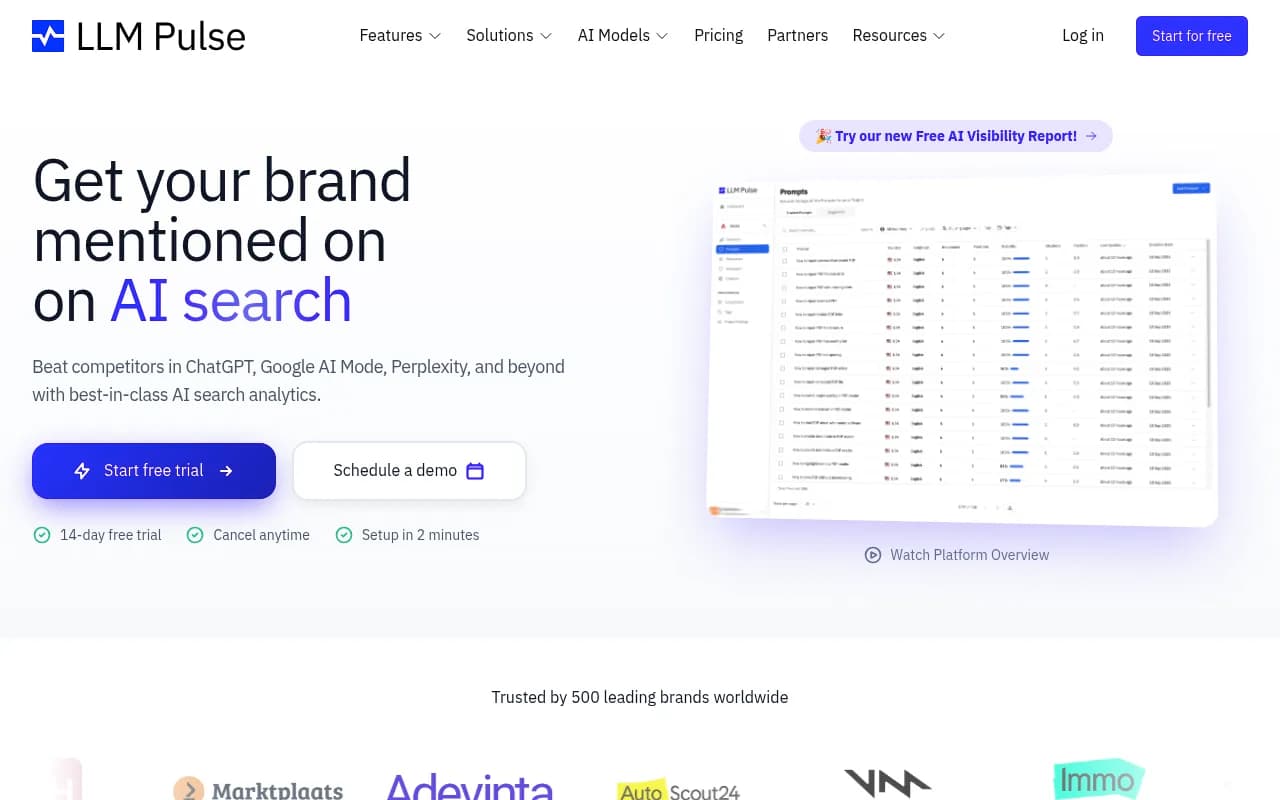
The interface is clean and the setup is fast. For a founder or small marketing team that has never tracked AI visibility before, LLM Pulse is a reasonable first step. You get a sense of your mention rate, can compare yourself against a competitor or two, and see which prompts you're winning or losing.
Where it falls short is depth. The prompt volume on entry-level plans is low enough that your data can be noisy. There's no content generation to help you fix gaps, no crawler logs to understand how AI models are reading your site, and no traffic attribution to connect visibility to actual revenue. It's a dashboard, not a workflow.
That's fine if you're just getting started and want to understand the concept. It's less fine if you're trying to move the needle.
Omnia
Omnia (useomnia.com) takes a slightly more polished approach to the same core problem: measuring your brand's presence in AI-generated answers.
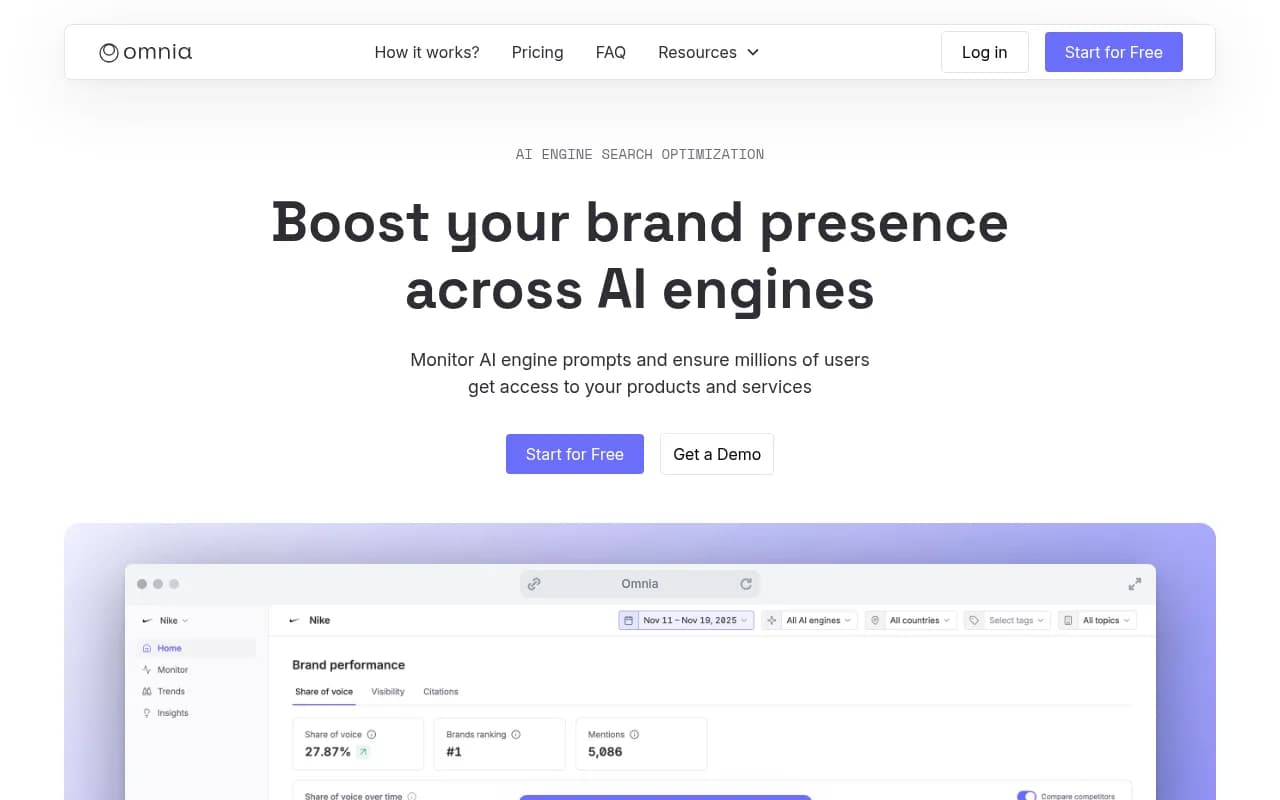
The focus is on brand presence specifically — how often your brand appears when AI models answer questions in your category. The dashboard is well-designed and easy to read, which makes it appealing for marketing teams that need to share data with stakeholders who aren't deep in the GEO weeds.
Omnia tracks across ChatGPT, Perplexity, and Claude, which covers the most important models for most brands. The reporting is clear. But like LLM Pulse, it's fundamentally a monitoring tool. There's no built-in guidance on what to do when your visibility is low, no content tools, and no way to close the loop between tracking and improvement.
For a brand team that needs to report on AI visibility to leadership and wants clean visuals to do it, Omnia is a reasonable pick. For a team that wants to actually improve their standing, it's only half the answer.
TrackMyBusiness
TrackMyBusiness takes a slightly different angle — it's aimed at small businesses that want to know what ChatGPT, Gemini, and Perplexity are saying about them specifically, not just whether they're being mentioned.
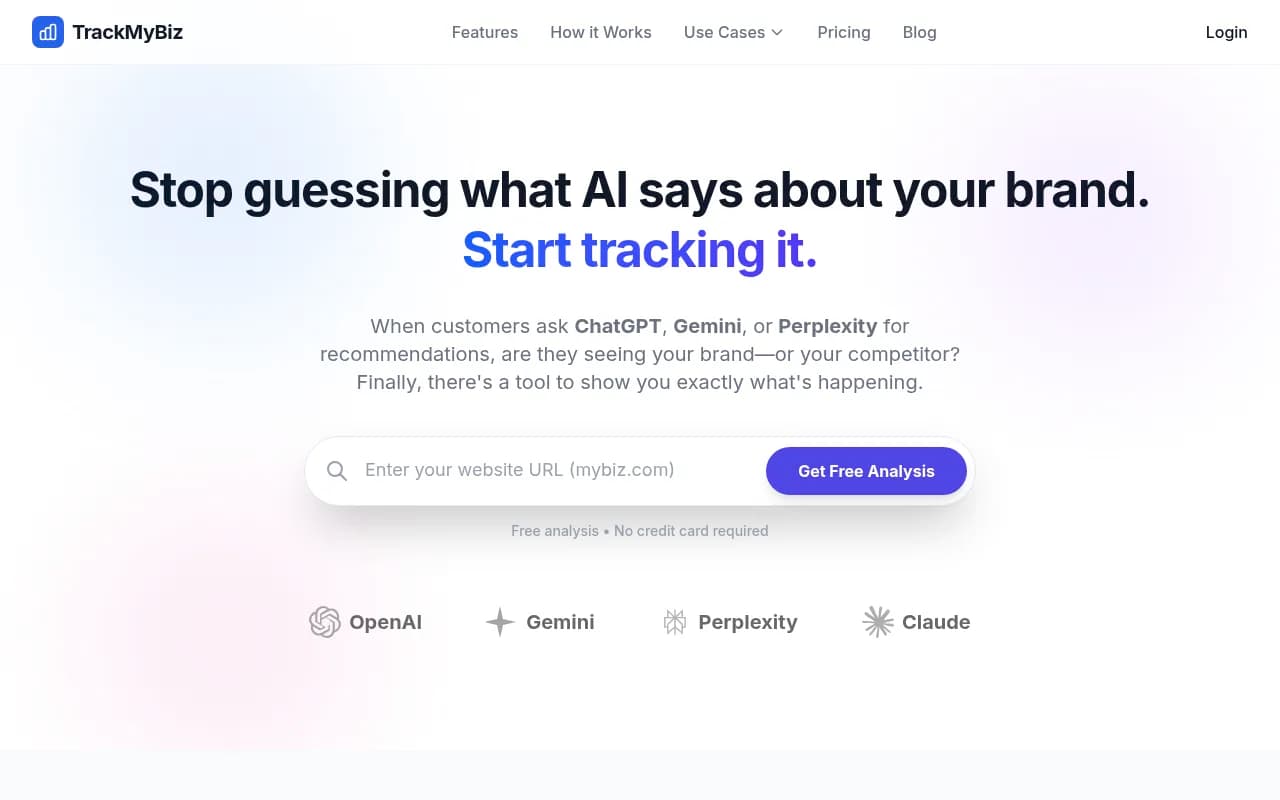
This is a meaningful distinction. A lot of AI visibility tools focus on brand mention rate, but TrackMyBusiness also surfaces the actual language models use when describing your business. That can be genuinely useful: you might discover that ChatGPT is describing your product incorrectly, or that Gemini is recommending you for use cases you don't actually serve.
The freemium entry point makes it accessible, and the setup is simple enough that a non-technical business owner can get started without help. But the limitations are similar to the other lightweight tools here: limited prompt volume, no content optimization, no crawler data, and no traffic attribution.
It's a good tool for a local business or early-stage startup that wants a basic pulse check on their AI presence. It's not a platform for teams trying to systematically grow their AI visibility.
Promptwatch
Promptwatch is the odd one out in this comparison — not because it's more expensive (the Essential plan starts at $99/month, which is competitive), but because it's built around a fundamentally different idea.
The other three tools answer the question "where do we stand?" Promptwatch answers that question and then asks "what are we going to do about it?"
The core workflow looks like this:
- You track your brand across 10+ AI models (ChatGPT, Claude, Perplexity, Gemini, Grok, DeepSeek, Copilot, Meta AI, Mistral, Google AI Overviews) with real prompt volume and difficulty scoring.
- The Answer Gap Analysis shows you exactly which prompts your competitors are winning that you're not — the specific topics and questions where AI models have nothing from your site to cite.
- The built-in AI writing agent generates articles, listicles, and comparisons grounded in 880M+ citations analyzed, designed to get cited by AI models rather than just rank in Google.
- AI Crawler Logs show you which pages ChatGPT, Claude, and Perplexity are actually reading on your site, how often they return, and what errors they're hitting.
- Traffic attribution (via code snippet, GSC integration, or server log analysis) connects your AI visibility to actual clicks and revenue.
That last part is worth pausing on. Most teams tracking AI visibility are doing it in a vacuum — they see their mention rate go up but can't connect it to anything in their business. Promptwatch's traffic attribution closes that loop.
The Essential plan ($99/month) covers 1 site, 50 prompts, and 5 AI-generated articles per month. The Professional plan ($249/month) adds crawler logs, city/state tracking, and 150 prompts across 2 sites. For small teams that are serious about AI search, the Essential plan is a reasonable starting point — and the upgrade path is clear.
How to choose
The honest answer depends on what stage you're at.
If you've never tracked AI visibility before and want to understand the basics without spending much, LLM Pulse or TrackMyBusiness are fine starting points. They're low-commitment, easy to set up, and will give you a rough sense of where you stand.
If you need clean reporting for stakeholders and your primary goal is visibility measurement rather than improvement, Omnia's dashboard is probably the most polished of the lightweight options.
If you're past the "what's our AI visibility?" question and into "how do we improve it?", none of the first three tools will get you there. Promptwatch is the only one in this group with content gap analysis, an AI writing agent, crawler logs, and traffic attribution. It's built for teams that want to treat AI search as a growth channel, not just a metric to report.
The table below summarizes the key decision factors:
| What you need | Best pick |
|---|---|
| Free or near-free basic tracking | LLM Pulse or TrackMyBusiness |
| Clean dashboards for stakeholder reporting | Omnia |
| Content gap analysis to find what's missing | Promptwatch |
| Built-in AI content generation | Promptwatch |
| Crawler logs to fix indexing issues | Promptwatch |
| Traffic attribution (visibility to revenue) | Promptwatch |
| Multi-model tracking (10+ AI engines) | Promptwatch |
| Reddit and YouTube citation tracking | Promptwatch |
A note on the broader market
These four tools represent a small slice of a rapidly growing category. There are now well over 100 platforms claiming to track AI visibility, ranging from free Chrome extensions to enterprise platforms with custom pricing.
The pattern that keeps emerging in practitioner communities is a frustration with tools that show you data but leave you stuck. Knowing your brand mention rate is 12% while your top competitor sits at 34% is useful information — but only if you know what to do next. Most lightweight tools don't answer that.
That's the gap Promptwatch is designed to fill. It's not the cheapest option in this comparison, but it's the only one that treats AI visibility as something you can actively improve rather than passively observe.
For small teams with limited time and budget, the practical question isn't "which tool gives me the most data?" It's "which tool helps me actually move the number?" On that question, the answer in this comparison is clear.
Bottom line
LLM Pulse, Omnia, and TrackMyBusiness are all legitimate tools for teams taking their first steps into AI visibility tracking. They're accessible, relatively affordable, and will give you a baseline understanding of where your brand stands.
But if your goal is to grow your AI search presence — to show up more often when your customers ask ChatGPT or Perplexity about your category — you need more than a dashboard. You need to know what content to create, have a way to create it, and be able to measure whether it worked.
That's what separates Promptwatch from the rest of this group. The $99/month Essential plan is a reasonable entry point for a small team that's ready to treat AI search as a real channel.