Key takeaways
- Nightwatch, Gauge, and Orchly are solid monitoring tools -- they show you where you stand in AI search, but largely leave you to figure out what to do next.
- Promptwatch is the only platform in this comparison that closes the full loop: find gaps, generate content, track results.
- For teams that need to act on data -- not just collect it -- Promptwatch's built-in content generation and answer gap analysis make a meaningful difference.
- Pricing varies widely: Gauge and Orchly are lighter on features and price, Nightwatch sits in the mid-range, and Promptwatch's $99/mo entry tier is competitive given what it includes.
- If you're a growing team with limited bandwidth, the question isn't just "what can I track?" -- it's "what can I actually fix?"
AI search is no longer a side project. ChatGPT, Perplexity, Claude, and Google AI Overviews are now primary research channels for B2B buyers, consumers, and anyone who used to type something into Google. If your brand isn't being cited in those responses, you're invisible to a growing chunk of your potential audience.
That's created a new category of software: AI visibility platforms. And like every emerging category, it's messy. There are dozens of tools, most of them built in the last 18 months, and they vary wildly in what they actually do. Some track mentions. Some track citations. Some claim to help you optimize. Very few do all three well.
This guide focuses on four tools that tend to come up together for mid-market teams: Nightwatch, Promptwatch, Gauge, and Orchly. They're not enterprise-only, they're not free toys, and they're all trying to solve roughly the same problem. But they solve it very differently.
What these tools are actually trying to do
Before comparing features, it's worth being clear about what "AI visibility" even means in 2026.
When someone asks ChatGPT "what's the best project management tool for remote teams?" -- your brand either appears in that answer or it doesn't. AI visibility platforms track those appearances. They let you define prompts (questions your target customers might ask), then run those prompts across AI models and record whether your brand is mentioned, cited, or recommended.
That's the monitoring layer. Where tools diverge is what happens next. Do they just show you a dashboard? Do they explain why you're not appearing? Do they help you create content that would change the answer?
The monitoring-only tools are useful for awareness. The optimization tools are useful for growth. Most teams need both.
Nightwatch
Nightwatch started as a traditional rank tracking tool and has since expanded into AI search monitoring. It's a reasonable choice if you're already using it for Google rank tracking and want to add AI visibility without switching platforms.
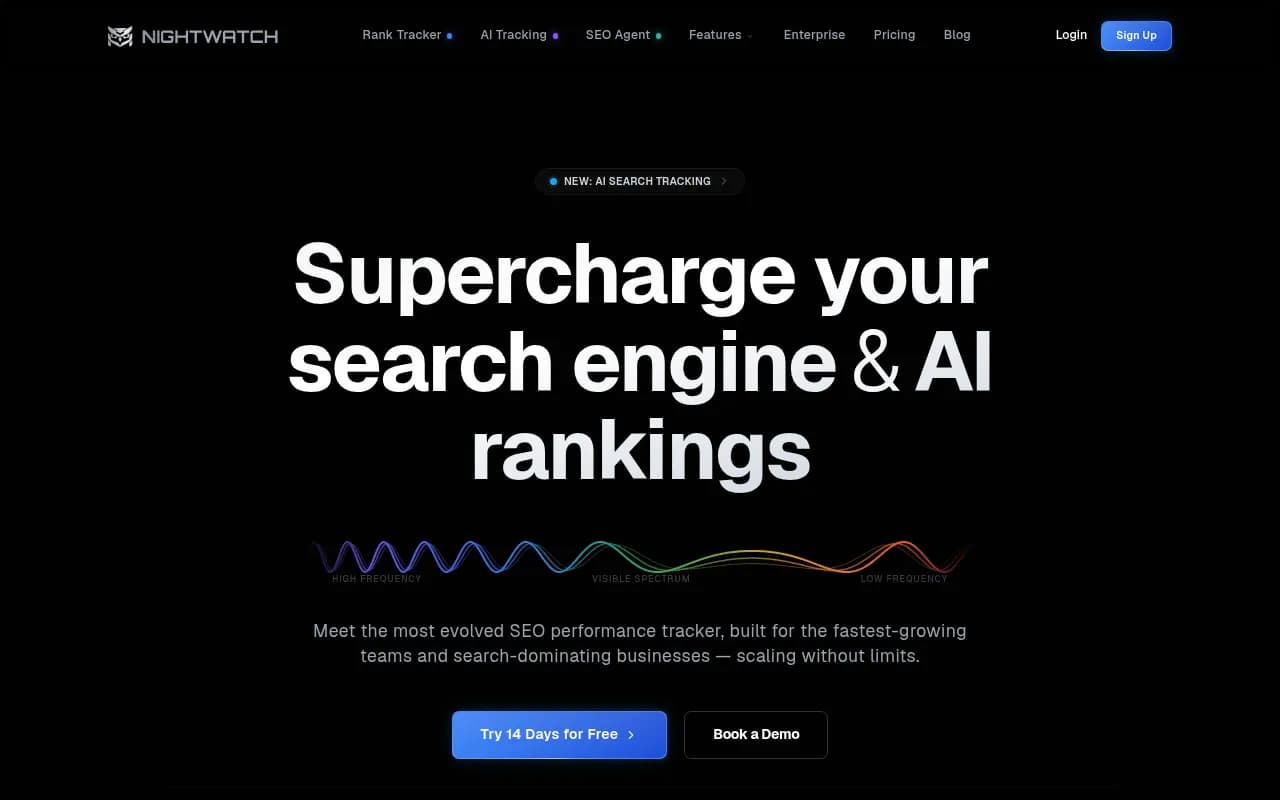
The AI monitoring side covers ChatGPT and Perplexity, with prompt tracking and brand mention detection. The interface is clean, reporting is solid, and the learning curve is low. For teams that are primarily SEO-focused and want AI visibility as a secondary layer, Nightwatch makes sense.
Where it falls short: there's no content gap analysis, no built-in content generation, and no crawler log monitoring. You can see that you're not appearing for a prompt, but you won't get much help understanding why or what to do about it. It's a tracker, not an optimizer.
Pricing sits in the mid-range. It's not the cheapest option here, but it's not trying to be enterprise software either.
Best for: Teams already using Nightwatch for traditional SEO who want to add basic AI visibility tracking without adding another platform.
Gauge
Gauge is a newer entrant focused specifically on AI search visibility. It tracks brand mentions across AI engines and gives you a visibility score you can monitor over time.
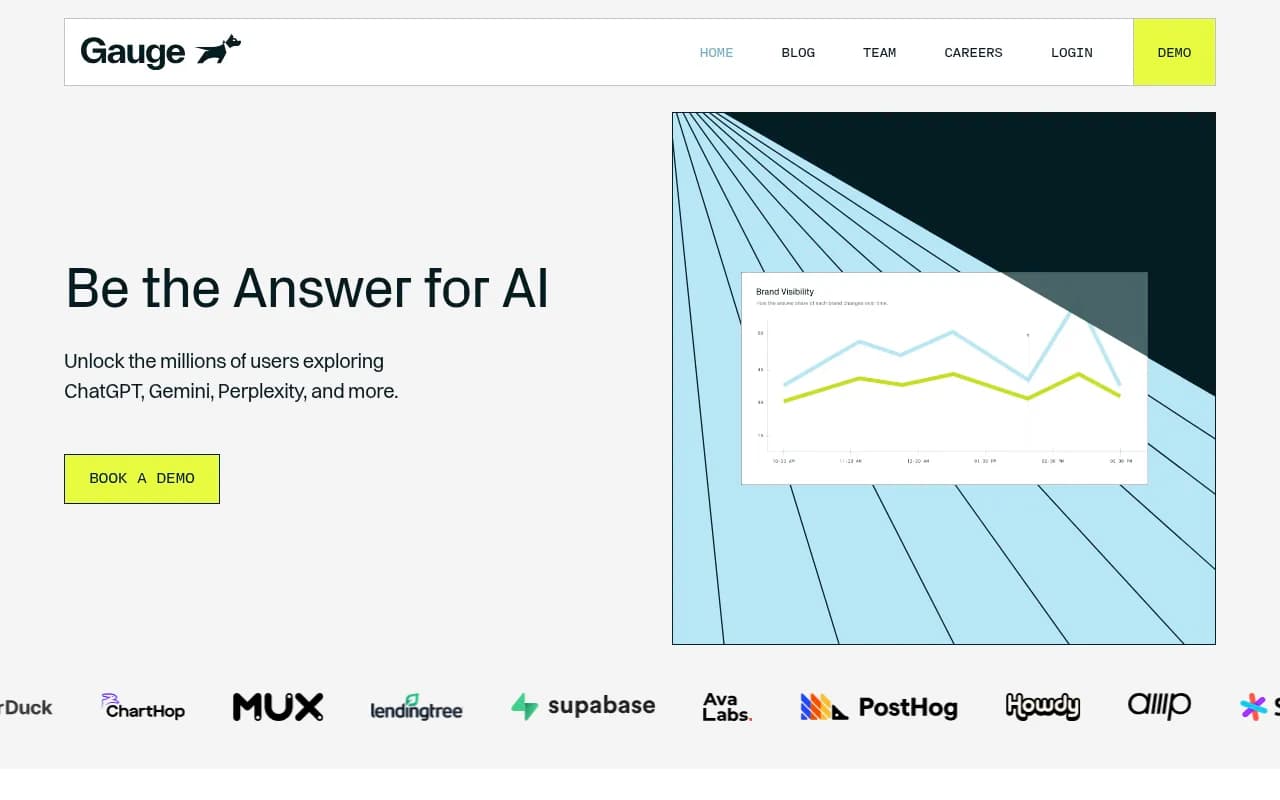
The pitch is simplicity: set up your brand, define your prompts, watch the numbers. For smaller teams or those just starting to think about AI visibility, that simplicity has real value. You don't need to spend a week configuring the tool before you get useful data.
The trade-off is depth. Gauge doesn't offer content generation, detailed competitor analysis, or crawler monitoring. It's a clean monitoring dashboard, and it does that job well. But if you're trying to move the needle -- not just measure it -- you'll hit the ceiling quickly.
Pricing is on the lighter end, which makes it accessible for teams that want to start tracking before committing to a full platform.
Best for: Teams in the early stages of AI visibility who want simple, affordable monitoring to establish a baseline.
Orchly
Orchly positions itself as an AI SEO automation and visibility tracking tool, with a focus on content operations for marketing teams. It's one of the few tools in this comparison that tries to bridge monitoring and content workflow.
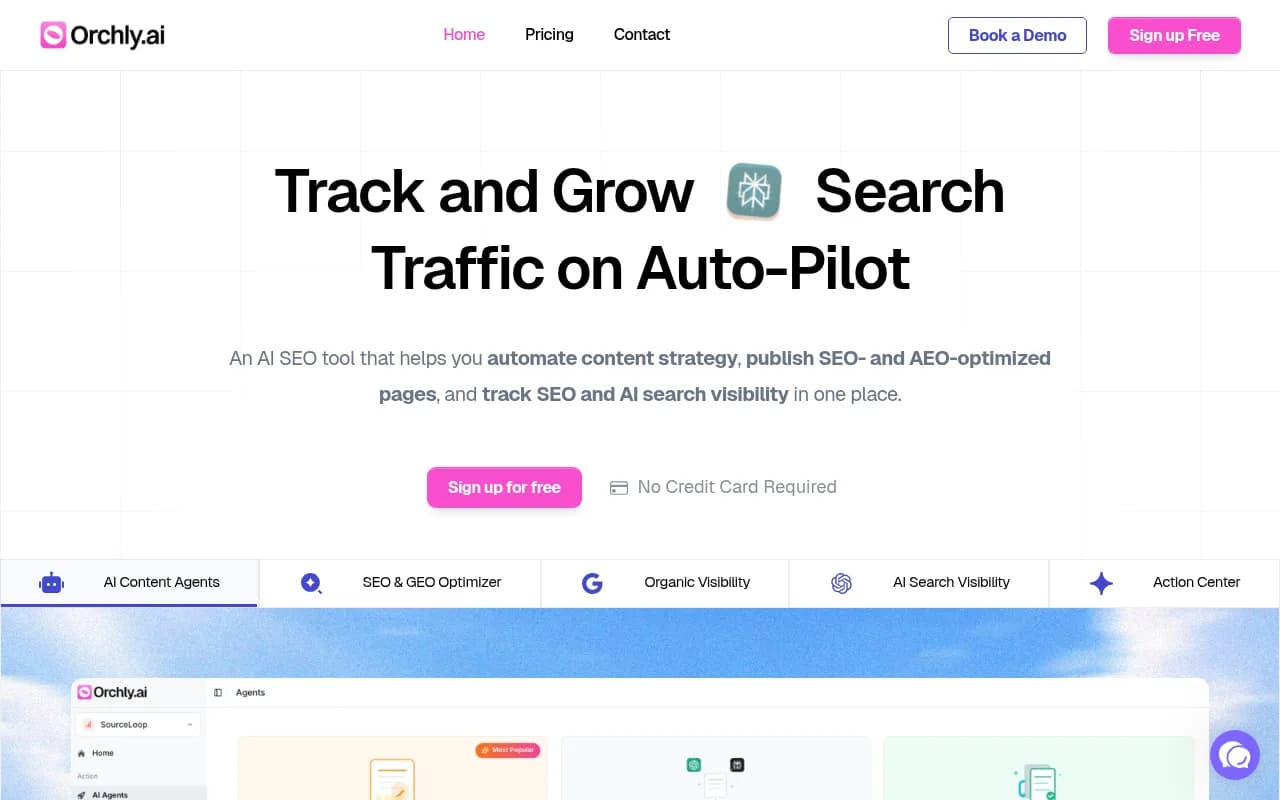
The visibility tracking covers multiple AI platforms, and there's some automation built in for content operations. For teams that are running high content volume and need to connect AI visibility data to their publishing workflow, Orchly is worth a look.
That said, the platform is still maturing. The depth of citation analysis and prompt intelligence doesn't match what more established platforms offer. And the content generation capabilities, while present, aren't as tightly integrated with actual citation data as you'd want for a serious optimization workflow.
Best for: Content-heavy marketing teams that want AI visibility data connected to their content operations, and are willing to work with a platform that's still developing.
Promptwatch
Promptwatch is the most fully-featured platform in this comparison, and the one most clearly built around the idea that monitoring alone isn't enough.
Promptwatch tracks visibility across 10 AI models -- ChatGPT, Perplexity, Claude, Gemini, Google AI Overviews, Grok, DeepSeek, Copilot, Meta AI, and Mistral. That's a broader model coverage than any of the other tools here.

But the real differentiator is what happens after you see the data. The Answer Gap Analysis shows you exactly which prompts your competitors are appearing for that you're not -- and more importantly, what content your site is missing that would change that. It's not just "you're invisible for this prompt." It's "here's the specific topic gap that's causing it."
From there, the built-in AI writing agent generates content grounded in real citation data. Promptwatch has processed over 880 million citations, so when it generates an article or listicle, it's working from actual data about what AI models cite -- not generic SEO templates. The content is engineered to get picked up by ChatGPT, Perplexity, and other models.
Then you track results. Page-level tracking shows which specific pages are being cited, how often, and by which models. Traffic attribution (via code snippet, Google Search Console integration, or server log analysis) connects visibility to actual revenue.
A few other capabilities worth noting:
- AI crawler logs show you in real time which AI crawlers (ChatGPT, Claude, Perplexity) are hitting your site, which pages they're reading, and any errors they're encountering. Most competitors don't offer this at all.
- Prompt intelligence includes volume estimates and difficulty scores, so you can prioritize high-value prompts instead of guessing.
- Reddit and YouTube tracking surfaces discussions that directly influence AI recommendations -- a channel most tools ignore entirely.
- ChatGPT Shopping tracking monitors when your brand appears in product recommendations and shopping carousels.
Pricing starts at $99/month for the Essential plan (1 site, 50 prompts, 5 articles), $249/month for Professional (2 sites, 150 prompts, 15 articles, crawler logs), and $579/month for Business (5 sites, 350 prompts, 30 articles). There's a free trial available.
Best for: Growing teams that need to move from tracking to actually improving their AI visibility -- and want one platform to do both.
Feature comparison
| Feature | Nightwatch | Gauge | Orchly | Promptwatch |
|---|---|---|---|---|
| AI model coverage | ChatGPT, Perplexity | Multiple | Multiple | 10 models |
| Brand mention tracking | Yes | Yes | Yes | Yes |
| Competitor benchmarking | Basic | Basic | Basic | Yes (heatmaps) |
| Answer gap analysis | No | No | No | Yes |
| Built-in content generation | No | No | Partial | Yes |
| AI crawler logs | No | No | No | Yes |
| Prompt volume/difficulty scores | No | No | No | Yes |
| Reddit/YouTube tracking | No | No | No | Yes |
| ChatGPT Shopping tracking | No | No | No | Yes |
| Traffic attribution | No | No | No | Yes |
| Entry-level pricing | Mid-range | Low | Low-mid | $99/mo |
| Free trial | Yes | Yes | Yes | Yes |
How to choose
The honest answer is that the right tool depends on where you are in your AI visibility journey.
If you're just starting out and want to establish a baseline without a big commitment, Gauge is a reasonable entry point. It's simple, affordable, and will tell you whether you're showing up in AI search.
If you're already using Nightwatch for traditional SEO and want to add AI monitoring without switching tools, the expanded Nightwatch feature set is a logical next step. You won't get optimization capabilities, but you'll get visibility data in a familiar interface.
If you're running a content-heavy operation and want AI visibility data connected to your publishing workflow, Orchly is worth evaluating -- with the caveat that it's still maturing.
If you need to actually move the needle -- if you want to understand why you're not appearing, create content that changes that, and track whether it worked -- Promptwatch is the only platform in this group that supports the full cycle. The Answer Gap Analysis alone is worth the price for teams that are serious about AI search as a growth channel.
The monitoring-only tools will tell you that you have a problem. Promptwatch helps you fix it.
A note on what "mid-market" actually means here
All four tools are positioned for teams that aren't Fortune 500 enterprises but aren't solo bloggers either. The sweet spot is marketing teams of 3-20 people, agencies managing multiple clients, and B2B companies where AI search visibility is becoming a real pipeline concern.
For that audience, the key constraint usually isn't budget -- it's bandwidth. A team of five marketers doesn't have time to pull data from a monitoring tool, manually analyze gaps, brief a writer, and then track results across four spreadsheets. That's why the "action loop" matters more than any individual feature. The tools that compress that workflow -- from gap identification to content creation to result tracking -- are the ones that actually get used.
That's the real argument for Promptwatch in a mid-market context. It's not just that it has more features. It's that the features are connected in a way that makes the workflow manageable for a small team.
Bottom line
Four tools, four different bets on what "AI visibility" means.
Nightwatch bets that you want AI monitoring layered onto traditional SEO. Gauge bets that simplicity wins. Orchly bets that content operations integration is the missing piece. Promptwatch bets that monitoring without optimization is only half the job.
For most growing teams in 2026, that last bet is the right one. AI search isn't slowing down, and the gap between brands that appear in AI responses and those that don't is widening. Knowing you have a gap is the first step. Closing it is the point.