Key takeaways
- GitHub is the most cited domain in ChatGPT answers to software prompts, but it earns only 1.2% of those citations. Your repo competes with docs sites, vendor pages, and review sites for the same answer slots.
- Models learn about your project from training data and from live web search. You need a good README and also crawlable docs, third-party mentions, and consistent descriptions across the web.
- Measure before you change anything. Run a fixed set of prompts, record whether your repo is named and cited, and repeat monthly.
- Open-source trackers like Elmo and Canonry are free to self-host, but you pay for LLM API calls and they mostly report rather than fix.
- Check robots.txt, CDN and WAF rules. If AI crawlers can't read your docs site, nothing else you do matters much.
Why maintainers should care about AI recommendations
Developers increasingly start with a question instead of a search: "What's a good Python library for X?" or "Which self-hosted tool replaces Y?" The model answers with two to five names. If yours isn't one of them, a prospective user never sees your star count.
This is different from classic SEO in a few ways. There is no page one of ten blue links, only a short list. The list can differ between ChatGPT and Claude. And the answer depends on two separate knowledge sources: what the model absorbed during training, and what it fetches at answer time.
I should be upfront about something. I didn't find solid research on repo-specific tactics, such as how much README structure or an llms.txt file moves the needle. What follows combines measured data on what AI engines cite for software prompts with sensible practice. Treat the tactics as hypotheses to test, not guarantees.
How ChatGPT and Claude decide what to recommend
Training data versus live retrieval
ChatGPT can browse the web for real-time answers. Claude is trained on web data and focuses on carefully reasoned responses. In both cases, two things are happening:
- Parametric knowledge: what the model "remembers" about your project from training. This changes slowly, and you can't edit it directly.
- Retrieval: pages fetched at answer time. This is where you can move quickly, because a new docs page can get cited within days.
For a young or niche repo, retrieval is your main lever. For an established project, you also want the training-era descriptions of you to be accurate, which means consistent descriptions across many sources.
What the citation data says about software prompts
Promptwatch Data looked at which sites ChatGPT cites for organic software prompts between Sep 28 and Oct 4, 2026. In that ChatGPT software citation report, GitHub was the most cited domain at 1.2% of all software citations. Microsoft Learn followed at 0.98%, then G2 (0.73%), AWS docs (0.41%), Google Cloud docs (0.35%), Gartner (0.34%) and Capterra (0.32%).
By source type, the pattern is clearer:
| Source type | Share of software citations |
|---|---|
| Docs and help centers | 2.64% |
| Vendor sites | 2.01% |
| Review sites and analysts | 1.57% |
| GitHub | 1.2% |
| App stores | 0.47% |
These are shares of all software citations, not just the listed domains, so the absolute numbers look small. The relative picture is what matters. Documentation and vendor pages together earn about three times what review sites and analysts do. A repo with a thin README and no docs site is leaving the biggest category on the table.
One more data point: almost half of ChatGPT responses cite 10 or more unique domains. That means answers draw on many sources, and a project mentioned across several independent pages has more chances to appear than one that exists only on its own repo.
Make your project readable to AI crawlers first
Check access before writing anything
This is the boring step that most maintainers skip. If your docs site blocks AI crawlers, through robots.txt, a CDN rule, or a WAF, retrieval can't see you.
Promptwatch's AI crawler traffic report (Jun 8 to Sep 6, 2026, IP-verified requests only) found OpenAI accounted for 79.8% of verified AI crawler requests in the week of Aug 31 to Sep 6, down from 94.8% in mid-June. Other providers are growing their share. The practical advice from that report: check rules for every provider, compare your logs to that mix, and separate training bots from answer-time fetchers. If a big provider shows near zero in your logs, you are probably blocked.
You can check this for free. The AI crawler URL inspector and the Robots.txt generator for AI cover the basics, and the AI bots directory lists 400+ crawlers with robots.txt guidance.
Keep content in plain HTML
If your docs are a client-rendered single-page app, crawlers that don't execute JavaScript see an empty shell. Server-render or prerender your docs. Prerendering services such as [tool:prerender-io] exist for this exact problem.
Markdown files, for what it's worth, make up just 0.05% of AI search citations according to Promptwatch's markdown data. Markdown serves AI agents, not AI search. A raw .md file in your repo is fine as source, but the rendered docs page is what gets cited.
What to publish so a model has something to cite
A README that states what the project is
Write the first paragraph as if a model will quote it verbatim, because it might. Say what the project does, who it is for, what language or platform it targets, and what it replaces. "X is an MIT-licensed Rust library for parsing Y, an alternative to Z" is far more useful than a tagline.
A few habits that help:
- Use the same name and one-line description everywhere: repo, docs, package registry, social profiles.
- State the license, supported versions and install command near the top.
- Include a short comparison section naming real alternatives. Models answering "X vs Y" prompts look for exactly this.
A docs site with real pages
Docs and help centers are the largest cited source type for software prompts. Build pages around the questions people actually ask: install, migrate from the alternative, common errors, performance, security. Each page should answer one question completely.
Query fan-outs are worth understanding here. When ChatGPT answers a prompt it runs several web searches behind the scenes. Promptwatch's query fanout data tracks how many it triggers, and the free ChatGPT query fan-out generator lets you see the likely sub-queries for a prompt. Write pages that match those sub-queries.
Comparison and landing pages
Product and landing pages are the most cited content type in ChatGPT, at 22.4% of citations between Sep 28 and Oct 4, 2026. For an open-source project, the equivalent is a clear project homepage that says what it is, plus honest "X vs Y" pages. These also age well: in Promptwatch's content half-life study, landing pages and docs stayed cited longest while news lost half its pages within 36 days. Evergreen beats announcement posts.
Third-party mentions
Because answers cite many domains, being named elsewhere matters. Useful places for a software project:
- Package registries (npm, PyPI, crates.io) with complete descriptions
- Awesome lists and curated GitHub lists
- Review and directory sites like G2 and Capterra, if your project has a commercial side. Promptwatch's report recommends keeping those profiles complete and current.
- Conference talks, podcasts, and technical blog posts by other people
A caution on Reddit: its share of ChatGPT citations fell from about 4% to 0.5% on August 14, 2026. Don't build a strategy around threads. Social platforms overall gave ChatGPT only 0.46% of its citations in late September, versus 12.2% for Google AI Overviews, per the social media citations report. If Google AI Overviews matter to you, community posts still count there.
Measure whether it works
Start with a fixed prompt set
Write 20 to 50 prompts a developer would ask. Mix three types: category prompts ("best open-source X"), comparison prompts ("X vs Y"), and branded prompts ("what is X?"). Run them in ChatGPT and Claude, and note whether you're named, in what position, and which sources are cited. Repeat monthly. Results vary between runs, so look at trends over many prompts, not single answers.
Open-source trackers you can self-host
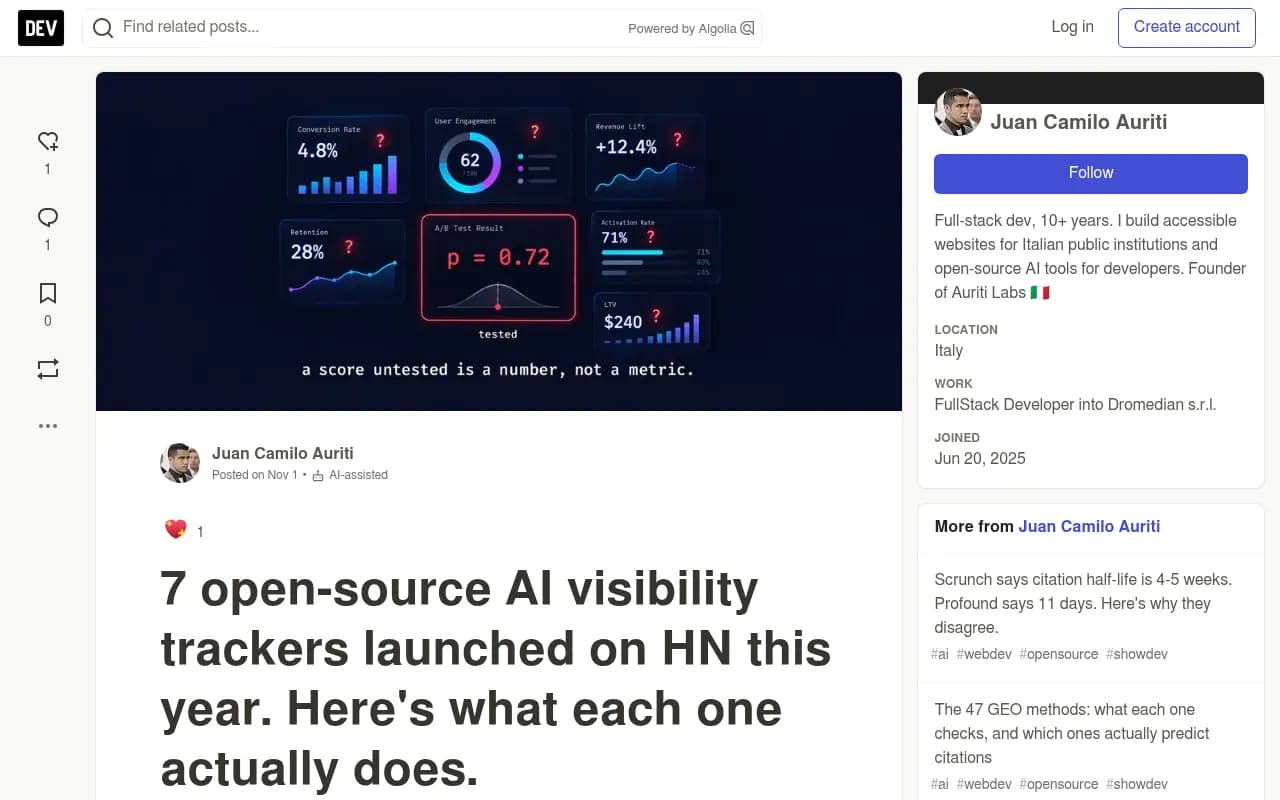
If you want to stay in the open-source world, several trackers launched in 2026. The summary below comes from a DEV Community roundup of seven trackers and the Elmo directory.
| Project | License / form | Engines covered | Notable gap |
|---|---|---|---|
| Elmo | MIT, self-hosted | 9+ engines incl. ChatGPT, Claude, Gemini, Perplexity | No site audit |
| Canonry | CLI, SQLite, YAML config | ChatGPT, Gemini, Claude | No fix recommendations |
| Auto-geo | npm/brew CLI | ChatGPT, Claude, Gemini, Perplexity, Grok | Lighter audit than a full crawl |
| Lettertrace | MIT, BYOK library | Your own LLM harness | A library, not a platform |
| Ansvisor | Open source | ChatGPT, Gemini, Perplexity, Claude, Copilot, AI Overviews, AI Mode | Check current docs |
The real cost is API usage. The roundup estimates $5 to $15 per week for 50 prompts across nine engines with Elmo, depending on models. "Free to self-host" is not free to run, and you maintain the infrastructure.
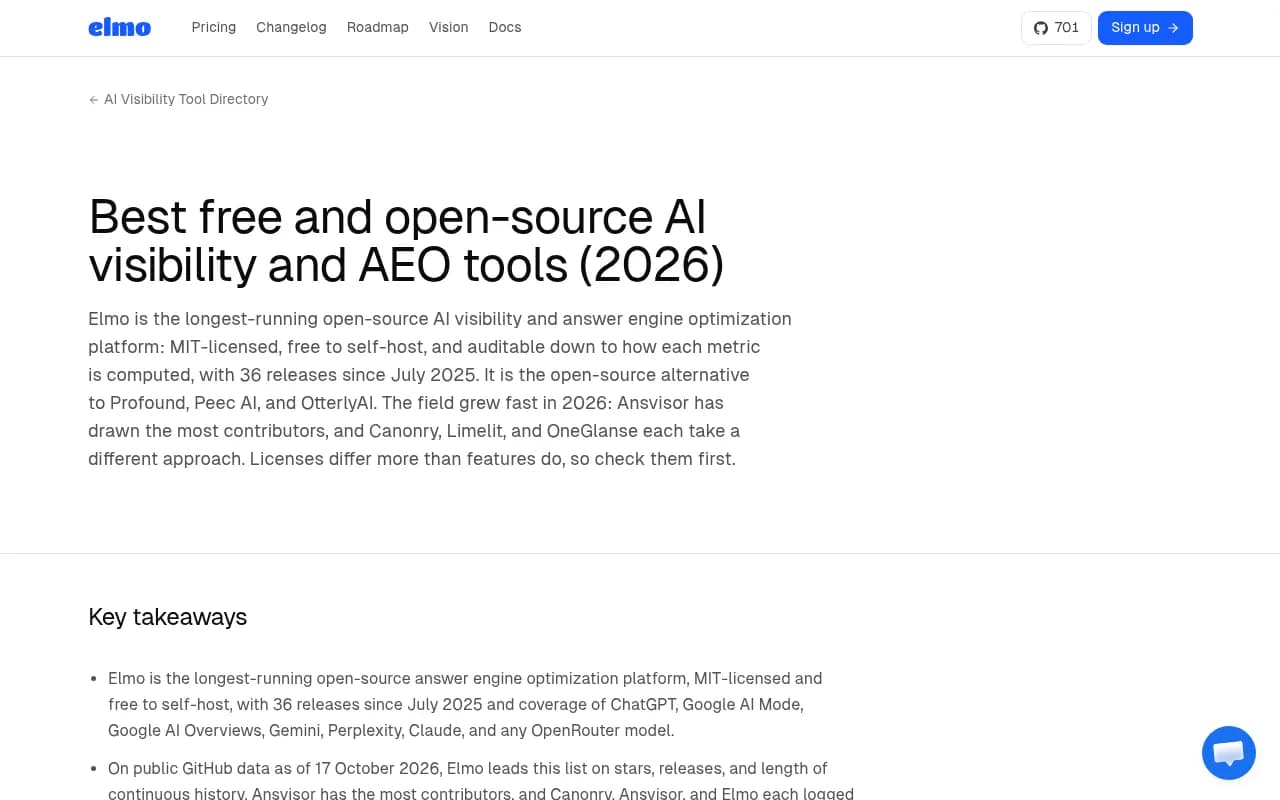
Licenses vary, so read them. According to the Elmo directory, Elmo, Ansvisor, Canonry and OneGlanse are MIT, Limelit is Apache-2.0, and Cited (AGPL-3.0) and Gego (GPL-3.0) add conditions on modified versions. That page also notes a project can go closed: Notra took its AGPL repository private in October 2026.
A warning about simulated scores
The repo sharozdawa/ai-visibility shows up in searches for this topic and offers an MCP server with a recommendations tool. Its commit history describes a "realistic simulation with seeded RNG, platform biases". I haven't read the code, but that wording suggests the scores may be simulated rather than pulled from real AI answers. Verify before trusting any number from it. Any tracker you use should query the actual models, ideally through the real user interfaces, since API outputs can differ from what a user sees.
When a hosted platform makes sense
Self-hosted trackers tell you what's happening. They mostly don't tell you why, or fix it. If you're maintaining a commercial open-source company, or tracking visibility for several products, a hosted platform can save time. Promptwatch tracks how ChatGPT, Claude, Gemini, Perplexity and Google's AI surfaces mention and cite you, shows which pages get cited, and logs AI crawler visits so you can tell an access problem from a content problem. It also includes coding agent visibility for Codex, Claude Code and OpenCode, which matters when developers ask those tools to pick a library.

The 7-day free trial and the free AI visibility report are the low-commitment starting points. Check pricing for current plans.
Other trackers in the same space include [tool:otterly-ai], [tool:peec-ai] and [tool:profound], and the GEO software directory lists more.
Otterly.AI


Profound

A 30-day plan for one repo
- Week 1: audit access. Check robots.txt, CDN rules and rendering for your docs site. Fix blocks. Write your 20 to 50 prompt list and record a baseline.
- Week 2: rewrite the README opening and project homepage. Add install, license, supported versions and a comparison table naming alternatives.
- Week 3: publish three docs pages that answer the questions in your fan-out list, plus one honest "X vs Y" page.
- Week 4: fill out package registry descriptions, submit to relevant curated lists, and ask users who've written about you to link the docs site. Re-run the prompt set.
Expect noise. A single week of data tells you little, and models update frequently. ChatGPT's citation behavior shifted noticeably around the GPT-5.3 rollout in March 2026, when average citations per response dropped. Your baseline can move without you doing anything.
Common mistakes
- Treating stars as the goal. Stars help humans, and no evidence I found shows models weighting them directly.
- Blocking all bots by default after a scraping scare, then wondering why you vanish from answers.
- Describing the project differently on GitHub, npm and your site, which splits the signal.
- Chasing one-off hacks. A hidden prompt in a README aimed at models is the kind of trick that gets filtered and damages trust.
- Trusting a single answer. Run each prompt several times.
What to do this week
Pull your docs site's access logs or run the crawler inspector, and confirm that at least the major AI crawlers can fetch your homepage and docs. Then write down 20 prompts and run them. That baseline costs an afternoon and tells you whether your problem is access, content or reputation.