Key takeaways
- Most serious AI visibility vendors now ship an MCP server, so the question is no longer who has one. It is how many tools it exposes, whether it can write, how it authenticates, and what the request quota is.
- Peec AI, Geoptie, and ZeroRank AI are the cheapest ways in on paper. Quota and plan gating matter more than sticker price.
- Promptwatch is the one on this list that goes past monitoring: its hosted MCP server has 110+ read and write tools and sits on top of crawler logs, content generation, and CMS publishing.
- OAuth servers suit marketers working in a chat window. API-key servers suit people working in Claude Code, Cursor, or Codex.
- Treat write tools carefully. Scope keys to read-only first and widen later.
Why developer-focused marketing teams care about MCP
If your marketing team ships code, or sits next to people who do, a dashboard is the slowest way to look at AI visibility data. You want to ask your assistant "which prompts did we lose this week to competitors?" and get a table. Then you want it to open a pull request that fixes the page.
That is what the Model Context Protocol buys you. A tool with an MCP server lets Claude, ChatGPT, Gemini, or Cursor read its data and take actions inside it. For AI visibility, that means pulling citation data into the same session where you edit content, check crawler errors, or draft a brief.
There is a caveat before we go further. Most of the pricing and tool-count numbers below come from a single vendor-written comparison, Geoptie's "8 Best AI Visibility Tools with API and MCP Access" (which checked pricing pages and docs in October 2026). Geoptie ranks itself first, so take the ordering with salt. I have used its numbers because they are the most specific available, but verify everything on each vendor's own pricing and docs page before you buy.
One claim I deliberately left out: a competing roundup says one tool is "the only tool in the category that works natively inside AI coding environments." That is not true. Several tools below connect to Claude Code, Cursor, and Codex.
What to check before you pick an MCP-enabled tool
Five questions separate a useful MCP server from a checkbox feature.
- Which plan includes it? Some vendors put MCP on every plan. Others reserve it for enterprise or agency tiers.
- Read only, or read and write? Write tools let an assistant add prompts, edit tags, or run audits. Useful, and also a way to wreck a workspace by accident.
- How does it authenticate? OAuth is easy to add in ChatGPT or Claude connector settings. API keys work better in Claude Code, Cursor, or Codex.
- What is the quota? A plan that allows 2,000 MCP requests per month runs out fast if an agent loops through client dashboards.
- What is behind the data? Some tools query models through APIs. Others collect from the real interfaces of the AI platforms. Answers and citations can differ between the two.
The last one is easy to overlook. If your assistant is reasoning over data that does not match what users actually see in ChatGPT or AI Overviews, the clever agent workflow is built on sand.
Comparison table: MCP access by tool
Figures below are from the Geoptie comparison unless noted. Confirm on each vendor's site.
| Tool | MCP from | API from | Auth | Tool count / limits |
|---|---|---|---|---|
| Promptwatch | Essential, $95/mo | Every plan | OAuth or API key | 110+ read and write tools, 500 to 50,000 requests/hour by plan |
| Geoptie | $99/mo | $99/mo | API key in header | 24 read + 24 write, 120 req/min, no monthly cap |
| ZeroRank AI | $39/mo | $39/mo | OAuth (MCP), bearer key (REST) | Read/write, 60 req/min on Starter, scopable keys |
| Peec AI | $95/mo | Enterprise only | OAuth or personal token | 51 read + 48 write, API 200 req/min per project |
| Otterly AI | $189/mo | $189/mo | OAuth only | 31 read + 15 write, 2,000 MCP requests/month on Standard |
| SE Ranking | $129/mo | $129/mo | OAuth or API key | 180+ tools across SEO and AI search, credit-based |
| Ahrefs Brand Radar | $129/mo | $129/mo | Hosted connector | 200,000 API units/month on Lite, shared with API |
| Profound | Enterprise | Enterprise | OAuth or API key | About 60 tools, 600 req/hour per key |
| Scrunch | $500/mo | $500/mo | OAuth | 51 tools, up to 1,000 records per request |
Promptwatch: the one that closes the loop
Promptwatch is the option I would put first for a developer-leaning team, and not because the MCP server is the biggest number in the table, though 110+ tools is large. It is because the MCP server is attached to a platform that does more than report.

Promptwatch tracks ChatGPT, Gemini, Claude, Perplexity, Google AI Overviews, Google AI Mode, Copilot, and others from their real user interfaces, per country and language. Then it traces where answers come from: which of your pages get cited, which Reddit threads and YouTube videos AI leans on, and, through IP-verified AI crawler logs, whether bots can even read your pages. That crawler layer is the part most MCP-enabled competitors simply do not have, and for a technical team it is often where the real problem lives.
The MCP server works with Claude, Claude Code, ChatGPT, Cursor, Lovable, Codex, and any MCP client, with one-click OAuth or an API key. It has read and write tools, and publishing is available through the REST API and MCP too. In practice that means a session like this is possible: ask the assistant for citation gaps, have it queue content through the Content Agent, push a draft to WordPress, Webflow, or Framer, then check later whether crawlers visited and AI cited the page. The case study on TreeHouse automated weekly reporting through the Promptwatch MCP while growing AI search to roughly 25% of organic conversions.
A few other things that matter to technical teams:
- Scoped project, organization, and read-only API keys, plus an audit log (Business and above) that records whether a change came from the dashboard, the API, an MCP client, or Agent Chat.
- Tracking of coding agents (Codex, Claude Code, OpenCode), which is relevant if you sell developer tools or APIs and want to know what those agents recommend.
- ISO/IEC 27001 certification and GDPR compliance, which helps when security reviews the MCP connection.
Pricing is $95/mo for Essential, $245/mo for Professional, and $579/mo for Business, with a 7-day free trial on monthly billing. Confirm on promptwatch.com/pricing. The Content Agent and faster-than-daily tracking start at Business, so budget accordingly if you want the full write-and-publish loop. API docs are at promptwatch.com/docs. You can also run the free AI visibility report first to see whether the problem is worth solving.
If you are weighing it against a monitoring-only tool, the Promptwatch vs Peec and Promptwatch vs Profound pages go through the differences.
Peec AI: cheapest MCP on every plan
Peec AI puts an MCP server on every plan from $95. Its server is one of the larger ones in the group, with 51 read and 48 write tools covering prompts, tags, competitors, and reports. Peec is known for multilingual tracking and sentiment.

The catch is API access. According to the Geoptie comparison, the REST API is Enterprise only, so if your engineers want to pipe data into a warehouse, you will be pushed up a tier. It also stops at monitoring: no crawler logs, no visitor analytics, no content generation. For a team that mainly wants to query data through an assistant, it is a good fit.
Geoptie: flat pricing, generous quota
Geoptie's pitch is simple. The $99 Professional plan includes the REST API and a 48-tool MCP server (24 read, 24 write), at 120 requests per minute per key with no monthly cap. The Business plan is $249 with 300 prompts and unlimited brands, and all plans have unlimited seats.
No monthly cap is a real advantage for agencies syncing many clients. Remember that this is the vendor behind the comparison I am drawing numbers from, so check its claims against its docs. It also has no free trial, and the $49 Starter plan has neither API nor MCP.
ZeroRank AI: lowest entry price
ZeroRank AI lists MCP and API from $39/month and covers 17 platforms, including Grok and DeepSeek. It uses OAuth for MCP and a bearer key for REST, and keys can be scoped read-only or read/write. The Starter limit is 60 requests per minute.
The low price makes it attractive for a team experimenting with agent workflows. I would want to confirm data collection methods and support before trusting it for client reporting. ZeroRank is not in our catalog, so I cannot point you to a review here.
Otterly AI: write tools, tight quota
Otterly's MCP server adds write tools for prompts, tags, reports, and audits (31 read, 15 write), and connects through OAuth only. The Standard plan at $189 allows 2,000 API requests and 2,000 MCP requests per month.
Otterly.AI

That is the quota trap Geoptie warns about. An agent that polls a dozen client dashboards will chew through 2,000 requests quickly. OAuth-only also means it is easier in a chat window than in Cursor or Codex.
Ahrefs Brand Radar and SE Ranking: SEO suites with MCP
If you already pay for an SEO suite, the MCP server may come bundled.
Ahrefs Brand Radar uses a hosted connector with Brand Radar and SEO tool groups. The Lite tier includes 200,000 API units per month, shared with the API. Pricing is metered, so the cost of a call depends on how much data it returns.
SE Ranking has 180+ tools across SEO and AI search, credit-based, with 25,000 API credits per month on the Core plan.
Both are sensible if you want classic SEO and AI data in one assistant session. The tradeoff is that AI-specific depth, like crawler logs or per-response citation analysis, tends to be shallower than in dedicated platforms.
Profound and Scrunch: enterprise-gated
Profound has the widest engine coverage in the Geoptie table, including Claude, DeepSeek, and Exa Search, with about 60 MCP tools and a 600 requests per hour limit per key. But MCP and API are Enterprise-only.
Profound

Scrunch has an OAuth MCP server with 51 tools, starting around $500/month per the same source. Responses return up to 1,000 records per request.
Both are strong monitoring products. If you need MCP now and do not want a sales call, they are harder to justify.
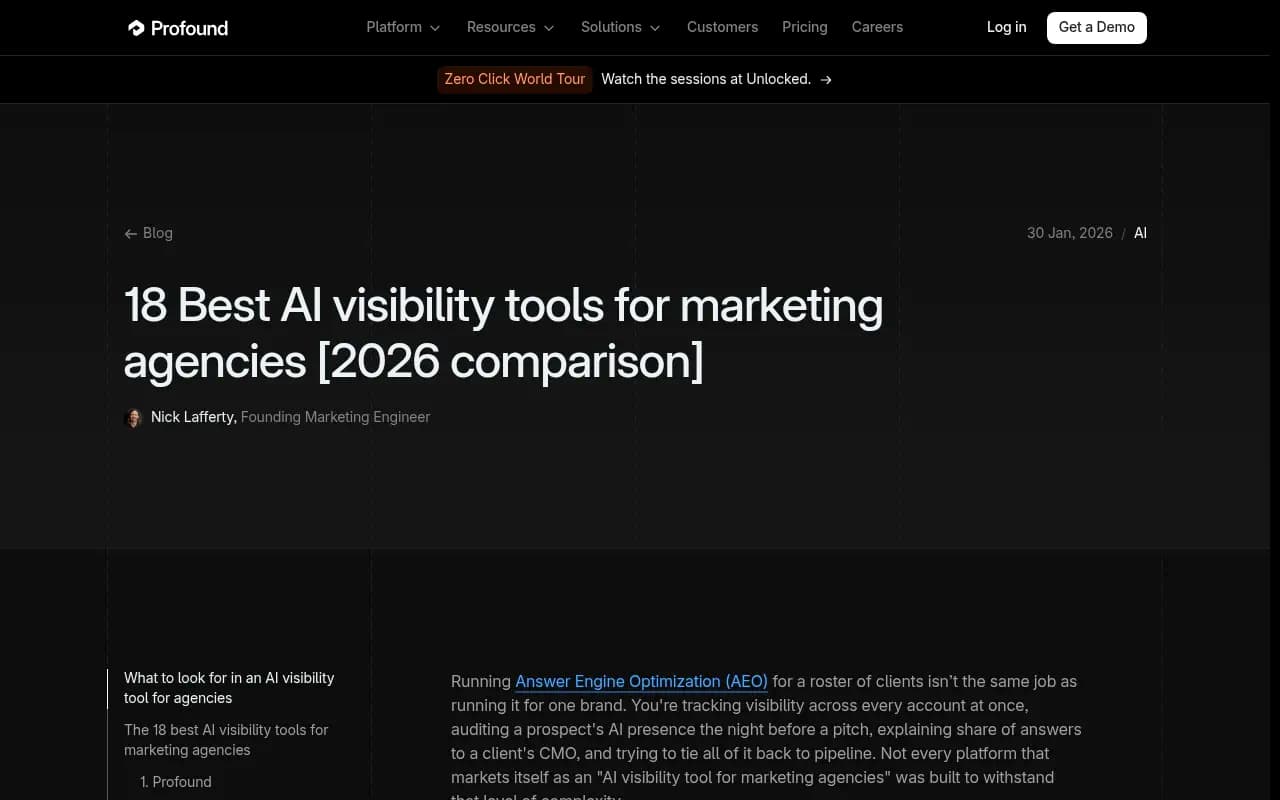
The image above is from Profound's own roundup. Like Geoptie's, it is vendor-authored, so read the rankings accordingly.
OAuth versus API key: pick based on where you work
This choice shapes how pleasant the setup is.
OAuth servers (Peec, Otterly, Scrunch, ZeroRank for MCP) can be added through the ChatGPT or Claude connector settings. A marketer can do it in two minutes with no terminal.
Key-based servers (Geoptie) are configured in Claude Code, Cursor, or Codex. That suits technical teams and gives you scoped keys for automation. Promptwatch, Profound, SE Ranking, and Peec support both, which is the more flexible position.
Whatever you choose, test it in the client your team actually uses. The same server can feel very different in a chat UI versus an editor.
Write tools: how to avoid expensive mistakes
A write-capable MCP server can add prompts, change tags, run audits, queue content, or publish. That is the point, and also the risk.
- Start with a read-only key and run it for a week.
- Scope keys per project, not per organization.
- Prefer vendors that log which client made each change.
- Require a human review step for anything that publishes.
Promptwatch's Content Agent, for example, has a review inbox where you approve, edit, or decline drafts, or you can run it hands-off once you trust the output.
What the data says about where AI answers come from
An MCP server is only as useful as the questions you can answer with it, so it helps to know what AI engines cite. Promptwatch Data shows ChatGPT citing about 5 sources per web-search answer, while Google AI Overviews and Perplexity sit around 10. The same report suggests Perplexity's steady citation count makes it a useful test bench when you change content and want a stable signal.
For software brands, Promptwatch's October 2026 software citation report found that GitHub, Microsoft's docs, and G2 lead ChatGPT citations (Sep 28 to Oct 4, 2026), and documentation and help centers earn the largest share. For a developer-focused team, that is a nudge to treat docs as marketing assets, and an MCP-connected assistant can help you audit which docs get cited.
Recommendations by team type
| Situation | Pick | Why |
|---|---|---|
| You want monitoring, crawler logs, content, and publishing driven from your editor | Promptwatch | MCP sits on top of the full loop, not just a dashboard |
| Cheapest possible MCP experiment | ZeroRank AI or Peec AI | Low entry price, OAuth setup |
| Agency syncing many clients, wants no monthly cap | Geoptie | Flat price, 120 req/min |
| Already live in Ahrefs or SE Ranking | The vendor's built-in connector | One login, SEO and AI data together |
| Enterprise with procurement | Profound | Widest engine coverage, sales-led |
If none of these fits, the GEO software directory at bestgeosoftware.com lists more options.
How to evaluate in one week
- Pick five prompts that matter to pipeline and add them to two tools.
- Connect each MCP server to the client your team uses daily.
- Ask the same three questions: which competitor beats us, which page gets cited, what should we publish next.
- Check whether each tool can tell you why, not just what. Crawler access and citation paths are where that answer usually lives.
- Hit the quota on purpose. Run a bulk query and see what happens.
The tool that wins is usually not the one with the biggest tool count. It is the one whose data matches what users see and whose server does not run out of requests on Wednesday.
If you would rather hand the selection and setup to people who do this daily, agencies like 1001 SEO Media run GEO programs on Promptwatch. For most developer-led teams, though, a trial of two tools and an afternoon in Claude Code will tell you more than any roundup, including this one.