Key takeaways
- For software prompts, ChatGPT leans on docs, help centers, vendor pages and GitHub. Promptwatch Data (Sep 28 to Oct 4, 2026) shows vendor sites and docs earn about 3x the citation share of review sites and analysts.
- You don't need a big domain rating. Mid-authority sites (DR 46-75) earned almost half of ChatGPT citations in August 2026.
- Product pages and landing pages are the most cited content types (22.4% and 16.8%). Build those before you write a pile of blog posts.
- Skip X and don't count on social posts for ChatGPT. Reddit, YouTube and LinkedIn matter more for Google AI Overviews and Perplexity.
- Days 1-30 are about access and a baseline, days 31-60 about the pages AI actually cites, days 61-90 about third-party mentions and measurement.
Why seed-stage dev tools should care now
You have a small team, a thin content library and a founder who is also doing support. Developers still search Google, but a growing share of them ask an AI assistant "what's the best tool for X" before they open a single tab. G2's March 2026 survey of 1,076 B2B buyers found 51% start software research with an AI chatbot more often than Google (via 100signals). Treat that as direction, not gospel, since it covers software buyers broadly rather than developers specifically.
Here's the part I find encouraging. AI answers are not a pure authority contest. Ahrefs found only 12% of links cited by ChatGPT, Gemini and Copilot also appear in Google's top 10 for the same prompt. And Promptwatch's domain rank data shows DR 46-75 sites earned almost half of ChatGPT citations in August 2026, while DR 91-100 fell to about 3%. A young startup with a clean docs site can compete.
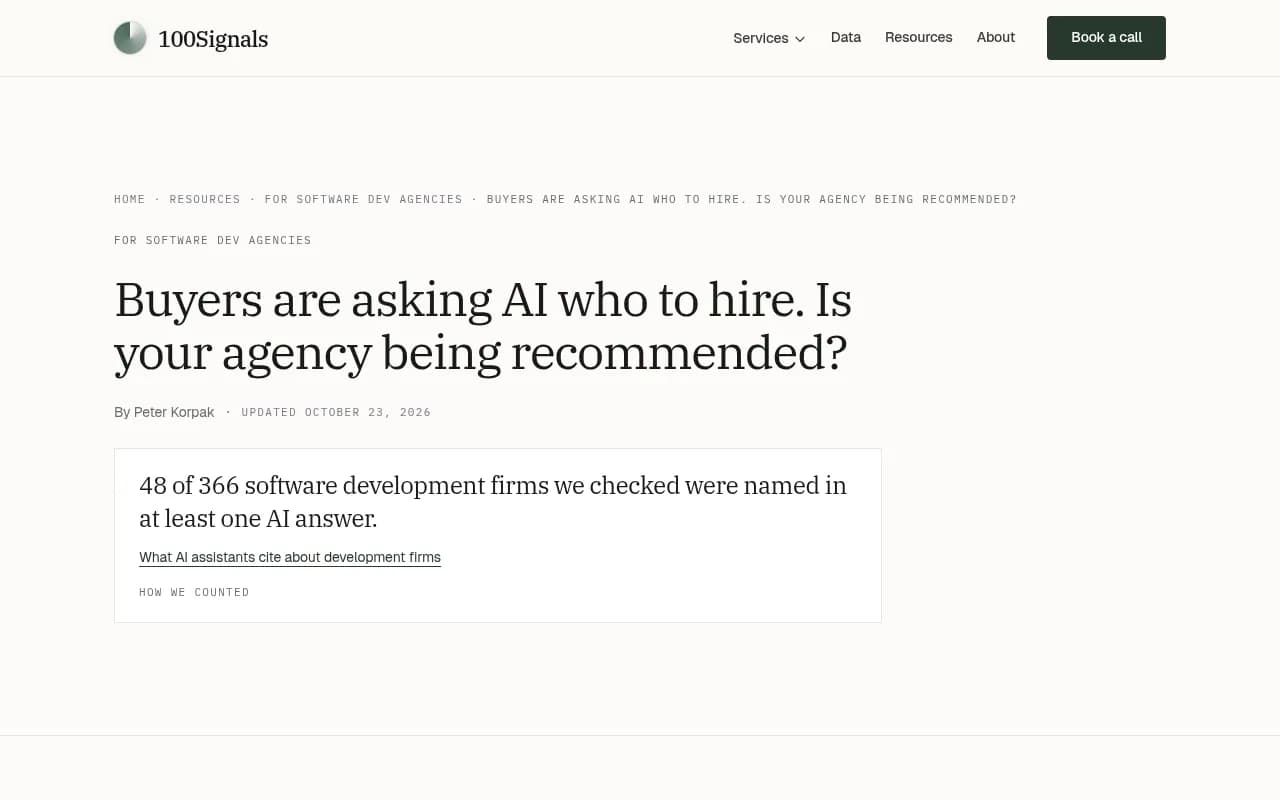
The flip side: when AI recommends tools in your category, an absent brand isn't ranked lower. It's missing. One agency study of 366 software development firms found only 48 were named in at least one AI answer. That's a different segment than dev tools, but it shows how sparse AI shortlists are.
What AI cites for software prompts
Before planning, look at what actually gets cited. Promptwatch Data on ChatGPT software citations (Sep 28 to Oct 4, 2026) shows:
- GitHub is the most cited domain at 1.2% of software citations.
- learn.microsoft.com follows at 0.98%, then G2 at 0.73%.
- Docs and help centers earn 2.64% as a group, vendor sites 2.01%, review sites and analysts 1.57%, app stores 0.47%.
Vendor pages and docs together earn about 3x what review sites and analysts do. For a seed-stage team, that is the best news in the report: the pages you fully control matter most.
The content type data for the same week backs this up:
| Content type | Share of ChatGPT citations |
|---|---|
| Product pages | 22.4% |
| Landing pages | 16.8% |
| Listicles | 13.6% |
| How-to guides | 8.7% |
| Documentation | 7.5% |
| Comparisons | 5.9% |
| FAQ | 3.3% |
| Reviews | 1.7% |
For commercial prompts (the "best X for Y" kind), product pages, landing pages, listicles and comparisons make up almost 70% of citations. For informational prompts, how-tos (10.7%) and docs (8.5%) get a bigger slice.
Two more facts shape the plan. Almost half of ChatGPT responses cite 10 or more unique domains, so there is room for you in the source list. And landing pages and docs stay cited longest while news loses half its pages in about 5 weeks. Evergreen beats newsy.
The 90-day plan at a glance
| Phase | Days | Goal | Main outputs |
|---|---|---|---|
| Foundation | 1-30 | Be readable and measured | Crawler access, baseline prompts, docs audit |
| Content | 31-60 | Own the pages AI cites | Product pages, comparisons, how-tos, FAQ |
| Authority | 61-90 | Get named elsewhere | GitHub, G2, Reddit, YouTube, mentions |
| Loop | Ongoing | Measure and refresh | Weekly review, refresh underperformers |
Days 1-30: foundation
Week 1: make sure AI can read your site
Many dev tool sites are JavaScript-heavy single-page apps, and some are built fast with AI site builders. If a crawler fetches an empty shell, nothing you write later will matter. Check these first:
- Open robots.txt and confirm you aren't blocking GPTBot, OAI-SearchBot, ClaudeBot, PerplexityBot or Google's agents by accident.
- Fetch your key pages without JavaScript. If the content isn't in the HTML, add server-side rendering or a prerender service. Tools such as Prerender.io exist for this.
- Make sure docs aren't gated behind a login or a cookie wall.
- Keep a clean sitemap that includes docs, changelog, pricing and comparison pages.
The free AI crawler URL inspector and Agentic Readiness Check from Promptwatch are quick ways to see what bots can reach. If you want to learn which bots exist, there is a directory at promptwatch.com/bots.
A note on llms.txt and markdown: Promptwatch Data found markdown files are only 0.05% of AI search citations. They serve AI agents, not AI search. Fine to generate an llms.txt if it takes ten minutes, but don't make it your project.
Week 2: build a prompt set from real buyer questions
Write 30 to 50 prompts a developer would actually type. Mix three kinds:
- Category: "best observability tool for small teams"
- Comparison: "[competitor] vs alternatives for Kubernetes cost tracking"
- Problem: "how do I rate limit an API per customer in Node"
Pull ideas from Google Search Console queries, your support inbox, Discord or Slack community questions, and the "People Also Ask" results. Run them yourself in ChatGPT, Gemini and Perplexity and write down who is named. This manual pass is free and usually humbling.
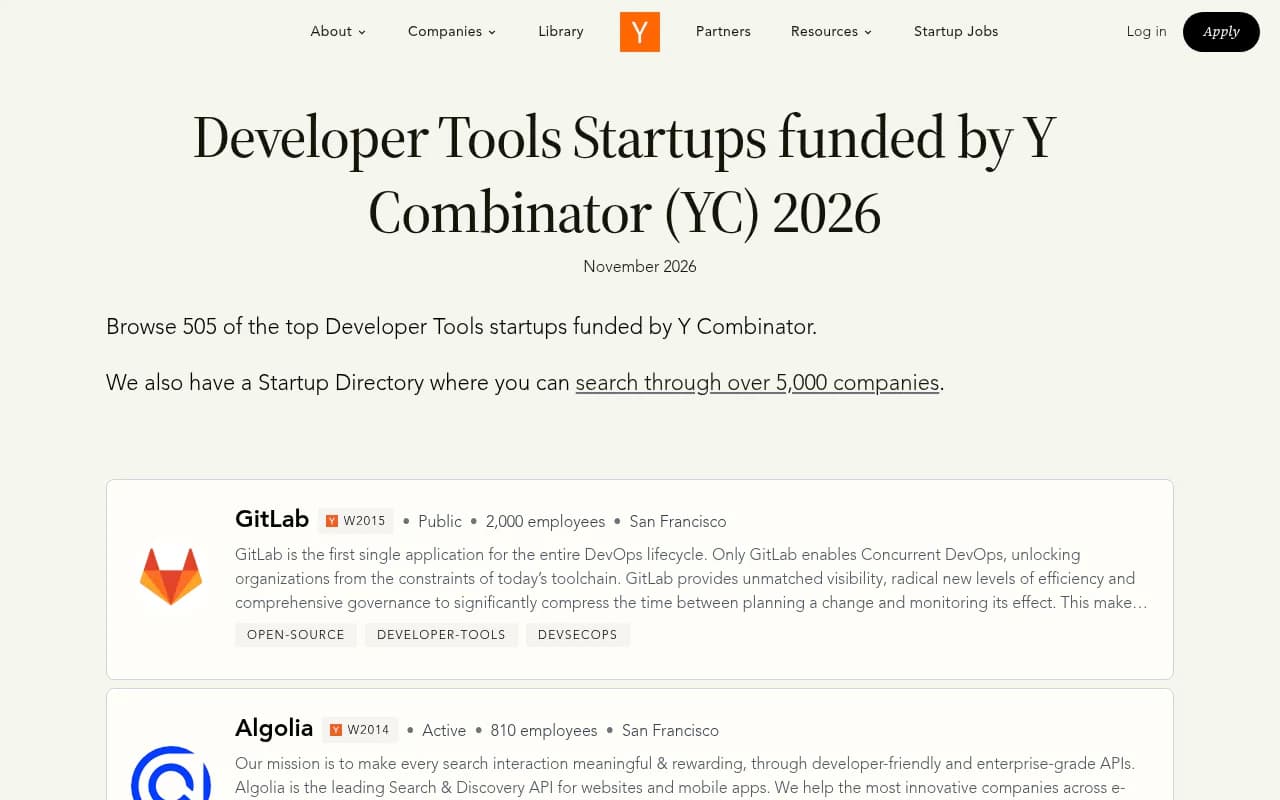
Use a directory like the YC developer tools list to build your competitor set. Include open source projects, since AI often recommends those first.
Weeks 3-4: set up tracking and a baseline
A spreadsheet works for a month. Past that, you want automation, because prompts get answered differently each day and across engines. Options at seed stage:
- Promptwatch tracks the real interfaces of ChatGPT, Google AI Overviews, Gemini, Perplexity and others, then goes further with crawler logs, content gap analysis and a Content Agent. Essential is $95/mo with 50 prompts, and there is a 7-day free trial; confirm current plans at promptwatch.com/pricing.

- Lighter monitoring tools like Otterly.AI, Peec AI and Rankshift cover mentions and citations without the optimization side.
Otterly.AI



- Semrush and Ahrefs have added AI tracking if you already pay for them. Expect fixed prompt sets and shallower AI data.
For a broader list, see the directories at bestgeosoftware.com and ai-rank-tools.com.
Whatever you choose, record four numbers on day 30: how often you're mentioned, where you appear in the answer, which of your pages get cited, and which competitors show up instead. The Promptwatch Academy explains these metrics if you want definitions.
Also install analytics that can separate AI referrals. ChatGPT stopped sending a referrer on October 8, 2026, so tag links you control with utm_source=chatgpt.com where possible. PostHog or Plausible-style tools work, and so does a tracker built into your AI visibility platform.
Days 31-60: build the pages AI cites
Fix the product and landing pages first
Product and landing pages are 39% of ChatGPT citations combined. Most seed-stage homepages say things like "the modern platform for engineering teams." A model can't quote that. Rewrite so a model can lift a sentence:
- One plain sentence on what it is, who it's for and what it replaces.
- Supported languages, frameworks, integrations and deployment options, as visible text.
- Pricing in HTML, not an image or a "contact us" wall.
- Limits, security posture and compliance statements. Security reviewers read these and so do models.
Create one landing page per use case or integration ("Postgres monitoring", "Terraform integration"). They are cheap to produce and match the long-tail prompts developers type.
Treat docs as marketing
Docs and help centers are the largest source type in the software citation data. Practical steps:
- Give every doc page a descriptive title and a first paragraph that answers the question directly.
- Add a real quickstart, a troubleshooting section and an FAQ.
- Include working code samples with the language labelled.
- Keep versioned docs from creating duplicates that compete with each other.
- Date your changelog entries and keep it public.
If you run docs on a headless setup, platforms like Sanity, Strapi or Payload are fine as long as the output is server-rendered HTML.
Publish comparison and "best of" pages honestly
Listicles (13.6%) and comparisons (5.9%) are cited a lot on commercial prompts. Write "X vs Y" pages for your two or three closest competitors and one "best tools for [use case]" page. Be fair: say where a competitor wins. Pages that read as pure sales copy tend to be less useful to a model deciding what to cite, and developers can smell them anyway.
Use query fan-outs to choose topics
When ChatGPT answers, it runs several web searches behind the scenes. Since August 8, 2026, it uses the site: operator at scale, jumping from about 0.4% to about 17% of fan-out queries. In practice, that means clean, well-structured pages on your own domain are easier to retrieve for specific sub-questions. Look at fan-outs for your tracked prompts with the free ChatGPT query fan-out generator or the GEO Inspector extension, and write a page for each sub-question you don't cover yet.
Draft faster, but keep a human on technical accuracy
AI writing tools can speed up first drafts. Tools like Frase or Surfer SEO help with research and structure, and Promptwatch's Content Agent (Business plan and up) writes against your visibility gaps and publishes to WordPress, Webflow or Framer. At seed stage, I'd still have an engineer review anything with code in it. Wrong code samples in a doc page are worse than no page.
Days 61-90: earn mentions outside your site
Ahrefs' study of 75,000 brands found brand web mentions correlate with AI Overview visibility at 0.664, versus 0.218 for backlinks. Being named in places AI trusts matters more than raw link count.
GitHub
GitHub is the single most cited software domain. Do the boring things: a README that explains what the project does in two sentences, a clear install section, a license, topics and tags, and links back to your docs. If your product is closed source, open-source an SDK, examples repo or CLI and make that discoverable.
Review sites
G2 (0.73%) and Capterra (0.32%) are cited less than docs and vendor pages, but they are still in the mix. Claim your profiles, fill every field, and ask ten happy customers for honest reviews. Don't buy reviews. Make sure the profile description matches your site wording so models see one consistent story.
Community and video
The split by engine matters. Promptwatch's November 2026 social citation data (Oct 11 to Nov 9) shows:
| Engine | Social share of citations | Notes |
|---|---|---|
| Google AI Overviews | 13.16% | YouTube 6.71%, Facebook 2.34%, Reddit 2.10% |
| Perplexity | 1.94% | Reddit 0.82%, LinkedIn 0.66% |
| ChatGPT | 0.64% | Reddit 0.40%, LinkedIn 0.20% |
Two takeaways. YouTube is worth a few short screencasts (install, a first integration, a migration) if you care about Google's AI surfaces. And X peaks at 0.04% of citations, so leave it out of your AI plan. Reddit's share of ChatGPT citations collapsed from about 4% to 0.5% in August and has only partly recovered, so participate honestly for the humans and for Perplexity and Google, not as a ChatGPT play. Put your own site, listicles, guides and comparisons first.
Third-party articles and directories
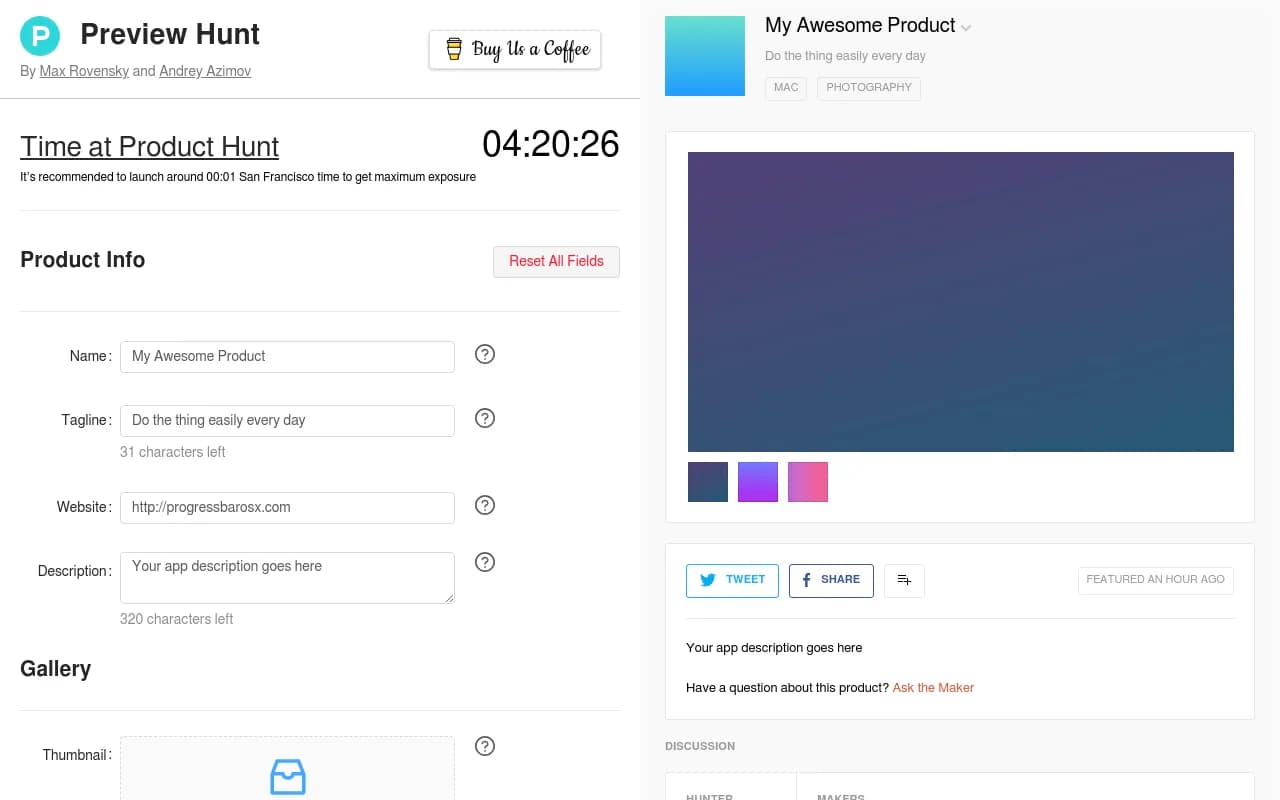
Get named in the pages AI already cites. Look at which domains show up for your tracked prompts, then pitch those authors with something useful: benchmark data, a free tool, a real customer story. List the product on relevant directories. For general software directories, surferstack.com is one place to start. Product Hunt-style launches help too, and Preview Hunt can help you test a listing first.
If you'd rather hand off the outreach, an SEO and GEO agency can run digital PR for you. 1001 SEO Media, which publishes this site, does technical SEO, content and AI search work with no long-term contracts. Plenty of seed teams do fine without one for the first 90 days, so treat it as optional.
Measuring whether it worked
At day 90, compare against your day 30 baseline:
- Mention rate across your prompt set, split by engine.
- Citation count to your own domain, and which pages earn them.
- Share of voice against your three closest competitors.
- AI referral sessions and signups from those sessions.
- Crawler activity: are AI bots reading your new pages, and are they hitting errors?
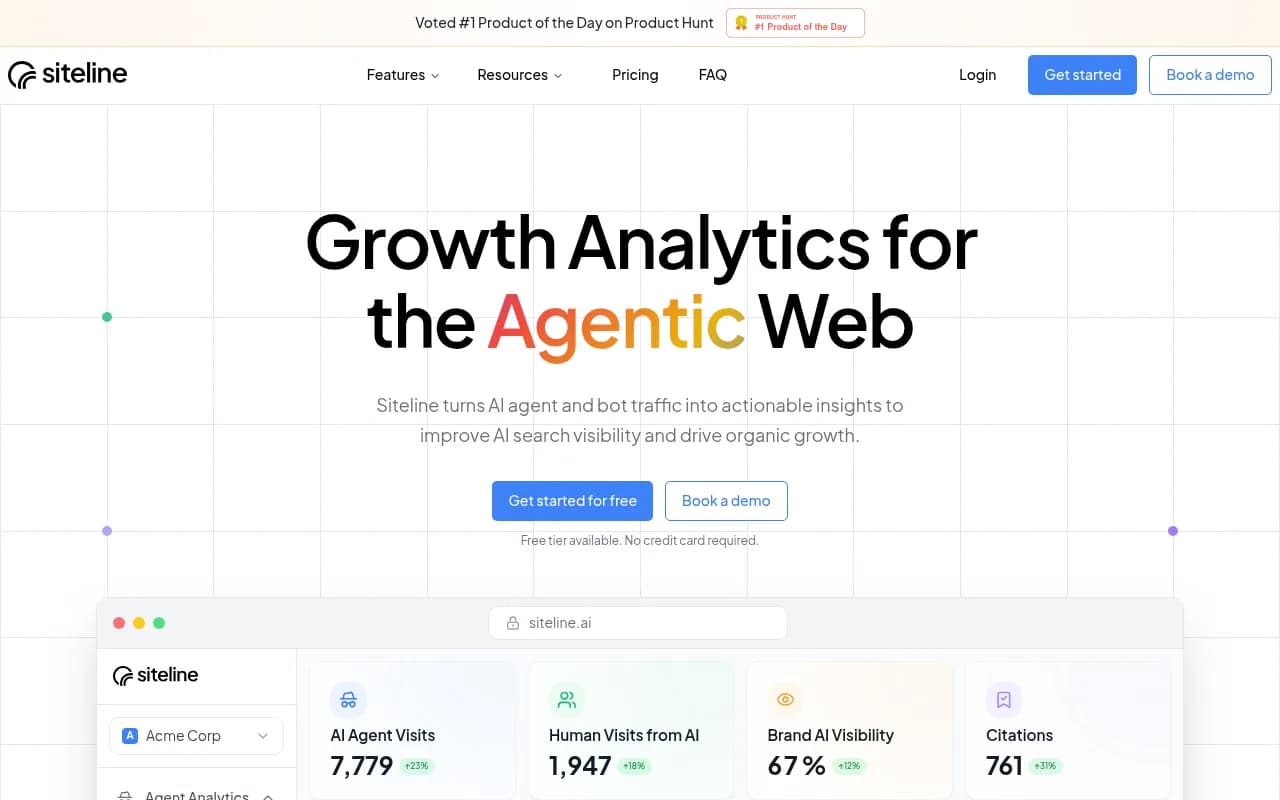
The last one is underrated. If a page isn't getting cited, you need to know whether bots never fetched it (an access problem) or fetched it and passed (a content problem). Server logs can answer this if you can parse them. Promptwatch's AI crawler logs do it with IP verification, and cheaper options such as Siteline AI focus on AI agent traffic.
About expectations: Ahrefs reported AI visitors converting at 23x organic on its own site, but that is a single-site result from June 2025. Your volume will be small at first. Seed-stage wins usually look like "we showed up in 8 of our 40 prompts, up from 1," plus a handful of high-intent signups. Crisp, a Promptwatch customer, saw 2x higher conversion from AI traffic than other channels, which fits the pattern that AI visitors arrive further along in their decision.
Common mistakes
- Gating docs or pricing. Models can't cite what they can't fetch.
- Chasing schema as a silver bullet. Ahrefs tested 1,885 pages and found adding JSON-LD produced no major change in AI citations. Use structured data for clarity, not as a lever.
- Publishing news-style posts. They lose half their citations in about 5 weeks.
- Inconsistent naming. If your product is called three things across GitHub, G2 and your site, models split the signal. Pick one name and one description.
- Over-investing in backlinks. Mentions matter more.
- Tracking one engine. ChatGPT, Gemini, Perplexity and AI Overviews cite different sources. Track all of them.
A weekly rhythm after day 90
- Monday: check mention rate and new citations by engine.
- Tuesday: review crawl errors and site audit findings.
- Midweek: ship one page, either a new use case, a comparison or a refresh of a decaying page.
- Friday: log what changed and write the next week's three actions.
Promptwatch's 90-day GEO program guide and its GEO for B2B page are decent references if you want a second structure to compare against this one.
Final word
The order matters more than any single tactic: make the site readable, build the product, landing and docs pages AI cites, then earn mentions on GitHub, review sites and the communities your buyers read. Do that, measure honestly, and a seed-stage dev tool can end up in the answer next to companies with ten times the budget.