Key takeaways
- Self-hosted trackers like Elmo give you data ownership, readable scoring code and no per-prompt license fee. You pay for API keys, scraping providers and your own maintenance time instead.
- Elmo's self-hosted core is MIT-licensed with unlimited prompts and all models. Elmo Cloud starts at $29/mo for teams that do not want to run servers, but covers fewer platforms.
- The real difference is not hosting. It is whether your numbers come from model APIs or from the actual consumer interfaces, and whether anything fixes what the tracker finds.
- Pick self-hosted if you have engineering time and want raw data in your own warehouse. Pick SaaS if you need UI-level data, crawler logs, traffic attribution and content execution without building them.
- I could not verify Voyage details or independent accuracy benchmarks, so treat any claim about API vs UI accuracy as something to test yourself.
Why engineers ask this question first
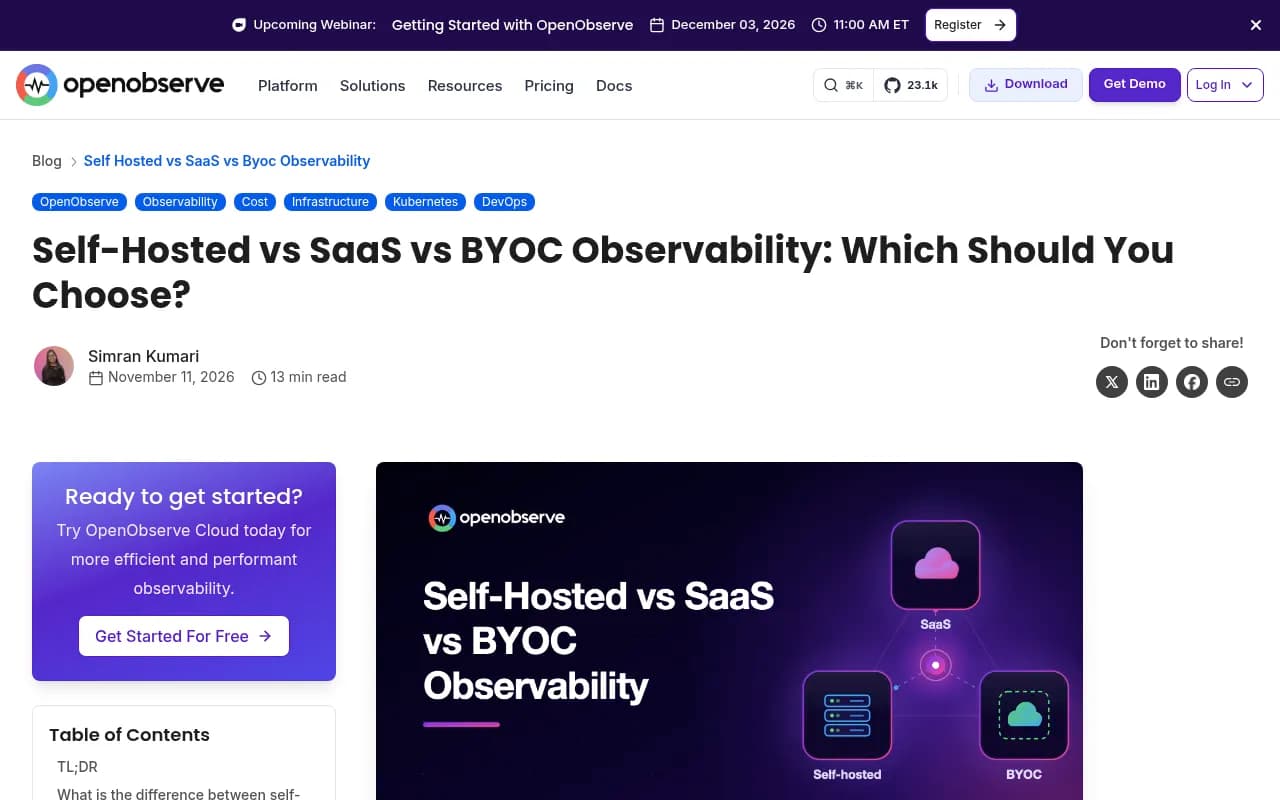
Engineering-led teams tend to approach AI visibility the way they approach observability. Do we run it ourselves, buy it, or split the difference? The framing is not wrong. The OpenObserve guide on self-hosted vs SaaS vs BYOC puts it simply: with SaaS the vendor runs everything and you pay per use, with self-hosted you run the platform on your own infrastructure and own every part of it.
That mental model carries over to AI visibility, with one big catch. Log data is deterministic. You emit an event, you store it. AI answers are not. The same prompt returns different answers run to run, so the thing you are measuring is noisy before any hosting decision enters the picture. That changes what you should care about.
What an AI visibility tracker actually does
Strip away the branding and every tracker does the same core loop. It sends a set of prompts to AI engines on a schedule, stores the answers, extracts brand mentions and cited URLs, and computes metrics like visibility, share of voice and position against competitors.
Where they differ:
- Where the answers come from (model API, scraped consumer UI, or both)
- How many runs sit behind each number
- Whether you can export raw data
- Whether anything beyond monitoring exists, such as crawler logs, traffic attribution or content creation
Elmo's own comparison post uses four criteria for judging tools: engine coverage on the tier you would actually buy, sample size, reproducibility, and export. Keep in mind that post is published by Elmo and lists Elmo, so read its rankings with that conflict in mind. The criteria themselves are sensible, though, and I will use them below.
Self-hosted option: Elmo
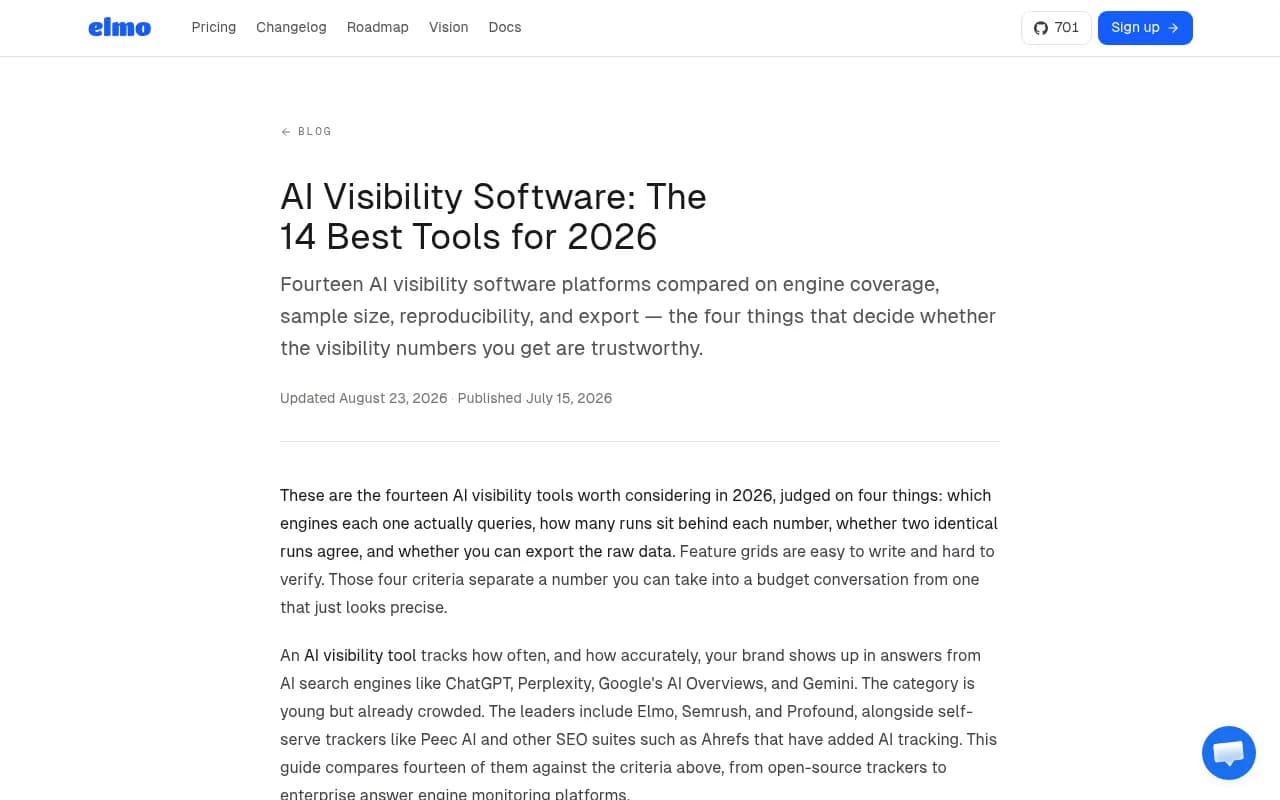
Elmo is an open-source, MIT-licensed AI visibility platform published on GitHub. It tracks mentions, citations, competitors, share of voice and query fan-out. According to its own materials, the self-hosted core has no license fee, unlimited prompts and every model you have keys for.
What you actually run
From the research: you run Docker and PostgreSQL, supply your own LLM API keys, and pull responses through each model's API or through OpenRouter. Engines listed include ChatGPT, Claude, Gemini, Grok, Perplexity, Copilot, DeepSeek, Mistral, plus Google AI Mode and AI Overviews. Because prompts, answers and metrics sit in your own database, you can also read the code that calculates the scores. For an engineer, that is the main draw. A visibility number you can audit is worth more than one you have to trust.
What it costs in practice
Free is not zero. The Ansvisor write-up on Elmo is blunt about this: you bring API keys for each provider, scraping consumer apps needs a scraping provider, and those bills scale with prompt count and run frequency. Add the time to maintain the deployment. An independent writer comparing no-enterprise-subscription routes called self-hosted Elmo the most balanced option for technical teams, which matches my read.
Elmo Cloud
Elmo Cloud is the managed path, from $29/mo according to Elmo. Per the Ansvisor summary, it starts with a ChatGPT-only tier and moves up to plans covering any four platforms, more brands and premium models, with unlimited seats plus API and MCP access. I did not verify the detailed tier limits, so check Elmo's site before budgeting.
Elmo vs Ansvisor, and where Voyage fits
Ansvisor is another open-source, self-hostable tracker with a 14-day free cloud trial. It also sells a hosted service, so its explainer is not neutral either. I found no reliable material on Voyage, so I am not going to describe it. If Voyage is on your shortlist, run the same checklist below against it: license, what you host, where answers come from, export format.
The accuracy question nobody has settled
This is the part I would worry about most as an engineer. Many self-hosted trackers call model APIs. Consumer products like ChatGPT search, AI Overviews and AI Mode do live retrieval with their own search behavior, and the user-facing answer and citations can differ from what the raw API returns.
The behavior also drifts. Promptwatch's ChatGPT query fanout data shows average fanouts per response falling from about 2.15 in early December to about 1.84 by early March, then returning in April at 1.0 per response. Average fanout query length dropped from about 117 characters to the high 80s, and about 53 characters after fanouts returned. Separately, Promptwatch's data on the site: operator shows ChatGPT jumping from about 0.4% to about 17% of fanout queries on August 8, 2026. If the search behavior you are measuring changes that much, a tracker that does not hit the real interface can drift away from what users see without any error on your side.
I found no independent benchmark comparing API-based and UI-based tracking accuracy, so I would not claim either is right. Test it: take 20 prompts, run them through your tracker and by hand in the real interface, and compare cited domains.
SaaS options
SaaS trackers split into a few groups. Pricing figures below are from vendors' models as described in Elmo's post, with no dollar amounts verified, except Promptwatch's own published plans.
Enterprise and suite add-ons
Profound is enterprise and demo-gated.
Profound

Semrush sells AI tracking as an add-on to its SEO suite, and Ahrefs Brand Radar does the same inside Ahrefs.

These suit teams already living in those tools.
Self-serve trackers
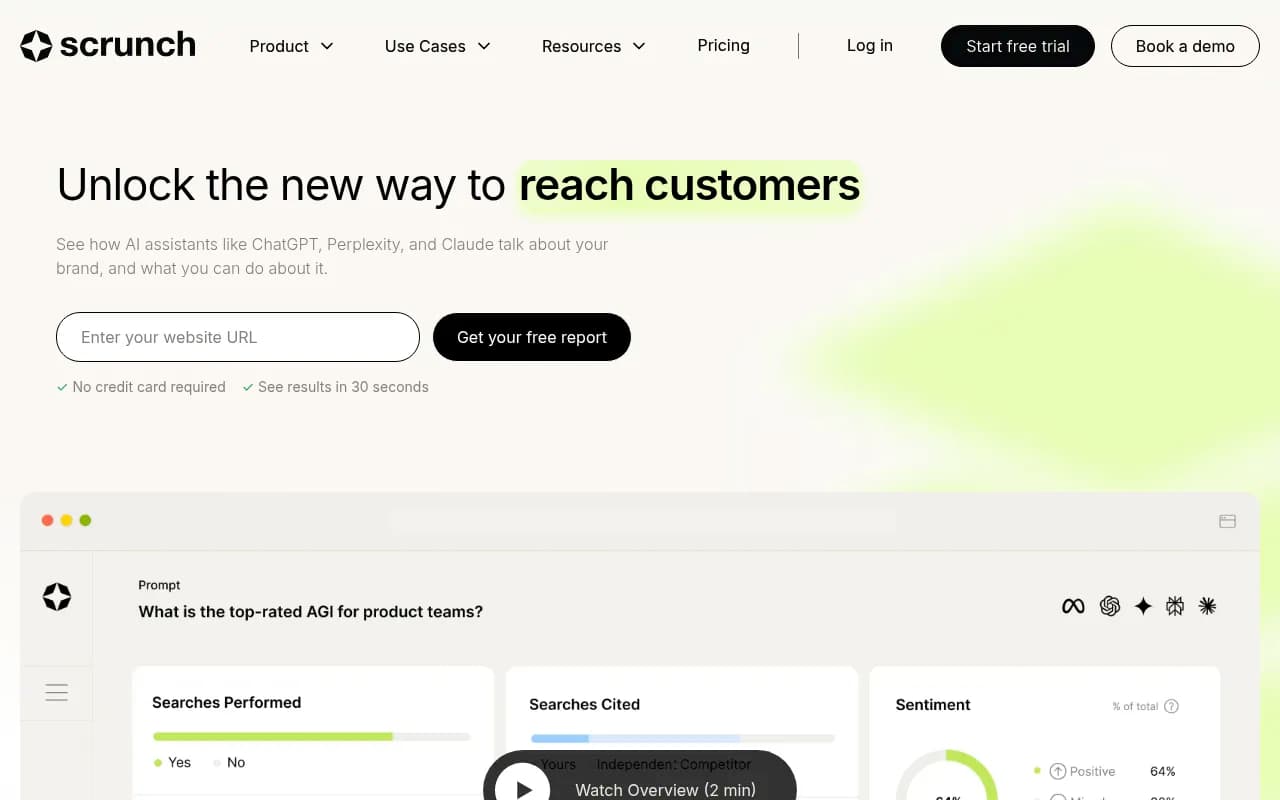
Peec AI, Scrunch AI and Otterly.AI are self-serve subscriptions. Otterly has a low entry price, with Gemini and AI Mode as add-ons.

Otterly.AI

Credit-based and BI-friendly
Rankshift is credit-based and has Looker, BigQuery and Power BI connectors, which is interesting for engineers who want to pipe visibility data into existing BI.

AirOps has a free tier that tracks ChatGPT only, per Elmo's FAQ.
End-to-end platform: Promptwatch
Promptwatch is the option I would point to when monitoring is not enough. It tracks the real interfaces of ChatGPT, Google AI Overviews, AI Mode, Gemini, Perplexity, Copilot and others per country and language, and adds IP-verified AI crawler logs, visitor analytics, and a Content Agent that writes and publishes pages to WordPress, Webflow or Framer. For engineers it also has a hosted MCP server and REST API v2 with date ranges up to 92 days. Plans run Essential $95/mo, Professional $245/mo and Business $579/mo (the Content Agent starts on Business), plus agency tiers from $199/mo. Confirm current numbers at promptwatch.com/pricing. There is a 7-day free trial, and a free AI visibility report if you just want a first read.

Side-by-side comparison
| Option | Hosting | Cost model | Data source | Strongest for |
|---|---|---|---|---|
| Elmo (self-hosted) | You run Docker + PostgreSQL | Free license; you pay API and scraping bills | Model APIs or OpenRouter | Data ownership, auditable scoring |
| Elmo Cloud | Managed | From $29/mo | Same reports, four platforms on higher tiers | Elmo without ops |
| Ansvisor | Self-host or cloud | Free self-host; cloud trial 14 days | Not verified | Open-source alternative |
| Peec AI, Scrunch, Otterly | SaaS | Self-serve subscription | Vendor-run | Quick monitoring setup |
| Profound | SaaS | Enterprise, demo-gated | Vendor-run | Large brands |
| Semrush, Ahrefs Brand Radar | SaaS add-on | Add-on to suite | Vendor-run | Existing suite users |
| Rankshift | SaaS | Credit-based | Vendor-run | BI pipelines |
| Promptwatch | SaaS | $95 to $579/mo, agency and Enterprise tiers | Real UI monitoring plus API models | Monitor, fix and measure in one loop |
Hidden costs on each side
Self-hosted
- API spend that scales with prompts times runs times models
- A scraping provider if you want consumer-app answers
- Upgrades, backups, and the on-call burden when a run silently fails
- Everything past monitoring: crawler logs, traffic attribution, content workflows are yours to build or bolt on
SaaS
- Seat, prompt or response caps depending on the tier
- Less ability to inspect how a score is computed
- Export limits on lower plans
- Dependence on the vendor's definition of a mention
One honest note: sample size matters more than hosting. Elmo's own post says a score built on one sample a week is noise because engines answer differently each time. Whichever you choose, check how often prompts run. Promptwatch runs daily on every plan and every 12, 6 or 1 hours on Business and Agency Scale.
Decision checklist
- Do you have engineering time to own a deployment, or will it rot after the first quarter?
- Do you need raw answers in your own warehouse? If yes, self-hosted or an API-friendly SaaS both work.
- Do you need consumer-UI accuracy for ChatGPT, AI Overviews or AI Mode? Run the 20-prompt test above.
- Will anything act on the findings? A dashboard does not publish a page. Look at whether crawler access, content gaps and traffic are covered.
- Do procurement or security reviews apply? Self-hosting helps with data residency, but a vendor with ISO/IEC 27001 and GDPR compliance may clear review faster than a new internal service.
My recommendation
If your team is mostly engineers and the goal is measurement you can inspect, start with self-hosted Elmo on a small prompt set and watch your API bill for a month. It is the cheapest way to learn what your numbers look like. If you find yourself building crawler log pipelines, traffic attribution and a content workflow on top, that is the signal to move to a platform that already has them.
For teams whose job is revenue from AI search rather than running a tracker, a SaaS platform like Promptwatch removes that build work. Crisp reported 2x higher conversion rates from AI traffic in its case study, which is the kind of outcome monitoring alone does not produce.
For wider browsing, the GEO software directory lists more trackers in each category. Prices and features in this space change fast, so verify everything with each vendor before you commit.