Key takeaways
- All four platforms track brand visibility in AI search engines, but they differ significantly in what they do after showing you the data.
- Promptwatch is the only platform here that closes the full loop: find gaps, generate content, track results -- making it the strongest choice for agencies that need to show ROI.
- Peec AI is a solid, affordable option for teams that mainly need monitoring across ChatGPT, Perplexity, and Claude, with a clean interface and smart prompt suggestions.
- Scrunch focuses on enterprise-grade tracking with strong reporting, but lacks content generation and Reddit/YouTube signal tracking.
- Search Party is agency-oriented but leans toward custom workflow automation rather than self-serve AI visibility -- a different kind of tool entirely.
The AI search visibility category has exploded in the last 18 months. Every week there's a new platform claiming to tell you how your brand appears in ChatGPT, Perplexity, or Google AI Overviews. Most of them do roughly the same thing: run your prompts through a few LLMs, show you whether your brand got mentioned, and call it a day.
For agencies, that's not enough. You need to explain to clients why they're invisible, show a plan to fix it, and prove that the fix worked. That's a much higher bar -- and most tools don't clear it.
This comparison focuses on four platforms that agencies commonly evaluate: Peec AI, Promptwatch, Scrunch, and Search Party. They're not identical products. Some are monitoring dashboards. One is closer to a full optimization platform. One is arguably a different category of tool altogether. Let's get into it.
What agencies actually need from an AI visibility tool
Before diving into the platforms, it's worth being clear about what "good" looks like for an agency context specifically.
Agencies have different requirements than in-house teams. You're managing multiple clients, each with their own competitive landscape. You need white-label or multi-client reporting. You need to show progress over time, not just a snapshot. And you need to be able to act on what you find -- because a client paying a monthly retainer wants results, not a dashboard.
The capabilities that matter most for agencies:
- Multi-site or multi-client management
- Prompt intelligence (volume estimates, difficulty, which prompts are worth targeting)
- Competitor visibility comparison
- Content gap analysis -- what topics are competitors getting cited for that you're not?
- Content generation or optimization tools to close those gaps
- Traffic attribution -- connecting AI visibility to actual website visits and revenue
- Crawler logs -- understanding how AI bots interact with client sites
- Reporting that clients can actually understand
With that frame in mind, here's how the four platforms stack up.
Promptwatch
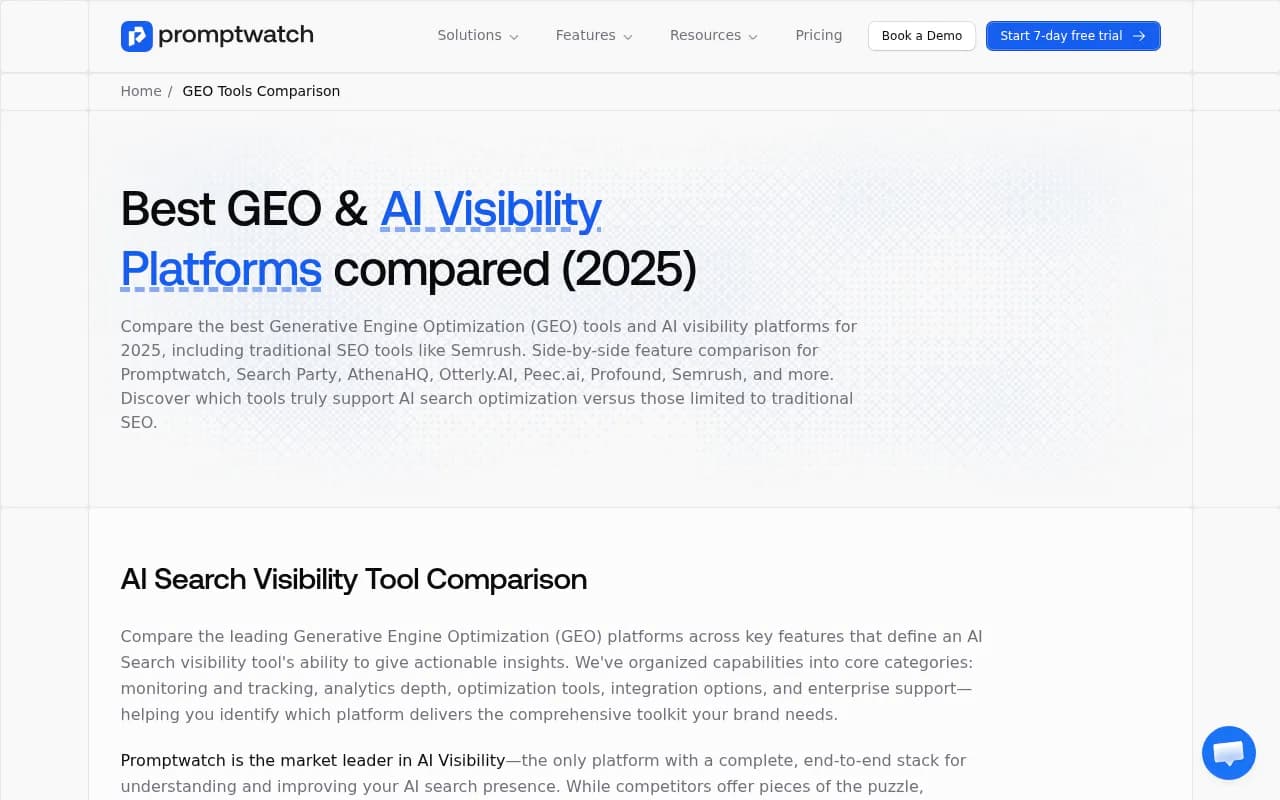
Promptwatch is the most complete platform in this comparison. It's built around what the company calls an "action loop": find gaps, create content, track results. That framing matters because it's genuinely different from how most AI visibility tools are designed.

Most platforms show you a visibility score and leave you to figure out what to do next. Promptwatch's Answer Gap Analysis shows you specifically which prompts competitors are getting cited for that you're not -- and then the built-in AI writing agent can generate articles, listicles, or comparison pages designed to close those gaps. The content generation is grounded in citation data (Promptwatch has processed over 880 million citations), so it's not generic AI filler -- it's content engineered to get picked up by LLMs.
For agencies, a few features stand out:
AI Crawler Logs are something most competitors don't offer at all. You can see in real time which AI crawlers (GPTBot, ClaudeBot, PerplexityBot, etc.) are hitting client sites, which pages they're reading, and what errors they're encountering. This is genuinely useful for diagnosing why a client isn't getting cited -- sometimes it's a content gap, sometimes it's a crawlability issue.
Prompt Intelligence gives you volume estimates and difficulty scores for each prompt, plus query fan-outs that show how one prompt branches into related sub-queries. For agencies building a GEO strategy, this is the difference between guessing which prompts to target and actually prioritizing the ones that are winnable and high-value.
Reddit and YouTube tracking surfaces discussions that directly influence AI recommendations. Most platforms ignore this channel entirely, but AI models frequently cite Reddit threads and YouTube videos -- knowing which ones are driving recommendations for your clients' categories is a real edge.
ChatGPT Shopping tracking monitors when brands appear in ChatGPT's product recommendation carousels. For e-commerce clients, this is increasingly important.
Pricing runs from $99/month (Essential: 1 site, 50 prompts) to $579/month (Business: 5 sites, 350 prompts, 30 articles). Agency and enterprise pricing is available on request. The Business tier includes crawler logs, state/city tracking, and 30 AI-generated articles per month -- enough to run a meaningful GEO content program for several clients.
The main limitation: the platform covers a lot of ground, and there's a learning curve. Agencies that want to get full value will need to invest time in setup and onboarding.
Peec AI
Peec AI is the most accessible option in this group. It's priced for smaller teams, has a clean interface, and does a good job of the core monitoring task: running prompts through ChatGPT, Perplexity, Claude, and other AI engines, then showing you where your brand appears.

One thing Peec does well is prompt suggestion. Rather than making you figure out which prompts to track from scratch, it offers smart recommendations based on your industry and competitors. For teams new to AI visibility tracking, this reduces the initial setup friction significantly.
According to Zapier's 2026 review of AI visibility tools, Peec "operates with a baseline layer of smart AI suggestions, offering ideas for the most relevant prompts and competitors to track." That's a fair summary -- it's a thoughtful monitoring tool that lowers the barrier to entry.
Where Peec falls short for agencies:
- No content generation or optimization tools. You can see where you're invisible, but the platform doesn't help you fix it.
- No AI crawler logs. You can't diagnose crawlability issues or see how AI bots interact with client sites.
- Limited traffic attribution. Connecting AI visibility to actual revenue is difficult.
- Multi-client management is less developed than Promptwatch's agency tier.
For a small agency with a handful of clients who mainly want to monitor and report on AI visibility, Peec is a reasonable choice. For agencies that need to show measurable improvement and tie it to business outcomes, it's not enough on its own.
Scrunch AI
Scrunch (scrunch.com) positions itself as an AI search visibility platform with a focus on brand tracking across LLMs. It has stronger enterprise reporting than Peec and covers a reasonable range of AI models.
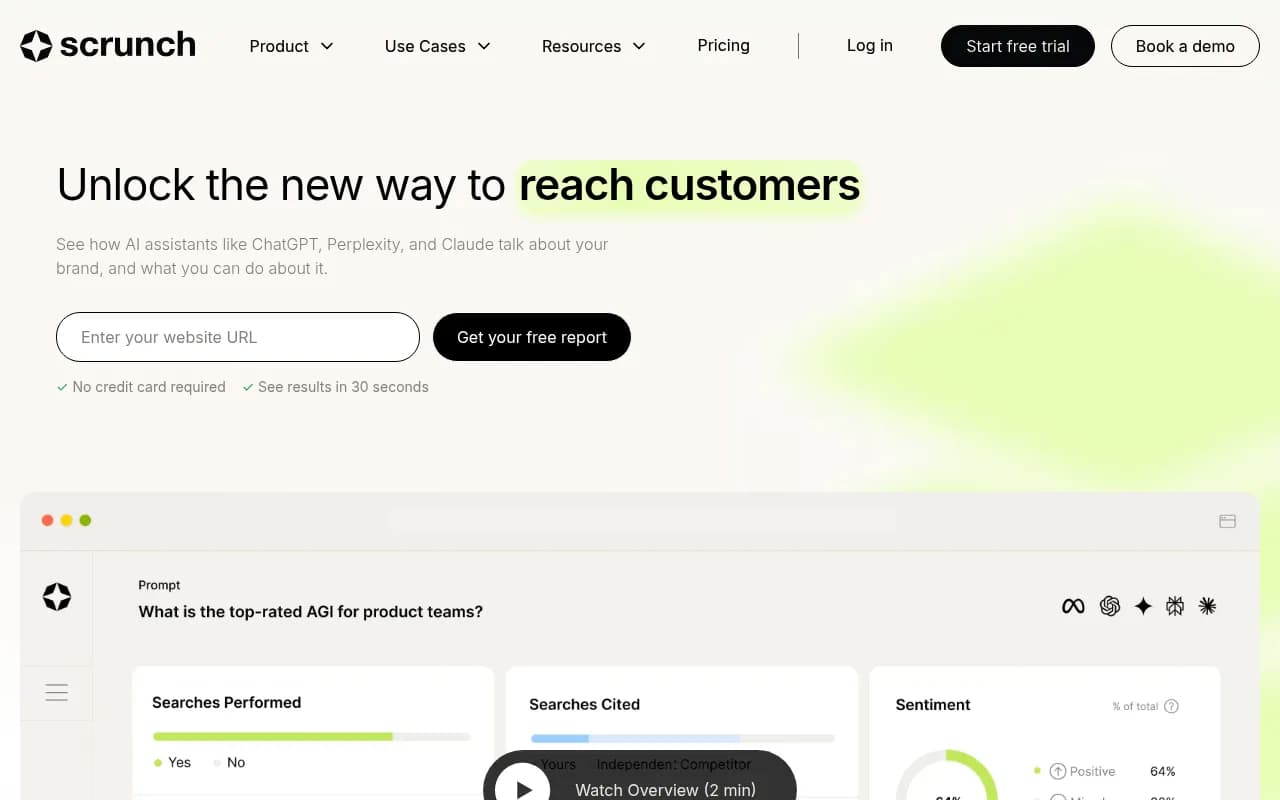
Scrunch's strengths are in visibility monitoring and competitive benchmarking. The platform tracks brand mentions across major AI engines and provides heatmap-style comparisons showing how your brand stacks up against competitors across different models. For clients who want to understand their competitive position in AI search, this is useful.
The gaps are significant for agencies that need to do more than report:
- No content generation. Like Peec, Scrunch shows you the problem but doesn't help you solve it.
- No Reddit or YouTube signal tracking. AI models frequently cite these sources, and ignoring them means missing a meaningful part of the picture.
- No ChatGPT Shopping tracking.
- No AI crawler logs.
- Pricing is less transparent than Peec or Promptwatch, which can make it harder to evaluate for budget-conscious agencies.
Scrunch is a reasonable choice for enterprise clients who need solid monitoring and competitive reporting and have separate resources for content creation. For full-service agencies that want one platform to handle the whole workflow, it leaves gaps.
Search Party
Search Party is a different kind of product. It's described as an "AI automation consultancy that engineers custom workflows to eliminate busywork" -- which is accurate, but also means it's not really a self-serve AI visibility platform in the same sense as the others.
Search Party
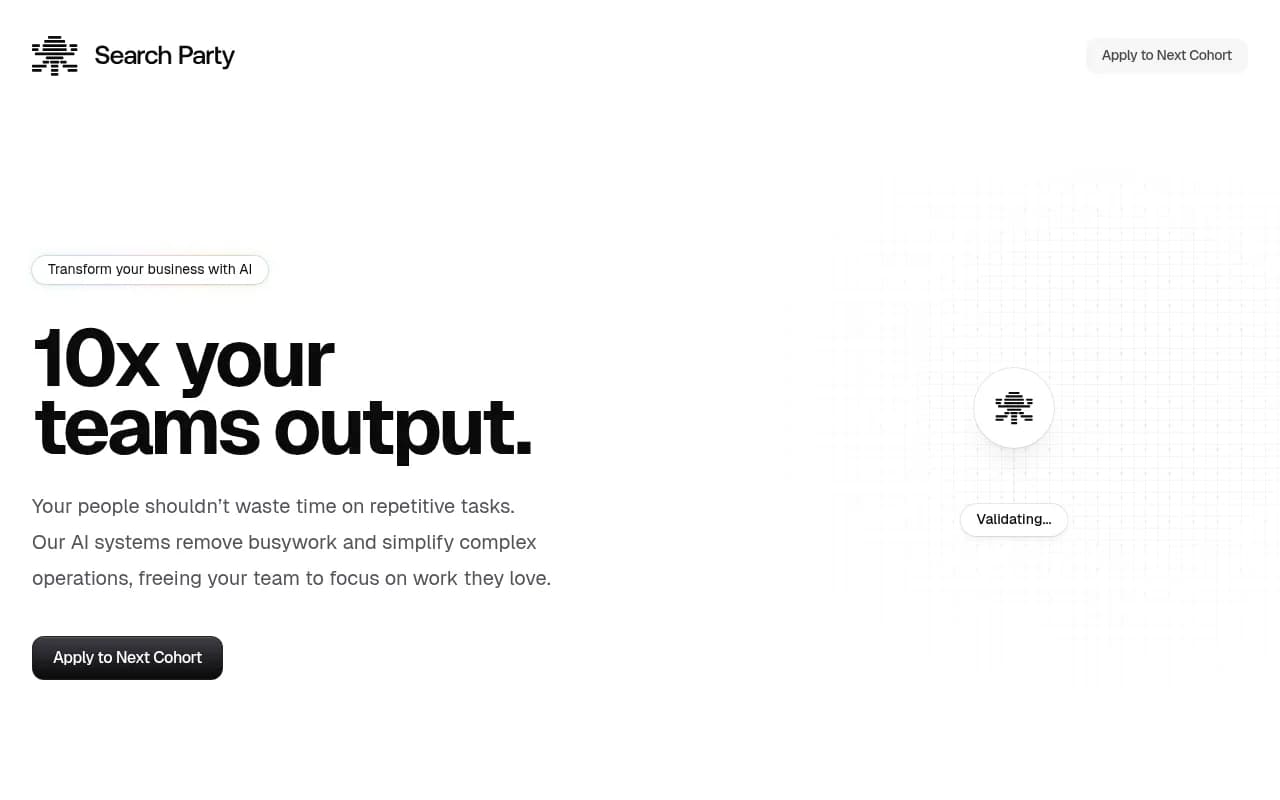
Search Party is agency-oriented in the sense that it's built for teams that need custom solutions. But rather than giving you a dashboard to monitor AI visibility yourself, it tends toward bespoke workflow automation. That's valuable for some agencies -- particularly those with complex, non-standard requirements -- but it means the comparison to Promptwatch, Peec, and Scrunch is somewhat apples-to-oranges.
For agencies evaluating Search Party as an AI visibility tool specifically:
- Prompt metrics and content gap analysis are limited compared to dedicated GEO platforms.
- There's no built-in content generation.
- The custom workflow approach means higher implementation overhead.
- It may work well as a complement to a dedicated visibility platform, rather than a replacement.
If your agency's primary need is understanding and improving AI search visibility for clients, Search Party is probably not the right starting point. If you need custom automation around AI workflows more broadly, it's worth a conversation.
Feature comparison
| Feature | Promptwatch | Peec AI | Scrunch AI | Search Party |
|---|---|---|---|---|
| AI model coverage | 10+ (ChatGPT, Perplexity, Claude, Gemini, Grok, DeepSeek, Copilot, Meta AI, Google AI Overviews, Mistral) | ChatGPT, Perplexity, Claude, others | Major LLMs | Varies (custom) |
| Prompt volume & difficulty scores | Yes | Basic suggestions | No | No |
| Answer gap / content gap analysis | Yes | No | No | No |
| Built-in content generation | Yes (AI writing agent) | No | No | No |
| AI crawler logs | Yes | No | No | No |
| Reddit & YouTube tracking | Yes | No | No | No |
| ChatGPT Shopping tracking | Yes | No | No | No |
| Traffic attribution | Yes (GSC, code snippet, server logs) | Limited | Limited | No |
| Competitor heatmaps | Yes | Basic | Yes | No |
| Multi-site / agency support | Yes (agency/enterprise tier) | Limited | Yes | Yes (custom) |
| Pricing transparency | Clear tiers ($99-$579/mo) | Clear tiers | Less transparent | Custom only |
| Free trial | Yes | Yes | Varies | No |
Which platform is right for your agency?
The honest answer depends on what you're trying to accomplish.
If you need a full-service AI visibility platform that can find gaps, generate content to close them, and prove the results to clients, Promptwatch is the clear choice. It's the only platform here that handles the complete workflow. The pricing is reasonable for what you get, and the agency tier is built for multi-client management.
If you're running a small agency and your clients mainly want to know whether they're showing up in ChatGPT and Perplexity -- and reporting on that is enough -- Peec AI is a solid, affordable starting point. It won't help you fix visibility problems, but it will tell you clearly where they exist.
If you have enterprise clients who need robust competitive benchmarking and polished reporting, and they have separate content teams to act on the insights, Scrunch is worth evaluating. Just go in knowing you'll need other tools to actually improve visibility.
Search Party is a different category. If you need custom AI workflow automation and have the budget and patience for a bespoke implementation, it's worth a conversation. But it's not a replacement for a dedicated GEO platform.
A note on the broader landscape
These four platforms represent a slice of a fast-moving market. There are now well over 20 tools claiming to track AI visibility, ranging from free basic monitors to enterprise platforms charging tens of thousands per year.
The most important question to ask any vendor: what happens after you see the data? Monitoring is table stakes. The platforms that will matter in 2026 and beyond are the ones that help you act on what you find -- generating content that gets cited, fixing crawlability issues, and connecting visibility to revenue.
Most platforms stop at step one. That's worth knowing before you sign a contract.
For agencies specifically, the ability to show clients a clear before-and-after -- here's where you were invisible, here's what we did, here's how your visibility improved, here's the traffic it drove -- is what justifies the retainer. That requires more than a monitoring dashboard. It requires the full loop.
Promptwatch is currently the only platform in this comparison that delivers that end-to-end. Whether that's worth the price difference over a simpler monitoring tool depends on what your clients are paying you to do.