Key takeaways
- Yext and Uberall are built for local/multi-location listing management and are adding AI search features, but neither was designed as a GEO optimization platform
- Peec AI is a solid monitoring tool for tracking brand presence across AI engines, but stops short of helping you actually fix visibility gaps
- Promptwatch is the only platform in this comparison that closes the full loop: find gaps, generate content engineered for AI citation, and track the results
- For enterprise brands that need both listing management and AI search optimization, the answer is likely a combination of tools rather than one platform doing everything
- Price alone doesn't tell the story -- what matters is whether a platform helps you act on what it finds
Multi-location brands have a specific problem that most AI visibility tools weren't designed to solve. You're not just asking "does ChatGPT mention our brand?" You're asking "does ChatGPT recommend our Denver location when someone in Denver asks for the best [your category]?" That's a different question, and the answer requires a different kind of platform.
This comparison looks at four tools that enterprise brands are currently evaluating for this exact problem: Peec AI, Promptwatch, Yext, and Uberall. They come from different traditions -- GEO monitoring, local listing management, and reputation platforms -- and they overlap in some areas while being completely different in others.
Let's get into it.
What "multi-location AI visibility" actually means
Before comparing tools, it's worth being precise about what we're measuring. Multi-location AI visibility has two distinct layers:
The first is brand-level visibility: does your brand appear in AI-generated answers at all? When someone asks Perplexity or ChatGPT about your category, are you mentioned? This is what most GEO tools track.
The second is location-level visibility: when someone asks an AI engine for a recommendation near a specific city or neighborhood, does the right location appear? Does the AI have accurate information about your hours, address, and services? This is where local listing management intersects with AI search.
These two layers require different capabilities. A platform that only does one of them will leave gaps.
Peec AI
Peec AI built its reputation as one of the earlier platforms to track brand visibility across multiple AI engines. It monitors ChatGPT, Perplexity, Claude, Google AI Overviews, and several others, giving you share-of-voice data and prompt-level analytics.

For multi-location brands, Peec AI's flexible model selection is genuinely useful -- you can configure which AI engines to track based on where your audience actually searches. The platform also supports unlimited seats, which matters for enterprise teams where multiple regional marketers need access.
Where Peec AI runs into friction is on the action side. The platform is primarily a monitoring dashboard. It shows you where you're visible and where you're not, but the next step -- figuring out what to do about it -- is left to you. For a lean team, that gap is manageable. For an enterprise brand managing 50+ locations across multiple markets, it becomes a real bottleneck.
There's also a cost issue that comes up frequently in enterprise contexts. As keyword sets grow to cover location-specific prompts (think "best [category] in [city]" multiplied across dozens of markets), costs can escalate quickly. Several enterprise SEO teams in industry communities have flagged this as a reason they looked elsewhere.
What Peec AI does well:
- Multi-engine tracking with flexible model selection
- Prompt-level analytics and brand mention tracking
- Unlimited seats for large teams
- Clean, navigable interface
Where it falls short for multi-location enterprise:
- No content generation or gap-filling tools
- Cost scales steeply with large prompt sets
- No AI crawler logs to understand how AI engines are reading your site
- No location-specific tracking at the city or neighborhood level
Promptwatch
Promptwatch takes a different approach. Where Peec AI is a monitoring tool, Promptwatch is built around what it calls the action loop: find gaps, create content, track results.

For multi-location brands, this distinction matters more than it might seem. Knowing that a competitor ranks in AI responses for "best hotel near [city center]" is useful information. But knowing that, plus having a tool that shows you exactly what content your site is missing to compete for that prompt, plus a built-in AI writing agent that generates location-specific articles grounded in real citation data -- that's a different category of tool.
Promptwatch tracks 10 AI models including ChatGPT, Perplexity, Google AI Overviews, Google AI Mode, Claude, Gemini, Meta/Llama, DeepSeek, Grok, and Mistral. Its Answer Gap Analysis shows which prompts competitors are appearing for that you're not -- including location-specific queries -- and maps those gaps to the specific content your site is missing.
The AI crawler logs feature is particularly relevant for enterprise brands. It shows in real time which pages AI crawlers (ChatGPT's GPTBot, Perplexity's PerplexityBot, etc.) are reading, how often they return, and what errors they encounter. If your Denver location page isn't being crawled, you'll see it. Most competitors in this space don't offer this at all.
The Business plan ($579/mo) supports 5 sites and 350 prompts with state/city-level tracking -- the Professional plan ($249/mo) already includes city tracking. For brands with more than 5 locations, the Agency/Enterprise tier handles custom configurations.
What Promptwatch does well:
- Full action loop: monitoring + gap analysis + content generation
- AI crawler logs showing exactly how AI engines read your site
- City and state-level tracking for location-specific queries
- 880M+ citations analyzed to ground content recommendations in real data
- Reddit and YouTube tracking (sources that heavily influence AI recommendations)
- ChatGPT Shopping tracking for product-oriented brands
- Traffic attribution to connect AI visibility to actual revenue
Where to consider the tradeoffs:
- Not a listing management platform -- it won't sync your NAP data across directories
- Content generation is engineered for AI citation, not traditional local SEO content
Yext
Yext is a different beast. It started as a business listings platform -- the tool you use to make sure your address, phone number, and hours are consistent across Google, Yelp, Apple Maps, and hundreds of other directories. Over the years it's grown into a broader "digital presence" platform, and more recently it has added features aimed at AI search visibility.
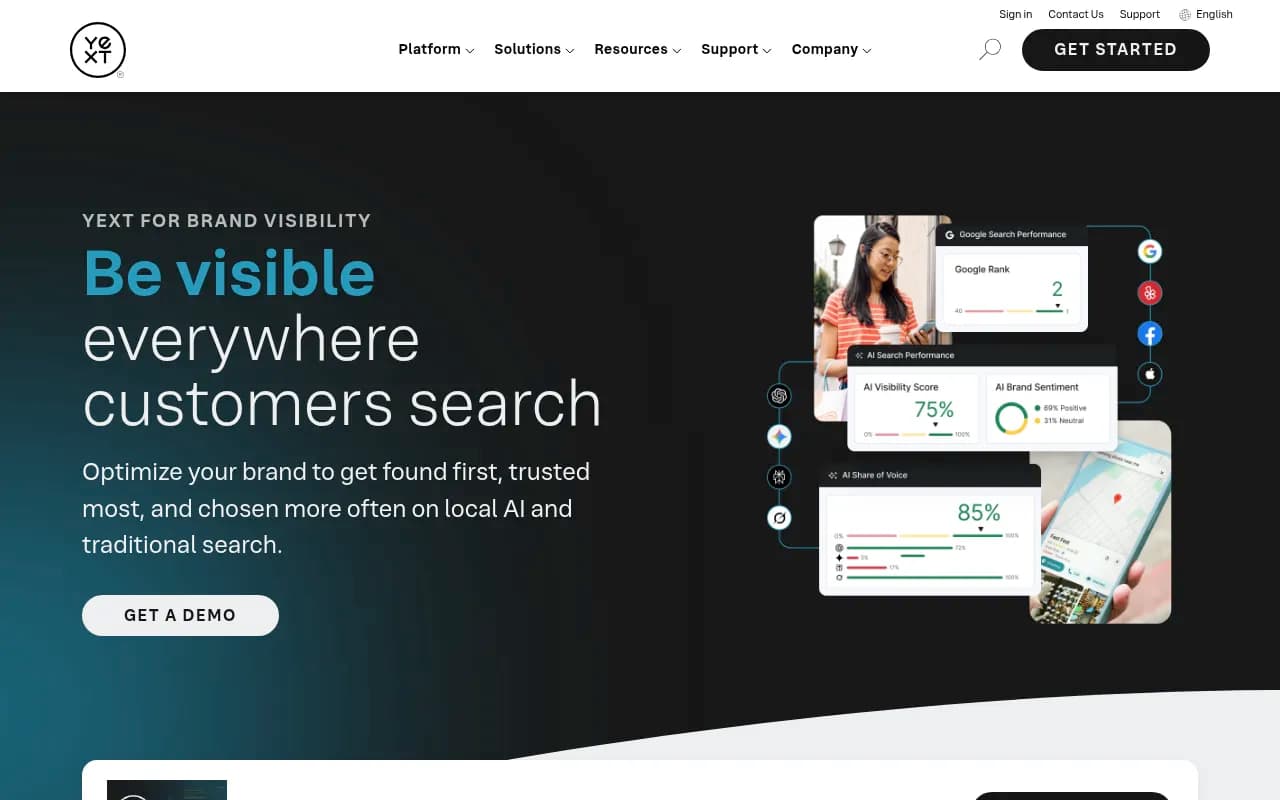
For multi-location brands, Yext's core strength is still listing management at scale. If you have 200 locations and need to push accurate NAP data to 100+ directories simultaneously, Yext is genuinely good at that. The platform also has a Knowledge Graph that structures your brand data in a way that's designed to be machine-readable -- which, in theory, helps AI engines understand and cite your locations correctly.
Yext's AI search features are real but limited compared to dedicated GEO platforms. It can show you how your brand appears in AI-generated answers and flag inconsistencies, but it doesn't have the depth of prompt analytics, competitor gap analysis, or content generation that platforms like Promptwatch offer. It's a listing platform that has added AI monitoring, not an AI visibility platform that also handles listings.
Pricing is enterprise-tier and typically requires a sales conversation. For brands already in the Yext ecosystem, the AI features are a reasonable add-on. For brands evaluating from scratch, the cost-to-capability ratio on the AI side is worth scrutinizing.
What Yext does well:
- Listing management at scale across 100+ directories
- Knowledge Graph for structured brand data
- Consistent NAP data for location pages
- Review management and local reputation features
Where it falls short for AI visibility:
- AI search features are supplementary, not core
- No content gap analysis or AI content generation
- Limited prompt-level analytics compared to dedicated GEO tools
- No AI crawler logs or traffic attribution
Uberall
Uberall sits in a similar category to Yext -- a multi-location marketing platform that has been expanding into AI search visibility. Its core product handles local listing management, review management, and local social media publishing across a brand's location network.
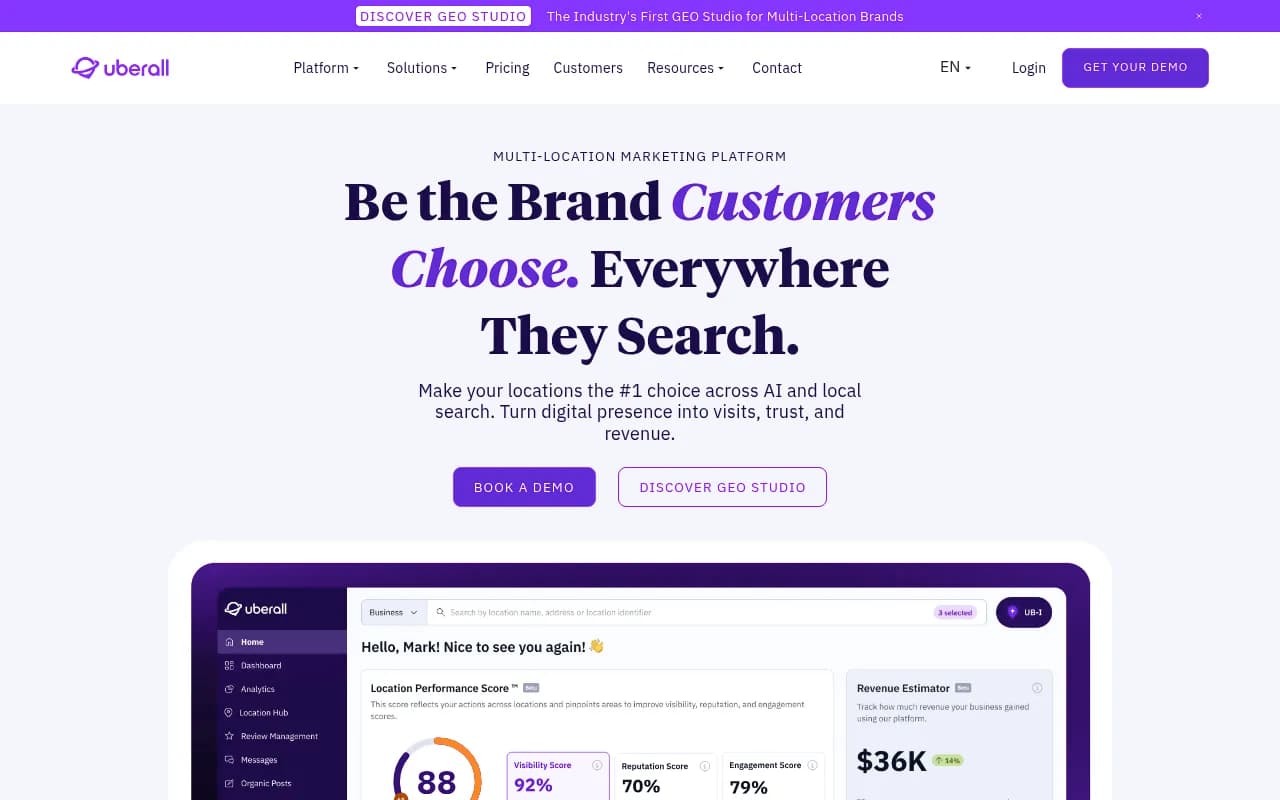
The platform has been adding features around AI search, including monitoring how locations appear in AI-generated local recommendations. For brands in retail, hospitality, or food service with dense location networks, Uberall's local marketing automation is genuinely useful -- it's designed for the operational reality of managing hundreds of locations with regional teams.
On the AI visibility side, Uberall is in a similar position to Yext: the features exist but they're not the platform's primary strength. You won't find the depth of prompt analytics, competitor heatmaps, or content generation that a dedicated GEO platform provides. What you will find is tight integration between your location data and AI search monitoring, which is valuable if listing accuracy is a significant driver of your AI visibility problems.
What Uberall does well:
- Multi-location listing management with regional team workflows
- Review management and response tools
- Local social publishing at scale
- AI search monitoring integrated with location data
Where it falls short:
- AI visibility features are secondary to the listing management core
- No content gap analysis or generation
- Limited LLM coverage compared to dedicated GEO platforms
Head-to-head comparison
| Feature | Peec AI | Promptwatch | Yext | Uberall |
|---|---|---|---|---|
| AI engines tracked | Up to 10 | 10 | Limited | Limited |
| Location-level tracking | Limited | City/state level | Yes (via listings) | Yes (via listings) |
| Content gap analysis | No | Yes | No | No |
| AI content generation | No | Yes | No | No |
| AI crawler logs | No | Yes | No | No |
| Listing management | No | No | Yes | Yes |
| Reddit/YouTube tracking | No | Yes | No | No |
| ChatGPT Shopping tracking | No | Yes | No | No |
| Traffic attribution | No | Yes | No | No |
| Competitor heatmaps | Basic | Yes | No | No |
| Starting price | ~EUR 85/mo | $99/mo | Enterprise (custom) | Enterprise (custom) |
| Best for | Monitoring-focused teams | Full GEO optimization | Listing-heavy brands | Multi-location local marketing |
Which tool fits which situation
This is where the honest answer gets more nuanced than "just pick one."
If your primary problem is listing accuracy affecting AI recommendations, Yext or Uberall makes sense as your foundation. AI engines increasingly pull from structured local data, and if your location pages have inconsistent NAP data or missing attributes, fixing that is step one. Neither platform will help you create content that gets cited in AI responses, but they'll make sure the foundational data is right.
If your primary problem is brand-level AI visibility -- you're not appearing in AI responses for your category, competitors are getting cited instead of you, and you need to understand why and fix it -- Promptwatch is the most complete tool in this comparison. The combination of gap analysis, content generation grounded in citation data, and AI crawler logs gives you a path from "we're invisible" to "we're being cited."
If you need monitoring without the optimization layer, Peec AI is a reasonable choice, particularly if your team has the internal capacity to act on what the data shows. The unlimited seats model works well for larger teams.
For most enterprise brands with multiple locations, the realistic answer is probably Promptwatch for AI search optimization combined with Yext or Uberall for listing management. They're not competing for the same job.
The gap that matters most in 2026
The AI visibility market has split into two camps: monitoring tools and optimization tools. Monitoring tools show you data. Optimization tools help you do something with it.
Peec AI is a monitoring tool. Yext and Uberall are listing management platforms with monitoring features. Promptwatch is the only platform in this comparison that was built around the full optimization cycle.
For a multi-location brand where "AI search visibility" means appearing in location-specific AI recommendations across dozens of markets, the monitoring-only approach creates a workflow problem. You end up with a dashboard full of gaps and no systematic way to close them.
The platforms that will matter most in 2026 are the ones that don't just show you where you're invisible -- they help you fix it. That's the real differentiator in this comparison, and it's worth weighting heavily when you're making a decision.
Related tools worth knowing
A few other platforms that come up in enterprise AI visibility evaluations:
Profound

Profound is frequently mentioned alongside Peec AI for enterprise monitoring. Strong on research and prompt volume data, though like Peec AI it's primarily a monitoring platform without content generation.
Otterly.AI

Otterly.AI is a lower-cost monitoring option that works well for smaller teams or brands just getting started with AI visibility tracking. Not built for enterprise multi-location complexity.
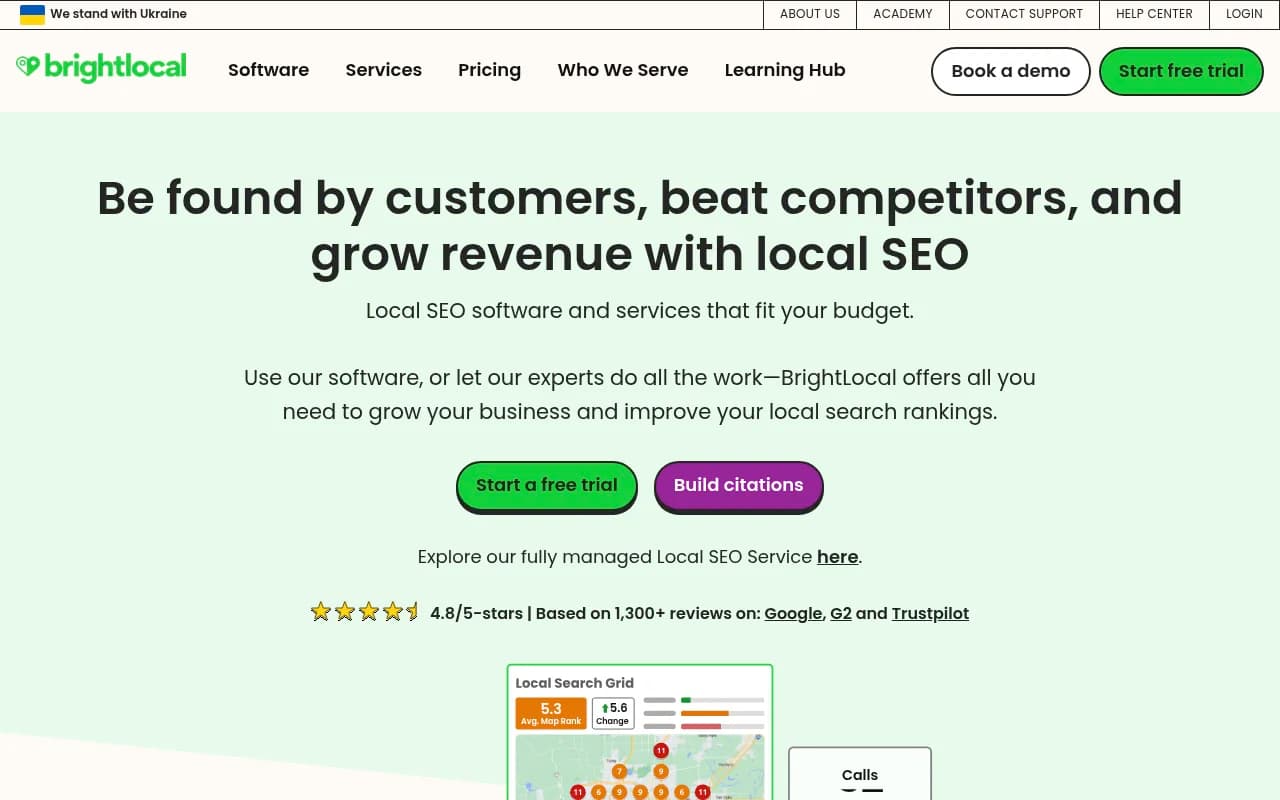
BrightLocal is worth knowing for the local SEO side of the equation -- it handles citation building and local rank tracking, and it's a common complement to AI visibility platforms for multi-location brands.
Semrush has AI visibility features built into its broader platform. Useful if your team is already deep in the Semrush ecosystem, though the AI tracking uses fixed prompts rather than the custom prompt sets that dedicated GEO platforms offer.