Key takeaways
- ChatGPT commands 87.4% of AI chatbot referral traffic but drives few direct clicks -- its value is brand recall and purchase-decision influence, not referral volume
- Perplexity delivers inline citations that convert at roughly 11x the rate of traditional organic search, making it the highest ROI platform per citation earned
- Google AI Overviews reach 2 billion monthly users but reduce organic CTR by ~35% when triggered -- structured data is the primary lever for getting cited
- For most B2B brands, the recommended sequence is: Perplexity first, then Google AI Overviews, then ChatGPT -- though this depends heavily on your audience and funnel stage
- All three platforms reward the same upstream input: authoritative, independently corroborated content that humans already cite
If you've been treating ChatGPT, Perplexity, and Google AI Overviews as basically the same thing, you're not alone. Most marketing teams in 2026 are running identical content strategies across all three, watching aggregate numbers, and wondering why AI visibility hasn't moved the revenue needle.
The problem is that these platforms are not interchangeable. Each one operates on different citation mechanics, serves different buyer stages, and responds to different optimization inputs. A tactic that earns you consistent Perplexity citations will not automatically surface you in Google AI Overviews. Neither approach translates directly to ChatGPT recommendations.
This guide breaks down exactly how each platform works, what the data says about their impact on brand visibility, and how to decide where to focus your energy first.
How each platform actually works
Before you can prioritize, you need to understand what you're optimizing for. These platforms differ not just in audience size, but in how they retrieve and cite content.
ChatGPT
ChatGPT is primarily a conversational AI with a massive user base -- 910 million weekly active users according to Sacra's research. When users ask questions, ChatGPT generates responses from a combination of its training data and, in browsing-enabled sessions, live web retrieval.
The critical thing to understand: ChatGPT doesn't always show citations, and when it does, it doesn't always link to them inline. Brand mentions happen, but they often happen without a clickable link. This means ChatGPT's value to your brand is mostly indirect. Someone asks "what's the best project management tool for remote teams?" and ChatGPT mentions your product. That person might not click anything -- but they remember the name when they're ready to buy.
ChatGPT holds 68% of AI chatbot traffic overall and drives 87.4% of all AI chatbot referrals. The volume is undeniable. The conversion path is just longer and harder to measure.
Perplexity
Perplexity is built around search. It generates internal sub-queries before answering, retrieves sources in real time, and displays inline citations with direct links. Every citation is a clickable reference.
This is what makes Perplexity different. When your brand gets cited here, users can click through immediately. According to data from AuthorityTech, those citations convert at roughly 11x the rate of traditional organic search. The audience is also self-selecting: people using Perplexity are typically in active research mode, often comparing options and closer to a decision.
The tradeoff is volume. Perplexity drives only 15-20% of AI referral traffic compared to ChatGPT. But the quality of that traffic is substantially higher.
Google AI Overviews
Google AI Overviews (formerly SGE) appear at the top of search results for a growing range of queries. They reach 2 billion monthly users across 200+ countries -- by far the largest reach of any AI search surface.
The catch: when AI Overviews appear, they reduce organic CTR by an average of 35%. Users get their answer without clicking. If you're cited in the overview, some of that lost traffic comes back to you. If you're not cited, you lose visibility without any compensating benefit.
Google AI Overviews draw heavily from existing Google signals: structured data, E-E-A-T signals, featured snippet eligibility, and traditional domain authority. If you already have strong SEO, you have a head start here. The optimization inputs are the most familiar of the three platforms.
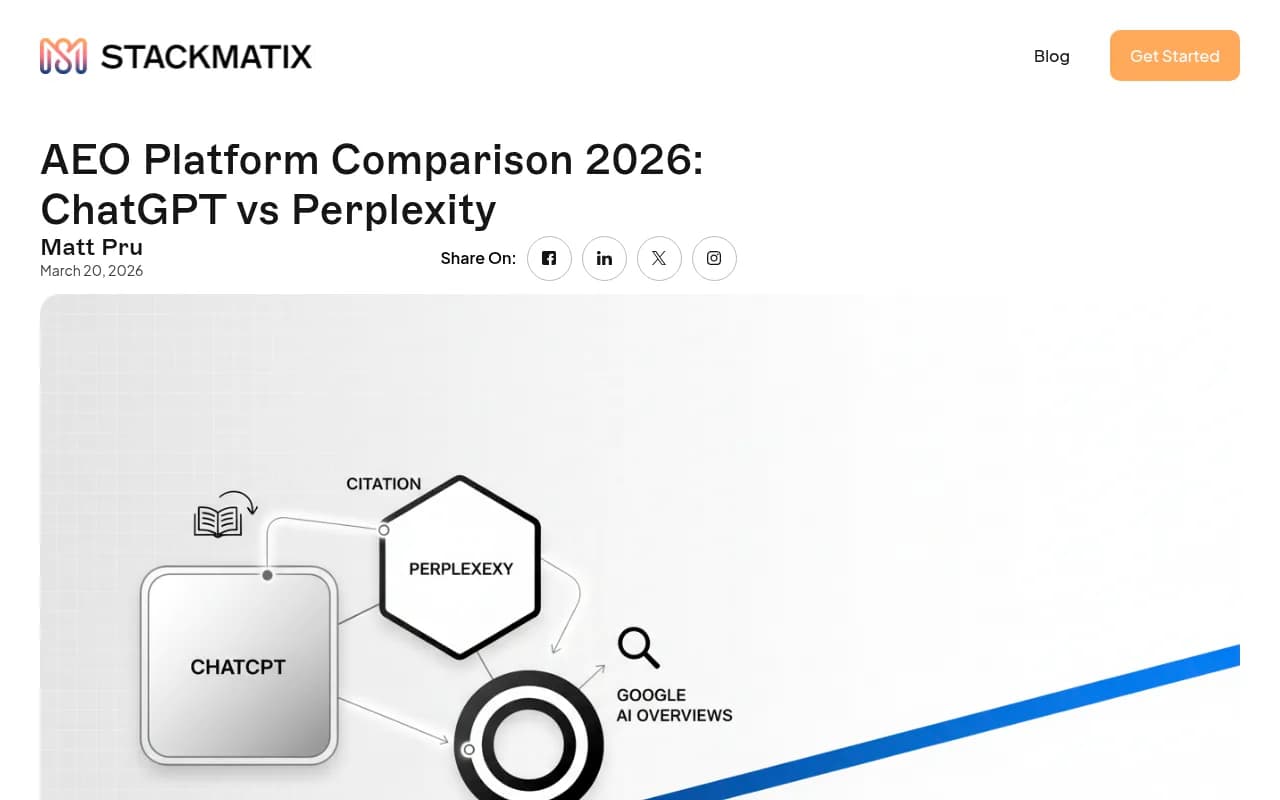
Platform comparison at a glance
| ChatGPT | Perplexity | Google AI Overviews | |
|---|---|---|---|
| Monthly reach | 910M+ weekly active users | ~100M monthly | 2B+ monthly |
| Share of AI referral traffic | ~87% | 15-20% | Integrated into Google |
| Citation style | Often uncited / no link | Inline linked citations | Linked sources panel |
| Conversion quality | Low (indirect brand recall) | Very high (11x organic) | Moderate (comparable to organic) |
| Primary buyer stage | Awareness / consideration | Active research / decision | Awareness to decision |
| Key optimization lever | Brand authority, third-party mentions | Freshness, specificity, direct answers | Structured data, E-E-A-T, traditional SEO |
| Click-through behavior | Rare | Common | Reduced vs. traditional organic |
| Best for | Brand recall at scale | High-intent conversions | Reach + existing SEO leverage |
The prioritization question
Here's where it gets practical. You probably can't optimize for all three simultaneously with the same depth. So which one first?
The answer depends on your situation, but the data points to a defensible default sequence.
Start with Perplexity if conversion quality is your primary concern
For B2B SaaS companies, professional services, and any brand where a single converted visitor is worth hundreds or thousands of dollars, Perplexity is the highest-ROI starting point. The traffic volume is lower, but the people clicking through are actively researching. They're comparing options. They're close to a decision.
Perplexity also has the most transparent citation mechanics of the three. It generates sub-queries before answering, which means you can reverse-engineer what it's looking for. Content that directly answers specific questions, with clear sourcing and recent publication dates, tends to get picked up.
Move to Google AI Overviews next if you have existing SEO infrastructure
If you've been doing traditional SEO for a while, Google AI Overviews is the most natural second step. The optimization signals overlap significantly: structured data, clear authorship, topical authority, and content that matches featured snippet patterns all help.
The reach argument is also compelling. Two billion monthly users is a number that's hard to ignore, even if the direct click behavior is complicated. Getting cited in AI Overviews for high-intent queries puts your brand in front of people who are actively searching -- and it partially offsets the CTR losses that AI Overviews create for traditional organic results.
Add ChatGPT last for brand recall at scale
ChatGPT is the hardest to optimize for directly because its citation behavior is the least transparent. It doesn't always show sources, and when it does, it doesn't always link. The optimization levers are mostly indirect: earn third-party coverage, get mentioned on authoritative sites, build the kind of brand presence that humans already cite.
That said, ChatGPT's scale means it's worth taking seriously. If your brand is consistently mentioned in ChatGPT responses, you're building awareness with nearly a billion weekly users. That has real value -- it just operates through brand recall rather than direct clicks.
What actually gets you cited across all three
Despite their differences, all three platforms share a common upstream requirement: they cite brands that humans already cite.
This isn't a technical observation -- it's a strategic one. AI engines are trained on and retrieve from the web. If your brand is mentioned in authoritative third-party sources, industry publications, Reddit discussions, YouTube reviews, and comparison articles, you're building the raw material that all three platforms draw from.
A few specific things that move the needle:
Third-party coverage: A mention in a credible industry publication carries more weight than ten self-published blog posts. AI models are trained to weight independently corroborated information. If multiple sources say you're good at something, that signal is stronger than your own claims.
Direct, specific answers: All three platforms favor content that answers questions clearly. Vague thought leadership doesn't get cited. A page that directly answers "how does [your product] handle [specific use case]" is more likely to surface than a general overview of your company.
Freshness: Perplexity in particular weights recency. Regularly updated content -- especially content that references current data, recent events, or updated product features -- gets prioritized over stale pages.
Structured data: This matters most for Google AI Overviews but doesn't hurt on the others. FAQ schema, HowTo schema, and proper article markup help AI systems understand and extract your content.
Reddit and YouTube presence: This one surprises people. AI models, including the ones powering these platforms, frequently cite Reddit threads and YouTube videos in their responses. A well-placed Reddit comment or a YouTube review from a credible creator can drive citations just as effectively as a formal blog post.
How to track whether any of this is working
The frustrating reality of AI visibility is that it's genuinely hard to measure without dedicated tooling. Google Analytics won't tell you that someone discovered your brand through a ChatGPT response. Standard rank tracking doesn't cover AI-generated answers.
You need to be actively querying these platforms with the prompts your customers are likely using, and tracking whether your brand appears -- and how prominently.
Promptwatch is built specifically for this. It monitors your brand visibility across ChatGPT, Perplexity, Google AI Overviews, and seven other AI models, and it goes beyond just showing you where you appear. The Answer Gap Analysis shows which prompts competitors are getting cited for that you're not -- the specific content gaps your site has. From there, the built-in content generation tools help you create articles and pages engineered to fill those gaps and earn citations.

For teams that want a simpler starting point, a few other tools are worth knowing about:
Otterly.AI tracks brand mentions across the major AI platforms with a clean interface.
Otterly.AI

Peec AI covers ChatGPT, Perplexity, and Claude with basic monitoring features.

Profound is an enterprise-focused option with strong tracking across 9+ AI engines.
Profound

The honest caveat: most monitoring tools show you data but don't help you act on it. Knowing you're invisible in Perplexity is useful. Knowing exactly what content to create to fix that is more useful.
Platform-specific optimization tactics
For Perplexity
Perplexity generates multiple sub-queries before producing an answer. This means a single user question might trigger searches for several related topics. To get cited, your content needs to answer not just the top-level question but the likely follow-up questions too.
Practical tactics:
- Write content that directly answers specific questions in the first paragraph, not buried three sections down
- Include publication dates and update them when you refresh content
- Use clear headings that match question formats ("How does X work?", "What is the difference between X and Y?")
- Build topical clusters so Perplexity can find multiple relevant pages on your site for a given topic
For Google AI Overviews
Google AI Overviews draw heavily from the same signals as featured snippets. If you've optimized for featured snippets before, you're already partway there.
Practical tactics:
- Add FAQ schema to pages that answer common questions in your category
- Write concise, direct answers (40-60 words) to target questions, then expand with detail
- Maintain strong E-E-A-T signals: clear authorship, credentials, and citations to authoritative sources
- Keep your traditional SEO fundamentals strong -- domain authority still matters here
For ChatGPT
ChatGPT is the hardest to optimize for directly. The most reliable approach is building the kind of brand presence that shows up in the training data and live retrieval sources that ChatGPT draws from.
Practical tactics:
- Earn coverage in publications that ChatGPT is likely to have in its training data (major industry publications, well-known review sites)
- Get listed and reviewed on platforms like G2, Capterra, and Trustpilot -- these are frequently cited
- Build a presence in Reddit communities relevant to your category
- Create content that gets linked to and referenced by other authoritative sites
A note on the "one platform" trap
The biggest mistake brands make isn't choosing the wrong platform to prioritize -- it's treating this as a permanent choice. The right answer in early 2026 might be different from the right answer in late 2026 as these platforms evolve.
Perplexity is growing fast. ChatGPT is adding more shopping and recommendation features. Google is integrating AI more deeply into every part of search. The platforms are moving targets.
The most durable strategy is building the underlying asset that all three platforms reward: genuine authority in your category, expressed through content that humans find useful enough to cite, share, and link to. That's what gets you into AI responses -- not metadata tricks or prompt injection.
Start with Perplexity if you need near-term conversions. Layer in Google AI Overviews if you have existing SEO leverage. Build toward ChatGPT visibility as a long-term brand recall play. And track all of it so you can see what's actually working.
The brands that figure this out early will have a meaningful head start. The ones that wait until AI search is "mature" will be playing catch-up against competitors who've already built citation authority across all three platforms.