Key takeaways
- Profound is the deeper data play: prompt-level volume claims, daily front-end querying, and citation analytics. Public pricing is now a trial plus custom Enterprise, so budget for a sales call.
- Scrunch is cheaper to start (about $250 to $300 a month) and stronger on the technical side: page audits, AI bot traffic, and its Agent Experience Platform (AXP). The Core tier's 125-prompt cap is tight for a SaaS team with several personas.
- Sitecore acquired Scrunch in 2026. It still sells standalone, but the roadmap now sits with Sitecore.
- Almost every comparison online is vendor-authored. I found no neutral, hands-on test of comparison and "best X for Y" prompts, so run your own pilot.
- Both tools mostly stop at monitoring and diagnostics. Someone still has to write and publish the content.
What buyer research prompts actually look like
B2B SaaS buyers ask AI assistants things like "best CRM for a 50-person sales team", "Tool A vs Tool B", "alternatives to Tool C", and "does X integrate with Salesforce". Those are commercial, comparison and informational prompts, and they pull from different content.
Promptwatch Data shows how different. In ChatGPT citations by content type (Sep 28 to Oct 4, 2026), product pages were 22.4% of all citations. For commercial prompts, product pages hit 26.0%, landing pages 20.6%, listicles 15.0% and comparisons 7.9%. Those four types made up almost 70% of commercial citations. Branded prompts lean on reviews, which were 5.6% of citations there, more than 3x their share across all prompts.
So the question for a SaaS team is not just "can this tool track my brand?" It is:
- Can I segment prompts by intent (commercial, informational, branded, competitor comparison)?
- Can I see which sources get cited, vendor pages and docs versus review sites like G2 and Capterra?
- Does the prompt set match what AI actually searches?
- How many prompts can I run before the plan runs out?
On the software category, Promptwatch's ChatGPT software citation data (Sep 28 to Oct 4, 2026) found vendor sites plus docs and help centers earned 4.65% of citations, about 3x the 1.57% earned by review sites and analysts like G2, Gartner and Capterra. That matters for how you read each tool's strengths, which I get to below.
Profound vs Scrunch at a glance
| Profound | Scrunch | |
|---|---|---|
| Positioning | Enterprise analytics, attribution, agentic marketing | Monitoring plus page audits and agent-facing content delivery |
| Ownership | Independent | Acquired by Sitecore in 2026, integrating with SitecoreAI |
| Entry pricing | Free trial (50 prompts, 7 days), then custom Enterprise | Core around $250/mo annual, $300 monthly (verify) |
| Prompt limits | Vendor claims unlimited daily prompts | 125 prompts and 5,000 responses a month on Core |
| Prompt demand data | Claims 2B+ real user prompts with volume | Topic-level trends from third-party data |
| Technical side | Crawler observability, enterprise integrations | Site audits, AI bot traffic, AXP |
| Best fit | Teams treating AI search as a revenue channel | Teams starting out, or already on Sitecore |
Treat the Profound claims as vendor claims. Several come from Profound's own site.
Profound for buyer research prompts
Profound

Profound is the heavier platform. Its pitch is that it tracks up to 9 answer engines daily using front-end browser querying, so you see what a real user would see. It also says it has prompt-level volume data from 2B+ real user prompts, broken down by intent, age, income, country and platform.
If that holds up in your account, it solves the biggest problem in B2B prompt tracking: deciding which prompts are worth tracking. A SaaS team can choose "alternatives to [competitor]" prompts by demand instead of guessing.
What I like:
- Demand-ranked prompts, if the volume data is as good as claimed.
- Citation analytics across third-party sources, which covers the G2, Capterra and listicle side of buyer research.
- Enterprise integrations and security documentation, which procurement teams ask for.
What gives me pause:
- Pricing. IndustryLens reports the $99 Starter tier is gone, leaving a 7-day trial (50 prompts, ChatGPT, Gemini and Google AI Overviews) and custom Enterprise. Some third-party pages still list $99, so confirm at tryprofound.com/pricing.
- Profound's FAQ reportedly points teams of more than three people to Enterprise. That is a big step for a 10-person SaaS marketing team.
- Much of the "Profound beats Scrunch" evidence is self-published. The 47.1% versus 4.7% visibility table in one comparison is unverified.
Scrunch for buyer research prompts
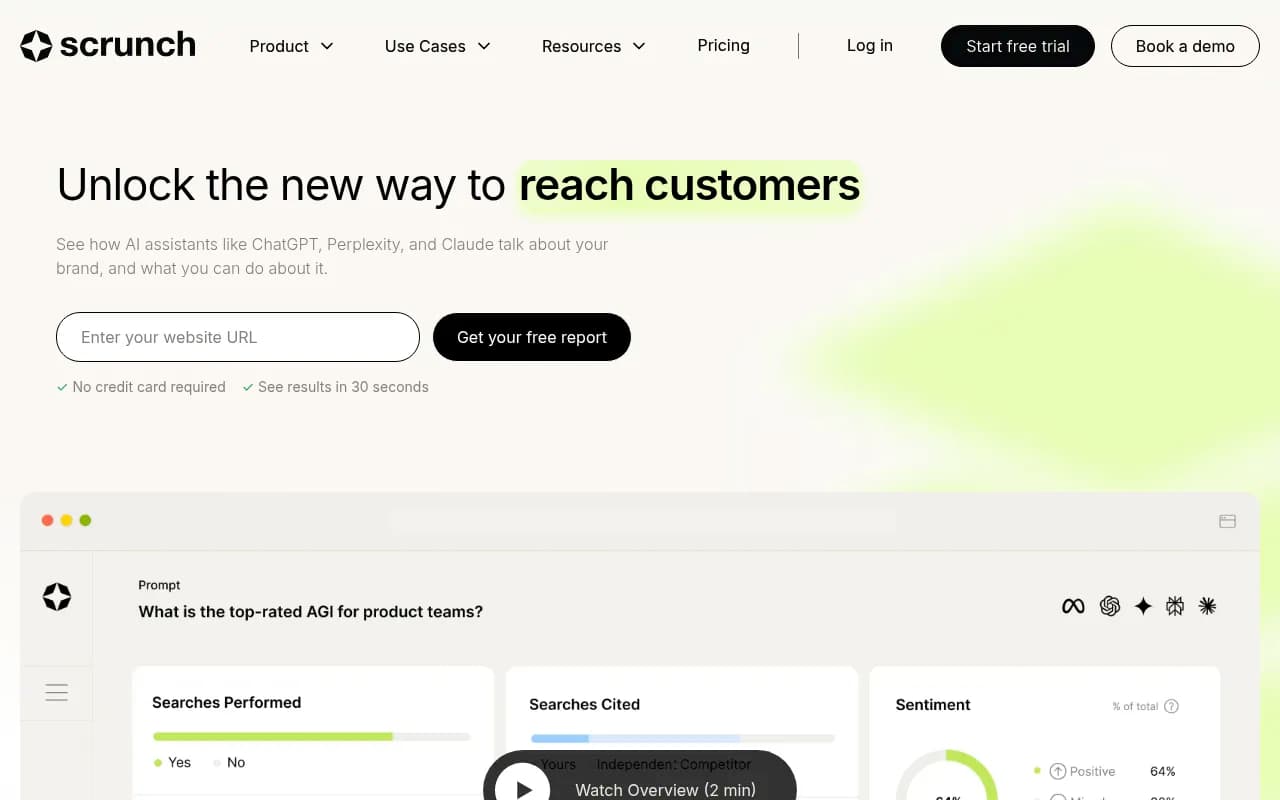
Scrunch tracks mentions across major AI engines with configurable prompt sets, so you control which buyer questions you monitor. Its edge is on the technical side: page audits, live AI crawler monitoring, and AXP, which serves a machine-readable version of your site to AI crawlers. The claimed token reduction is about 98.9%, which is a vendor number I would test before believing.
Given the Promptwatch Data above, where vendor pages and docs outearned review sites roughly 3 to 1 in software citations, a tool focused on making your own pages readable to AI is a sensible bet for SaaS teams with big docs sites and product catalogs. SuperMarketers makes the same point about teams with lots of docs and product pages.
The weak spots for buyer research:
- The reported Core tier is 125 unique prompts, one country, one persona, one language and four LLMs. A SaaS company with three personas, six use cases and a dozen competitors burns through 125 prompts quickly.
- Pricing sources conflict. IndustryLens lists Core at $250/mo, another note lists Starter at $250 annual or $300 monthly with Growth at $417/$500, and AirOps says "from $300". Check the pricing page.
- SuperMarketers calls Scrunch the most generous on prompt count in its group. That does not square with the 125-prompt limit, so confirm which plan they meant.
- Sitecore now owns it. If you are not a Sitecore shop, ask how the roadmap will be prioritized.
Which handles buyer research prompts better?
Honest answer: neither has been independently tested on this, and I would not trust anyone who says otherwise. Here is how I would split it.
| Buyer research need | Better fit | Why |
|---|---|---|
| Choosing which prompts to track by demand | Profound | Claims prompt-level volume; Scrunch offers topic-level trends |
| Tracking many prompt variants across personas | Profound | No published low prompt cap on Enterprise; Scrunch Core caps at 125 |
| Seeing third-party citations (G2, listicles, Reddit) | Profound | Deeper citation analytics |
| Fixing your own product and docs pages for AI | Scrunch | Page audits and AXP |
| Watching AI bot traffic | Both, Scrunch more accessible | Scrunch markets this strongly at lower price points |
| Budget under a few hundred dollars a month | Scrunch | Public pricing |
| Fortune 500 procurement | Profound | Enterprise integrations and security documentation |
AirOps, itself a competitor, frames it this way: choose Profound when AI search is a real revenue channel and you need deep benchmarking, and Scrunch when agent-facing content delivery and persona-level filtering matter. That is a fair summary, and both tools leave execution to your team.
A pilot plan for your own buyer prompts
Because the public evidence is thin, run a two-week pilot with each vendor:
- Write 40 prompts: 10 "best X for Y", 10 "A vs B", 10 "alternatives to C", 10 branded.
- Tag each by intent and persona. Check whether the tool lets you do this natively.
- Compare the answers in the tool to what you see in ChatGPT yourself. Count mismatches.
- Look at the cited sources. Does it separate your pages, docs, G2 and Reddit?
- Check whether it shows what ChatGPT actually searched. Promptwatch's query fanout data showed average fanouts per response falling from 2.15 in December 2025 to 1.0 in April 2026, with query length dropping from about 117 to about 53 characters, and a later report found ChatGPT began using the site: operator at scale on August 8, 2026. A fixed prompt list drifts from reality fast.
- Ask for the real quote on the plan you need, including seats, countries and models.
Other options worth a look
If neither fits, the field is wide. Peec AI and Otterly.AI are cheaper monitoring baselines. AthenaHQ is an all-rounder with a free tier. AirOps is stronger when you want visibility gaps to turn into published content.


If you want monitoring and the work that follows in one place, Promptwatch is worth a trial. It tracks the real interfaces of ChatGPT, Google AI Overviews, Perplexity and others, scores prompts with volumes and difficulty, shows query fan-outs, logs AI crawler visits, and has a Content Agent that plans, writes and publishes to Webflow, Framer or WordPress. Plans start at $95/mo with a free tier, and the Business plan ($579/mo) adds the automated Content Agent. Confirm current pricing at promptwatch.com/pricing.

For a wider shortlist, the GEO software directory at bestgeosoftware.com lists many more.
How I would decide
- Pick Profound if AI search is already tied to pipeline, you have budget for Enterprise, and you want demand data to prioritize prompts.
- Pick Scrunch if you are early, want public pricing, care about technical readiness of your site, or already run Sitecore. Ask hard questions about the 125-prompt cap and the roadmap.
- Pick neither until you have piloted both on your own prompts if the decision is more than a few thousand dollars a year.
One last point. Both tools tell you where you are missing. Closing the gap means content: comparison pages, product pages and docs that match how buyers ask. Budget for that separately, whichever tool you choose.