Key takeaways
- Enterprise GEO platforms split into two camps: monitoring-only tools and full-stack optimization platforms that help you fix what they find.
- Promptwatch is the only platform in this comparison rated as a "Leader" across all GEO categories, with crawler logs, content generation, and revenue attribution in one place.
- Evertune targets Fortune 500 brands with deep brand perception tracking; Conductor brings AI visibility into a broader enterprise SEO suite; Qwairy is a newer entrant focused on multi-engine tracking at a lower price point.
- For enterprise teams that need to move from "we're invisible in AI search" to "we're being cited," the platform with content generation and gap analysis built in will deliver faster ROI than a pure monitoring dashboard.
- Price alone is a poor guide -- what matters is whether the platform closes the loop from discovery to action.
The GEO platform market has gotten genuinely confusing. Every tool now claims to track your brand across ChatGPT, Gemini, Perplexity, and a dozen other AI engines. The marketing language is nearly identical. And for enterprise teams with real budgets and real accountability, picking the wrong platform means months of data with no clear path to improvement.
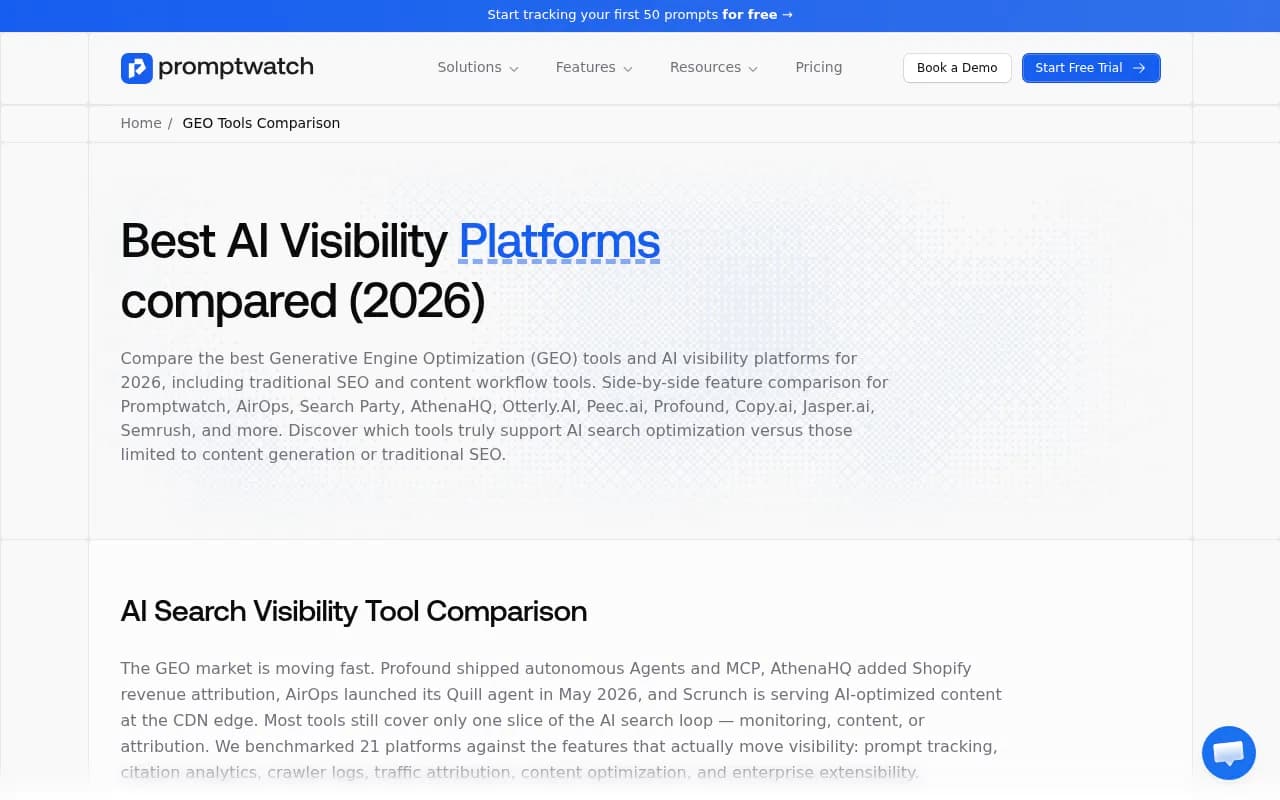
This comparison focuses on four platforms that come up repeatedly in enterprise shortlists: Qwairy, Promptwatch, Evertune, and Conductor. They're not all the same category of tool -- which is actually the most important thing to understand before you start a trial.
What enterprise teams actually need from a GEO platform
Before comparing features, it's worth being specific about what "enterprise" requirements actually look like in practice.
Most enterprise marketing teams aren't just curious about AI visibility -- they're being asked to defend budget, show ROI, and compete against brands that are already appearing in ChatGPT answers for their category. That means they need:
- Coverage across multiple AI engines (not just one or two)
- Competitor benchmarking, not just self-monitoring
- Content gap analysis that tells them what to create, not just what's missing
- Traffic attribution that connects AI citations to actual revenue
- Crawler and crawl-log data to understand why AI engines are or aren't citing specific pages
- Multi-site, multi-region, multi-language support
- API access and integrations for custom reporting
A platform that only delivers monitoring data -- "here's your citation rate this week" -- doesn't meet that bar. Enterprise teams need the full loop: find gaps, create content, track results.
The four platforms at a glance
Promptwatch
Promptwatch is a Dutch GEO platform (Promptwatch B.V.) used by 1,480+ brands and agencies including Booking.com, Center Parcs, and Elaboratum. It monitors 10 AI engines: ChatGPT, Perplexity, Google AI Overviews, Google AI Mode, Claude, Gemini, Meta/Llama, DeepSeek, Grok, and Mistral.
What separates it from the others in this comparison is the action loop. It doesn't just show you citation data -- it shows you which prompts competitors are visible for that you're not (Answer Gap Analysis), generates content designed to close those gaps (Content Agents), and then tracks whether that content gets crawled and cited (AI Crawler Logs and Agent Analytics). Page-level visibility tracking shows exactly which pages are being cited, by which models, and how often. Traffic attribution connects that visibility back to revenue.
It also has features that none of the other three have: Reddit and YouTube insights (both channels that directly influence AI recommendations), ChatGPT Shopping tracking, and real-time AI crawler logs that show when GPTBot, ClaudeBot, and other AI crawlers hit your pages.
Pricing starts at $99/month (Essential, 1 site, 50 prompts), $249/month (Professional, 2 sites, 150 prompts, crawler logs), and $579/month (Business, 5 sites, 350 prompts). Agency and enterprise pricing is custom.

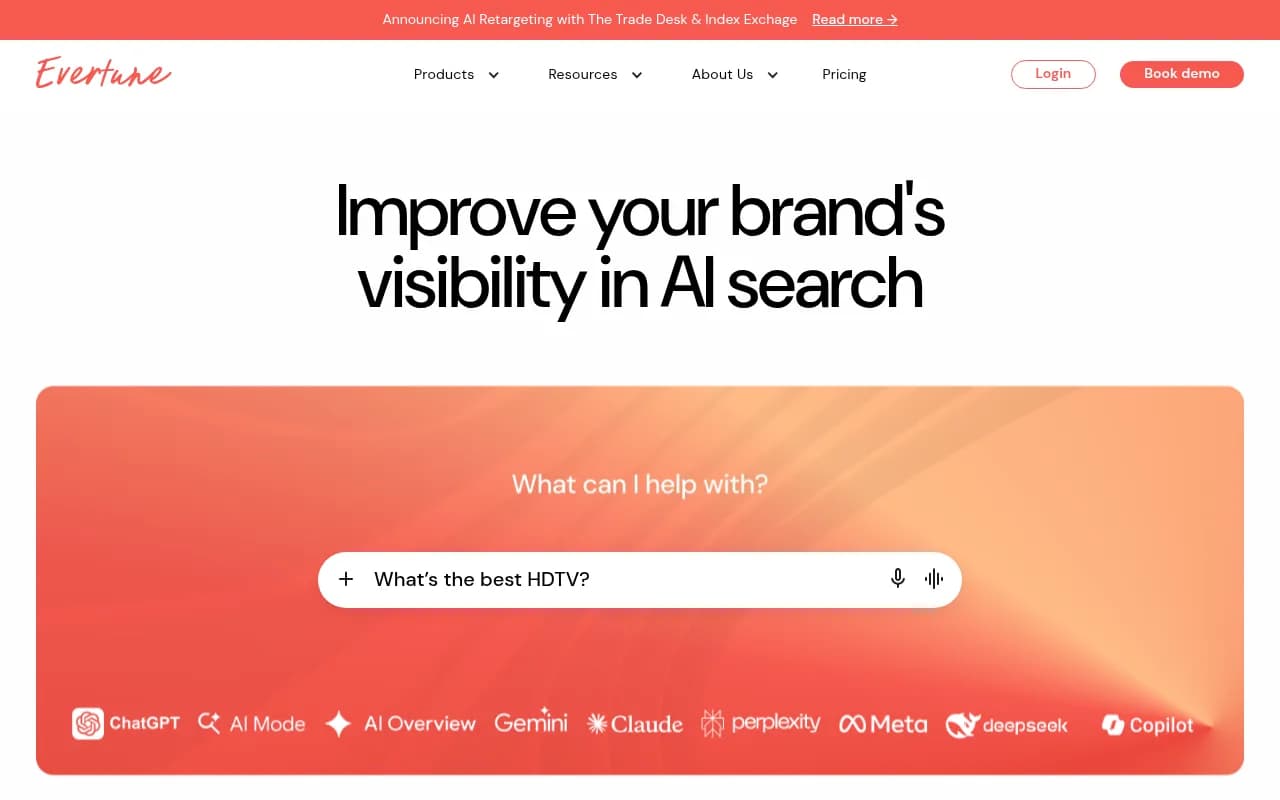
Evertune
Evertune positions itself as an enterprise GEO platform built for Fortune 500 brands. Its focus is on brand perception inside AI answers -- not just whether you're mentioned, but how you're described, what attributes AI models associate with your brand, and how that compares to competitors.
The platform covers multiple AI engines and offers brand monitoring, competitive benchmarking, and GEO insights. Evertune's strength is in brand intelligence depth: sentiment analysis, attribute tracking, and understanding the narrative AI models have built around your brand over time.
Where it's weaker: Evertune doesn't have content generation built in, and its crawler log capabilities are limited compared to Promptwatch. It's a strong monitoring and analysis tool, but it leaves the "now what do we do?" question largely unanswered.
Pricing is enterprise-tier and not publicly listed -- expect a sales conversation.
Conductor
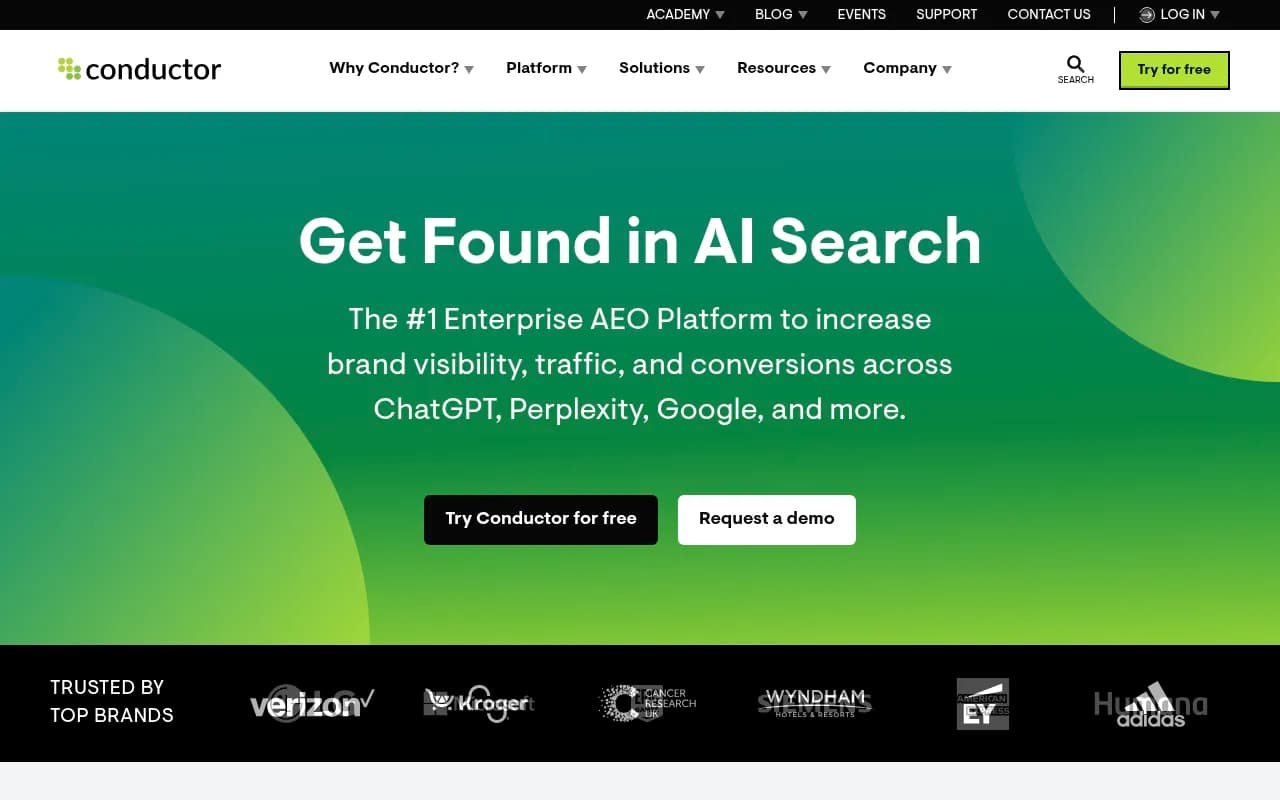
Conductor is primarily an enterprise SEO platform that has added AI search visibility features. It tracks brand authority and citations in AI search engines, and its AI visibility module sits inside a broader suite that includes traditional rank tracking, content optimization, and website monitoring.
For enterprise teams that are already Conductor customers, the AI visibility add-on is a reasonable way to get basic GEO data without adding another vendor. For teams evaluating from scratch, the question is whether you want a purpose-built GEO platform or an SEO platform with GEO features bolted on.
Conductor's AI visibility coverage is narrower than Promptwatch or Evertune, and it doesn't offer content generation specifically engineered for AI citation. Its strength is in the breadth of the overall SEO platform and its enterprise integrations.
Qwairy
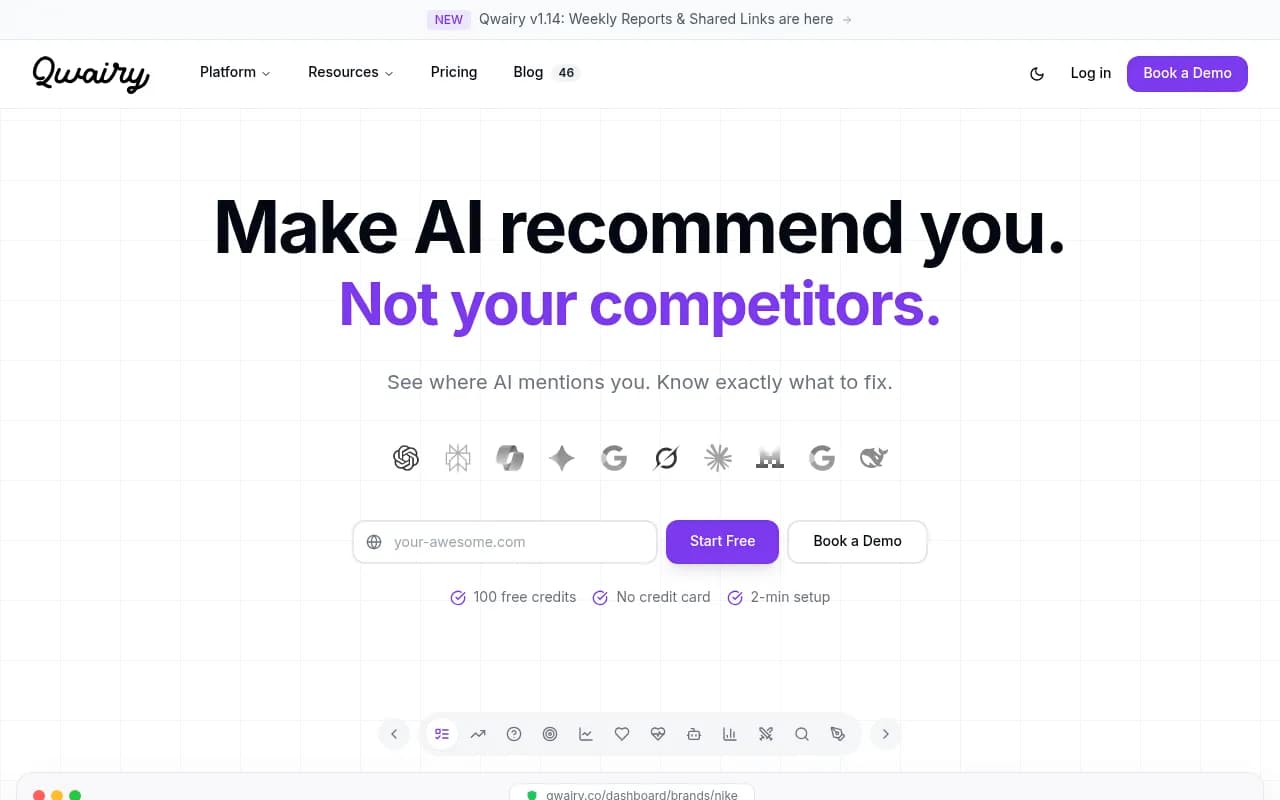
Qwairy is a newer entrant in the GEO space. It tracks brand visibility across 10 AI engines and is positioned around helping teams identify and fix visibility gaps. The platform is more accessible in terms of price point than Evertune or Conductor, which makes it attractive for teams that want multi-engine coverage without committing to an enterprise contract.
Qwairy's gap analysis features are genuinely useful, and the interface is clean. The tradeoff is depth: it doesn't have AI crawler logs, Reddit/YouTube insights, ChatGPT Shopping tracking, or the content generation capabilities that Promptwatch offers. It's a solid monitoring and gap-identification tool, but the "fix it" part of the workflow still requires other tools.
Feature comparison
| Feature | Promptwatch | Evertune | Conductor | Qwairy |
|---|---|---|---|---|
| AI engines covered | 10 | Multiple (undisclosed) | Limited | 10 |
| Competitor benchmarking | Yes | Yes | Yes | Yes |
| Answer gap analysis | Yes | Partial | No | Yes |
| Content generation (AI) | Yes | No | No | No |
| AI crawler logs | Yes | No | No | No |
| Page-level citation tracking | Yes | No | No | No |
| Traffic/revenue attribution | Yes | No | Partial | No |
| Reddit & YouTube insights | Yes | No | No | No |
| ChatGPT Shopping tracking | Yes | No | No | No |
| Multi-language/region | Yes | Yes | Yes | Limited |
| Prompt volume & difficulty | Yes | No | No | No |
| API access | Yes | Yes | Yes | Limited |
| Looker Studio integration | Yes | No | Yes | No |
| Public pricing | Yes ($99-$579/mo) | No (enterprise) | No (enterprise) | Limited |
| Free trial | Yes | No | No | Yes |
Where each platform wins
Promptwatch wins on: closing the loop
The core case for Promptwatch in an enterprise context is that it's the only platform here that takes you from "we're invisible" to "we're being cited" without requiring three other tools. The Content Agents generate articles, listicles, and comparisons grounded in real prompt data -- not generic SEO content, but pages engineered to answer the specific gaps AI models are exposing. Agent Analytics then shows the timeline from publish to crawl to citation.
For enterprise teams that are accountable for results (not just data), this matters. A monitoring dashboard that shows you're losing to competitors in AI search is frustrating without a clear path to fix it.
The crawler log feature is also genuinely rare. Knowing that GPTBot crawled your pricing page three times last week but your comparison page zero times -- and then seeing that your comparison page has zero citations -- is actionable intelligence. Most competitors don't offer this at all.
Evertune wins on: brand perception depth
If your primary concern is how AI models describe your brand -- the attributes, sentiment, and narrative they've built around you -- Evertune has the deepest analysis here. For large brands where brand perception is a board-level concern, this is valuable.
The limitation is that Evertune is better at diagnosing the problem than solving it. You'll know your brand is being described as "expensive" or "complex" in AI answers, but the platform won't help you create content to change that narrative.
Conductor wins on: existing enterprise SEO integration
If your team is already deeply embedded in Conductor for traditional SEO, adding AI visibility data inside the same platform reduces context-switching and keeps reporting unified. Conductor's enterprise integrations and workflow tools are mature.
The honest caveat: Conductor's AI visibility features feel like an addition to an SEO platform rather than a purpose-built GEO solution. Teams that are serious about winning in AI search will likely outgrow it.
Qwairy wins on: accessible entry point
For enterprise teams that want to start tracking AI visibility without a long procurement process or a six-figure contract, Qwairy offers a reasonable starting point. The multi-engine coverage is solid, and the gap analysis is useful for initial diagnosis.
The risk is that you'll quickly hit the ceiling. When the team asks "what do we do about these gaps?" or "why isn't our content being crawled?", Qwairy doesn't have answers.
The honest comparison: monitoring vs. optimization
The most useful frame for this decision isn't features vs. features -- it's monitoring vs. optimization.
Evertune, Conductor, and Qwairy are primarily monitoring tools. They show you what's happening in AI search. That's genuinely valuable, especially early in your GEO journey when you're trying to understand the landscape.
Promptwatch is built around optimization. It assumes you already know that AI visibility matters and want to systematically improve it. The monitoring is there, but it's in service of the action loop: find gaps, create content, track results.
For enterprise teams that are past the "let's see what's happening" phase and into "we need to move the needle," the optimization platform will deliver more value. For teams that are still building the business case internally and need data to justify investment, a monitoring-first tool might be the right starting point.
Pricing reality for enterprise teams
One thing worth noting: Evertune and Conductor both require a sales conversation before you see pricing. That's not unusual for enterprise software, but it does mean you're committing significant time to evaluation before you know if the numbers work.
Promptwatch publishes its pricing ($99 to $579/month for standard tiers, custom for enterprise/agency), which makes it easier to evaluate ROI before you're deep in a procurement process. There's also a free trial, which none of the enterprise-tier competitors offer.
Qwairy is more transparent on pricing than Evertune or Conductor, which is a point in its favor for teams that need to move quickly.
Which platform should enterprise teams choose?
There's no universal answer, but here's a practical framework:
If you need the full stack -- monitoring, gap analysis, content generation, crawler logs, and revenue attribution -- and you want one platform instead of three, Promptwatch is the strongest option in 2026. It's the only platform in this comparison that has all of those capabilities, and it's the only one that's been rated a "Leader" across all GEO categories in independent comparisons.
If brand perception and narrative analysis are your primary concern and you have budget for an enterprise contract, Evertune is worth evaluating seriously. Just go in knowing you'll need other tools for the content side.
If you're already a Conductor customer and want basic AI visibility data without adding a new vendor, the Conductor AI module is a reasonable starting point -- but treat it as a bridge, not a destination.
If you need multi-engine monitoring at a lower price point and you're comfortable doing the content work separately, Qwairy is a solid entry-level option.
The pattern across all four: the platforms that only monitor will eventually leave you with a dashboard full of data and no clear path forward. Enterprise teams that want to actually improve their AI visibility -- not just measure it -- need a platform that helps them act on what they find.
Bottom line
The GEO platform category is still maturing, and the gap between monitoring tools and optimization platforms is the most important distinction to understand before you buy. Evertune, Conductor, and Qwairy all have real strengths, but they leave the hardest part of the job -- creating content that AI models will actually cite -- to you.
Promptwatch is the only platform in this comparison that covers the full loop, from identifying which prompts you're invisible for to generating the content to fix it to tracking whether that content gets crawled and cited. For enterprise teams that are accountable for results, that's the difference between a reporting tool and a growth lever.