Key takeaways
- Most AI visibility tools stop at monitoring -- they show you where you're invisible but don't help you fix it.
- Otterly.AI and Peec AI are solid entry points for teams that need basic tracking on a budget, but both lack crawler logs, content generation, and traffic attribution.
- Scrunch AI is a monitoring-first platform with a cleaner interface than most, but it's still primarily a dashboard tool.
- Promptwatch is the only platform in this comparison that closes the full loop: find gaps, generate content, track results -- with crawler logs, prompt intelligence, and built-in AI writing.
- If your goal is to actually improve your AI visibility (not just measure it), that distinction matters more than any pricing difference.
Why this comparison matters in 2026
AI search isn't a future trend anymore. ChatGPT, Perplexity, Google AI Overviews, and Gemini are now part of how a meaningful chunk of your potential customers find information and make decisions. Brands that appear in those answers get considered. Brands that don't, don't.
The market responded by producing a wave of "AI visibility" tools -- most of which are monitoring dashboards dressed up as optimization platforms. They'll show you a score, maybe a list of prompts where a competitor outranks you, and then... leave you to figure out what to do next.
That gap between "here's your data" and "here's how to fix it" is the most important thing to understand when evaluating these four platforms. Let's go through each one honestly.
The four platforms at a glance
Before diving into each tool, here's a side-by-side comparison across the features that actually matter for optimization (not just monitoring):
| Feature | Promptwatch | Scrunch AI | Otterly.AI | Peec AI |
|---|---|---|---|---|
| AI visibility tracking | Yes (10 models) | Yes | Yes | Yes |
| Prompt volume & difficulty scores | Yes | No | No | No |
| Answer gap / competitor analysis | Yes | Limited | Limited | Limited |
| AI crawler logs | Yes | No | No | No |
| Built-in content generation | Yes | No | No | No |
| Reddit & YouTube citation tracking | Yes | No | No | No |
| ChatGPT Shopping tracking | Yes | No | No | No |
| Traffic attribution (GSC / logs) | Yes | No | No | No |
| Page-level citation tracking | Yes | No | No | No |
| Starting price | $99/mo | Higher | $29/mo | €89/mo |
| Free trial | Yes | Yes | Yes | Yes |
The pattern is clear. Three of these tools are monitoring platforms. One is an optimization platform. Whether that difference justifies the price gap depends entirely on what you're trying to accomplish.
Otterly.AI
Otterly.AI is probably the most recommended entry-level tool in this category. At $29/month, it's genuinely affordable, and it does what it promises: tracks your brand mentions across ChatGPT, Perplexity, and Google AI Overviews, runs automated prompt tests, and gives you a basic GEO audit.
For teams that are just getting started with AI visibility -- maybe you want to prove to a client or a skeptical CMO that this is worth paying attention to -- Otterly.AI is a reasonable first step. The interface is clean, setup is fast, and the price means you're not making a big bet.
The limitations show up quickly once you want to do something with the data. There are no crawler logs, so you can't see which pages AI models are actually reading (or failing to read). There's no content generation, no traffic attribution, and no way to understand prompt difficulty or volume. You'll know you're invisible for certain prompts, but you won't know why or what to do about it.
Otterly.AI

Peec AI
Peec AI sits in a similar space to Otterly.AI but targets a slightly different audience. At €89/month, it's aimed at SaaS companies, B2B brands, and ecommerce teams that want a clean dashboard for tracking AI visibility across ChatGPT, Perplexity, and Claude, with competitor benchmarking built in.
The competitor benchmarking is genuinely useful -- seeing how your visibility compares to two or three direct competitors across different AI models gives you a sense of where you're losing ground. The interface is straightforward and the data is easy to read.
But Peec AI has the same ceiling as Otterly.AI. It's a monitoring tool. You can see the gap between you and your competitors, but there's no mechanism inside the platform to close it. No content tools, no crawler visibility, no attribution. For a team that already has strong content operations and just needs a tracking layer, that might be fine. For most teams, it means you're paying for a dashboard that tells you what you already suspect.

Scrunch AI
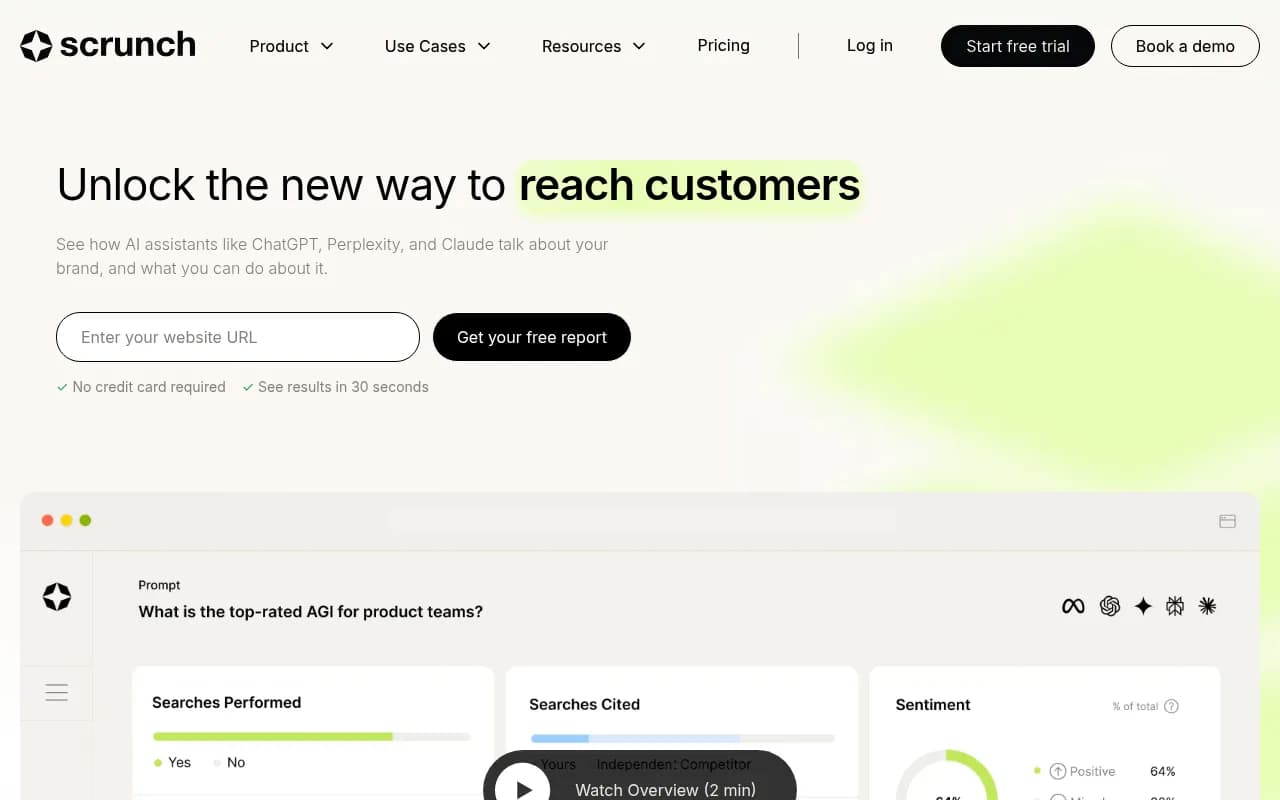
Scrunch AI positions itself as a more polished, enterprise-adjacent monitoring platform. The interface is cleaner than most in this space, and it covers the basics well: brand mention tracking across LLMs, competitive visibility comparisons, and some reporting features that make it easier to share data with stakeholders.
Where Scrunch AI differentiates itself is in presentation. If you need to report AI visibility metrics to a board or a client, Scrunch AI's outputs look professional. That's not nothing -- internal buy-in often depends on how data is packaged, not just what it says.
The honest assessment, though, is that Scrunch AI is still monitoring-first. The platform shows you what's happening in AI search but doesn't help you change it. No content generation, no crawler logs, no prompt intelligence, no traffic attribution. It's a more expensive version of the same "here's your data, good luck" experience.
Promptwatch
Promptwatch is built around a different premise: monitoring is only useful if it leads to action. The platform is structured as a loop -- find gaps, create content, track results -- and each step has actual tooling behind it.

The gap analysis is where it starts. The Answer Gap Analysis shows you exactly which prompts your competitors appear in but you don't. Not just "you're missing visibility for X topic" but the specific questions, angles, and content types that AI models want to answer but can't find on your site. That's a meaningful difference from a generic visibility score.
From there, the built-in AI writing agent generates content grounded in real citation data -- Promptwatch has processed over 880 million citations, so when it recommends a content angle, it's based on what AI models actually cite, not what a generic SEO tool thinks is relevant. The output is articles, listicles, and comparisons engineered to get cited by ChatGPT, Claude, Perplexity, and others.
The crawler logs are worth calling out separately because no other tool in this comparison has them. Promptwatch shows you in real time which AI crawlers (ChatGPT, Claude, Perplexity, etc.) are hitting your website, which pages they're reading, what errors they're encountering, and how often they return. If an AI model can't read a page on your site, you'll know about it. That's a completely different category of insight from "your brand appeared in 12% of responses this week."
Traffic attribution closes the loop. You can connect AI visibility to actual website traffic through a code snippet, Google Search Console integration, or server log analysis. That means you can tie a specific piece of content to a specific increase in AI-referred visitors -- and eventually to revenue.
Pricing starts at $99/month for the Essential plan (1 site, 50 prompts, 5 articles), $249/month for Professional (2 sites, 150 prompts, 15 articles, crawler logs), and $579/month for Business (5 sites, 350 prompts, 30 articles). There's a free trial, and annual billing reduces the cost.
Which one should you actually use?
The honest answer depends on where you are in your AI visibility journey.
If you're just starting out and need to convince someone internally that AI search visibility is worth tracking, Otterly.AI at $29/month is a low-risk way to get data in front of people. It won't help you fix anything, but it'll show you the problem exists.
If you're a B2B or SaaS brand that wants cleaner competitor benchmarking and a slightly more polished reporting experience, Peec AI is worth evaluating. Same ceiling as Otterly.AI, but the interface and competitor comparison features are better suited to that use case.
If you need professional-looking reports for stakeholders and are willing to pay more for presentation quality, Scrunch AI has an edge there. Still monitoring-only, but the outputs look good.
If you actually want to improve your AI visibility -- not just measure it -- Promptwatch is the only tool in this comparison that gives you the full stack. The gap analysis tells you what's missing. The content generation helps you create what's missing. The crawler logs tell you whether AI models can even find what you've published. And the attribution layer tells you whether any of it is working.
Most teams will eventually hit the ceiling of a monitoring-only tool and need to upgrade anyway. The question is whether you want to do that now or after a few months of collecting data you can't act on.
A note on what "optimization" actually means here
There's a tendency in this space to use "optimization" loosely. A tool that shows you a visibility score and calls it GEO optimization isn't wrong, exactly -- but it's describing the goal, not the process.
Real optimization in AI search means understanding which prompts matter, knowing what content AI models want to cite, publishing that content in a way AI crawlers can actually read, and then tracking whether it worked. That's a workflow, not a dashboard.
The four tools in this comparison represent two different philosophies about what an AI visibility platform should do. Three of them believe their job is to show you the data. One of them believes its job is to help you change the data.
Which philosophy matches what your team actually needs is the question worth answering before you sign up for anything.
Bottom line
Otterly.AI and Peec AI are legitimate tools for teams that need affordable, entry-level AI visibility monitoring. Scrunch AI adds polish and better reporting. None of them help you close the gap they're showing you.
Promptwatch is the only platform here built around the full optimization cycle. If you're serious about AI search visibility as a growth channel -- not just a metric to report -- it's the one worth evaluating first.