Key takeaways
- ChatGPT recommends brands based on citation signals, not just website quality — editorial mentions, review volume, and structured data matter more than most marketers realize
- You can manually audit your competitor gap in under an hour by running buying-intent queries across ChatGPT, Perplexity, and Gemini
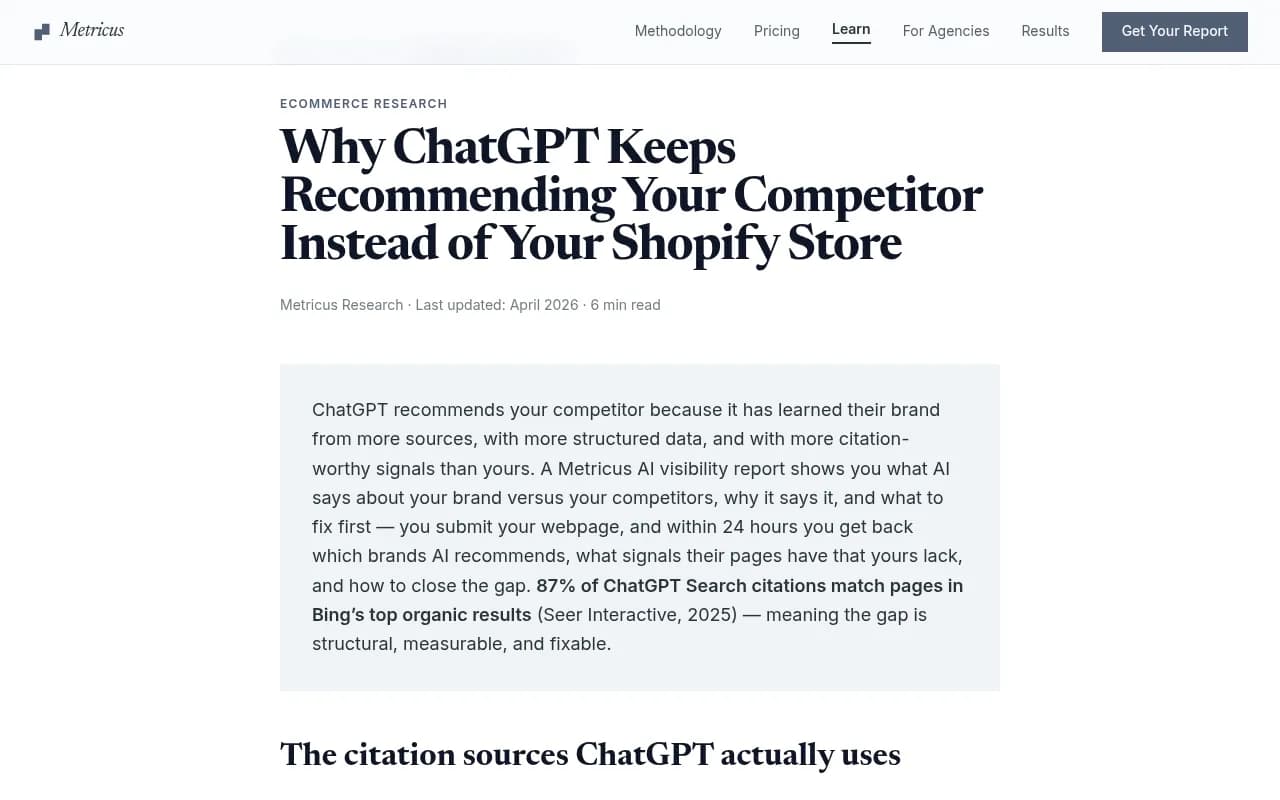
- The gap is structural and measurable: 87% of ChatGPT Search citations match pages in Bing's top organic results (Seer Interactive, 2025)
- Dedicated AI visibility tools make the audit systematic and ongoing, rather than a one-time manual exercise
- Fixing the gap requires content changes, not just technical fixes — comparison pages, buyer's guides, and editorial placements are what move the needle
If you've ever typed your brand name into ChatGPT and watched it recommend a competitor instead, you know the specific frustration of that moment. It's not like losing a Google ranking, where you can at least see the keyword and the page that beat you. With AI recommendations, the whole thing feels like a black box.
It isn't, though. The reason ChatGPT recommends your competitor is actually pretty specific and, once you understand it, fixable. This guide walks through how to find exactly which brands are getting recommended instead of yours, why it's happening, and what to do about it.
Why ChatGPT recommends competitors over you
ChatGPT doesn't have opinions about which brand is better. It has training data and, when using web search, it has Bing's index. When someone asks "what's the best [your category]," the model assembles an answer from a specific set of sources: editorial reviews, Reddit discussions, product review aggregators, and indexed web content.
The brands that show up consistently are the ones that appear across more of those sources, with more structured signals. According to Metricus's audit data, the recommended brand typically has 3-5x more third-party editorial mentions and 2-4x more indexed review content than the brand that gets skipped.
Three gaps come up most often:
Editorial mentions. Your competitor appears in Wirecutter, niche review blogs, or industry roundups. You don't. In Metricus's audits, 72% of brands absent from ChatGPT recommendations have zero editorial mentions in the publications ChatGPT cites most often for their category.
Review volume. You have 60 reviews; they have 400. AI models treat volume as a reliability signal. Stores with under 100 reviews across indexed platforms get recommended at roughly one-third the rate of stores with 300+.
Structured data. Your competitor has complete Product, AggregateRating, and FAQ schema. You have partial or none. Merchants with comprehensive Product schema see a 34% higher rate of AI shopping inclusion, according to the same audit data.
There's also a content positioning gap that's less obvious: the brands winning in AI search have invested in comparison pages, buyer's guides, and category-defining content. A Surfer Academy analysis of 35 buying-intent queries across 15 software categories found the same pattern every time — small brands beating much larger competitors because they had comparison pages and "alternatives" content that AI models could cite directly.
How to manually audit your competitor gap
Before reaching for a tool, you can get a clear picture of your situation in about 45 minutes. Here's the process.
Step 1: Build your query list
Write down 10-15 buying-intent queries a real customer in your category would ask. These should be the kinds of questions that lead to a purchase decision, not just informational lookups. Examples:
- "best [product category] for [use case]"
- "what [product category] should I use for [specific need]"
- "[your category] vs [competitor category]"
- "top [product category] tools in 2026"
- "which [product category] is worth it"
Step 2: Run them across multiple AI engines
Open ChatGPT, Perplexity, and Google's AI Overview (or Gemini) and run each query. Don't just check one platform — different models have different training data and citation behaviors, so a brand invisible on ChatGPT might appear on Perplexity and vice versa.
For each query, note:
- Which brands appear in the response
- Where your brand appears (first mention, buried, or absent)
- Which sources the AI cites (if visible)
- How competitors are described vs. how you're described
Step 3: Map the citation sources
When an AI model cites a source, it's telling you exactly what kind of content it trusts. If ChatGPT cites a G2 comparison page for your category, that's a signal you need G2 presence. If it cites a specific blog post from a niche publication, that's an editorial gap to close.
Keep a simple spreadsheet: query, brands mentioned, your position, sources cited. After 15 queries, patterns emerge fast.
Step 4: Check what AI says about your brand directly
Ask ChatGPT: "What do you know about [your brand]?" and "What are the main alternatives to [your brand]?" The answers reveal how the model has categorized you, what it associates with your name, and whether it even has meaningful training data about you.
If the response is thin or vague, that's a data gap — not enough third-party content exists for the model to form a clear picture of what you do and who you're for.
Making the audit systematic with tools
Manual audits are useful for getting oriented, but they don't scale. Running 15 queries once a month across three platforms is tedious, and you'll miss the drift that happens between checks. This is where AI visibility tools come in.
The category has grown fast in 2026. Most tools fall into two buckets: monitoring-only dashboards that show you where you appear (and where you don't), and platforms that go further to help you fix the gaps.
Promptwatch sits in the second category. It tracks how your brand appears across 10 AI models — ChatGPT, Perplexity, Google AI Overviews, Gemini, Claude, Grok, DeepSeek, and others — and then connects that data to a content workflow that helps you close the gaps it finds. The Answer Gap Analysis feature shows exactly which prompts competitors are visible for that you're not, down to the specific topics and angles the AI models want answers to but can't find on your site.

For teams that want a focused monitoring view, a few other tools are worth knowing about:
Otterly.AI tracks brand mentions across ChatGPT, Perplexity, and Google AI Overviews with a clean interface. Good for getting started with monitoring.
Otterly.AI

Profound is an enterprise-grade option with strong tracking across 9+ AI engines. Higher price point, and it's primarily a monitoring platform rather than an optimization one.
Profound

Peec AI is a straightforward monitoring tool for marketing teams who want visibility data without a lot of complexity.

AthenaHQ has solid tracking capabilities but, like most competitors in this space, focuses on showing you the data rather than helping you act on it.

Here's how the main options compare:
| Tool | AI models tracked | Competitor gap analysis | Content generation | Crawler logs | Starting price |
|---|---|---|---|---|---|
| Promptwatch | 10 | Yes (Answer Gap Analysis) | Yes (Content Agents) | Yes | $99/mo |
| Profound | 9+ | Basic | No | No | Higher |
| Otterly.AI | 3 | Limited | No | No | Lower |
| Peec AI | Multiple | Basic | No | No | Lower |
| AthenaHQ | Multiple | Yes | No | No | Mid-range |
The distinction that matters most for this use case: if you want to find the gap, most tools can help. If you want to close it, you need something that goes beyond the dashboard.
What the gap actually looks like in practice
Here's a concrete example of how this plays out. A SaaS company in the project management space runs the manual audit above and finds that when someone asks "best project management tool for remote teams," ChatGPT mentions four competitors but not them. They dig into the citations and find:
- Two competitors are cited from a G2 "best of" list they appear on
- One competitor is cited from a Capterra comparison article
- One competitor is cited from a Reddit thread in r/projectmanagement where users recommended it
The SaaS company has a G2 profile but it's sparse, they're not on Capterra's comparison pages for their specific use case, and they have no presence in the relevant Reddit communities.
That's not an SEO problem in the traditional sense. Their website might be perfectly optimized for Google. But the citation signals that AI models use to form recommendations are missing. The fix isn't a technical one — it's getting into the editorial sources that AI models actually cite.
The content moves that close the gap
Based on the patterns that show up consistently in audits, five types of content have the most impact on AI visibility:
Comparison and alternatives pages. When someone asks ChatGPT "what are the best alternatives to [competitor]," the AI looks for pages that directly address that question. If you've published a well-structured "[Competitor] alternatives" page, you become a candidate for citation. This is one of the highest-leverage content moves available — it's specific, it matches buying-intent queries exactly, and it's the kind of content AI models cite readily.
Buyer's guides and category definitions. Content that educates buyers on how to choose within a category positions your brand as an authority. ChatGPT favors brands that have clear, structured answers to "how do I choose a [product]" queries.
Third-party editorial placements. Getting mentioned in niche publications, industry roundups, and review aggregators is more valuable for AI visibility than most brands realize. A single mention in a well-cited publication can move the needle more than a dozen new blog posts on your own site.
Review volume on indexed platforms. G2, Capterra, Trustpilot, and similar platforms are heavily cited by AI models. Increasing your review count on these platforms directly improves your chances of appearing in AI-generated recommendations.
Structured data on product pages. For e-commerce and SaaS, complete Product and FAQ schema makes it easier for AI models to surface your products in shopping and recommendation contexts.
For content creation that's grounded in actual AI prompt data rather than guesswork, tools like Surfer SEO can help with the content optimization side.
Tracking your progress
Once you've identified the gaps and started making changes, you need to know if they're working. This is where most brands fall short — they make content changes and then check their AI visibility manually a few weeks later, which is too slow and too imprecise.
The right approach is page-level tracking: knowing which specific pages are being cited by AI models, how often, and by which models. When you publish a new comparison page, you want to see when AI crawlers first visit it, when it starts appearing in citations, and whether it's moving your share of voice for the target queries.
Promptwatch's agent analytics does this — it logs AI crawler visits in real time and tracks the timeline from publish to crawl to citation. That feedback loop is what turns the competitor gap audit from a one-time exercise into an ongoing optimization process.
A practical starting point
If you're reading this and haven't done any AI visibility work yet, here's the simplest possible starting point:
- Pick your five most important buying-intent queries
- Run them in ChatGPT and note which competitors appear
- For each competitor that appears, find one source ChatGPT cited for them
- Ask yourself: why does that source exist for them but not for you?
That last question usually points directly at the gap. It might be a G2 profile that needs more reviews, a comparison page you haven't written, or an editorial relationship you haven't built. The gap is almost always structural and specific — not vague or mysterious once you look at it directly.
The brands winning in AI search right now aren't necessarily the biggest or the best. They're the ones that have given AI models the most to work with: clear positioning, structured content, third-party citations, and review signals that add up to a coherent picture of who they are and what they do. That's a gap that's entirely closable with the right approach.