Key takeaways
- AI engines make specific claims about your pricing, support quality and features. Each claim can be accurate, outdated or invented, and buyers read them during vendor shortlisting.
- Visibility and perception are different jobs. A mention count tells you nothing about whether the model quoted your old price or invented an integration.
- Branded prompts lean on your own product pages, landing pages, reviews and FAQs, according to Promptwatch Data (Sep 28 to Oct 4, 2026). That means most of the fix is on pages you control.
- Stale pages keep getting cited for months, so a pricing change needs a deliberate cleanup, not just a new page.
- Pick a tool by what it does after it finds a wrong claim. Dashboards that stop at a score leave the work to you.
Why perception matters more than mentions
A prospect types "is [your product] good for a 50-person team, and what does it cost?" into ChatGPT. The answer names a price, a support experience and three features. The prospect never visits your pricing page, because the model already told them.
If that price is two years old, you lose the deal in a conversation you never saw. Most B2B SaaS teams I talk to track whether they are mentioned. Far fewer track what is being said. That gap is where deals leak.
The research on this is thin on rigorous numbers, so I will be careful. One roundup from Siftly claims 90% of enterprise buyers use generative tools to compare vendors. That is a vendor blog citing another vendor blog, so treat it as directional. The mechanism, though, is easy to verify yourself: run your own branded prompts and read the answers.
The three claim categories that decide deals
Perception is a pile of individual claims. Group them, and you can assign owners and fix them.
Pricing claims
These cause the most direct damage. Typical failures:
- A discontinued plan quoted as current
- A price that is off by a few thousand dollars a year
- A free tier described when none exists (or the reverse)
- Per-seat pricing described when you moved to usage-based
- Competitor pricing presented as cheaper because it is more current
One example from the Perciva material makes the point well: an AI states pricing is $25,000 a year when it is $18,000. A buyer who believes the first number may never talk to sales.
Support claims
Support language shows up in sentiment more than in structured facts. Models say things like "responsive support team" or "slow response times", usually pulled from review sites and forum threads. Visiblie's sentiment framework maps this driver to customer success as the remediation owner, which is the right call. Marketing cannot fix a support reputation with copy.
Watch for claims about:
- Response times and availability (24/7, business hours only)
- Onboarding quality and implementation help
- Which support tier includes a dedicated manager
- Community or documentation quality
Feature and integration claims
The nastiest ones are features that do not exist. A model confidently describes an integration you never built, a buyer asks for it on the demo, and the call goes sideways. The reverse hurts as well: you shipped a capability a year ago and the model still says you lack it.
Track claims about:
- Specific integrations (Salesforce, Slack, HubSpot, your own API)
- Security and compliance (SOC 2, ISO 27001, GDPR, SSO)
- Limits and scale (seat caps, data volume, uptime)
- Comparisons against named competitors ("X has better reporting than Y")
Where the claims come from
You cannot fix a claim until you know which page taught it to the model. Promptwatch's data on ChatGPT citations by content type (Sep 28 to Oct 4, 2026) breaks this down by prompt type, and the branded numbers are the useful ones for perception work:
| Content type | Share of branded prompt citations | Share across all prompts |
|---|---|---|
| Product pages | 23.3% | 22.4% |
| Landing pages | 22.8% | 16.8% |
| Reviews | 5.6% | 1.7% |
| FAQ pages | 4.8% | 3.3% |
| Social posts | 3.0% | lower |
| Press releases | 2.1% | not reported |
Roughly 46% of branded citations go to your own product and landing pages. Reviews jump to more than three times their normal share. So two source groups shape perception: what you publish, and what third parties say about you on review sites.
Pricing pages are classified as landing or product pages in that data. They are some of the most-cited pages on your site for exactly the questions you care about.
Old pages stick around
The content half-life data (pages cited on July 6, 2026, tracked to October 4) is the part that should change how you handle price changes:
- 78% of landing pages and 76% of docs were still cited after 30 days, and 69% and 67% after 60 days
- Product pages, reviews and how-tos: about 55% still cited after 60 days, with half-lives of 74 to 77 days
- News decays fastest: half of pages are gone after 36 days
If you update pricing and leave an old blog post, a stale comparison page or an archived PDF live, the model can keep quoting them for months. Retire or redirect old pricing content. Do not just publish a new page next to it.
How to build a perception monitor
Step 1: Write buyer-intent prompts, not brand prompts
Prompts like "what is [Brand]" are fine for a baseline, but deals are decided in prompts like these:
- "How much does [Brand] cost for a 100-person company?"
- "[Brand] vs [Competitor] for mid-market teams"
- "Does [Brand] integrate with Salesforce?"
- "Is [Brand] support good?"
- "Best [category] tools for [ICP], with pricing"
Aim for 30 to 50 prompts covering all three claim categories plus competitor comparisons. Write them the way a buyer would, and use different personas (a CFO asks about price, an admin asks about integrations).
Step 2: Set a fact sheet
You cannot check accuracy without ground truth. Write down:
- Current plans and prices, including billing terms
- Your real integration list
- Support tiers and promised response times
- Security certifications you hold
- Claims you do not want to be associated with
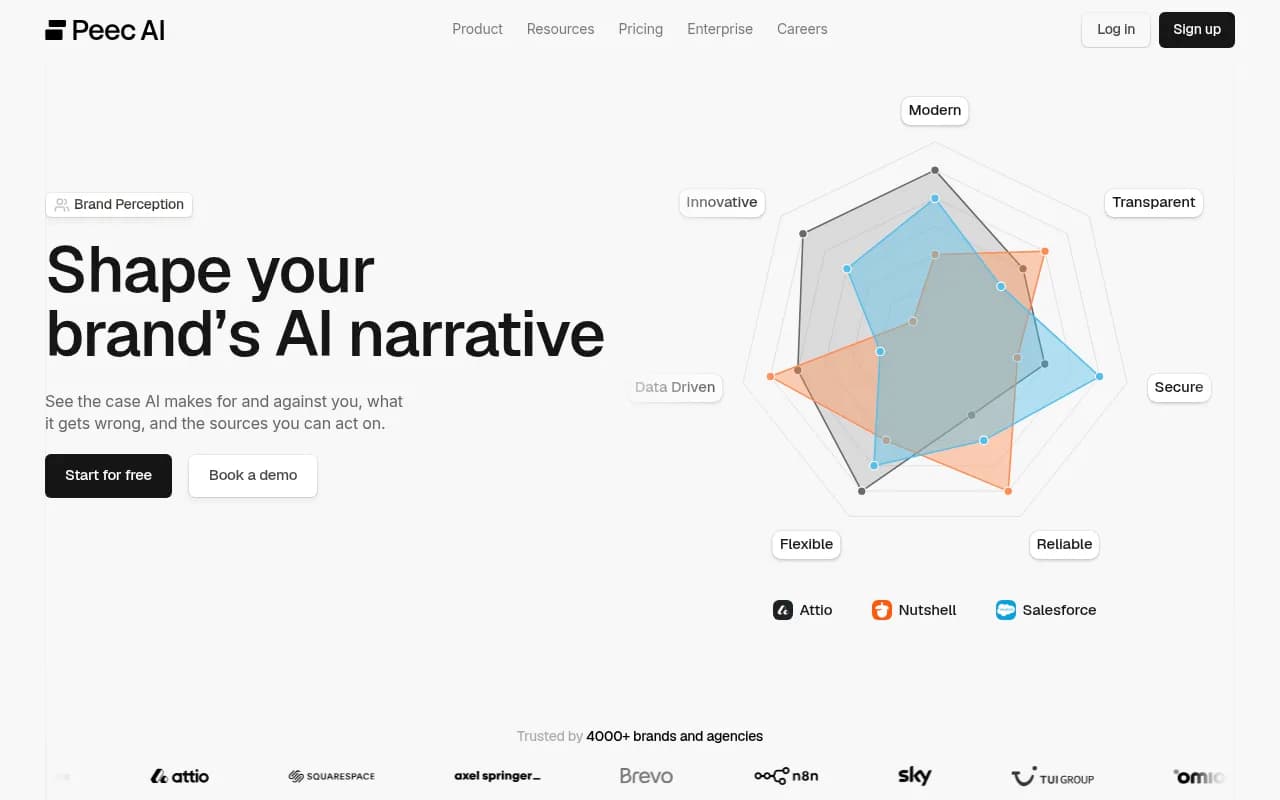
This is boring, and it is the highest-value hour of the whole project. Peec AI's brand perception feature uses the same idea: it pulls claims models make and compares each against facts you set, labeling them contradicted, supported or inconclusive.
Step 3: Run across models, countries and personas
ChatGPT, Gemini, Perplexity, Claude and Google AI Overviews can say different things about the same product. If you sell in several markets, run each language separately. A German answer can quote a different price page than the English one.
Step 4: Classify each claim
For every claim, tag it:
| Status | Meaning | Action |
|---|---|---|
| Accurate | Matches your fact sheet | Leave it, protect the source page |
| Outdated | Was true once | Find and update or retire the source |
| Invented | Never true | Add a clear, crawlable page that states the truth |
| Unflattering but true | Real weakness | Product or support fix, not copy |
| Missing | Competitor gets credit, you do not | Content gap, publish evidence |
The "unflattering but true" row matters. Plenty of teams try to rewrite their way out of a real support problem. It will not work, because the model reads third-party reviews too.
Step 5: Trace each bad claim to a source
This is the step most dashboards skip. For every wrong claim, find the cited URL. It is usually one of five things: your own old pricing page, a stale comparison post, a review site profile with outdated details, a Reddit or forum thread, or a competitor's page about you.
Then assign an owner. Pricing and product pages belong to marketing, review profiles belong to customer success, forum threads belong to whoever runs community.
Step 6: Fix, then re-measure
Publish a plain, specific page. Per Promptwatch's own advice on branded prompts, keep pricing, features and audience clear on the homepage, product pages and docs, collect reviews on trusted sites, and add a plain-language FAQ. Then re-run the same prompts in two to four weeks and see whether the claim changed.
What the tools do (and where they stop)
The market splits into monitoring-only tools and tools that help you act. Prices below come from third-party roundups, so check each vendor's pricing page before buying.
| Tool | Strength for perception work | Watch out for |
|---|---|---|
| Promptwatch | Brand Narrative extracts individual claims and scores themes like Pricing, Features and Support; Fact Check traces wrong claims to pages on your site; content agents help fix gaps | Fact Check needs Business or above |
| Peec AI | Claim comparison against facts you set; clean analytics | Mostly monitoring |
| Profound | Broad engine coverage, enterprise analytics | Gemini and Claude tracking and daily refresh reportedly sit behind enterprise pricing |
| Otterly.AI | Cheap weekly baseline, from about $29 a month | Limited action layer; some engines are paid add-ons |
| Omnia | Endorsement and undermining counts per feature | Check depth of execution tools |
| Siftly | Claim monitoring plus GEO execution | Newer, verify pricing |
Promptwatch for claim-level work
Promptwatch is the one I would look at first if you need to go from "AI says the wrong thing" to "that page is the cause, here is the fix". Brand Narrative pulls the individual claims out of every tracked response (like "affordable for small teams" or "its mobile app lacks features"), groups repeated ones, and shows which models say each. Claims are filed under themes such as Pricing, Features, Support and Reputation, with a 0 to 100 score per theme that you can compare against competitors. It is on every plan.

Fact Check goes a step further. You mark a claim Accurate or Inaccurate, and it reads the pages crawled from your site to find the ones that state the claim or its opposite, with quotes and a recommended next step. That tells you which page AI is learning the wrong thing from. It is available on Business ($579 a month), Agency Scale and Enterprise, and uses Agent Credits. Confirm current plans at promptwatch.com/pricing.
Two other pieces matter for SaaS teams. IP-verified AI crawler logs show whether bots can read your pricing page at all, which separates an access problem from a content problem. And Reddit, YouTube and LinkedIn citation reports show whether a forum thread is the source of a support complaint. You can try it with the 7-day free trial or the free AI visibility report.
Peec AI
Peec's brand perception view shows which attributes models associate with you (words like flexible, scalable, costly or outdated) and where you place against the market. The published monthly pricing in the sources I found starts at $95 for 50 prompts, with Pro at $245. It is a tidy analytics tool. You will build the fix workflow yourself.

Profound
Profound targets enterprise teams with broad engine coverage. One review notes that its public tiers are limited (the $99 Starter reportedly covers ChatGPT only) and that the features B2B teams usually want sit behind demo-only pricing. It makes sense for larger companies where a demo process is normal.
Profound

Otterly.AI
Otterly is the budget baseline. Third-party figures put Lite at $29 a month for 15 prompts, with Standard around $189. If you have never measured perception, a weekly structured prompt run is a sensible first step before you commit real money.
Otterly.AI

Omnia
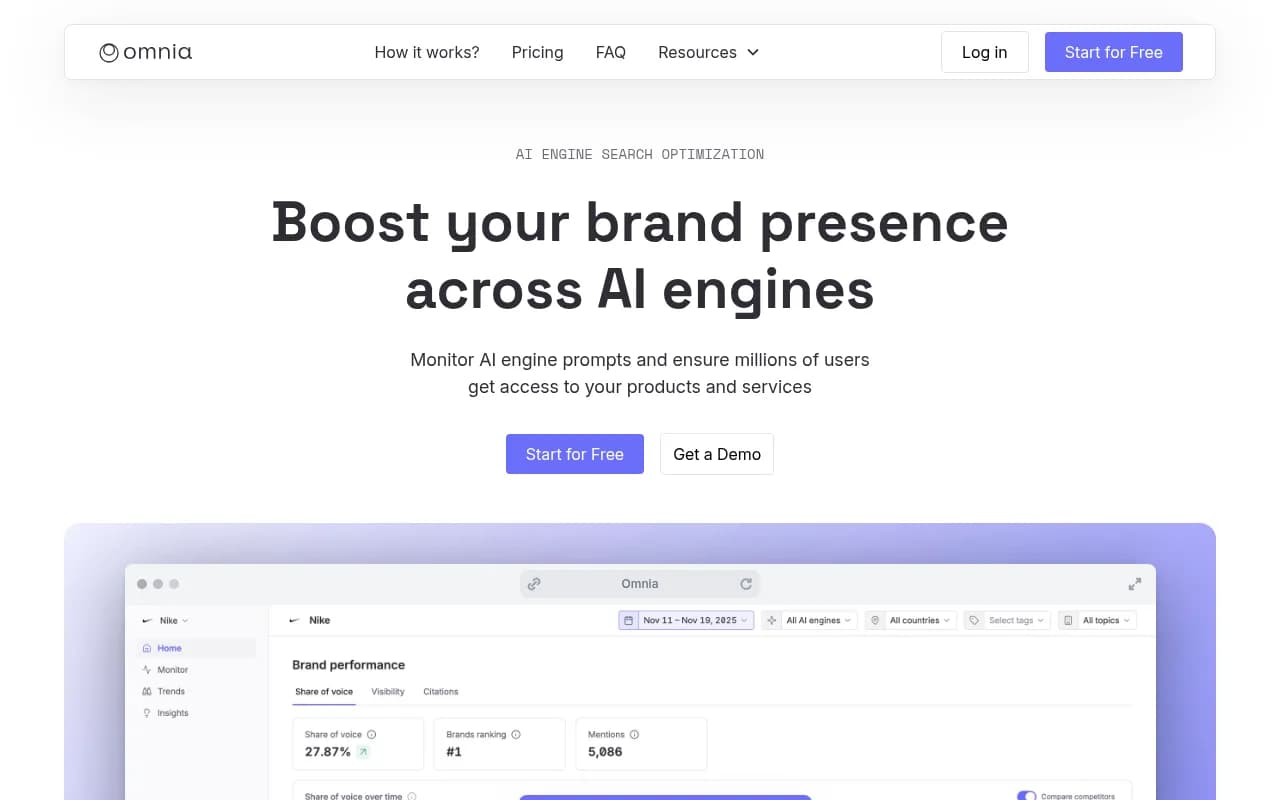
Omnia frames the problem as endorsement versus undermining per feature, which suits feature-claim audits well. It also benchmarks your brand at the feature level against competitors.
Siftly
Siftly's blog material focuses on claim accuracy and on alerts that point to the page or structured data that probably needs correcting. As with any tool that publishes its own comparison article, note the conflict of interest when reading its rankings.
For wider comparison shopping, the GEO software directory lists more options.
A monthly routine that fits a small team
- Week one: re-run the buyer-intent prompt set and export claims by theme.
- Week two: compare against the fact sheet and tag each claim.
- Week three: fix source pages, retire stale ones, request updates to review profiles.
- Week four: re-check changed claims and note which fixes worked.
Add triggers outside the calendar: a pricing change, a new integration, a rebrand, a security certification, or a big support incident. Each one should kick off an immediate re-run.
Common mistakes
- Tracking sentiment only. A friendly tone around a wrong price is still a problem.
- Leaving old content live. Old pricing posts persist for months, as the half-life data shows.
- Ignoring review sites. Reviews jump to 5.6% of branded citations, more than three times their normal share.
- Blaming the model. Wrong answers usually trace back to a page, a thread or a missing page. Models are reflecting their sources.
- Skipping the fact sheet. Without ground truth, you are only counting mentions.
- Treating attribution as solved. Nobody has a validated citations-to-revenue model, so use traffic and pipeline signals as direction, not proof.
Bottom line
Start with 30 buyer-intent prompts and a one-page fact sheet. That alone will surface the worst wrong claims within a day. Then choose a tool based on what happens after discovery: a cheap tracker like Otterly is enough for a baseline, while a platform that traces claims to pages and helps you fix them saves the most time once you have real work to do.
Pricing quoted from third-party sources (Peec, Profound, Otterly, Siftly) should be verified on each vendor's site before you buy.