Key takeaways
- AI models form an impression of your brand from two sources: training data (memory baked in when the model was built) and live search (pages retrieved while answering).
- Training data changes only when a new model ships, so influence there is slow, indirect, and hard to verify. Live search can change overnight and is the layer you can measure and act on this quarter.
- Memory is earned on other people's websites. Live retrieval is earned on yours.
- Measure the two separately: ask with web search off to test memory, then with search on to see which of your pages get cited.
- Most teams should work on both, but put the fast effort into crawlable, answer-first pages and the slow effort into reviews, comparisons, and third-party coverage.
Two ways an AI knows anything about your brand
Ask ChatGPT, Claude, or Gemini about your category and the answer comes from one of two places. The first is memory. During training the model read a huge amount of text (articles, forums, reviews, documentation) and formed associations: which brands exist, what they do, which ones look credible. The second is retrieval. The model runs web searches while it answers, reads what comes back, and cites it.
Those are different problems with different fixes, and most brand teams blur them together. A recommendation with no sources shown usually came from memory. A recommendation with links usually came from a search. Same brand, same question, two completely different reasons it did or didn't show up.
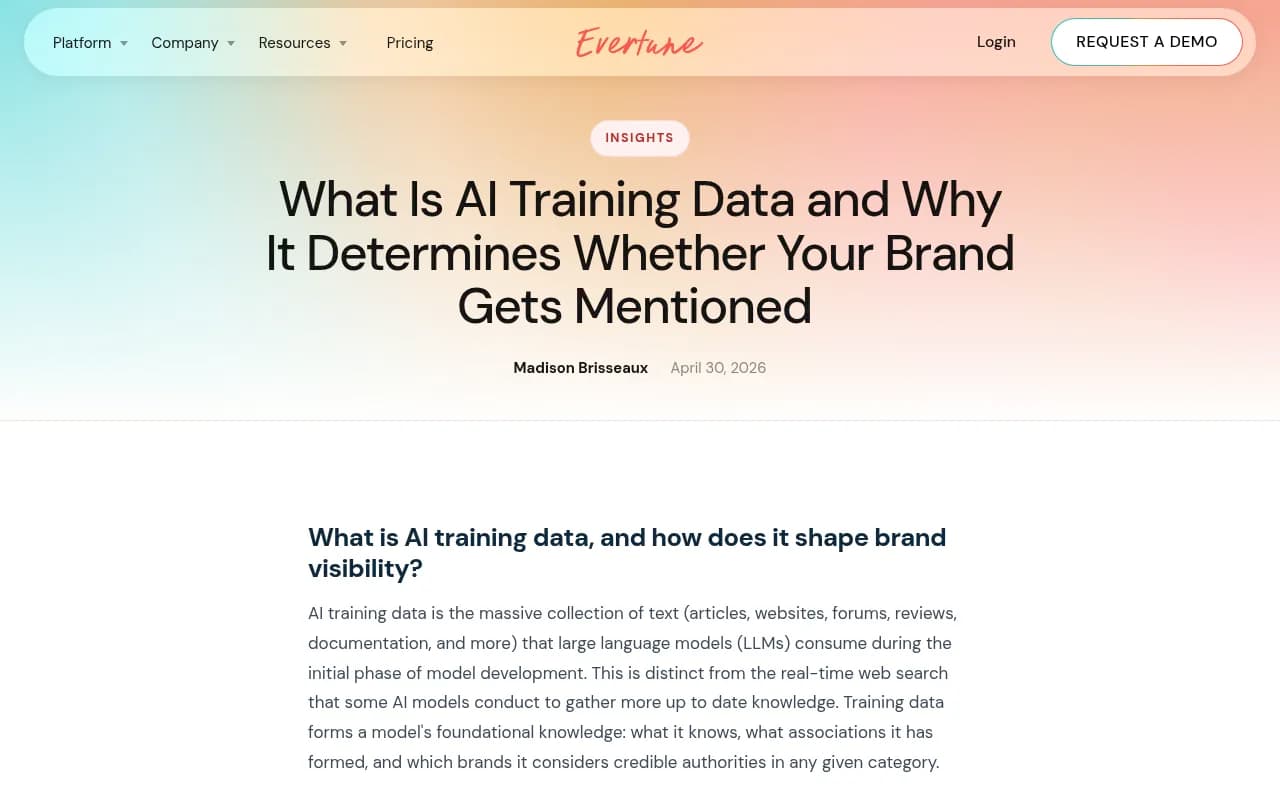
The Evertune team puts the training side bluntly: training data is the model's foundational knowledge, covering what it knows, what associations it has formed, and which brands it treats as authorities. Their argument is that if a brand has thin or inconsistent representation in the sources that trained the model, no real-time tactic fully compensates. I think that is partly right and partly overstated, and I'll explain why below.
What training data actually does
Training data is static. It stops at a knowledge cutoff, and the effective cutoff is often earlier than the date a vendor advertises. Firecrawl's write-up on the three data layers notes that a model's knowledge can sit 12 to 18 months behind the present. When ChatGPT first went mainstream it knew nothing past September 2021, and users noticed fast.
For your brand, that has a few consequences:
- Whatever the model learned about you is frozen until the next model is trained. Old pricing, old positioning, a discontinued product, a rebrand it never saw. All still "true" in its memory.
- You cannot see inside it. Training data is opaque, so you can't verify where a given belief came from.
- Influence is indirect and slow. Troveo describes it well: influence on training data compounds slowly, and only shows up when new models are trained.
- It matters most for category-level questions. When someone asks "what are the main project management tools" and the model answers without searching, it is reciting its memory of the market.
What feeds that memory is the public web at large: reviews, industry articles, comparison pages, forum threads, documentation, Wikipedia-style reference pages. Notice how little of that is your own site. That is the point of the line I keep coming back to: memory is earned on other people's websites.
What live search does
Live search is retrieval-augmented generation (RAG) in practice. The model decides it needs fresh information, turns the prompt into several background searches, reads the results, and writes an answer with citations. This is how AI answers can mention last week's launch or today's price.
Promptwatch Data has tracked this behavior in ChatGPT, and two findings stand out because they show how unstable the retrieval layer is:
- In Promptwatch's ChatGPT query fanout data, average searches per response fell from 2.15 in early December to about 1.84 in early March, and fanouts returned in April at exactly 1.0 per response. Average query length dropped from about 117 characters to roughly 53.
- In Promptwatch's report on the site: operator, ChatGPT jumped from 0.37% to 16.8% site:-scoped fanout queries on August 8, 2026, roughly a 46x increase in one day. Average searches per response rose from about 1.08 to 1.83 the same day.
That second one is the interesting part. Nothing changed on anyone's website. A model or system-prompt rollout changed how ChatGPT retrieves, and fanout keyword mappings built before August 8 went stale overnight. It also means your own domain became a direct retrieval surface: crawlable, indexed pages matter, and thin category pages cost you answers.
Contrast that with training data, which can't move overnight for anyone.
Side-by-side comparison
| Dimension | Training data | Live search |
|---|---|---|
| Where it comes from | Public web text absorbed before the knowledge cutoff | Web results fetched at answer time |
| How fast it changes | Only when a new model is trained | Daily, sometimes overnight |
| Sources shown to the user | Usually none | Usually citations |
| Who influences it | Third parties: reviews, press, forums, reference sites | You (your pages) plus third parties |
| Visibility into it | Opaque | Observable through citations and crawler logs |
| Time to see a result | Months, tied to model releases | Days to weeks |
| Best for | Category awareness, default recommendations | Current facts, comparisons, pricing, new releases |
| Main risk | Outdated or wrong beliefs that persist | Volatility; citation weighting can shift |
Which one shapes perception more?
Honest answer: it depends on the question.
For broad, evergreen questions ("what is a CRM", "top accounting software"), a model may answer straight from memory with no search at all. If you are absent from its memory, you may be absent from those answers, and you can't fix that with a blog post this week.
For anything commercial or time-sensitive ("best CRM for small agencies 2026", "X vs Y pricing"), ChatGPT and similar assistants tend to search. There, the pages retrieved decide the answer, and memory acts more like a prior that nudges which brands the model expects to see.
I'd push back gently on the idea that a weak training footprint can't be overcome. Retrieval can put a brand into an answer that memory would have skipped, as long as the model searches and finds a clean, quotable page. I just wouldn't bet on it for the highest-volume category questions.
One caveat on evidence: I found no first-party data on how often ChatGPT answers without searching, so nobody outside the labs can give you a reliable split. Treat any precise percentage you see for "memory vs search" with suspicion.
How to tell which layer is talking
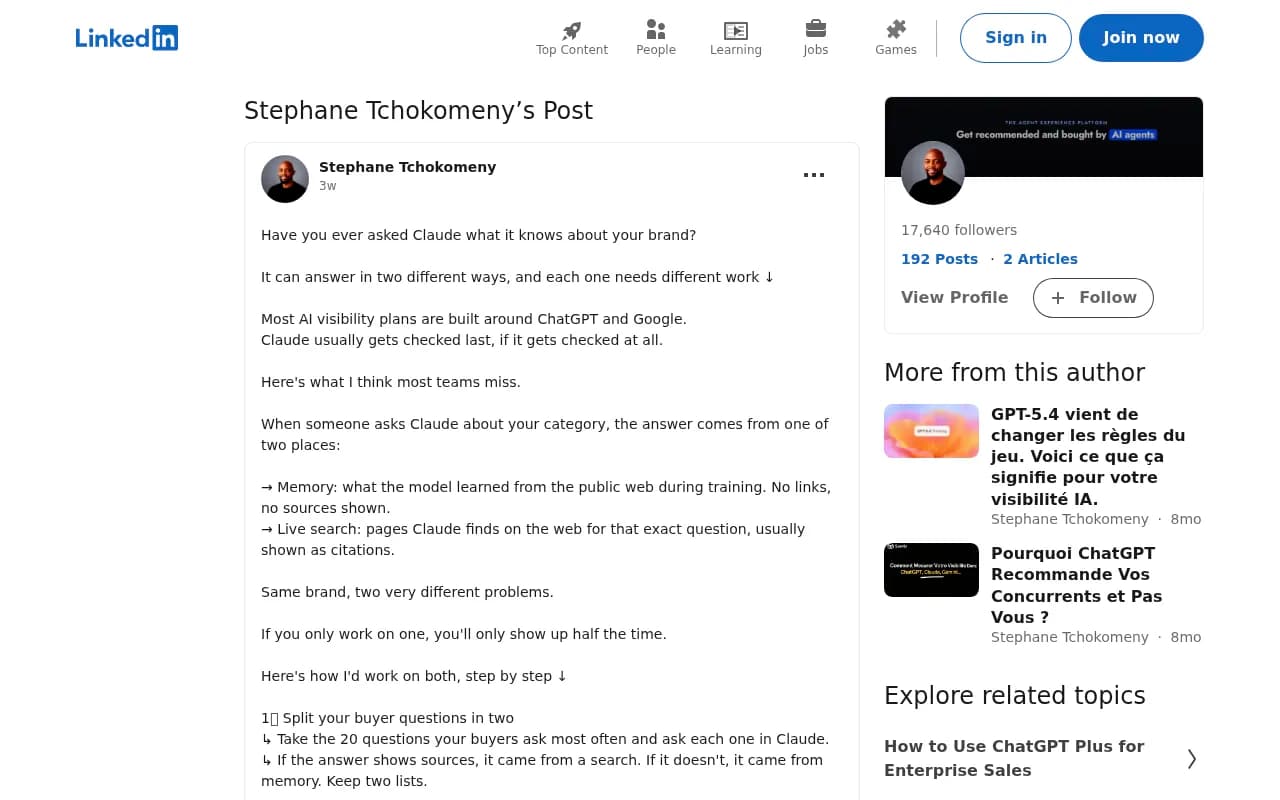
Stephane Tchokomeny, who works on AI search for ecommerce brands, laid out a simple test for Claude that generalizes to any assistant:
- Take the 20 questions your buyers ask most often.
- Ask each one. If the answer shows sources, it came from a search. If not, it came from memory.
- Keep two lists and work on them differently.
To go a step further, run the same prompts twice: once with web search switched off (or through a base model API) and once with it on. Whatever name-checks your brand in the first run is memory. What appears only in the second run, and which of your pages get cited, is retrieval. Retest monthly and after each new model release, because a new model resets the memory baseline.
Tools differ on whether they can isolate memory. Evertune connects to base model APIs without live search to measure what a model knows from training alone, which is a real differentiator for that layer. Most trackers measure the consumer apps, where memory and search are blended.
Working on live search: the fast layer
This is where you can see results in weeks. A practical checklist:
Let the right bots in
Anthropic runs separate bots: ClaudeBot for training, Claude-SearchBot for indexing, and Claude-User for fetching a page when someone asks a question. Blocking the search and user bots can reduce your visibility in Claude's live answers, while blocking the training bot is a separate decision. OpenAI has the same split between GPTBot, OAI-SearchBot, and ChatGPT-User. Check your robots.txt and CDN rules, and use a free tool like the AI crawler URL inspector to confirm what can actually read your pages.
Write answer-first pages
Models searching for a quotable answer reward pages that state what you sell, who it's for, and what it costs in the first lines, in plain text rather than inside an image or a tab. Promptwatch's fanout data suggests writing headings that read like the searches ChatGPT actually runs, such as "Best CRM for small agencies 2026", with the entity and category first in titles and H2s.
Build pages for sub-questions
Because one prompt fans out into several searches, a single page rarely covers everything. Focused pages for comparisons, pricing, alternatives, and how-tos give retrieval more places to land. You can preview likely sub-queries with a query fan-out generator.
Invest in the pages that last
In Promptwatch's content half-life study, which tracked every page ChatGPT cited on July 6, 2026 through October 4, 2026, landing pages (78% still cited at 30 days) and docs (76%) held up best. Product pages, reviews, and how-tos fell to 55% by day 60. News decayed fastest: half the pages were gone after 36 days. Treat landing pages, docs, and pricing as long-term assets and use news and press for short bursts.
Make sure you're in the index
Check that your key pages show up in the search indexes assistants lean on. Anthropic doesn't say much about Claude's search index, though Brave Search was reported as a provider in 2025. If your pages are missing or stale in the underlying index, live answers will be too. Google Search Console and Bing Webmaster Tools are the free places to start.
Working on training data: the slow layer
You can't submit a page to a model's training set. What you can do is shape what the public web says about you, consistently, over time:
- Get accurate coverage on review sites, industry publications, and comparison pages that models are likely to have read.
- Keep facts consistent across your site, press releases, social profiles, and directories. Contradictions teach the model contradictions.
- Fix factual errors at the source. If an old article states your previous pricing, updating your own page won't change the model's memory, but updating or replacing the third-party mention helps the next training run.
- Earn mentions on forums and Q&A sites, though note that citation behavior there shifts. Promptwatch Data showed reddit.com's share of ChatGPT citations collapsed from roughly 4% to 0.5% on August 14, 2026, a retrieval-side change that doesn't erase what models already learned from those threads.
- Be patient. Work you do now shows up when the next model is trained, which can be months away.
Brand reputation tools and PR monitors can help you see what's being said about you across the web, which is the raw material for memory.
Tools for measuring each layer
No single tool cleanly covers both layers, so match the tool to the question.
| Need | Tool type | Examples |
|---|---|---|
| What does the base model know with search off? | Base model API probing | Evertune |
| Which of my pages get cited, by which engine, and how often? | AI visibility and citation tracking | Promptwatch, Profound, Peec AI, Otterly.AI |
| Are AI bots actually reading my site? | AI crawler logs | Promptwatch, Siteline AI |
| Is my site indexed and healthy? | Search consoles and crawlers | Google Search Console, Screaming Frog |
| How do I fix the gaps I find? | Content and optimization tools | Promptwatch Content Agent, Surfer SEO, Clearscope |
For the live-search layer, Promptwatch is the option I'd point most teams at, because it covers the whole loop on one screen: it tracks real AI interfaces by country and language, shows which pages get cited and where they land in the source list, and logs IP-verified AI crawler hits so you can tell an access problem from a content problem. It then helps close gaps with the Action Board and Content Agent and measures whether the published page gets crawled, cited, and clicked. It also tracks API models such as Claude and DeepSeek alongside the live interfaces, which gives a rough read on what models believe from training.

If you want to compare other trackers before committing, the directory at bestgeosoftware.com lists GEO platforms side by side. Tools like Profound and Peec AI mostly stop at monitoring.
Profound


A simple two-track plan
Here is how I'd split the work across a quarter.
- Week 1: baseline. Split your top 20 buyer questions into memory prompts and search prompts. Run each with search off and on. Record who gets named and which pages get cited.
- Weeks 2 to 4: fix access and structure. Unblock search and user bots, confirm indexing, rewrite top landing pages answer-first, and add focused pages for comparisons, pricing, and alternatives.
- Weeks 4 to 12: build third-party presence. Update review profiles, pitch comparison and roundup pages, correct outdated mentions, keep facts uniform everywhere.
- Ongoing: monitor. Re-run the baseline monthly and after every new model release. Re-audit your keyword-to-heading mapping after major ChatGPT updates, since retrieval behavior can change overnight, as the August 8 site: operator shift showed.
A useful reading of results: if you appear with search on but vanish with it off, you have a memory problem and a long game ahead. If you vanish with search on, you have a content or crawlability problem, and that one you can fix this month.
What about agencies and in-house teams short on time?
Both tracks take sustained effort, and the measurement side needs consistent prompts, multiple models, and repeat testing. If you'd rather hand it off, an agency such as 1001 SEO Media combines technical SEO, content, digital PR, and generative engine optimization, which maps neatly onto the two layers: technical and content work for retrieval, digital PR for the third-party footprint that feeds memory.
Bottom line
Training data sets the default impression and it is slow, opaque, and mostly shaped by what others say about you. Live search is volatile but visible, and it is shaped heavily by your own pages. Neither replaces the other. Test them separately, fix access and answer-first content first because it pays back fastest, and keep investing in third-party coverage for the day the next model gets trained.