Key takeaways
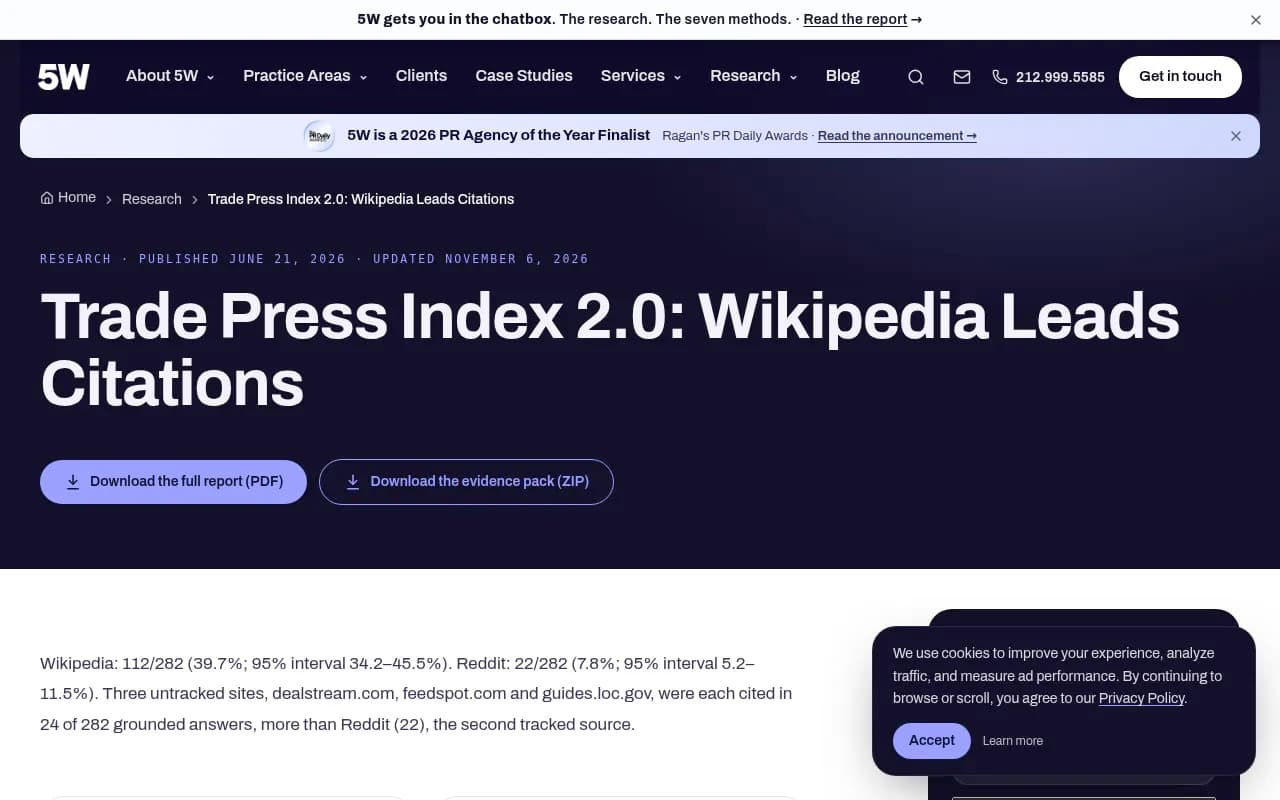
- Wikipedia is the most visible single source in small studies (cited in 39.7% of grounded answers in the 5WPR Trade Press Index 2.0), but in Promptwatch's May 2026 ChatGPT data it was only 0.72% of all citations. Both numbers are real. They measure different things.
- Review sites and communities (G2, Trustpilot, Reddit) do not count toward a Wikipedia page, yet they shape branded answers. Reviews rise to 5.6% of ChatGPT citations on branded prompts, more than 3x their overall share.
- Trade press matters most by sector. Becker's Hospital Review leads healthcare, Retail Dive leads retail, Skift and Hospitality Net lead travel. Wikipedia barely registers in healthcare.
- Engines disagree. ChatGPT named Wikipedia in 56.9% of answers in the 5WPR test, Gemini in 0.0%. Check each engine separately.
- Your own product and landing pages still account for about 39% of ChatGPT citations. Fix those before you chase anything else.
Why this question is harder than it looks
Somebody has probably pitched you a Wikipedia page as the best AI visibility investment a brand can make. The pitch has two halves. Wikipedia is cited a lot, which is documented. So your brand needs a page, which is a jump. As the Omnibound analysis of public sources puts it, no public study we found compares brands with and without a page, or tracks mentions before and after one appears.
So the honest framing is three separate questions:
- Which sources do AI engines actually pull from when they answer questions about a category or a brand?
- Which of those sources can you realistically influence?
- Does influencing them change the answer, or just correlate with it?
The rest of this guide goes through Wikipedia, review sites and trade press with those questions in mind.
Wikipedia: cited a lot, or barely cited?
The published Wikipedia numbers range from under 1% to nearly 48%. They are not contradictory. They count different units.
| Source | What it measured | Wikipedia figure |
|---|---|---|
| 5WPR Trade Press Index 2.0 | Share of 282 grounded answers citing Wikipedia (24 questions, 4 chat engines) | 39.7% |
| 5WPR, Google AI Overviews | Share of 64 overviews naming Wikipedia | 12.5% (8 of 64) |
| Profound analysis (as relayed by Omnibound) | Share within ChatGPT's top ten sources | 47.9% |
| Same analysis | Share of all citations | 7.8% |
| Promptwatch Data, May 2026 | Share of all ChatGPT Search citations | 0.72% |
| Qvery (undisclosed sample, as relayed by Omnibound) | Share of ChatGPT responses, Jan to Mar 2026 | 2.49% |
A share of responses asks how often an answer cites Wikipedia at all. A share of citations asks how much of the whole citation pool it holds. A share within a top-ten list is a share of a smaller pool. Different prompt sets and different months muddy things further.
The 5WPR sample is also small: 24 questions, each asked three times on four engines. Treat it as a directional read of trade-press behavior, not a market benchmark. Promptwatch's ChatGPT citation share data for May 2026 is the opposite kind of dataset: broad, but it reports share of citations, where even the leader leaves about 94% of citations to other sources.
The share moves
This is the part I would pin to the wall. Semrush reported the share of ChatGPT responses citing Wikipedia fell from about 55% to under 20% between early August and mid-September 2025, across 230,000 prompts over 13 weeks. Meltwater's volume data had Wikipedia up 55.2% in May 2026 and down 14.5% in July. A source that can lose more than half its ChatGPT presence in six weeks is a poor foundation for a strategy built around it alone.
The same goes for Reddit. Promptwatch Data on Reddit in ChatGPT shows reddit.com holding a steady 3.83% of ChatGPT citations from Jul 18 to Aug 7, 2026, then dropping below 1% on Aug 14 (Aug 14 to 17 average: 0.52%). Promptwatch flags the size of that drop as provisional, and it started the same day ChatGPT changed its query fanout behavior. Google's engines declined much more gently over the same window.
Three routes a Wikipedia page could take into an answer
Omnibound's breakdown is useful here because it separates the mechanisms:
- Retrieval: the engine searches the web, pulls in a Wikipedia article and cites it. This is what the citation figures measure.
- Training and licensing: models learn from Wikipedia text, and several AI companies pay for access. How much one company's article shapes a model's uncited answer about that company is hard to observe.
- Knowledge graph: commentators say Wikipedia and Wikidata feed Google's knowledge graph. Evidence that this reaches AI answers is mostly assertion.
Only retrieval is measurable from outside. So if you want evidence a page helps, check whether your brand's own page gets cited in answers about you.
The "50% of cited agencies had pages" problem
A statistic that circulates in AI-visibility guides says 50% of the marketing agencies most often cited in AI answers had Wikipedia pages. Without a base rate, that number means nothing. If 10% of agencies have pages, cited agencies are five times as likely to have one. If 50% do, there is no link at all. And agencies big enough to be widely cited are probably big enough to satisfy Wikipedia's notability rules in the first place. The independent coverage that earns the page may be exactly what engines cite.
The pages selling Wikipedia creation services tend to skip this. One vendor page calls Wikipedia "an AI infrastructure asset." That is a sales claim, not a finding.

Can you even get a page?
For many B2B companies the first question is whether Wikipedia would accept one. According to Klarivo's reading of Wikipedia's policy pages (read 15 October 2026), the rules are blunt:
| Source type | Counts toward notability? |
|---|---|
| In-depth feature by a staff reporter at a regional or national outlet | Yes, if independent |
| Independent analysis or study that discusses the company | Yes, if significant and independent |
| Press release, or a story rewritten from one | No |
| Trade magazine coverage | Rarely. NCORP states a presumption against it |
| Review platforms, forums, community threads | No. User-generated content is "generally unacceptable as sources" |
Notice the irony. Trade press is what AI engines cite heavily in many sectors, yet Wikipedia's company-notability guideline discounts it. And review sites shape branded answers but cannot support an article. Do not try to write your own page, and do not expect a trade-press mention to carry one. Earn independent coverage first.
Review sites: small share overall, big share when someone names you
Overall, reviews are a small slice of ChatGPT citations. Promptwatch's content-type data for Sep 28 to Oct 4, 2026 puts reviews at 1.7% of classified citations. Product pages are 22.4%, landing pages 16.8%, listicles 13.6%.
But branded prompts flip it. When the prompt names a company, reviews rise to 5.6%, more than 3x their overall share, and social posts rise to 3.0%, almost 4x. Anyone typing "is [your brand] any good" into ChatGPT is far more likely to be shown what customers said than what you said.
| Prompt type | Product pages | Landing pages | Reviews | Listicles |
|---|---|---|---|---|
| All prompts | 22.4% | 16.8% | 1.7% | 13.6% |
| Branded | 23.3% | 22.8% | 5.6% | n/a |
| Commercial | 26.0% | 20.6% | n/a | 15.0% |
| Informational | 19.1% | 13.9% | n/a | 13.6% |
Which review sites matter depends on the vertical. Promptwatch's software citation report has GitHub, Microsoft's docs and G2 leading ChatGPT citations. The travel report has Skyscanner, Going and Tripadvisor out front, with booking and search sites earning more than half. In automotive, marketplaces like Autotrader and Cars.com outrank every car brand. In each case the platform people use to compare is the platform the model cites.
Review platforms like Trustpilot are not a large share overall (Promptwatch Data had Trustpilot at 0.18% of ChatGPT citations in May 2026), but the branded-prompt jump means they carry weight exactly where reputation is decided.
What to do about reviews
- Collect reviews on the two or three platforms your category already uses, not all of them.
- Reply to the negative ones with specifics. Models quote what is written there.
- Keep pricing, features and policies on your own pages consistent with what reviewers describe, since contradictions show up in answers.
Trade press: where the sector decides
The 5WPR table is the most useful thing in the research for anyone doing this by industry. Wikipedia leads in entertainment (21 of 33 answers), food and beverage (18 of 36) and travel (16 of 36). But in healthcare and biotech it does not lead at all.
| Sector | Chat engines: most-cited tracked platforms | Google AI Overviews |
|---|---|---|
| Beauty and fashion | Wikipedia (14/36), Glossy (11/36), Cosmetics Business (9/36) | Business of Fashion (2/9) |
| Consumer and retail | Wikipedia (9/36), Retail Dive (7/36), Adweek (5/36) | None cited |
| Entertainment | Wikipedia (21/33), Reddit (6/33), Axios (4/33) | The Hollywood Reporter (2/8) |
| Food and beverage | Wikipedia (18/36), Nation's Restaurant News (10/36), Restaurant Business (6/36) | Food Dive (2/9) |
| Healthcare and biotech | Becker's Hospital Review (14/33), Fierce Biotech (9/33), Reddit (9/33) | Modern Healthcare (3/8) |
| Politics and public affairs | Wikipedia (13/36), The Hill (9/36), Punchbowl News (7/36) | Punchbowl News (2/7), Roll Call (2/7) |
| Technology | Wikipedia (14/36), Forbes (5/36), CIO.com (4/36) | CIO.com (3/8), Reddit (3/8) |
| Travel and hospitality | Wikipedia (16/36), Hospitality Net (8/36), Skift (8/36) | CNBC (2/8) |
A few things jump out. Google AI Overviews lean on trade titles more than Wikipedia in several sectors. Trade and specialist press supplied 12.5% of citations in the study and reference sites 9.5%. And the question-level view is stranger still: for one retail question, Retail Dive led at 58.3%, and for a healthcare question, Reddit led at 77.8% of grounded answers.
There is also a gap between being named and being cited. Wikipedia was named in only 14.6% of answers, yet its own domains were cited in 39.7%. Engines use it as a background source without necessarily saying so. Odd untracked sites showed up too: dealstream.com, feedspot.com and guides.loc.gov were each cited in 24 of 282 grounded answers, more than Reddit's 22. Directories and list sites that look like noise are doing real work in the retrieval layer.
And trade press ages fast. Promptwatch's content half-life data shows news losing half its cited pages within 36 days of ChatGPT citing them, while landing pages and docs stayed cited longest. A trade-press mention is a short-lived signal unless it is backed by pages you control.
Each engine reads the web differently
The 5WPR test found ChatGPT named Wikipedia in 56.9% of answers against 0.0% on Gemini. Claude named Forbes in 18.1% of answers against 0.0% on Perplexity. Google AI Overviews appeared on 64 of 64 searches in their sample. Promptwatch's social citation report found a similar split on social platforms: ChatGPT got 0.46% of citations from social platforms in the week of Sep 28 to Oct 4, 2026, while Google AI Overviews got 12.2%.
Practically, that means one cross-engine average tells you little. A brand strategy built on "get cited by Wikipedia" can work in one engine and do nothing in another.
Citations are also spread thin. Almost half of ChatGPT responses cite 10 or more unique domains, so no single source owns your category. And mid-authority sites earned almost half of ChatGPT citations in August 2026, with the very highest domain ranks falling to about 3%. Being named in a niche specialist outlet can beat a passing mention in a giant one.
A practical order of operations
- Fix the pages you control. Product and landing pages account for about 39% of ChatGPT citations. Keep them factual and complete, and add an FAQ page. 5WPR's data agrees: put your facts on your own domain.
- Map your sector's source mix. Use the table above as a starting point, then verify with your own prompts. In healthcare, Becker's matters more than a Wikipedia page. In entertainment, the reverse.
- Earn independent coverage. This is what feeds both trade-press citations and Wikipedia notability. Press releases and rewritten press releases do not count for Wikipedia.
- Build review presence where buyers compare. Pick the platform your category's models already cite.
- Audit what is already said. Mark claims AI makes about you as accurate or inaccurate, then fix the source pages that teach it the wrong thing.
- Re-run the same questions monthly and compare counts with their intervals, not ranks. Wikipedia's share swung by more than half in six weeks in one tracker.
- Only then ask whether a Wikipedia page is realistic. If independent significant coverage exists, a neutral editor may accept an article. If it does not, building that coverage comes first anyway.
Tools for tracking which sources matter
You can do this by hand with a spreadsheet and 20 prompts, and for a first pass I would. At scale you want something that records the cited URLs per engine and tracks them over time.
Promptwatch is built for this: it monitors the real interfaces of ChatGPT, Gemini, Perplexity, Google AI Overviews and others, shows which domains and pages get cited for your prompts (with Reddit, YouTube and LinkedIn citation reports), and its Brand Narrative and Fact Check features surface the specific claims AI makes about you and which page it is learning them from. Its Page Tracker also shows whether a competitor's or your own URL is cited. Pricing starts at $95/month, and there is a 7-day free trial and a free AI visibility report; confirm current plans at promptwatch.com/pricing.

Other options in the catalog for source and citation tracking:
| Tool | Strength | Limitation |
|---|---|---|
| Promptwatch | Citations, crawler logs, content gap analysis, publishing | More than a lightweight check needs |
| Profound | Enterprise monitoring across many engines | Monitoring-led, higher price tier |
| Otterly.AI | Simple brand mention tracking | Basic, no crawler or traffic data |
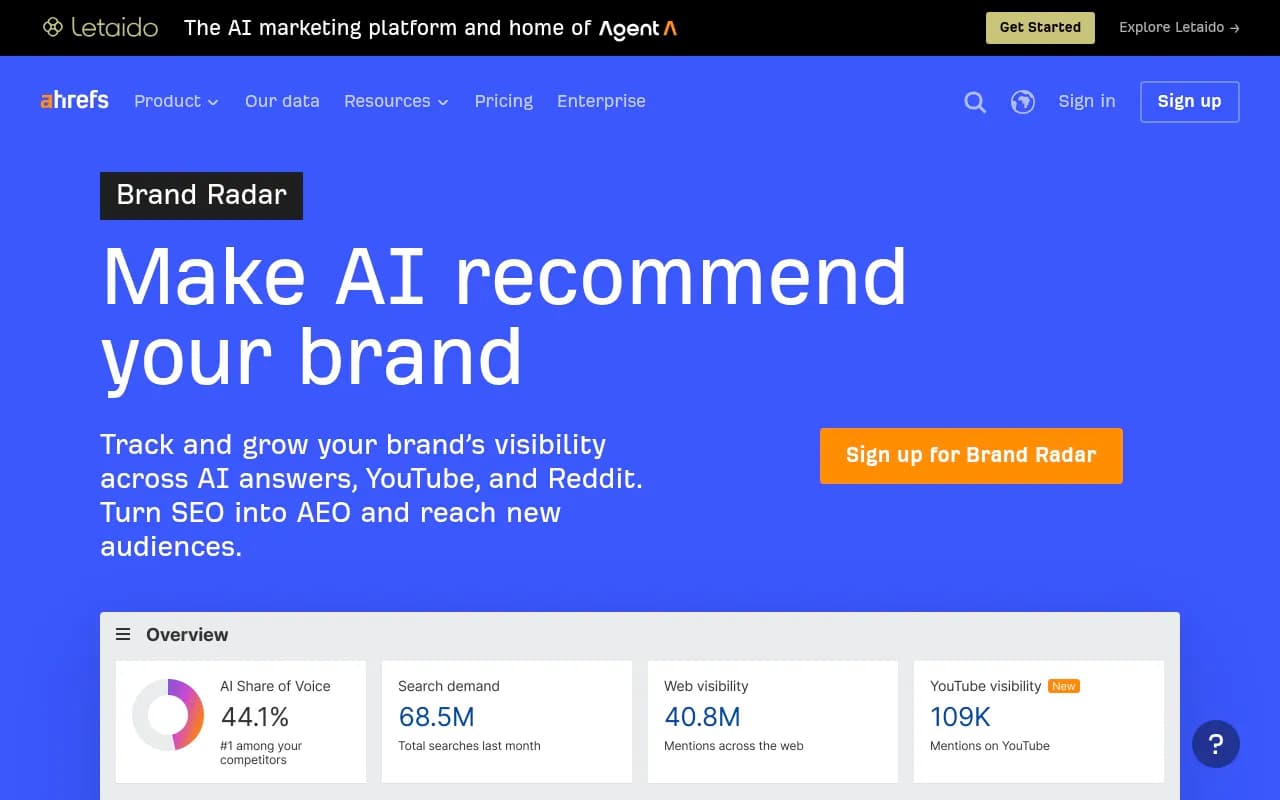
| Ahrefs Brand Radar | Brand visibility inside an SEO suite | Fixed prompt sets |
| Semrush | AI visibility next to classic SEO | Shallower AI-specific data |
Profound

Otterly.AI

More options are listed in the GEO software directory at bestgeosoftware.com.
What the evidence does not tell you
A few honest limits, since this topic attracts overstatement:
- Nobody has published a clean brand-level test of whether a Wikipedia page changes what AI says. Adobe's Wikipedia Analysis feature and agency price lists ($50,000 to $200,000 in one agency guide for mid-market B2B) rest on the same unproven premise.
- The 5WPR study is 24 questions and a small grounded-answer base. Intervals are wide: Wikipedia's 39.7% has a 95% interval of 34.2% to 45.5%.
- Share-of-citation numbers from different trackers cannot be compared directly.
- Reddit's ChatGPT drop is provisional, according to Promptwatch itself.
What holds up across every source: engines differ, sector matters, your own pages matter most, and any single source's share moves month to month. Pick two or three channels that match your sector, keep your own facts clean, and measure monthly.