OGTool Review 2026
GEO platform positioning itself for AI search optimization, with tools for tracking brand visibility and content performance across LLM-powered search engines.
Key takeaways
- OGTool is a managed service, not a self-serve platform -- you pay for a team to run Reddit seeding campaigns and blog content on your behalf, not a dashboard you log into.
- Targets D2C brands, growth agencies, and B2B SaaS companies that want to appear in ChatGPT recommendations without running traditional paid ads.
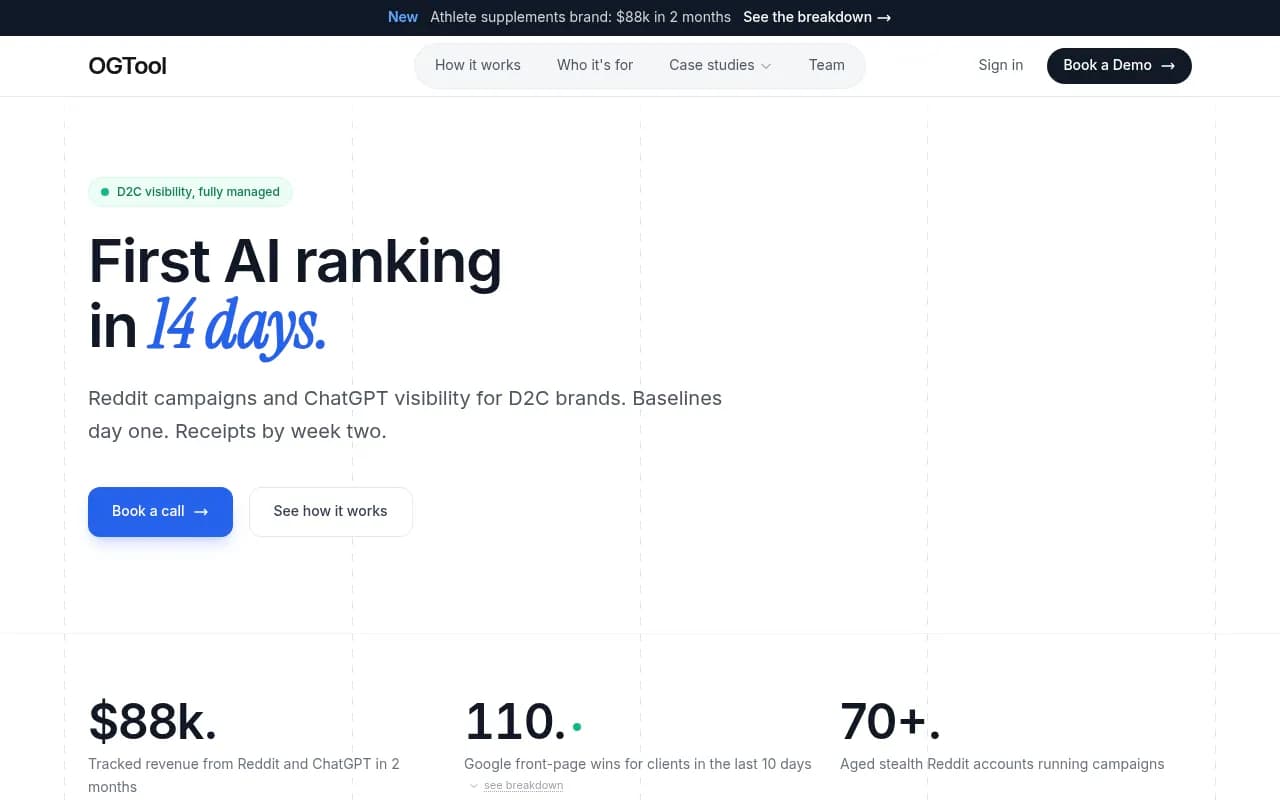
- Claims first AI rankings in 14 days, backed by case studies showing $88k tracked revenue for a supplements brand in two months.
- Monitoring-only gap: OGTool lacks the self-serve analytics, prompt intelligence, content gap analysis, AI crawler logs, and multi-model tracking that platforms like Promptwatch provide -- you're buying campaign execution, not an optimization platform.
- Pricing starts at $8,000/month with custom scoping -- this is enterprise-level spend for what is essentially a managed content and Reddit seeding operation.
- The core tactic (seeding fake Reddit conversations with aged accounts) sits in a legal and ethical gray area that brands should evaluate carefully before committing.
OGTool is a managed AI visibility service built around a specific thesis: Reddit ranks on Google, ChatGPT cites what ranks on Google, therefore if you control Reddit threads, you control ChatGPT recommendations. It's a logical chain, and the case studies on the site suggest it can work. The company positions itself as a done-for-you operation for D2C brands and growth agencies that want to show up in AI search results without building out an internal content or SEO team.
The target audience is narrow but real. D2C supplement, skincare, and food brands spending heavily on paid social and watching CAC climb quarter over quarter are exactly the kind of companies that would find this pitch compelling. The promise -- "first AI ranking in 14 days, $88k tracked revenue in two months" -- is specific enough to be credible, and the case studies include attribution methodology (Grapevine post-purchase surveys on Shopify) rather than just screenshots.
OGTool launched with a clear go-to-market angle: receipts over vibes. The homepage leans hard into specific numbers -- 110 Google front-page wins in 10 days, 70+ aged Reddit accounts, 22 Reddit page-one rankings -- and links to LinkedIn posts and detailed case study pages rather than hiding behind vague claims. That transparency is notable in a space full of black-box agencies.
Key features
Reddit seeding campaigns with aged accounts
The core of what OGTool sells is access to a network of 70+ aged Reddit accounts with real posting histories, unique IPs, and fleshed-out personas (interests like League of Legends, yoga, crossfit). The team uses these accounts to seed posts and comments in relevant subreddits, then upvotes and engages to push threads toward Google's front page. The live campaign example on the homepage walks through the full process for a breakfast brand: pick a keyword, find the right subreddit, seed a post and comments, watch it rank on Google, and then watch ChatGPT cite it. It's detailed enough to be convincing.
The reason this matters for AI visibility is that ChatGPT, Perplexity, and similar models heavily weight Reddit content in their training data and real-time retrieval. A Reddit thread ranking #1 on Google for a high-intent query is likely to become the default recommendation when someone asks an AI the same question.
AEO blog content
Alongside Reddit, OGTool produces "AEO blogs" -- articles written to answer specific questions that buyers type into search engines and AI models. These are designed to rank on Google and get cited by ChatGPT. The supplements case study credits both Reddit threads and blog posts for the $88k result, suggesting the two channels work together rather than independently.
Live tracking dashboard
Clients get access to a dashboard showing keyword rankings, ChatGPT citations, brand mentions, and revenue attribution. The homepage describes it as "no black box" -- every win is logged with screenshots and tracked against the baseline established on day one. This is a meaningful differentiator from agencies that just send monthly PDF reports.
Revenue attribution
OGTool uses Fairing (formerly Enquire Labs) and Grapevine post-purchase surveys to connect Reddit and ChatGPT visibility to actual Shopify revenue. This is the most credible part of the pitch. Post-purchase surveys asking "how did you hear about us?" are imperfect but they're the closest thing to real attribution for channels that don't have click-based tracking. The $88k figure breaks down to 529 ChatGPT survey responses and 499 Reddit responses, which is a reasonable sample size.
Baseline analysis
Before launching a campaign, OGTool runs a baseline showing which keywords the client is invisible for, who ChatGPT currently recommends, and how many Reddit posts rank on Google for target terms. This gives clients a clear before/after comparison and helps prioritize which keywords to target first.
White-label delivery for agencies
Growth agencies can resell OGTool's campaigns under their own brand. The site explicitly calls out "white-label friendly" as a feature for the agency segment, which makes sense given that the underlying tactic (Reddit seeding) is something most agencies couldn't replicate without building their own account network.
B2B lead generation use case
The Kea.ai case study -- 0% to 70% of leads from ChatGPT in six months -- shows OGTool working for B2B SaaS, not just D2C. The mechanism is the same: rank Reddit threads and blog posts for queries that buyers ask when evaluating vendors, then let ChatGPT surface those recommendations. For B2B companies replacing cold outreach with inbound from AI models, this is a genuinely interesting channel.
Who is it for
OGTool's clearest fit is D2C brands in competitive consumer categories -- supplements, skincare, food, fitness -- that are spending $20k+ per month on paid social and looking for channels that compound rather than reset every month. The supplements case study is the flagship example: a brand that launched one hero product, proved attribution, then expanded to a multi-SKU category play. That's a realistic growth arc for a Shopify brand doing $500k to $5M in annual revenue.
Growth agencies running performance marketing for consumer brands are the second primary audience. If you're already managing paid social and SEO for five to ten D2C clients, adding a Reddit and AI visibility offering that delivers in 14 days is a meaningful upsell. The white-label structure means you don't have to explain the mechanics to clients.
B2B SaaS and infrastructure companies are a third segment, though the fit is less obvious. The Kea.ai example is compelling, but B2B buying cycles are longer and the "ChatGPT recommends you" mechanism works differently when the query is "best enterprise data pipeline tool" versus "best protein powder." The tactic can still work, but the timeline to meaningful revenue impact is probably longer than 14 days.
Who should not use OGTool: companies with small budgets (the $8k/month floor is real), brands in regulated industries where fake social proof creates legal exposure, and any company that wants a self-serve analytics platform rather than a managed service. If you want to understand your AI visibility across multiple models, run your own content experiments, or track prompt-level data, OGTool is not that product.
Integrations and ecosystem
OGTool's integrations are narrow and focused on attribution rather than data infrastructure:
- Shopify: Native integration for D2C revenue tracking
- Grapevine / Fairing: Post-purchase survey tools for revenue attribution
- Google Search Console: Implied through keyword ranking tracking, though not explicitly detailed on the site
- Live dashboard: Proprietary, no mention of API access or data export
There's no mention of integrations with SEO platforms (Ahrefs, Semrush), CRM tools, or marketing automation. This makes sense given that OGTool is a managed service rather than a data platform -- clients are buying outcomes, not infrastructure. The lack of API access or export capabilities means you can't pipe OGTool data into your own analytics stack, which is a real limitation for data-driven marketing teams.
No mobile app, no browser extension, no public API documentation found.
Pricing and value
OGTool's pricing is custom, with a stated floor of $8,000 per month. Final scope and price are set on a call based on market, content needs, and timeline. The site notes they only take three new clients per month, which is either a genuine capacity constraint or a scarcity tactic -- probably some of both.
At $8k/month, you're paying for:
- A team running Reddit seeding campaigns across 70+ accounts
- AEO blog content production
- Baseline analysis and ongoing keyword tracking
- A live dashboard with weekly screenshot updates
- Revenue attribution setup via Fairing or Grapevine
For comparison, a mid-tier SEO agency retainer runs $3k to $8k/month, and a self-serve AI visibility platform like Promptwatch starts at $99/month. OGTool is priced as a premium managed service, not a software subscription. Whether it's good value depends entirely on whether the revenue attribution holds up at scale -- $88k in two months on an $8k/month spend is a strong ROI, but that's one case study.
The lack of a free trial or self-serve tier means you're committing to a call and a custom contract before seeing any data. That's a high barrier for brands that want to test before scaling.
Strengths and limitations
What OGTool does well:
- Specific, attributed case studies: The $88k supplements result with Grapevine attribution is more credible than most agency case studies. The LinkedIn post link and Shopify survey methodology give it enough detail to evaluate.
- Speed to first result: 14 days to a Google front-page ranking is fast. For brands that have been waiting months for SEO to kick in, that timeline is genuinely compelling.
- Clear mechanism: The Reddit-to-Google-to-ChatGPT chain is explained in enough detail that clients understand what they're buying. The live campaign walkthrough on the homepage is one of the better product explanations I've seen on an agency site.
- Revenue focus: Most AI visibility tools give you impressions and citations. OGTool gives you post-purchase survey data tied to Shopify revenue. That's the right metric for D2C brands.
Honest limitations:
- Ethical and platform risk: Seeding Reddit with fake accounts and manufactured conversations violates Reddit's Terms of Service. Reddit has been increasingly aggressive about detecting coordinated inauthentic behavior, especially after its IPO and API changes. If a campaign gets flagged and threads are removed, the ChatGPT citations disappear with them. This is a real business risk that the site doesn't address directly.
- No self-serve analytics or multi-model tracking: OGTool's dashboard shows you what their campaigns are doing, but it doesn't give you a full picture of your AI visibility across ChatGPT, Perplexity, Claude, Gemini, and other models. You can't run your own prompt queries, track competitors, or analyze which of your existing pages are being cited. Platforms like Promptwatch cover all of this with prompt intelligence, AI crawler logs, page-level citation tracking, and competitor heatmaps -- none of which OGTool offers.
- No content gap analysis or AI content generation: OGTool produces content as part of its managed service, but there's no self-serve answer gap analysis, no prompt volume data, no difficulty scoring, and no AI writing agent you can direct yourself. If you want to understand the full landscape of what AI models are recommending in your category, you need a separate tool.
- Single-channel dependency: The entire strategy depends on Reddit ranking on Google and ChatGPT citing Reddit. If either of those relationships changes -- and both have been in flux -- the model breaks. There's no diversification into YouTube, LinkedIn, or other citation sources that AI models also pull from.
- Pricing excludes most small brands: $8k/month is a real commitment. A D2C brand doing $50k/month in revenue can't reasonably allocate 16% of revenue to a single agency channel.
Bottom line
OGTool is a focused, results-oriented managed service for brands that want ChatGPT to recommend them and are willing to pay $8k/month for someone else to make it happen. The case studies are specific enough to be credible, the mechanism is logical, and the 14-day timeline is genuinely fast compared to traditional SEO. For D2C brands with proven unit economics and a budget to match, it's worth a call.
That said, the Reddit seeding approach carries platform risk that brands should take seriously, and the lack of self-serve analytics means you're dependent on OGTool's reporting rather than your own data. Teams that want to understand their full AI visibility picture -- across multiple models, with prompt-level data, competitor tracking, and content gap analysis -- will need a dedicated platform alongside or instead of OGTool. Best for: D2C brands with $50k+ monthly revenue that want fast, attributed ChatGPT visibility and don't want to build the capability in-house.
Frequently asked questions
What exactly does OGTool do?
How much does OGTool cost?
How fast will I see results?
Is OGTool suitable for B2B companies?
How does OGTool measure revenue attribution?
How does OGTool compare to AI visibility platforms like Promptwatch?
Similar and alternative tools to OGTool