Relay.app Review 2026
Workflow automation platform that combines AI automation with human review steps. Useful for content teams that need oversight in automated pipelines.
Key takeaways
- Relay.app is a no-code workflow automation tool that combines AI agents with human review steps, making it a strong fit for teams that can't afford to let automation run completely unsupervised
- Connects 200+ apps including OpenAI, Anthropic, HubSpot, Slack, Notion, Stripe, and Google Workspace
- Plain-English workflow builder lowers the barrier to entry significantly compared to Zapier or Make
- Free plan available; paid plans start around $19-38/month depending on the source, scaling by usage
- Not a monitoring or analytics tool -- purely an automation and workflow platform
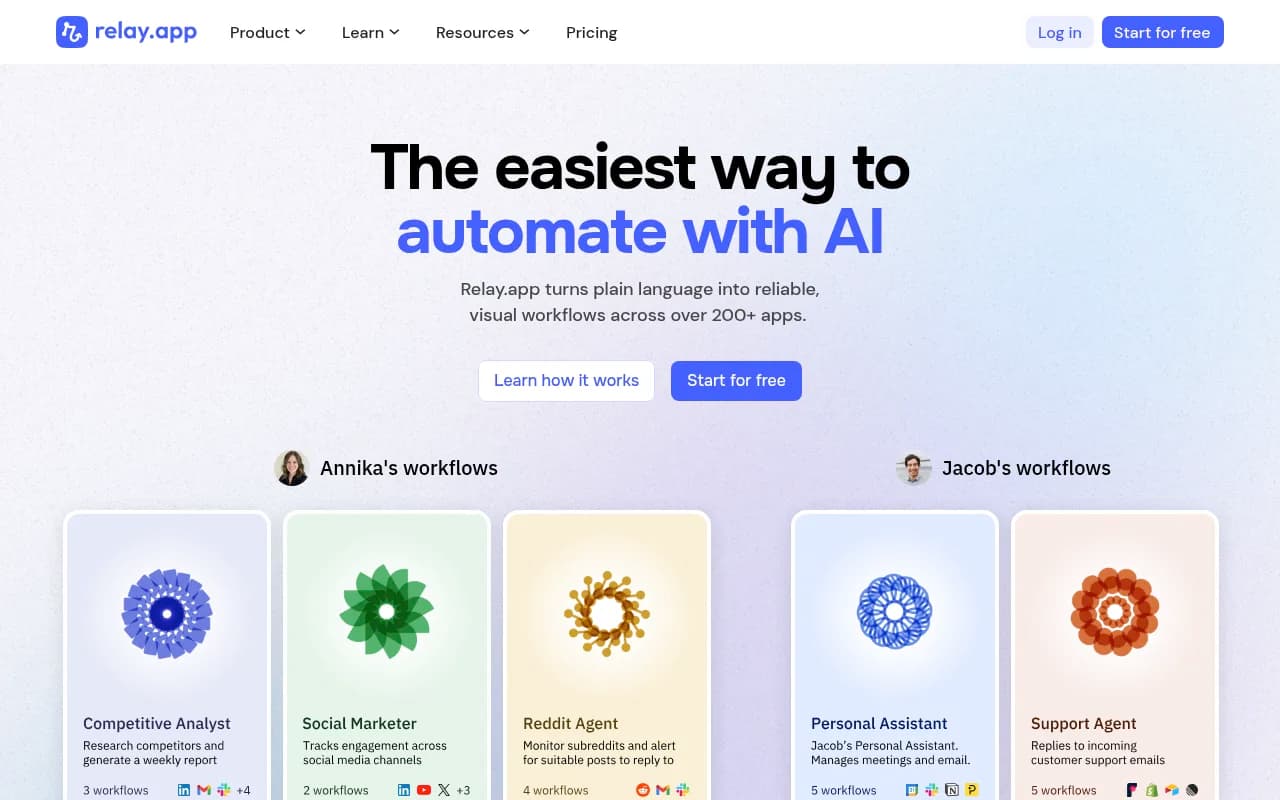
Relay.app is a workflow automation platform built around a simple but genuinely useful idea: not every step in an automated process should run without a human seeing it first. The company, Relay.app Inc., positions itself as the easiest way to automate with AI, and the pitch is that you can describe a workflow in plain English and have it running across your favorite apps in minutes. That's a familiar claim in 2026, but Relay.app earns it more than most.
The platform sits in a crowded space alongside Zapier, Make (formerly Integromat), and n8n. What separates it is the deliberate inclusion of human-in-the-loop steps -- moments in a workflow where a person reviews, approves, or edits before the automation continues. This sounds like a small thing, but for content teams, sales teams, and small business operators who've been burned by fully automated pipelines doing something embarrassing, it's actually a meaningful design choice.
The target audience is broad but skews toward non-technical users: solo operators, small business owners, marketing and operations teams at companies with 5-100 people, and consultants who need to automate client-facing processes without writing code. Relay.app has also built out a certified partner program and an affiliate program, which suggests it's actively courting agencies and freelance automation specialists as a distribution channel.
Key features
Plain-English workflow creation The headline feature is the ability to describe what you want in natural language and have Relay.app generate a workflow from it. In practice, this works reasonably well for common use cases -- "when a new lead fills out my Typeform, add them to HubSpot and send a Slack notification" is the kind of thing it handles cleanly. More complex, multi-branch logic still benefits from manual adjustment, but the starting point is much faster than building from scratch in a traditional drag-and-drop editor.
Human-in-the-loop steps This is Relay.app's most distinctive feature. You can insert a "human review" step anywhere in a workflow, which pauses execution and sends a task to a specific person (or anyone on the team) to approve, edit, or reject before the workflow continues. This is particularly useful for:
- AI-generated content that needs a human eye before it goes out
- Expense approvals or contract reviews embedded in a larger process
- Situations where data quality from an upstream source is unreliable
Most automation tools treat human involvement as a failure state. Relay.app treats it as a first-class workflow step.
AI agent integration Relay.app connects natively to OpenAI, Anthropic (Claude), Google Gemini, Mistral, Groq, xAI, and Perplexity. You can call these models as steps within a workflow -- summarize an email, classify a support ticket, draft a reply, extract structured data from unstructured text. The platform also supports building "agentic" workflows where the AI can make decisions and branch the workflow based on its output.
Visual workflow builder The interface is a visual canvas where workflow steps appear as connected nodes. Reviewers consistently praise the UI -- it's cleaner than Make's and more intuitive than n8n's. The visual representation makes it easy to see the full logic of a workflow at a glance, which matters when you're debugging or handing something off to a colleague.
200+ app integrations The integration library covers the major categories well:
- CRM: HubSpot, Pipedrive, Attio, Follow Up Boss
- Project management: Asana, ClickUp, Linear, Jira, Monday.com, Notion, Trello
- Email: Gmail, Outlook, Mailchimp, MailerLite, Brevo, Lemlist
- Sales: Apollo, Instantly, Smartlead.ai, Lemlist
- Payments: Stripe, Paddle, Chargebee, Lemon Squeezy
- AI/ML: OpenAI, Anthropic, Gemini, Mistral, Groq, ElevenLabs, HeyGen, AssemblyAI
- Communication: Slack, Discord, Teams, WhatsApp notifications
The AI tool integrations are notably comprehensive -- having ElevenLabs, HeyGen, and AssemblyAI alongside the major LLMs means you can build genuinely sophisticated media and content workflows.
Template library Relay.app maintains a browsable template library covering common use cases across sales, marketing, HR, and operations. Templates are a practical shortcut for new users and a good way to understand what the platform can do before committing to building something from scratch.
AI Agent Academy and learning resources The platform has invested in education: an "AI Agent Academy," live events, YouTube videos, and community forums. This is smart positioning for a tool targeting non-technical users who may need hand-holding to get value from automation.
Certified partner program For users who don't want to build workflows themselves, Relay.app has a marketplace of certified partners -- freelancers and agencies who can build and manage workflows on your behalf. This is a meaningful differentiator for small businesses that want automation without the learning curve.
Who is it for
Relay.app fits best with small to mid-sized teams that want automation without a dedicated technical resource. A solo consultant automating their client onboarding process, a 10-person marketing team routing leads from multiple sources into their CRM, or a service business owner who wants to eliminate manual data entry -- these are the people who get the most out of it. The human-in-the-loop feature specifically appeals to anyone running processes where errors have real consequences: client communications, financial approvals, content publishing.
Content teams are a natural fit. If you're using AI to draft social posts, newsletters, or blog outlines, Relay.app lets you build a pipeline where the AI does the drafting and a human does the final review before anything goes live. That's a workflow pattern that's hard to replicate cleanly in Zapier without workarounds.
Sales and revenue operations teams at early-stage companies also show up frequently in the testimonials. The combination of CRM integrations, email outreach tools (Apollo, Instantly, Lemlist), and AI enrichment steps makes it a reasonable choice for building lead qualification and outreach workflows.
Who should probably look elsewhere: large enterprises with complex compliance requirements and dedicated engineering teams will likely find Relay.app's feature set too lightweight. Power users who need highly conditional logic, custom code steps, or deep API customization may hit the ceiling faster than they would with Make or n8n. And developers who want to self-host their automation infrastructure should look at n8n, which is open source.
Integrations and ecosystem
The 200+ integration count is genuine and covers the apps most small business and marketing teams actually use. The AI integrations are a particular strength -- connecting to seven or eight different LLM providers natively means you're not locked into one model.
There's no mention of a public API for building custom integrations, which is a gap compared to Make or Zapier. The platform does support webhooks, which covers many custom integration needs, but it's worth checking if your specific tool is in the library before committing.
Relay.app has a community forum, a YouTube channel with tutorial content, and live events. There's no native mobile app mentioned, which is typical for workflow automation tools in this category.
The certified partner marketplace is worth noting for agencies: Relay.app actively recruits automation specialists to build on the platform and serve clients, which creates a services layer around the product.
Pricing and value
Pricing information from multiple sources suggests the following structure (note: always verify current pricing on relay.app/pricing directly):
- Free plan: Available, with limited automated steps and AI credits
- Professional: Approximately $19-38/month, covering individual use with around 750 automated steps and 5,000 AI credits
- Team: Approximately $138/month, for collaborative use across a team
- Enterprise: Custom pricing
The free plan is a genuine starting point, not just a trial. The Professional tier is priced competitively against Zapier's Starter plan ($19.99/month for 750 tasks) and Make's Core plan ($9/month but with a steeper learning curve). For small teams, the Team plan at ~$138/month compares favorably to Zapier's Team plan, which runs significantly higher.
The AI credits system means heavy AI usage will push you toward higher tiers or add-on costs, which is standard for tools that bundle LLM calls. If you're running dozens of AI-powered workflows daily, model the credit consumption before committing to a plan.
Strengths and limitations
What it does well:
- The human-in-the-loop concept is genuinely well-executed and fills a real gap in the automation market. No other major tool in this category makes it this easy to insert human review steps.
- The UI is consistently praised across G2 (4.9 stars) and Product Hunt (5.0 stars). It's cleaner and more approachable than Make, and the visual canvas is easier to reason about than Zapier's linear step editor.
- AI integration breadth is impressive -- seven LLM providers plus specialized tools like ElevenLabs and AssemblyAI means you can build sophisticated media workflows without leaving the platform.
- The plain-English workflow creation actually works for common use cases, which lowers the barrier for non-technical users meaningfully.
- Pricing is accessible for solo operators and small teams, with a real free tier.
Limitations:
- The integration count (200+) is solid but trails Zapier (6,000+) and Make (1,000+) significantly. If your stack includes niche or enterprise tools, check the library carefully.
- No public API for custom integrations is a notable gap for technical teams who want to extend the platform.
- The AI credits model adds cost unpredictability for heavy AI users. Running 500 AI-powered workflow steps per day will cost more than the base plan suggests.
- Compared to n8n, there's no self-hosting option, which matters for teams with data residency requirements.
Bottom line
Relay.app is the right choice for small teams and solo operators who want AI-powered workflow automation with the safety net of human review steps built in. It's particularly well-suited to content teams, marketing operations, and service businesses that need reliable automation without the risk of fully unsupervised AI pipelines.
Best use case in one sentence: a 10-person marketing team that wants to automate lead routing, AI-assisted content drafting, and CRM updates -- with a human approval step before anything customer-facing goes out.
Tags:
Frequently asked questions
What is Relay.app?
How much does Relay.app cost?
How does Relay.app compare to Zapier?
Does Relay.app require coding skills?
What AI models does Relay.app support?
Is there a free plan?
Similar and alternative tools to Relay.app