Triple Whale Review 2026
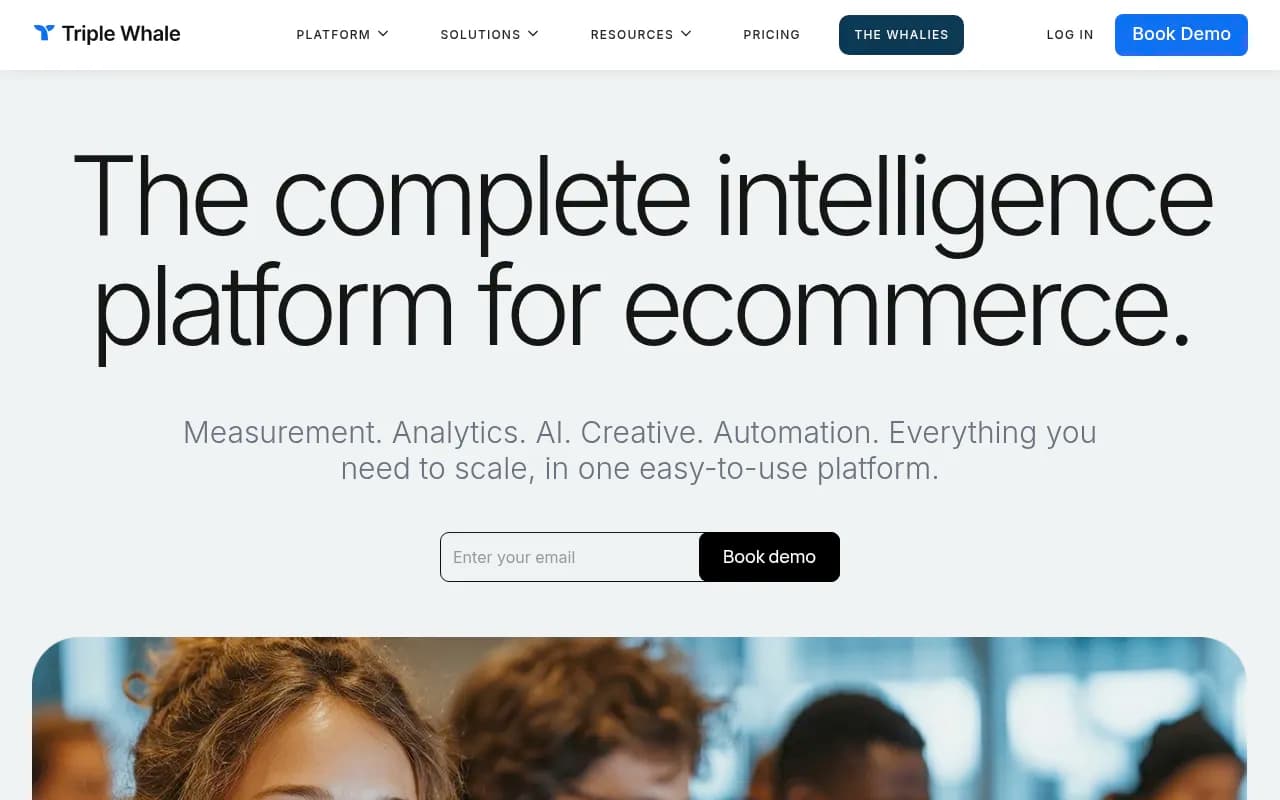
Triple Whale is an AI-powered ecommerce intelligence platform combining attribution, analytics, and automation for DTC brands. It unifies marketing data, offers multi-touch attribution via Triple Pixel, and uses Moby AI to turn insights into action.
Key takeaways
- Triple Whale is a comprehensive ecommerce intelligence platform built specifically for direct-to-consumer brands, combining first-party attribution, marketing analytics, AI-driven insights, and campaign activation in one place.
- Ramp's March 2026 data shows Triple Whale with a 57% adoption rate among marketing measurement tools -- nearly 4x its nearest competitor -- across SMB, mid-market, and enterprise segments.
- The platform's standout feature is Moby, an AI assistant trained on $82B+ in GMV from 50,000+ brands that can answer business questions, reallocate budgets, generate creative assets, and take autonomous actions.
- Pricing scales with GMV, starting around $549/month for brands doing $1M-$2.5M in annual revenue, which makes it a meaningful investment for smaller brands but reasonable for those spending heavily on paid media.
- Not a fit for brands outside ecommerce or those looking for a lightweight analytics tool -- Triple Whale's depth is its strength, but it comes with a learning curve and a price tag to match.
Triple Whale is an ecommerce intelligence platform built by a Columbus, Ohio-based company of the same name. It launched around 2021 and quickly found traction with Shopify-native DTC brands that were drowning in disconnected data from Meta, Google, TikTok, Klaviyo, and a dozen other tools. The core promise: one dashboard that tells you what's actually working, not just what each platform claims is working.
The problem Triple Whale is solving is real and persistent. Every ad platform overclaims conversions. Meta says it drove 300 sales, Google says it drove 250, and your Shopify backend shows 400 total orders. Someone is lying, or at least being very generous with attribution windows. Triple Whale's Triple Pixel sits on your storefront and tracks customer journeys first-party, then reconciles that data against platform-reported numbers to give you something closer to the truth. That's the foundation everything else is built on.
The company has grown to serve 50,000+ brands and 2,000+ agencies worldwide, with customers including True Classic, Peloton Apparel, LSKD, Marine Layer, and Milk Bar. It's raised significant venture funding and has expanded well beyond its attribution roots into a full intelligence platform covering measurement, business intelligence, AI, and campaign activation.
Key features
Triple Pixel and first-party attribution
This is where Triple Whale started and it's still the core of the platform. The Triple Pixel is a JavaScript snippet that installs on your Shopify store and tracks customer interactions across devices and sessions using advanced identity resolution. Unlike platform pixels that only see what happens within their own ecosystem, Triple Pixel follows the full customer journey -- from first ad click to purchase -- and matches that against your actual order data.
The result is attribution data you can actually trust. You can see which channels, campaigns, and creatives genuinely drove revenue, not just which ones claimed credit. Triple Whale supports multiple attribution models (first-click, last-click, linear, time-decay) so you can compare how different models tell different stories about the same data.
Compass: unified measurement
Compass brings together three measurement methodologies that most brands treat as separate tools: multi-touch attribution (MTA), marketing mix modeling (MMM), and incrementality testing. Having all three in one place is genuinely useful because each answers a different question. MTA tells you which touchpoints got credit. MMM tells you the macro relationship between spend and revenue. Incrementality testing tells you what would have happened if you hadn't run a campaign at all.
Most brands at the $5M-$50M GMV range only have access to one of these, usually MTA. Getting MMM and incrementality testing in the same platform, calibrated against the same data, is a meaningful advantage.
Moby AI
Moby is Triple Whale's AI layer, and it's more capable than most "AI analytics" features I've seen bolted onto data tools. It's trained on $82B+ in GMV from 50,000+ brands, which means it understands ecommerce-specific concepts -- ROAS, BFCM seasonality, LTV curves, AOV benchmarks -- without needing to be taught what these terms mean.
Moby Chat lets you ask plain-language questions like "Why did my ROAS drop last week?" and get answers grounded in your actual data, not generic advice. Moby Agents go further: they can autonomously take actions like reallocating budgets across channels, generating creative briefs, suggesting audience segments, triggering lifecycle automations, and even generating ad images and videos sized for different platforms. One customer (Underoutfit's co-founder) noted they were about to hire several analysts before Moby Agents made that unnecessary.
Context Engine
The Context Engine is what separates Moby from a generic AI assistant. It gives Moby a structured understanding of your business: your products, your seasonality, your customer segments, your historical performance benchmarks. When you ask Moby a question, it's not just querying your data -- it's reasoning about your data in the context of how your specific business works. This is why the answers tend to be more useful than what you'd get from dropping a CSV into ChatGPT.
Sonar: enrichment and activation
Sonar is Triple Whale's data enrichment and activation suite. It has two main components:
- Sonar Send: An email and SMS tool that uses your enriched customer data to trigger personalized messages. Origin's ecommerce team reported $420k in incremental revenue within a year of using Sonar Send, at roughly 40% margins.
- Sonar Optimize: Focused on improving conversion rates by surfacing insights about which customer segments are underperforming and why.
The activation angle is important. Most analytics platforms stop at telling you what happened. Sonar lets you act on that information directly, without exporting data to another tool.
Data platform and integrations
Triple Whale connects to 60+ platforms across marketing, sales, and operations. The data platform ingests all of this in real time -- they process 9.2 billion events per day -- and stores it in a unified warehouse that you don't have to pay for separately. No Snowflake bill, no Fivetran setup, no data engineering team required.
The reverse ETL capability means you can push enriched data back to your ad platforms, CRM, or email tool. Audience syncing lets you build segments in Triple Whale and push them directly to Meta, Google, or TikTok for targeting.
Business intelligence and dashboards
Triple Whale's BI layer includes pre-built dashboards for acquisition, retention, conversion, and operations teams. You can also build custom dashboards and reports. The self-serve analytics feature lets non-technical users explore data without writing SQL. For teams that need more, there's a Custom BI option that connects to tools like Looker Studio.
The dashboards are purpose-built for ecommerce, which sounds obvious but matters in practice. Metrics like new customer revenue, repeat purchase rate, contribution margin, and blended ROAS are front and center, not buried under generic web analytics concepts.
Who is it for
Triple Whale's sweet spot is DTC ecommerce brands doing somewhere between $1M and $100M+ in annual GMV that are spending meaningfully on paid media -- typically $50k/month or more across Meta, Google, and TikTok. At that spend level, even a 10-15% improvement in attribution accuracy translates to real money, and the platform's pricing becomes easy to justify.
The platform works particularly well for brands with complex multi-channel acquisition strategies. If you're running influencer campaigns, paid social, paid search, email, and SMS simultaneously, and you're trying to understand how they interact, Triple Whale's unified measurement approach is genuinely valuable. Brands in fashion, beauty, health and wellness, and home goods -- categories where customer LTV and repeat purchase behavior matter -- tend to get the most out of the retention and lifecycle features.
Agencies managing multiple DTC clients are another strong fit. Triple Whale has a dedicated agency tier with multi-brand management, white-label reporting, and Moby Agents for Agencies. With 2,000+ agencies already on the platform, there's a clear product-market fit here.
Who shouldn't use Triple Whale: B2B companies, SaaS businesses, or any brand not running an ecommerce storefront. The platform is built around Shopify (with some support for other platforms) and assumes an ecommerce business model. If you're not selling physical products online, most of the platform won't apply to you. Also, very early-stage brands doing under $500k in GMV will likely find the pricing hard to justify and the feature depth overwhelming.
Integrations and ecosystem
Triple Whale connects to 60+ platforms. The most important integrations for most users:
- Ad platforms: Meta Ads, Google Ads, TikTok Ads, Pinterest Ads, Snapchat Ads, Microsoft Ads
- Ecommerce: Shopify (primary), WooCommerce, BigCommerce
- Email/SMS: Klaviyo, Attentive, Postscript, Yotpo
- Analytics: Google Analytics 4
- Marketplaces: Amazon
- Subscription: Recharge
- Reviews: Okendo, Yotpo Reviews
The developer API is documented at triplewhale.readme.io and the public API repository is available on GitHub at github.com/Triple-Whale. This is useful for agencies or larger brands that want to build custom integrations or pull data into their own systems.
Triple Whale has iOS and Android mobile apps, which is genuinely useful for founders and marketing leaders who want to check performance on the go. The mobile experience is more dashboard-focused than the full web app, but it covers the key metrics you'd want to monitor daily.
There's also a partner ecosystem: Triple Whale maintains a directory of certified agencies (connect.triplewhale.com/agencies) and technology partners, which helps brands find implementation support if they need it.
Pricing and value
Triple Whale's pricing is GMV-based, which is a reasonable model for an ecommerce tool but can feel opaque if you're used to flat-rate SaaS pricing. Based on publicly available information:
- Around $549/month for brands with $1M-$2.5M GMV
- Around $1,129/month for brands with $5M-$7M GMV
- Around $1,849/month for brands with $10M-$15M GMV
- Enterprise pricing for larger brands is custom
There's a free tier available (triplewhale.com/free) that gives you basic access to explore the platform, and a free trial for paid plans. Annual billing discounts are available.
Compared to alternatives: Northbeam and Rockerbox are in a similar price range for attribution-focused tools, but neither has Triple Whale's breadth of AI features or the Sonar activation suite. Tools like Elevar are cheaper but more narrowly focused on tracking setup. Building a comparable stack yourself -- separate attribution tool, BI tool, data warehouse, AI analytics layer -- would cost significantly more and require engineering resources.
The value calculation really depends on how much you're spending on ads. If you're spending $100k/month on paid media and Triple Whale helps you reallocate even 5% more efficiently, the platform pays for itself many times over. The Sonar Send ROI story from Origin ($420k incremental revenue, $168k in profit) is a good illustration of how the activation features can generate returns that dwarf the subscription cost.
Strengths and limitations
What Triple Whale does well:
- Attribution accuracy: The Triple Pixel's first-party tracking and identity resolution is genuinely better than relying on platform-reported data. For brands that have been making budget decisions based on Meta's self-reported ROAS, this alone can be transformative.
- Moby AI depth: Most AI analytics features are thin wrappers around generic LLMs. Moby is trained on ecommerce-specific data and can take autonomous actions, not just answer questions. The Moby Agents capability in particular is ahead of what most competitors offer.
- All-in-one scope: Having attribution, BI, AI, and activation in one platform with one data model eliminates a lot of the integration headaches that come with stitching together separate tools.
- Agency support: The multi-brand management and agency-specific features are well-developed, which is rare in this category.
Honest limitations:
- Shopify-centric: While Triple Whale supports other platforms, the experience is clearly optimized for Shopify. Brands on Magento, custom storefronts, or headless commerce setups may find integration more complex.
- Pricing complexity: GMV-based pricing makes it hard to budget predictably, especially for fast-growing brands that might jump pricing tiers mid-year. The lack of transparent pricing on the website adds friction to the evaluation process.
- Learning curve: The platform's depth is a strength, but it also means there's a real onboarding investment required. Teams without a dedicated analyst or marketing ops person may struggle to get full value quickly.
Bottom line
Triple Whale is the most complete intelligence platform available for DTC ecommerce brands that are serious about paid media efficiency and data-driven growth. If you're spending $50k+ per month on ads, running multi-channel acquisition, and making decisions based on platform-reported data you don't fully trust, Triple Whale is worth evaluating seriously.
Best use case in one sentence: a $5M-$50M GMV DTC brand that wants to replace scattered ad platform dashboards, a separate BI tool, and manual analyst work with one AI-powered platform that tracks, measures, and acts on their data automatically.
Tags:
Frequently asked questions
What is Triple Whale?
How much does Triple Whale cost?
What is Moby in Triple Whale?
Does Triple Whale work with platforms other than Shopify?
How does Triple Whale compare to using each ad platform's native analytics?
Is Triple Whale suitable for small brands?
Similar and alternative tools to Triple Whale