Webyn AI Review 2026
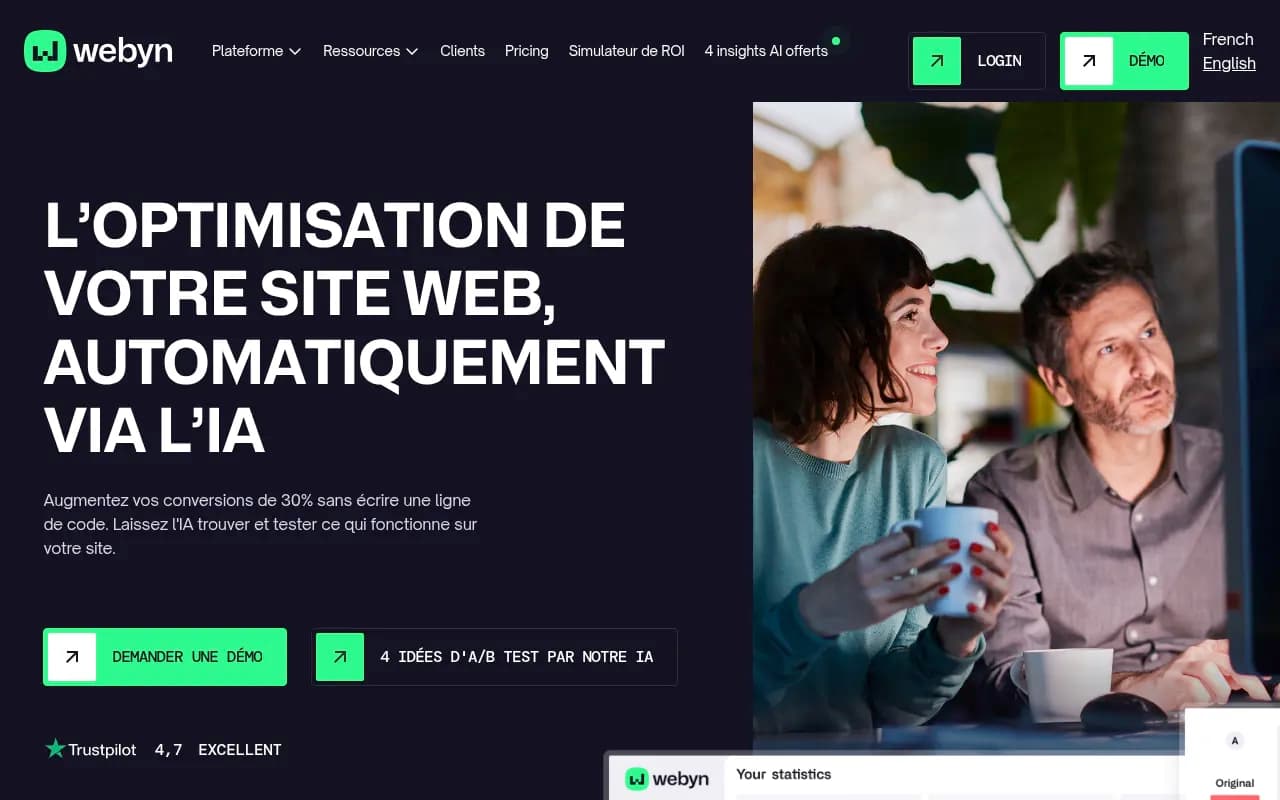
Webyn AI is an all-in-one conversion rate optimization platform combining AI-driven behavioral analysis, automated A/B testing, and real-time personalization. Built for e-commerce and digital teams wanting faster, data-backed conversion wins.
Key takeaways
- Webyn AI combines behavioral analysis, automated A/B testing, and real-time personalization in a single platform -- a genuine all-in-one CRO suite rather than a point solution
- Claims strong customer results: +29.7% conversion rate increase, 7.2x ROI, and 90 hours saved per month (customer-reported averages)
- Works across Shopify, PrestaShop, Magento, WordPress, Salesforce Commerce Cloud, and custom-built platforms with minimal setup
- Pricing starts around $599/month, positioning it firmly in the mid-market and above -- not a budget tool
- Primarily French-language product with an English version available; customer base is heavily European, with notable French brands like BNP Paribas, Volcom, and Nutrimuscle
- No public self-serve pricing page; demo-first sales process suggests a consultative, managed-service angle rather than pure SaaS
Webyn AI is a French conversion rate optimization platform that packages three things most CRO teams handle separately -- behavioral analytics, A/B and multivariate testing, and real-time personalization -- into one AI-driven product. The pitch is straightforward: you're already spending money to drive traffic, so you should be squeezing more out of every visit. Webyn's AI layer is supposed to make that process faster and less reliant on a dedicated CRO team.
The company appears to have launched in the mid-2020s and has built a client roster that spans e-commerce (Nutrimuscle, Volcom, Balzac Paris), automotive (Volkswagen), financial services (BNP Paribas), and leisure (Nausicaa, Gustave Rideau). That breadth is notable -- it suggests the platform isn't locked into a single vertical. The Trustpilot score sits at 4.6, and the testimonials on the site are specific enough to feel credible rather than generic.
The target audience is digital marketing and growth teams at mid-market to enterprise companies who want to run CRO programs without building a full in-house experimentation team. The managed-service element -- real CRO experts working alongside the software -- is a key differentiator from pure-play tools like VWO or Optimizely.
Key features
AI behavioral analysis
Webyn continuously monitors visitor behavior to surface friction points in the conversion funnel. Rather than requiring you to manually set up heatmaps or session recordings and then interpret the data yourself, the AI flags which pages and elements are hurting engagement and which user paths are performing best. It also segments visitors and compares behavior across those segments, so you can see whether mobile users are dropping off at a different point than desktop users, for example. This is the diagnostic layer that feeds the testing and personalization modules.
Automated A/B and multivariate testing
The experimentation module uses AI to generate test hypotheses based on the behavioral data rather than relying purely on human intuition. Tests are prioritized and run automatically, with the system making decisions based on statistical confidence. This is a meaningful step up from tools where you manually create variants and wait weeks for significance -- Webyn's automation is supposed to compress that cycle. The platform supports A/B tests, multivariate tests, and what it calls "automated experiments," though the exact mechanics of how the AI generates variants aren't fully documented in public materials.
Real-time personalization
This is arguably Webyn's most differentiated feature. The platform adapts content, product recommendations, messaging, and layout dynamically for each visitor based on their behavior, browsing history, and contextual signals. This isn't just rule-based segmentation (show banner X to visitors from Paris) -- the AI is supposed to make continuous adjustments in real time. For e-commerce specifically, this kind of personalization can have a meaningful impact on add-to-cart rates and average order value.
CRO expert support
Multiple customer testimonials specifically call out the human team at Webyn as a core part of the value. This isn't just a software subscription -- you get access to CRO specialists who help design experiments, interpret results, and suggest optimizations. For teams without in-house CRO expertise, this is significant. It's closer to a managed CRO service than a pure SaaS tool, which explains both the pricing and the demo-first sales process.
Universal CMS and platform compatibility
Webyn integrates with Shopify, PrestaShop, Magento, WordPress, Salesforce Commerce Cloud, and custom-built platforms. The integration is described as requiring "a few clicks," which typically means a JavaScript snippet or plugin installation. The fact that a customer specifically mentioned compatibility with a niche CMS (Vélotafeur's case study) and found it worked suggests the integration layer is genuinely flexible.
Conversion funnel analysis
Beyond page-level analysis, Webyn maps the full conversion funnel to identify where visitors drop off across multi-step journeys -- checkout flows, lead generation forms, onboarding sequences. This funnel-level view is what separates a CRO platform from a basic analytics tool.
Performance reporting and ROI tracking
The platform tracks conversion rate changes, visitor engagement metrics, and calculates ROI from experiments. The headline numbers Webyn publishes (+29.7% conversion rate, 7.2x ROI) are customer averages, not guarantees, but the reporting infrastructure is what makes those numbers calculable. Teams can use this data to justify CRO investment internally.
Who is it for
Webyn's sweet spot is e-commerce and digital marketing teams at mid-market companies -- think online retailers doing meaningful revenue who have traffic but aren't converting it efficiently. The France Toner and Nutrimuscle case studies fit this profile well: established brands with existing traffic who need to squeeze more conversion out of what they already have. If you're running a Shopify or PrestaShop store with decent monthly visitors but a conversion rate that feels stuck, Webyn is built for exactly that problem.
The managed-service angle makes it particularly well-suited to teams that don't have a dedicated CRO specialist. A growth marketer or e-commerce manager who understands the goal (more conversions) but doesn't have time to run a rigorous experimentation program can lean on Webyn's expert team to fill that gap. The testimonials from heads of performance and digital marketing managers -- not CRO specialists -- back this up.
Larger organizations with more complex needs are also in scope. BNP Paribas and Volkswagen appearing in the client list suggests Webyn can handle enterprise-scale traffic and compliance requirements, though the specifics of enterprise features aren't publicly documented.
Who should probably look elsewhere: very early-stage startups without meaningful traffic (you need volume for A/B tests to reach significance), teams with strong in-house CRO and data science capabilities who want a pure self-serve tool with maximum flexibility, and anyone on a tight budget -- $599/month is a real commitment for a small business.
Integrations and ecosystem
Webyn's integration story centers on CMS and e-commerce platform compatibility:
- Shopify: Native integration, likely via app or script tag
- PrestaShop: Supported, relevant for the French e-commerce market where PrestaShop has strong penetration
- Magento: Supported for Adobe Commerce / Magento 2 setups
- WordPress: Works with WooCommerce and standard WordPress sites
- Salesforce Commerce Cloud: Enterprise e-commerce integration
- Custom platforms: JavaScript-based integration for bespoke builds
The website mentions a dedicated integrations page but doesn't publicly list every tool in the ecosystem. Given the managed-service model, it's likely that analytics integrations (Google Analytics, Google Tag Manager) are part of the standard setup process handled by the Webyn team.
There's no public API documentation visible, and no mention of Zapier, Slack, or other workflow tool integrations. For a platform at this price point, that's a gap worth asking about during a demo. Mobile app support isn't mentioned -- the platform appears to be web-based.
Pricing and value
Webyn doesn't publish a full pricing page with tier breakdowns, which is a deliberate choice for a consultative sales model. Based on third-party sources, paid plans start from approximately $599/month. The demo-first approach means pricing is likely customized based on traffic volume, number of sites, and the level of expert support included.
For context:
- VWO (a direct competitor) starts around $199/month for basic testing but charges significantly more for personalization and full-stack features
- Optimizely is enterprise-priced and typically runs into five figures annually
- AB Tasty, another French CRO platform, is similarly priced to Webyn in the mid-market range
At $599/month and up, Webyn is not cheap. But if the managed-service element replaces the cost of a CRO consultant or agency retainer (which can run $3,000-$10,000/month), the math can work out favorably. The 7.2x ROI claim, if even partially accurate for your situation, would justify the spend quickly.
There's no free tier or self-serve trial visible. You book a demo, and the sales process takes it from there. This is standard for managed CRO services but frustrating if you want to evaluate the product independently before talking to sales.
Strengths and limitations
What Webyn does well:
- The combination of analysis, testing, and personalization in one platform genuinely reduces tool sprawl. Many CRO programs require separate tools for heatmaps, A/B testing, and personalization -- Webyn collapses that into one.
- The human expert layer is a real differentiator. Multiple customers specifically credit the Webyn team's expertise and responsiveness as central to their results. This isn't just software -- it's a service.
- Broad CMS compatibility, including less common platforms, makes it accessible to companies that can't use Shopify-only solutions.
- The French market focus means strong support and documentation in French, which matters for the European customer base.
- Customer testimonials are specific and credible -- named individuals with job titles from recognizable brands, not anonymous five-star reviews.
Honest limitations:
- The demo-only sales process and opaque pricing make it hard to evaluate without committing time to a sales conversation. For buyers who want to self-evaluate, this is friction.
- No public API documentation or developer resources visible, which limits how technical teams can extend or integrate the platform into custom workflows.
- The platform is primarily positioned for the French and European market. English-language support exists, but the product's roots and customer base are French -- international buyers should verify support quality in their language.
- At $599/month minimum, it's out of reach for small businesses and early-stage startups. There's no freemium or low-cost entry point.
- Limited transparency about how the AI generates test hypotheses or personalization rules. For data-driven teams who want to understand the methodology, the "AI does it" framing may feel like a black box.
Bottom line
Webyn AI is a solid choice for mid-market e-commerce and digital marketing teams in Europe who want a managed CRO program without building one from scratch. The combination of AI-driven analysis, automated testing, and real-time personalization -- backed by actual CRO experts -- is a compelling package for teams that have traffic but aren't converting it efficiently.
Best use case in one sentence: a French or European e-commerce brand with meaningful traffic, a Shopify or PrestaShop store, and a growth team that wants CRO results without hiring a dedicated CRO specialist.
Frequently asked questions
What is Webyn AI?
Who is Webyn AI best suited for?
How much does Webyn AI cost?
What platforms does Webyn AI integrate with?
Is there a free trial for Webyn AI?
How does Webyn AI compare to tools like VWO or Optimizely?
Similar and alternative tools to Webyn AI