Key takeaways
- Promptwatch is the most complete alternative if you want to go beyond monitoring -- it covers gap analysis, AI content generation, crawler logs, Reddit/YouTube tracking, and traffic attribution in one platform, starting at $99/mo.
- Profound is a strong enterprise pick with solid prompt volume data and content agents, but pricing starts at $499/mo and there's no free trial.
- Semrush makes sense if you're already using it for traditional SEO and want to add AI visibility tracking without switching tools -- though its GEO features are less deep than dedicated platforms.
- Otterly.AI is the lowest-friction entry point for teams that just need brand mention monitoring, with plans from $29/mo and a 14-day free trial.
- AthenaHQ sits between monitoring and optimization -- good for GEO/AEO specialists who want a structured workflow, but it's pricier than it looks once you factor in the credit model.
- Writesonic has pivoted toward AI search visibility and is worth watching, especially if you're already using it for content creation.
- Writer, HIX.AI, and Hypotenuse AI are content generation tools, not GEO platforms -- relevant only if content production volume is your primary bottleneck.
Addlly AI positions itself as an enterprise GEO platform -- audit your AI search presence, plan optimization, execute content at scale. It's a legitimate product with a structured workflow and enterprise-grade security credentials (NVIDIA Inception, Microsoft Azure, SOC 2 compliance). But it's also clearly built for large organizations, which means the pricing, onboarding complexity, and feature depth can be overkill for smaller teams. And even for enterprise buyers, there are real gaps: limited transparency around prompt volumes, no Reddit or YouTube citation tracking, and a relatively thin public track record compared to some competitors.
If you're evaluating Addlly AI, you're probably asking one of a few questions: Is there something cheaper that does the same job? Is there something more powerful? Or is there something that actually helps me act on the data, not just look at it? The alternatives below address all three.
The alternatives
Promptwatch

Promptwatch is the most direct competitor to Addlly AI -- and in most head-to-head comparisons, it comes out ahead. Where Addlly AI focuses on the audit-plan-execute workflow for enterprise teams, Promptwatch runs the same loop but with more data depth, more AI models covered, and a tighter connection between what you discover and what you actually do about it.
The core difference is what happens after the audit. Promptwatch's Answer Gap Analysis shows you the specific prompts where competitors are getting cited but you're not -- not just "you have gaps" but "here are the exact questions AI models are answering without mentioning you." From there, the built-in content agent generates articles, listicles, and comparison pages grounded in 880M+ real citations. That's not a generic AI writer -- it's content built specifically to get cited by ChatGPT, Claude, Perplexity, and others.
A few things Promptwatch does that Addlly AI doesn't: real-time AI crawler logs (see exactly when ChatGPT or Claude reads your pages and what errors they hit), Reddit and YouTube citation tracking (surfaces the discussions that actually influence AI recommendations), ChatGPT Shopping tracking, and traffic attribution via GSC integration or server log analysis. You can close the loop from "AI model cited my page" to "that citation drove revenue."
Coverage spans 10+ AI models: ChatGPT, Claude, Gemini, Perplexity, Grok, DeepSeek, Copilot, Meta AI, Mistral, Google AI Overviews, and Google AI Mode. Addlly AI's model coverage is less clearly documented.
Pricing is more accessible too: Essential at $99/mo (1 site, 50 prompts, 5 articles), Professional at $249/mo (2 sites, 150 prompts, crawler logs, city-level tracking), Business at $579/mo (5 sites, 350 prompts). A 7-day free trial is available. Addlly AI's paid plans also start at $99/mo but the feature depth at that tier is thinner.
Best for: Marketing teams, SEO professionals, and agencies who want to both track and improve AI visibility -- not just monitor it.
Semrush
Semrush is a different kind of alternative. It's not a GEO-first platform -- it's a full digital marketing suite that has added AI visibility tracking as one of many toolkits. If you're already paying for Semrush for keyword research, backlink analysis, and site audits, the AI Visibility Toolkit is a reasonable add-on rather than a separate subscription.
That said, the AI features are noticeably less deep than dedicated GEO platforms. Semrush uses a fixed set of prompts for tracking rather than letting you define your own prompt universe. There's no AI traffic attribution, no crawler logs, no Reddit/YouTube tracking, and no content generation specifically engineered for AI citation. It tells you where you stand but doesn't help you move.
The breadth is genuinely useful for teams that need one platform for everything -- traditional SEO, PPC, social, local, and now AI search. For those teams, Semrush avoids the "yet another tool" problem. But if AI visibility is your primary focus, you'll quickly hit the ceiling of what it can do.
Pricing starts at $165/mo (Starter) and goes up to $580/mo (Advanced) before enterprise custom pricing. That's more expensive than most dedicated GEO tools for what you get on the AI side specifically.
Best for: Teams already using Semrush who want basic AI visibility data without adding another platform to their stack.
Writesonic

Writesonic started as an AI writing tool and has since repositioned as an AI search visibility and GEO platform -- a pivot that's more substantial than it might sound. The current product tracks brand mentions across ChatGPT and 10+ AI platforms, monitors citations, identifies content gaps, and includes tools for creating and refreshing content. It also targets Reddit and UGC forums as citation sources, which is a smart move given how much AI models pull from community discussions.
The honest caveat: Writesonic is mid-transition. The GEO features are newer and less battle-tested than platforms that were built for this from day one. The content creation roots are still visible -- the writing tools are strong, but the monitoring and analytics layer is still catching up to dedicated GEO platforms in terms of depth and data volume.
Pricing isn't clearly published on the main site, which is a minor frustration when you're trying to compare options. Free trial is available.
Best for: Content-heavy teams that want AI visibility tracking bundled with strong writing tools, and don't mind being on a platform that's still maturing its GEO capabilities.
Profound
Profound

Profound is a serious enterprise GEO platform used by MongoDB, Ramp, and Mercury. It covers the full stack: prompt volume data (see what millions of people actually ask AI), answer engine insights, agent analytics (AI crawler behavior), and content generation agents. The product is well-built and the data is solid.
Where it falls short relative to Addlly AI and Promptwatch: no Reddit or YouTube tracking, no ChatGPT Shopping monitoring, and pricing that starts at $499/mo with no free trial. That last point matters -- you're committing significant budget before you've seen whether the data is actually useful for your specific use case.
The prompt volume feature is genuinely valuable and one of the better implementations in the market. Knowing what people are actually asking AI -- not just what you think they're asking -- changes how you prioritize content. Profound does this well.
SOC 2 compliance and enterprise-grade security make it a natural fit for larger organizations with procurement requirements.
Best for: Enterprise marketing and AEO teams with budget to match, who need compliance certifications and want strong prompt intelligence data.
Otterly.AI
Otterly.AI

Otterly.AI is the simplest and most affordable option on this list. It monitors brand mentions and citations across ChatGPT, Perplexity, Google AI Overviews, Google AI Mode, Gemini, and Copilot. You set up your prompts, it tracks them, you get reports. That's the product.
The GEO Audit tool analyzes 25+ on-page factors and gives you recommendations for improving citation likelihood. There's also AI keyword research to find conversational prompts your audience is using. These are useful features, but they're lighter-weight than what you get from Promptwatch or Profound.
What Otterly.AI doesn't have: crawler logs, traffic attribution, Reddit/YouTube tracking, ChatGPT Shopping, or a content generation agent. It's a monitoring tool with some audit capabilities, not a full optimization platform. That's fine if monitoring is what you need -- but if you're coming from Addlly AI specifically because you want to act on the data, Otterly.AI won't solve that problem.
Pricing is genuinely accessible: $29/mo for the Lite tier (15 prompts), $189/mo for Standard (100 prompts), with a 14-day free trial and no credit card required.
Best for: Small teams or solo marketers who want affordable AI brand monitoring without the complexity of a full GEO platform.
AthenaHQ

AthenaHQ markets itself as an "end-to-end AEO & GEO platform" and has real enterprise credentials -- Coinbase, ZoomInfo, SoFi, and PagerDuty are among its customers. The platform covers cross-platform AI visibility tracking across 8+ LLMs, citation source analysis, automated content optimization recommendations, and GEO workflow management.
The positioning is similar to Addlly AI: structured workflow for GEO specialists, executive dashboards, team collaboration. Where it differs is the credit-based pricing model, which can get expensive fast. The Self-Serve plan is listed at $295/mo (with a $95 first-month promotion), but each AI query costs a credit -- so heavy usage adds up. This makes it harder to predict your monthly cost compared to flat-rate plans.
AthenaHQ was featured in Forbes and the Wall Street Journal and came out of Y Combinator, which gives it credibility. The product is solid for monitoring and recommendations, but like most competitors, it stops short of actually generating content for you.
Best for: AEO/GEO specialists at mid-market companies who want a structured workflow platform and are comfortable with credit-based pricing.
Writer
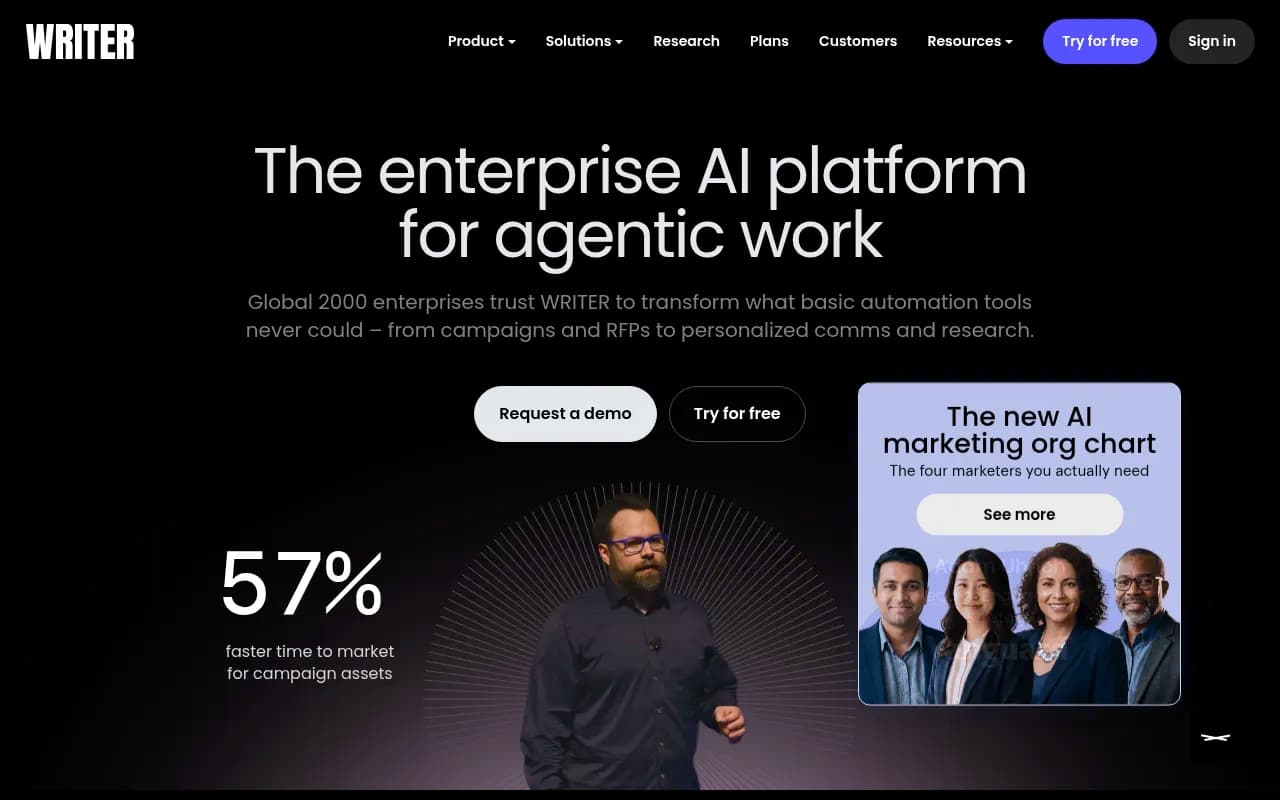
Writer is an enterprise AI platform for deploying agents across complex business workflows -- campaign creation, RFP responses, competitive intelligence, and yes, AEO/GEO optimization. It's used by Vanguard, KPMG, and Uber. The product is genuinely impressive for large organizations that need AI governance, brand controls, and compliance built in.
But Writer is not a GEO monitoring platform. It doesn't track your brand mentions in ChatGPT, analyze citation patterns, or show you crawler logs. What it does is help you build and execute content workflows at scale, including workflows oriented around AI search optimization. If you need an enterprise AI platform that can handle GEO content as one of many use cases, Writer is worth evaluating. If you specifically need to monitor and improve AI visibility, it's the wrong tool.
Pricing is enterprise custom, with starter plans estimated around $29-39/user/month.
Best for: Large enterprises that need a governed AI platform for multiple use cases, where GEO content is one workflow among many.
HIX.AI

HIX.AI is an AI agent workspace for writing, research, image generation, video creation, and presentations. It's a productivity tool, not a GEO platform. It has no brand monitoring, no citation tracking, no AI visibility analytics.
The reason it appears in this comparison is that some teams use general-purpose AI writing tools as a cheaper substitute for GEO content generation. HIX.AI can produce articles and blog posts quickly, and the deep research feature is useful for content that needs to be factually grounded. But it won't tell you which prompts to target, which competitors are outranking you in AI answers, or whether your content is actually getting cited.
Freemium pricing with a free tier and paid plans from around $39.99/mo makes it accessible.
Best for: Individuals or small teams who need a general AI writing and research workspace, not a GEO platform.
Hypotenuse AI
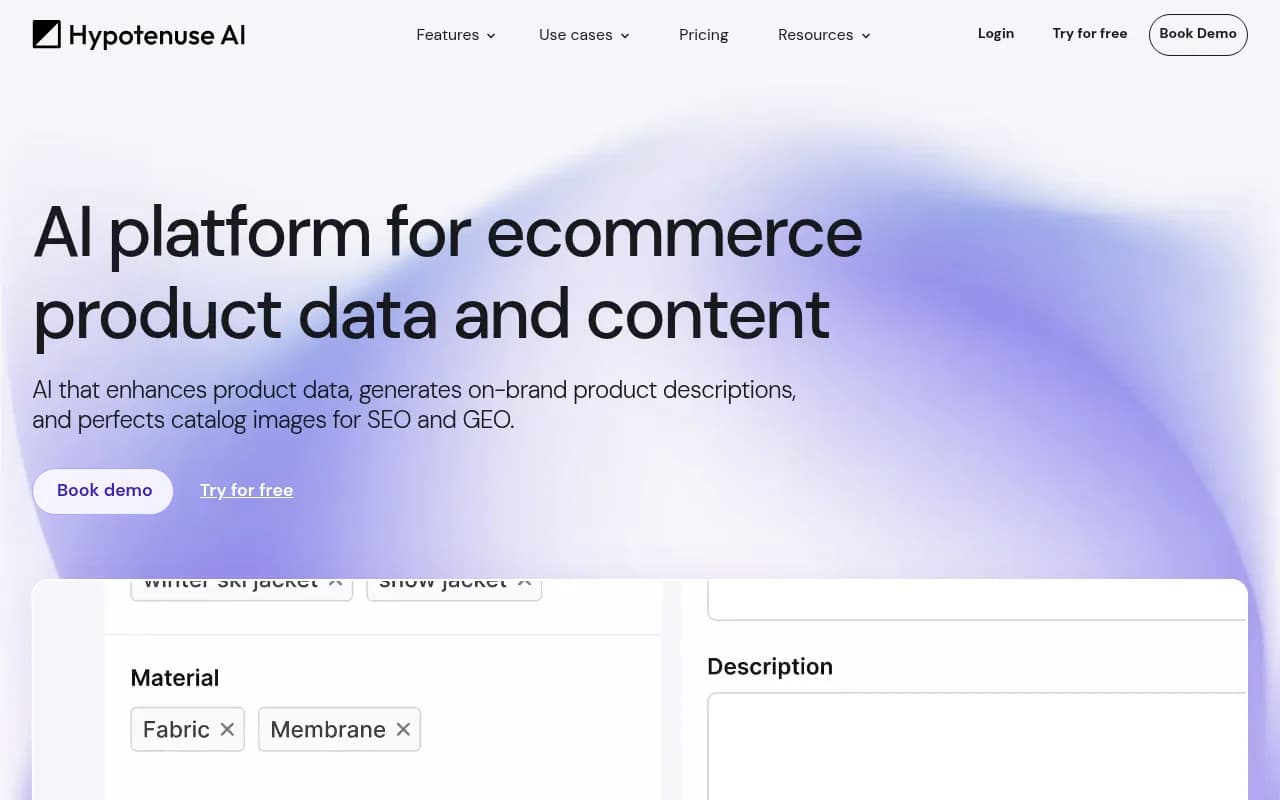
Hypotenuse AI is built specifically for ecommerce -- product data enrichment, on-brand product descriptions at scale, catalog image enhancement, and direct publishing to commerce platforms. It's a focused tool that does its specific job well.
Like HIX.AI, it's not a GEO monitoring or optimization platform in the traditional sense. Hypotenuse AI does mention GEO optimization for product content in its positioning, which is relevant for ecommerce brands trying to appear in AI shopping recommendations. But it doesn't track brand mentions, analyze citations across LLMs, or provide the kind of visibility analytics that Addlly AI or its direct competitors offer.
Pricing starts around $29/mo for individuals, with enterprise custom pricing for large catalog operations.
Best for: Ecommerce brands that need to generate and optimize product content at scale, particularly for AI shopping visibility.
Which alternative should you choose?
The right choice depends on what you're actually trying to solve.
If Addlly AI felt too enterprise-heavy or expensive for your team size, Otterly.AI ($29/mo) or Promptwatch ($99/mo) are the natural starting points. Otterly.AI is simpler; Promptwatch gives you more to work with.
If you want the full optimization loop -- find gaps, create content, track results -- Promptwatch is the most complete option at a price point that works for teams that aren't Fortune 500. The crawler logs, Reddit tracking, and traffic attribution are features that most competitors, including Addlly AI, don't offer.
If you're at a large enterprise with compliance requirements and budget to match, Profound ($499/mo+) or AthenaHQ ($295/mo+) are the serious contenders. Both have strong enterprise credentials and structured GEO workflows.
If you're already deep in the Semrush ecosystem and just want to add AI visibility data without another tool, stay with Semrush -- but go in knowing the AI features are shallower than dedicated platforms.
For content production at scale without GEO monitoring, Writer (enterprise), HIX.AI (freemium), or Hypotenuse AI (ecommerce) each serve specific use cases well.
The honest summary: most teams evaluating Addlly AI are looking for something that helps them actually improve their AI visibility, not just measure it. That's where Promptwatch has the clearest edge -- it's the only platform in this list that closes the full loop from gap discovery to content creation to traffic attribution.