Summary
- Promptwatch — Best for brands tracking AI search visibility and generating content that ranks in ChatGPT, Claude, and Perplexity. Goes beyond traditional keyword research to optimize for how AI models cite and recommend your brand.
- LowFruits — Best KWFinder alternative for finding genuinely easy-to-rank keywords through bulk SERP weakness analysis. Cheaper than KWFinder with more actionable data on low-authority ranking opportunities.
- Semrush — Best all-in-one platform if you need keyword research plus content marketing, PPC, social media, and emerging AI search tracking. Expensive but comprehensive.
- SE Ranking — Best value for agencies managing multiple clients. White-label reporting, AI content tools, and full SEO suite at a lower price point than Semrush or Ahrefs.
- Ubersuggest — Best budget option with lifetime plans. Neil Patel's tool offers solid keyword data and site audits without recurring costs, though the interface feels dated compared to competitors.
KWFinder built its reputation on making keyword research approachable -- clean interface, accurate difficulty scores, and a focus on long-tail keywords that smaller sites can actually rank for. But at $29-68/month for the full Mangools suite, you're paying for simplicity that might not scale as your SEO operation grows. The tool works well for finding low-competition keywords, but it stops there. No content optimization. No AI search tracking. No advanced SERP analysis beyond basic metrics.
If you've outgrown KWFinder's feature set, need better value, or want tools that address the shift toward AI-powered search, here are the alternatives worth considering.
Promptwatch

Promptwatch isn't a traditional keyword research tool -- it's built for the reality that search is moving to AI. When someone asks ChatGPT, Claude, or Perplexity for recommendations in your space, does your brand get mentioned? Promptwatch tracks that.
The platform monitors 10 AI models (ChatGPT, Perplexity, Google AI Overviews, Claude, Gemini, Meta AI, DeepSeek, Grok, Mistral, Copilot) and shows you exactly when and how they cite your brand. But unlike monitoring-only competitors (Otterly.AI, Peec.ai, AthenaHQ), Promptwatch helps you fix visibility gaps. Answer Gap Analysis reveals which prompts competitors rank for but you don't, then the built-in AI writing agent generates articles engineered to get cited by AI models -- grounded in 880M+ citations analyzed, prompt volumes, and competitor data.
You also get AI crawler logs (see when ChatGPT, Claude, and Perplexity crawl your site), Reddit and YouTube insights (discussions that influence AI recommendations), ChatGPT Shopping tracking, and page-level citation tracking with traffic attribution. It's the only platform rated as a "Leader" across all categories in a 2026 comparison of 12 GEO platforms.
Pricing starts at $99/month (Essential: 1 site, 50 prompts, 5 articles), $249/month (Professional: 2 sites, 150 prompts, 15 articles, crawler logs), or $579/month (Business: 5 sites, 350 prompts, 30 articles). Free trial available.
Best for: Brands that want to rank in AI search results, not just traditional Google. If you're creating content and wondering why ChatGPT never mentions you, this is the tool that shows you why and helps you fix it.
Trade-offs: Not a keyword research tool in the traditional sense. You won't get search volume estimates for "best running shoes" -- you'll see how often AI models recommend running shoe brands and which content gaps you need to fill. If you only care about traditional SEO, stick with KWFinder or the alternatives below.
LowFruits
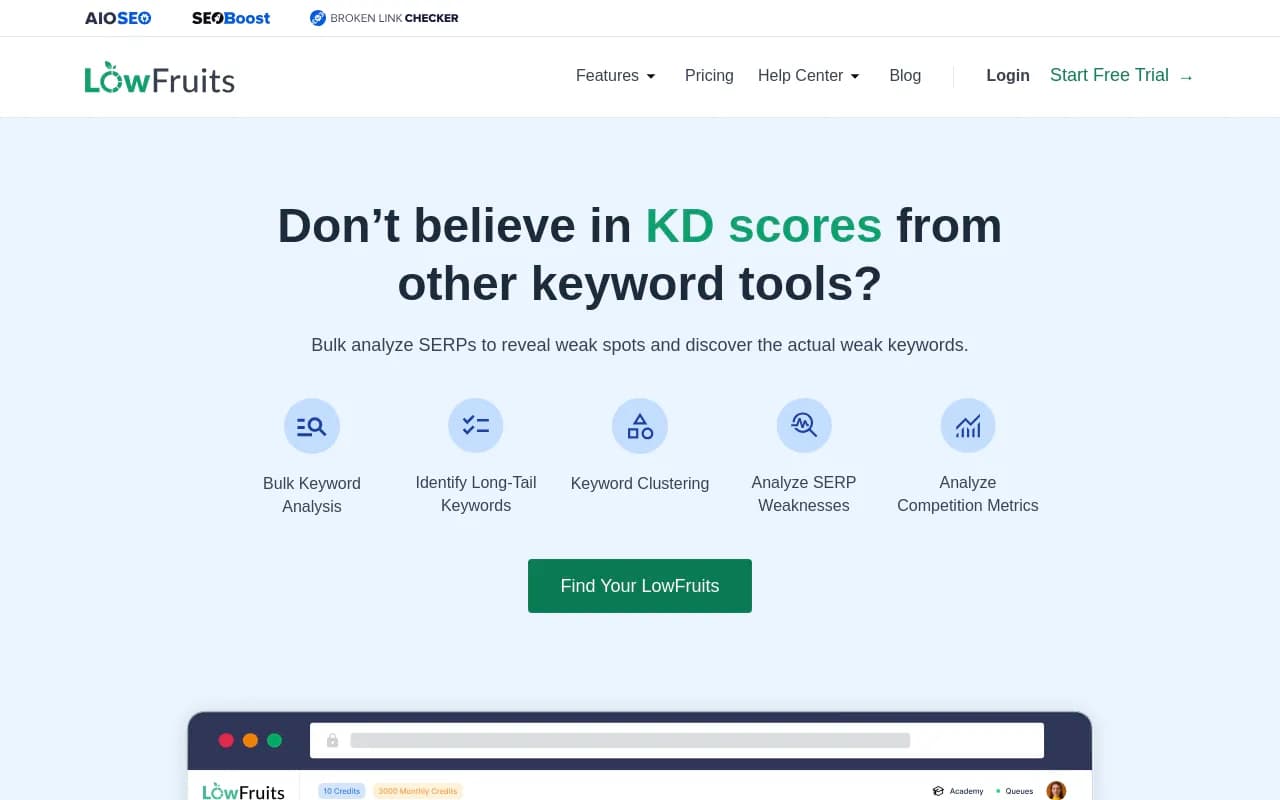
LowFruits does what KWFinder claims to do, but better: it finds keywords you can actually rank for. The difference is methodology. KWFinder shows you a difficulty score and search volume. LowFruits bulk-analyzes SERPs to reveal weak spots -- low-authority sites ranking in top positions, thin content, irrelevant titles. You see the actual competition, not an algorithmic guess.
Import your own keyword list or use wildcard searches to generate long-tail ideas straight from Google. LowFruits highlights SERP weaknesses (low DA sites in top 10, short content, weak backlink profiles) and clusters keywords by intent. The filtering is more granular than KWFinder -- you can isolate keywords where multiple low-authority sites rank, or where Reddit threads appear in top results.
Pricing is pay-as-you-go credits from $29 or subscriptions around $29-49/month (Standard) and $79-99/month (Premium). First analysis is free. Cheaper than KWFinder's $29-68/month, and you're not locked into a suite of tools you might not need.
Best for: SEOs and content creators who manually analyze SERPs to find winnable keywords. If you don't trust keyword difficulty scores and want to see the actual ranking competition before committing to a topic, LowFruits saves hours of manual work.
Trade-offs: The interface is functional but not as polished as KWFinder. No rank tracking, no backlink analysis, no site audits -- it's purely a keyword discovery and SERP analysis tool. If you need an all-in-one suite, look elsewhere.
Semrush
Semrush is the enterprise alternative -- 10M+ users, 35% of Fortune 500 companies, and 8 toolkits covering everything from traditional SEO to AI search visibility. Keyword research is just one piece. You get keyword magic tool (billions of keywords with AI insights), content marketing tools (topic research, SEO writing assistant, content audit), PPC research, social media management, local SEO, and brand monitoring across traditional search and AI models (ChatGPT, Perplexity, Gemini).
The AI visibility features are newer and less mature than specialized GEO platforms like Promptwatch -- Semrush uses fixed prompts and doesn't offer content gap analysis or AI-optimized content generation. But if you're already managing SEO, PPC, content, and social in separate tools, consolidating into Semrush makes workflow sense.
Pricing starts at $165/month (Starter), $290/month (Pro+), or $580/month (Advanced). Enterprise custom pricing. 7-day free trial.
Best for: Marketing teams and agencies that need one platform for everything. If you're spending $500+/month across multiple tools, Semrush consolidation could save money and reduce context-switching.
Trade-offs: Expensive for solo operators or small teams. The AI search features are basic compared to Promptwatch -- you'll see brand mentions but won't get actionable recommendations for improving visibility or generating optimized content. The interface is dense; expect a learning curve.
SE Ranking
SE Ranking is the value play for agencies. You get rank tracking, keyword research, site audits, backlink monitoring, content optimization, and white-label reporting for $103-223/month (annual billing). That's cheaper than Semrush or Ahrefs while covering the same core features. The platform tracks 188 countries with a 5.4B keyword database and includes AI-powered insights, local SEO tools, and automated client reporting.
The AI Search add-on ($71/month) monitors brand mentions in ChatGPT, Perplexity, and other AI models, but it's a separate purchase and less comprehensive than Promptwatch's GEO capabilities. The core value is traditional SEO at a lower price point with better agency features (white-label reports, client management, team collaboration).
Pricing: $103/month (Core), $223/month (Growth), plus optional add-ons like Agency Pack ($69/month) and AI Search ($71/month). 14-day free trial, no credit card required. 20% discount on annual billing.
Best for: Agencies managing multiple clients who need white-label reporting and team collaboration without Semrush's price tag. If you're billing clients for SEO services, the cost difference adds up quickly.
Trade-offs: The AI search features are an add-on, not integrated into the core workflow. Keyword database is smaller than Ahrefs or Semrush. The interface is clean but less polished than premium competitors.
Ahrefs
Ahrefs is the SEO power user's choice -- the largest backlink index online, comprehensive keyword database, and tools built for people who live in search data. Keyword Explorer shows search volume, difficulty, click potential, and parent topic groupings. Site Explorer reveals competitors' top pages and backlink profiles. Content Explorer surfaces high-performing content in any niche. Rank Tracker monitors positions across search engines and locations.
The Brand Radar feature tracks brand mentions in AI search (ChatGPT, Perplexity, etc.), but like Semrush, it's monitoring-only with fixed prompts and no content optimization capabilities. Ahrefs also added content creation workflows, PPC research, and social media management, but the core strength remains traditional SEO.
Pricing: $83/month (Lite), $166/month (Standard), $333/month (Advanced), or custom Enterprise pricing. Annual billing saves 20%. Free trial available.
Best for: SEO professionals and agencies that prioritize backlink analysis and competitive research. If you're building links, analyzing competitor strategies, or doing deep keyword research, Ahrefs has the most comprehensive data.
Trade-offs: Expensive. The AI search features are basic -- you'll see mentions but won't get recommendations for improving visibility. The interface is powerful but dense; not beginner-friendly.
Google Keyword Planner
Google Keyword Planner is free and comes straight from the source -- Google's own data on search volumes, competition, and bid estimates. You get keyword ideas, search trends over time, and forecasting features for both SEO and PPC planning. The data is accurate because it's Google's internal data, not third-party estimates.
The limitations are obvious: no difficulty scores, no SERP analysis, no backlink data, no rank tracking. The interface is built for Google Ads users, not SEO professionals. Search volume ranges are broad unless you're running active ad campaigns. You need a Google Ads account (free to create, no spending required).
Best for: Beginners on a zero budget or PPC managers who need Google's official data for campaign planning. If you're just starting keyword research and don't want to pay for tools yet, this is the place to start.
Trade-offs: Bare-bones feature set. No competitive analysis, no SERP insights, no content recommendations. The data is accurate but limited. You'll outgrow this quickly if you're serious about SEO.
Moz Pro
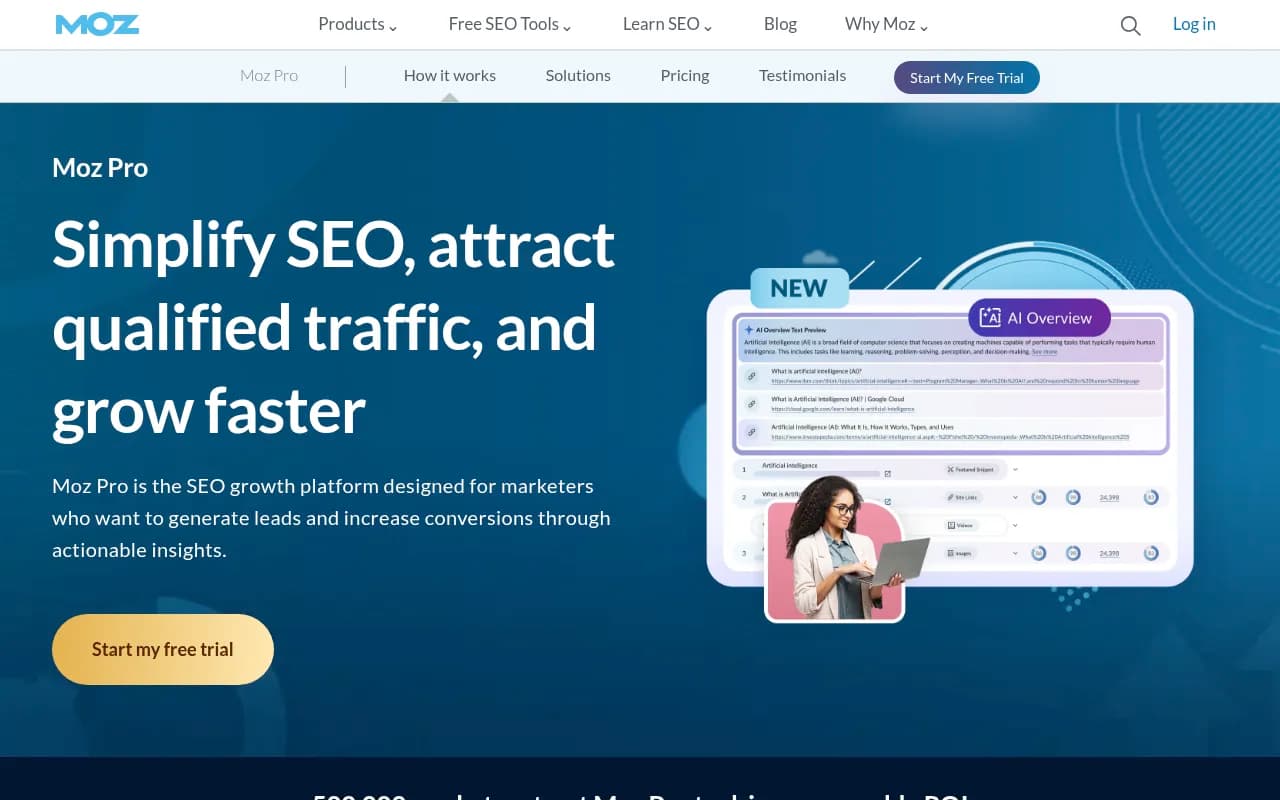
Moz Pro is the original SEO toolkit -- Keyword Explorer, On-Page Grader, site audits, rank tracking, and proprietary metrics (Domain Authority, Page Authority) that the industry still references. The platform is known for link opportunity discovery through Link Explorer and for educational resources that help you understand SEO fundamentals.
The interface is cleaner and more beginner-friendly than Ahrefs or Semrush. Keyword Explorer shows volume, difficulty, opportunity score, and potential reach. On-Page Grader gives actionable recommendations for improving page rankings. The site audit tool catches technical issues that hurt visibility.
Pricing: $49/month (Starter, currently $39/month with promotion), $99/month (Standard), $179/month (Medium), $299/month (Large). Annual billing saves 20%. 30-day free trial.
Best for: SEO beginners and small teams who want a user-friendly platform with strong educational resources. If you're learning SEO and want a tool that explains why recommendations matter, Moz is easier to understand than Ahrefs or Semrush.
Trade-offs: Smaller keyword and backlink databases than Ahrefs or Semrush. No AI search tracking. The proprietary metrics (DA, PA) are useful but not as widely adopted as Ahrefs' Domain Rating. Feature set is solid but not cutting-edge.
Ubersuggest
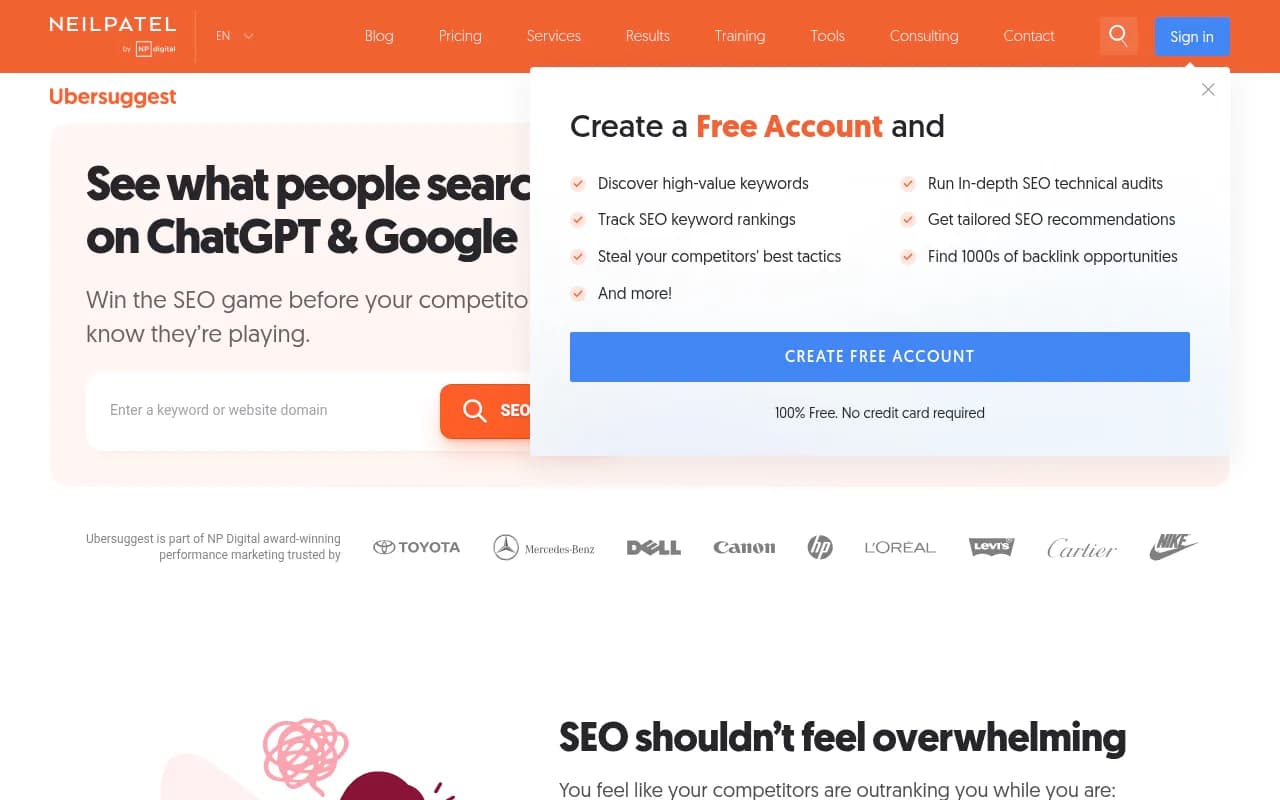
Ubersuggest is Neil Patel's budget-friendly keyword tool with a unique pricing model: lifetime plans from $290 (Individual), $490 (Business), or $990 (Enterprise), or monthly subscriptions from $29/month. You get keyword research, competitor analysis, site audits, rank tracking, and content ideas -- the core SEO toolkit without recurring costs.
The keyword data includes search volume, competition, and seasonal trends. The competitor analysis shows top-performing pages and backlink opportunities. The site audit catches technical issues. The content ideas feature surfaces popular topics in your niche. The interface is straightforward but feels dated compared to modern competitors.
Best for: Solo entrepreneurs and small businesses on a tight budget who want to avoid recurring subscription costs. If you're willing to pay once upfront, the lifetime plans offer the best long-term value in this list.
Trade-offs: The interface looks and feels like a tool from 2018. Keyword database is smaller than Ahrefs, Semrush, or SE Ranking. No AI search tracking. The data is accurate enough for basic keyword research but lacks the depth of premium tools. Customer support is limited on lower-tier plans.
Which KWFinder alternative should you choose?
If you're looking for the closest KWFinder replacement -- easy keyword research with low-competition focus -- LowFruits is the best match. It does what KWFinder does (find easy keywords) but better, with bulk SERP analysis that reveals actual ranking opportunities instead of algorithmic difficulty scores.
If you're thinking bigger and want to rank in AI search, not just traditional Google, Promptwatch is the only tool here built for that reality. It shows you where you're invisible in ChatGPT and Claude, then helps you fix it with content gap analysis and AI-optimized content generation.
If you need a full marketing suite and can justify the cost, Semrush or Ahrefs are the enterprise choices. Semrush is better for teams managing SEO, content, PPC, and social in one platform. Ahrefs is better for SEO specialists who prioritize backlink analysis and competitive research.
If you're an agency managing multiple clients, SE Ranking offers the best value with white-label reporting and team collaboration at a lower price point than the big players.
If you're just starting out or on a zero budget, Google Keyword Planner is free and accurate. If you want to avoid recurring costs entirely, Ubersuggest's lifetime plans are the cheapest long-term option.
And if you're learning SEO and want a tool that explains things clearly, Moz Pro has the most beginner-friendly interface and the best educational resources.
The right choice depends on what you're optimizing for. KWFinder works fine if you're happy with basic keyword research. But if you want to find genuinely easy keywords (LowFruits), rank in AI search (Promptwatch), or scale beyond keyword research into full SEO operations (Semrush, Ahrefs, SE Ranking), the alternatives above will get you further.