Key takeaways
- Best overall alternative: Promptwatch -- the only platform that combines monitoring, content gap analysis, AI writing, and crawler logs in one place, with transparent pricing from $99/mo
- Best for enterprise teams: Profound or Brandlight.ai -- both built for larger organizations, though Profound is more feature-complete for AEO workflows
- Best budget option: Peec AI or Otterly.AI -- solid monitoring at lower price points, though neither goes deep on content optimization
- Best if you already use SEO tools: Semrush or Ahrefs -- good for teams that want AI visibility layered on top of existing SEO workflows, not as a standalone GEO platform
- Meridian's core limitation: Custom pricing with no public tiers and a demo-required sales process makes it hard to evaluate without committing time upfront -- most teams exploring this space want to try before they talk to sales
Meridian positions itself as an "agentic" AI search optimization platform -- the kind of tool that doesn't just show you data but claims to take action on your behalf. The pitch is compelling: track your category-level AI visibility, monitor sentiment, benchmark competitors, and turn AI search into a revenue channel. For brands serious about generative search, that's exactly what they want.
But Meridian has a few friction points that push people to look elsewhere. There's no public pricing -- you have to book a demo to find out what it costs, which is a real barrier for smaller teams or anyone doing a quick evaluation. The platform is also relatively new and less established than some alternatives, which matters when you're trying to justify budget to a CMO. And the "agentic" framing, while interesting, can mean different things to different vendors.
If you're evaluating Meridian and want to compare it against what else is out there, here's an honest look at the alternatives.
Promptwatch

Promptwatch is the most complete AI search visibility platform available right now, and the one most worth comparing directly to Meridian. Where Meridian focuses on category-level tracking and competitive benchmarking, Promptwatch goes further: it shows you the gaps, then helps you close them.
The core difference is the action loop. Most platforms -- including Meridian -- are fundamentally monitoring tools. They tell you where you're invisible. Promptwatch's Answer Gap Analysis shows you exactly which prompts your competitors rank for that you don't, and its built-in AI writing agent generates content specifically engineered to get cited by ChatGPT, Claude, Perplexity, and other models. That's not generic SEO content -- it's grounded in 880M+ citations analyzed, prompt volumes, and competitor data.
A few things Promptwatch does that Meridian doesn't publicly document: real-time AI crawler logs (see exactly when ChatGPT or Perplexity crawls your site and which pages they read), Reddit and YouTube citation tracking (surfaces discussions that directly influence AI recommendations), ChatGPT Shopping tracking, and query fan-outs that show how a single prompt branches into sub-queries. The traffic attribution piece -- connecting AI visibility to actual revenue via GSC integration, code snippet, or server logs -- is also something most competitors skip entirely.
Promptwatch monitors 10 AI models: ChatGPT, Perplexity, Claude, Gemini, Google AI Overviews, Google AI Mode, Meta AI, DeepSeek, Grok, Mistral, and Copilot. It's trusted by 6,700+ brands including Booking.com and Center Parcs.
Pricing is transparent: Essential at $99/mo (1 site, 50 prompts, 5 articles), Professional at $249/mo (2 sites, 150 prompts, 15 articles, crawler logs), Business at $579/mo (5 sites, 350 prompts, 30 articles). A 7-day free trial is available -- no demo required to get started.
Compared to Meridian, Promptwatch wins on transparency, breadth of features, and the ability to actually act on what you find. If Meridian's demo-first model is slowing you down, Promptwatch is the obvious place to start.
Best for: Marketing teams, SEO teams, and agencies that want to monitor AI visibility AND do something about it -- without waiting for a sales call.
Profound
Profound

Profound is one of the more serious enterprise-grade AEO platforms out there. It's used by MongoDB, Ramp, and Mercury, which tells you something about the audience it's built for. The feature set is genuinely strong: prompt volume data, answer engine insights, AI crawler behavior analysis, and content generation agents.
The prompt volumes feature is worth calling out specifically -- it shows you what millions of people are actually asking AI models, which is useful for prioritizing which prompts to target. The agent-based content generation is also real, not just a checkbox feature.
Where Profound falls short compared to Promptwatch: no Reddit or YouTube citation tracking, no ChatGPT Shopping monitoring, and the pricing is steep. The Lite tier starts around $499/mo with limited history (2 months) and seat counts. There's no free trial -- you go through a demo process similar to Meridian. For a team that's already sold on AEO and has budget, Profound is a strong choice. For teams still evaluating, the lack of a trial is a real friction point.
Compared to Meridian, Profound is more established, has clearer (if still enterprise-level) pricing, and has a more documented feature set. Both require demos, but Profound's customer list and public documentation give you more to evaluate before the call.
Best for: Enterprise marketing and content teams with dedicated AEO budgets who want a full-stack platform and don't mind the sales process.
Peec AI

Peec AI is a clean, focused AI search analytics platform aimed at marketing teams. It tracks visibility, position, and sentiment across ChatGPT, Perplexity, Claude, and Gemini, and lets you benchmark competitors across those models. The interface is well-designed and the metrics are easy to understand.
The honest assessment: Peec AI is a monitoring tool. It's good at showing you what's happening -- where you rank, how sentiment is trending, which competitors are showing up. What it doesn't do is help you act on that data. There's no content generation, no crawler logs, no prompt gap analysis, no traffic attribution. You get the dashboard; the strategy is up to you.
That said, the pricing is genuinely accessible. The Starter plan is €89/mo (~$103) for 50 prompts across 10 models. Growth is €199/mo for 150 prompts and 2 workspaces. For a small team that just wants visibility data without a big platform commitment, Peec AI is a reasonable starting point.
Compared to Meridian, Peec AI is cheaper and more transparent about pricing, but narrower in scope. Meridian's "agentic" positioning suggests it does more than monitor -- Peec AI makes no such claim.
Best for: Small marketing teams that want clean AI visibility metrics at a reasonable price and don't need content optimization features yet.
Otterly.AI
Otterly.AI

Otterly.AI is one of the more accessible entry points into AI search monitoring. It covers ChatGPT, Perplexity, Google AI Overviews, Google AI Mode, Gemini, and Copilot, and includes a GEO audit tool that analyzes 25+ on-page factors. The 14-day free trial with no credit card required is a genuine differentiator -- you can actually test it before committing.
The Lite plan at $29/mo is the cheapest option in this space, though 15 prompts is quite limited. The Standard plan at $189/mo for 100 prompts is more practical for real monitoring work.
Otterly.AI's GEO audit is a nice touch -- it gives you actionable on-page recommendations rather than just showing you visibility scores. But like Peec AI, it's fundamentally a monitoring and auditing tool. No AI content generation, no crawler logs, no traffic attribution, no Reddit/YouTube tracking.
Compared to Meridian, Otterly.AI is much cheaper and easier to try, but considerably less sophisticated. If Meridian's agentic features are part of what attracted you, Otterly.AI won't scratch that itch.
Best for: Teams new to AI visibility monitoring who want to start cheap, test the concept, and upgrade later.
AthenaHQ

AthenaHQ has built a solid reputation in the GEO space, with clients like Coinbase, ZoomInfo, and SoFi. It covers 8+ LLMs, includes citation source analysis, and has automated content optimization recommendations. The platform is genuinely end-to-end in its positioning -- it's not just a dashboard.
The credit-based pricing model ($295/mo for self-serve, where 1 credit = 1 AI query) is a bit unusual and can make cost estimation tricky. You need to think about how many queries you're running per month, which adds cognitive overhead compared to flat-rate plans. The first month is discounted to $95, which is a decent way to try it.
AthenaHQ's content optimization recommendations are real, but the platform stops short of actually generating content for you -- it tells you what to fix, not how to write it. That's a meaningful gap compared to Promptwatch or Profound, which have AI writing agents built in.
Compared to Meridian, AthenaHQ has more transparent pricing and a clearer self-serve path. Both are positioned as optimization platforms rather than pure monitoring tools, but AthenaHQ has more public documentation of its capabilities.
Best for: Mid-market brands and growth-stage companies that want GEO guidance and have in-house content teams to execute on recommendations.
Semrush
Semrush is the 800-pound gorilla of digital marketing platforms, and it has added AI visibility tracking to its already massive toolkit. If you're already paying for Semrush for SEO, PPC, or content work, the AI visibility features are a reasonable add-on rather than a separate budget line.
The AI Visibility Toolkit tracks your brand across ChatGPT, Perplexity, and Gemini, and the platform's broader capabilities -- keyword research, backlink analysis, site audits, competitive intelligence -- are genuinely best-in-class for traditional SEO. The customer base (10M+ marketers, 35% of Fortune 500) speaks to the platform's reliability.
The trade-off: Semrush's AI features are add-ons to an SEO platform, not a purpose-built GEO tool. The AI visibility tracking uses fixed prompts (you don't define your own prompt set), there's no AI traffic attribution, and the depth of AI-specific features doesn't match dedicated platforms like Promptwatch or Profound. Pricing starts at $165/mo for the Starter plan, which is reasonable, but the plans you actually need for meaningful work run $290-$580/mo.
Compared to Meridian, Semrush is a much larger, more established platform with transparent pricing and a free trial. But if AI search visibility is your primary concern rather than traditional SEO, Semrush isn't the most focused tool for the job.
Best for: Teams already using Semrush for SEO who want to add AI visibility tracking without adopting a new platform.
Ahrefs
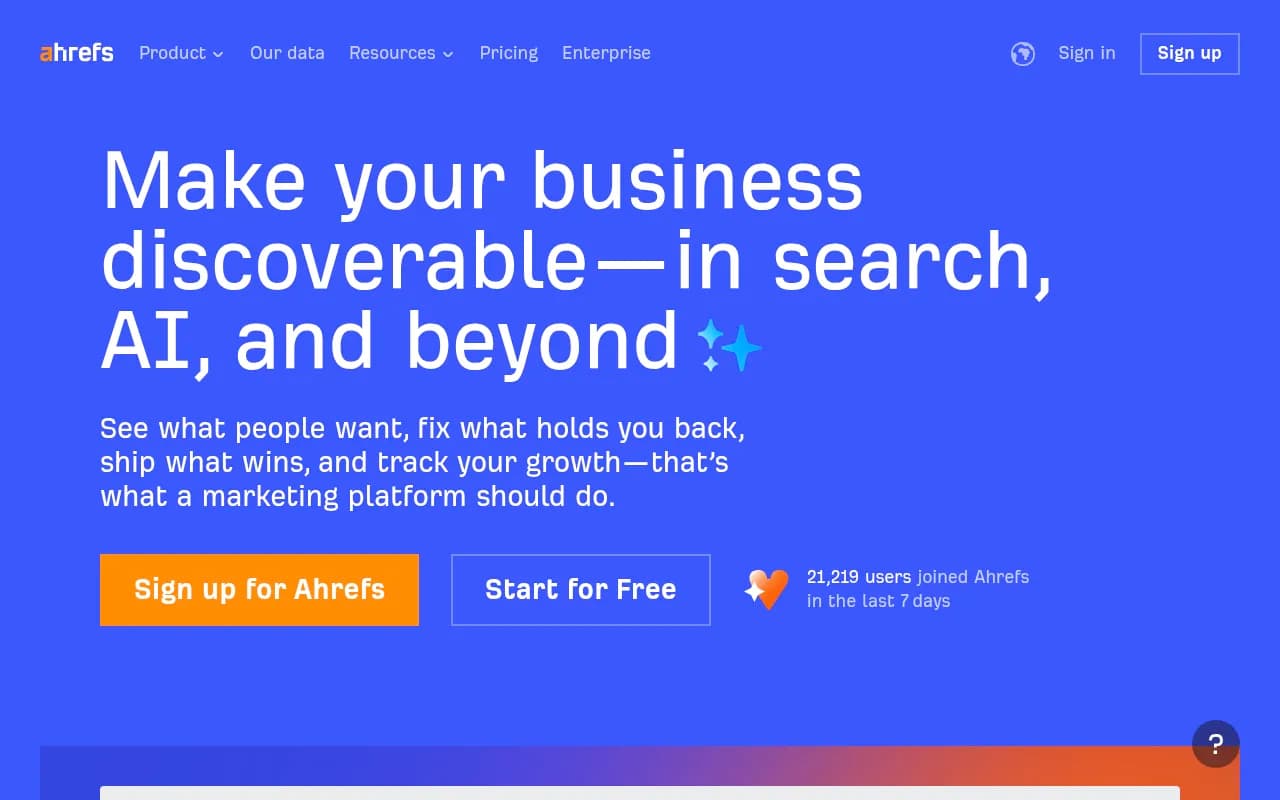
Ahrefs is Semrush's main competitor in the traditional SEO space, and it's taken a similar approach to AI search: add Brand Radar as an AI monitoring layer on top of a comprehensive SEO platform. The backlink index and keyword database are genuinely world-class, and 44% of Fortune 500 companies use Ahrefs for good reason.
Brand Radar tracks brand mentions across AI models, but like Semrush, it uses fixed prompts -- you can't define your own monitoring queries. There's no AI traffic attribution, no content generation for AI search, and no crawler logs. The AI features feel like they were added to keep pace with the market rather than built from the ground up for GEO.
Pricing starts at $29/mo for a very limited Starter plan, with the more practical plans running $83-$333/mo. Annual billing saves 20%. A free trial is available.
Compared to Meridian, Ahrefs is a much more established platform with transparent pricing, but the AI search features are shallower. If you're primarily an SEO team that wants to dip a toe into AI visibility, Ahrefs is a natural extension of existing workflows.
Best for: SEO-first teams that want AI brand monitoring as a supplement to their existing Ahrefs workflows, not as a standalone GEO strategy.
Scrunch AI
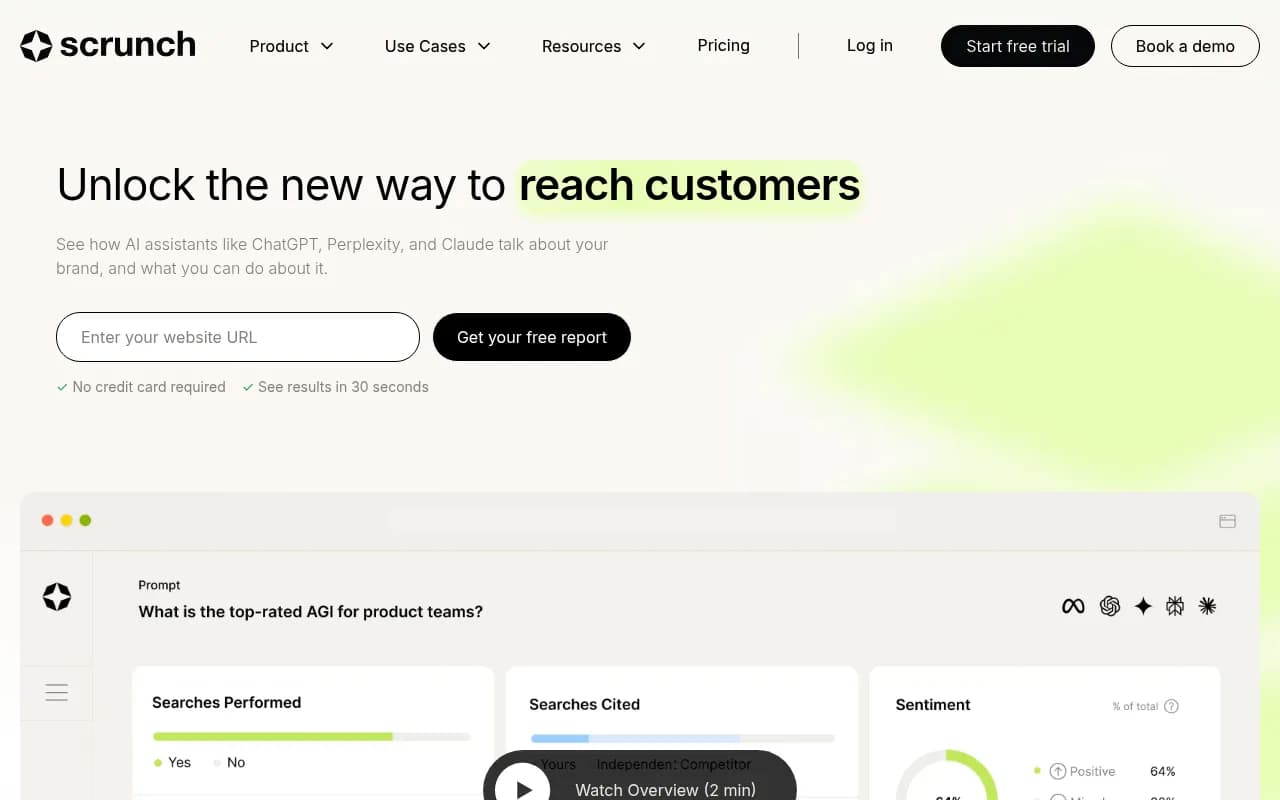
Scrunch has an interesting angle: it's not just a monitoring platform but also an "Agent Experience Platform" (AXP) that helps you translate your site content for AI traffic without disrupting the human experience. That's a genuinely different approach -- most competitors focus on what AI says about you, while Scrunch also focuses on how AI reads your site.
The monitoring side covers ChatGPT, Perplexity, Claude, and other LLMs, with real-time crawler feeds, citation tracking, and competitive benchmarking. The AXP piece -- serving structured content directly to AI agents -- is something most competitors don't offer at all.
Pricing starts at $83/mo (billed annually) for the Explorer plan, with Growth at $417/mo and Enterprise custom. A 7-day free trial is available. The customer base is smaller (500+ companies vs. Promptwatch's 6,700+), but the companies listed -- Lenovo, Crunchbase, Penn State -- suggest it's being used in real enterprise contexts.
Compared to Meridian, Scrunch is more transparent about pricing and has a unique technical angle with the AXP. The trade-off is that the platform is less established and the feature set, while interesting, is narrower than Promptwatch or Profound.
Best for: Technical marketing teams that want to optimize how AI agents actually read and interpret their site, not just track what AI says about them.
Brandlight.ai
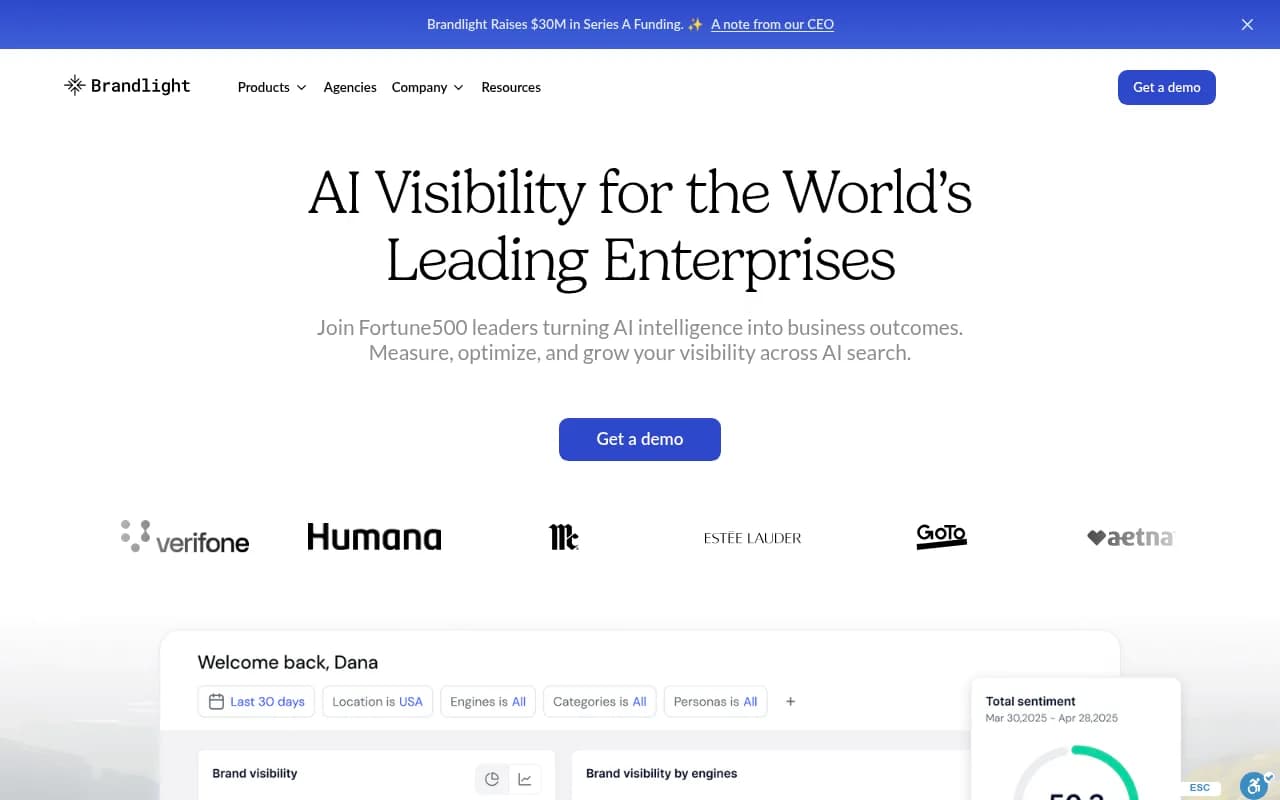
Brandlight.ai is squarely enterprise-focused -- the client list includes Fortune 500 names like MasterCard, Estee Lauder, Humana, and Aetna. The platform recently raised $30M in Series A funding, which signals serious investment in the space. It monitors brand mentions, sentiment, citations, and competitive positioning across ChatGPT, Perplexity, Claude, Gemini, and other AI engines.
The free version is a genuine differentiator -- you can get basic monitoring without paying anything, which is unusual in this space. Paid plans run from $199/mo (basic monitoring) to $750/mo (activation plan), with custom enterprise pricing for multi-brand deployments.
The honest limitation: Brandlight.ai is built for large enterprises with complex brand portfolios. If you're a mid-market company or a growing brand, the platform may be more than you need -- and the enterprise sales process reflects that. There's no public documentation of content generation features, crawler logs, or traffic attribution at the level Promptwatch provides.
Compared to Meridian, Brandlight.ai is better funded, has a clearer enterprise focus, and offers a free tier. But for most teams evaluating Meridian, Brandlight.ai's enterprise positioning may feel like a step in the wrong direction.
Best for: Large enterprise brands with multiple product lines that need AI visibility monitoring at scale and have the budget to match.
Which alternative should you pick?
Here's the honest summary:
If you want the most complete platform -- monitoring, gap analysis, content generation, crawler logs, traffic attribution -- Promptwatch is the clear choice. It's the only platform in this comparison rated as a leader across all GEO categories, and it's the only one that closes the full loop from "where am I invisible" to "here's the content that will fix it." Transparent pricing and a free trial mean you can evaluate it without a sales call.
If you're an enterprise team with a dedicated AEO budget and want a platform built specifically for that context, Profound is worth the demo. It's more established than Meridian with a stronger feature set for large organizations.
If you're already deep in Semrush or Ahrefs and just want AI visibility layered on top, stick with what you have. The AI features aren't as deep as dedicated platforms, but the integration with your existing SEO workflow has real value.
If you're just starting out and want to test AI visibility monitoring cheaply, Otterly.AI ($29/mo with a 14-day free trial) or Peec AI (€89/mo) are the lowest-friction entry points.
If you're a technical team interested in how AI agents actually read your site, Scrunch AI has a unique angle with its Agent Experience Platform that none of the others match.
Meridian might be the right fit for some teams -- particularly those that want hands-on execution support alongside the platform. But the lack of public pricing and the demo-required model means you're committing time before you know if it's even in your budget. Most of the alternatives above let you evaluate first and decide later.