Key takeaways
- Best for full-cycle optimization (find gaps, create content, track results): Promptwatch -- the only platform in this list that combines monitoring, content gap analysis, AI writing, and crawler logs in one place
- Best for teams already using Semrush: Semrush's AI Visibility toolkit adds GEO monitoring on top of traditional SEO, though it's limited compared to dedicated platforms
- Best enterprise option: Profound -- strong feature set, SOC 2 compliant, used by MongoDB and Ramp, but expensive and no free trial
- Best budget monitoring tool: Peec AI or Otterly.AI -- both cover the basics of brand tracking across LLMs at lower price points, without the optimization features
- Best for AI crawler insights + content delivery: Scrunch AI -- interesting "Agent Experience Platform" angle that few competitors have
Pendium.ai is a lightweight AI visibility tool aimed at SaaS and software companies who want to know how ChatGPT, Claude, and Gemini perceive and recommend their brand. The free scan is genuinely useful for a quick snapshot. But if you've tried it and found yourself wanting more -- deeper tracking, competitor analysis, content recommendations, or actual data over time -- you're not alone.
The main limitations people run into with Pendium: paid pricing isn't publicly listed (always a friction point), the platform appears focused on brand discovery scores rather than actionable optimization, and there's no clear path from "here's your score" to "here's how to improve it." For teams that want to move beyond a visibility report and actually do something about their AI search presence, Pendium starts to feel like a starting point rather than a full solution.
Here are the most credible alternatives, ranked by how useful they actually are.
Promptwatch

Promptwatch is the most complete AI search visibility platform available right now. Where Pendium gives you a score, Promptwatch shows you exactly why you're invisible for certain prompts -- and then helps you fix it.
The core workflow is what sets it apart. First, Answer Gap Analysis surfaces the specific prompts where competitors are getting cited but you're not. You see the actual content your site is missing. Second, a built-in AI writing agent generates articles, listicles, and comparison pages grounded in real citation data (over 880 million citations analyzed). This isn't generic content -- it's engineered to get cited by ChatGPT, Perplexity, and other models. Third, page-level tracking shows you whether the new content is working, which AI models are citing it, and how that translates to traffic.
On top of that loop, Promptwatch has features that most competitors simply don't offer: real-time AI crawler logs (so you can see when ChatGPT or Claude actually reads your pages), Reddit and YouTube citation tracking, ChatGPT Shopping monitoring, prompt volume and difficulty scoring, and query fan-outs that show how one prompt branches into sub-queries.
It monitors 10 AI models: ChatGPT, Claude, Gemini, Perplexity, Google AI Overviews, Google AI Mode, Grok, DeepSeek, Meta AI, Copilot, and Mistral.
Compared to Pendium, it's a different category of tool. Pendium tells you where you stand. Promptwatch tells you where you stand, why, and what to do about it.
Pricing: Essential $99/mo (1 site, 50 prompts, 5 articles), Professional $249/mo (2 sites, 150 prompts, 15 articles, crawler logs), Business $579/mo (5 sites, 350 prompts, 30 articles). Free trial available.
Best for: Marketing and SEO teams that want to treat AI search as a revenue channel, not just a reporting metric.
Semrush
Semrush is the tool most marketing teams already have open in another tab, which is both its biggest advantage and its biggest limitation in this context.
The AI Visibility toolkit was added relatively recently and covers brand monitoring across ChatGPT, Perplexity, and Gemini. You can track how LLMs represent your brand, compare against competitors, and get some optimization tips. For a team that lives in Semrush for keyword research, backlinks, and site audits, having AI visibility data in the same dashboard has obvious appeal.
The honest trade-off: Semrush's AI features use fixed prompts rather than letting you define your own tracking queries with volume and difficulty data. There's no AI traffic attribution, no crawler logs, and no content generation tied to citation gaps. It's monitoring layered onto a traditional SEO platform, not a purpose-built GEO tool.
Compared to Pendium, Semrush is obviously more powerful overall -- but the AI-specific features aren't necessarily deeper. If you're paying for Semrush anyway and just want a basic AI visibility layer, it works. If AI search optimization is a priority, you'll likely want something more specialized.
Pricing: From $165/mo (Starter) to $580/mo (Advanced). Enterprise custom. 7-day free trial.
Best for: Teams already using Semrush for traditional SEO who want AI visibility data without adding another tool to their stack.
Profound
Profound
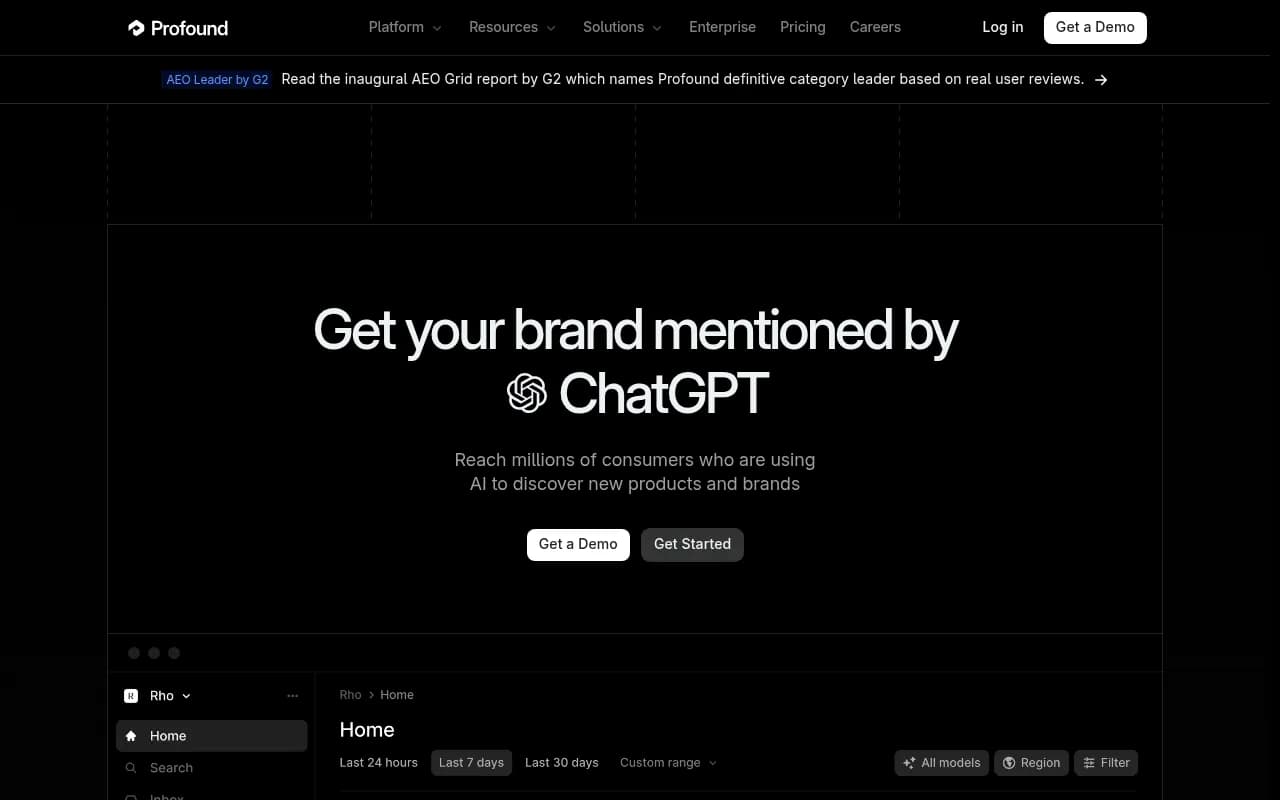
Profound is one of the more serious enterprise options in the GEO space. It's used by MongoDB, Ramp, and Mercury -- names that signal it's built for companies with real marketing budgets and compliance requirements (SOC 2 certified).
Feature-wise, Profound covers a lot of ground: answer engine insights, agent analytics, prompt volumes, shopping tracking, and AI content generation agents. The prompt volumes feature is particularly useful -- seeing what millions of people actually ask AI models helps you prioritize which topics to target. The content agents can generate AEO-optimized FAQs and other formats directly from the platform.
The main friction points: pricing starts at $499/mo for the Lite tier (3 seats, 24k responses/month, 2-month history), there's no free trial, and the enterprise focus means the onboarding process is consultative rather than self-serve. For a startup or a small marketing team, that's a real barrier.
Compared to Pendium, Profound is a significant step up in both capability and cost. Compared to Promptwatch, the feature sets are more comparable -- though Promptwatch has crawler logs, Reddit/YouTube tracking, and ChatGPT Shopping monitoring that Profound doesn't, and Promptwatch's pricing is more accessible for mid-market teams.
Pricing: Lite from $499/mo. Advanced ~$449/mo. Enterprise custom. No free trial.
Best for: Enterprise marketing and AEO teams at well-funded companies who need SOC 2 compliance and a full-stack platform with dedicated support.
Peec AI
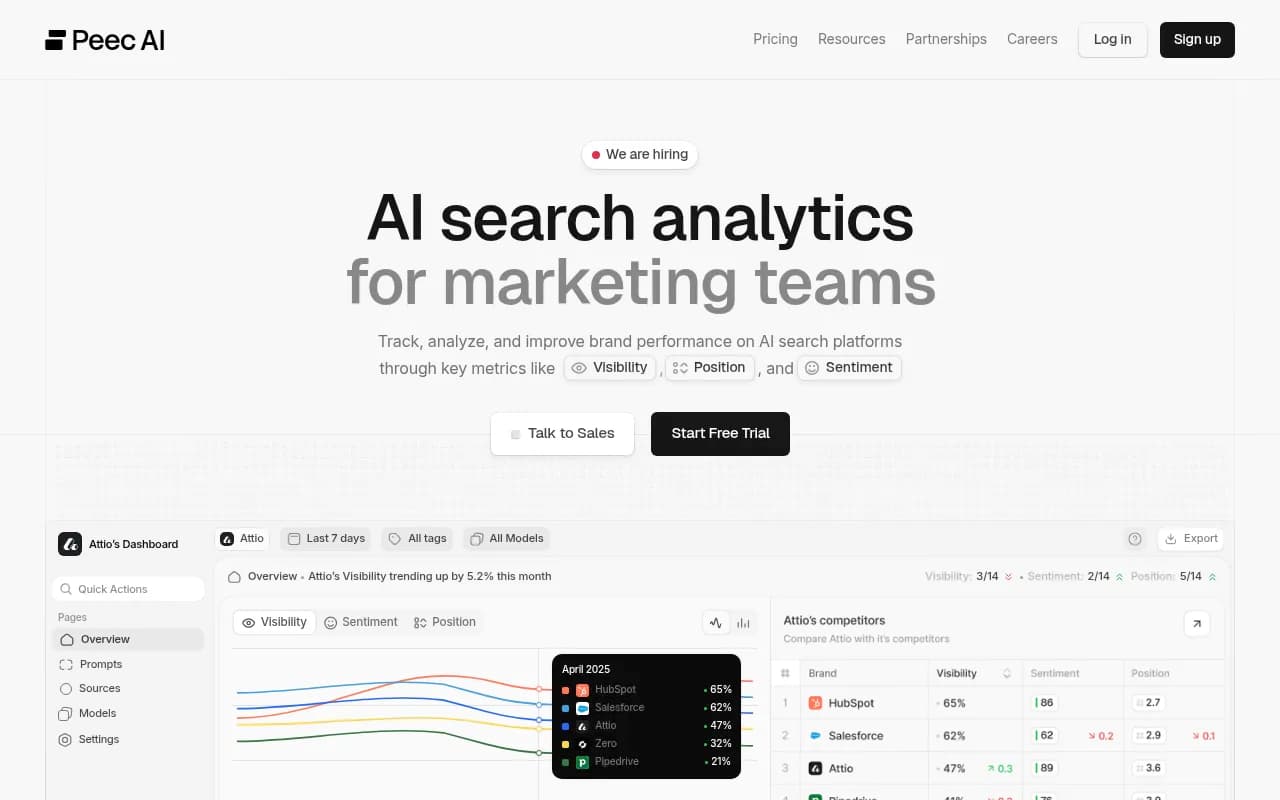
Peec AI is a clean, focused monitoring tool that tracks brand visibility, position, and sentiment across ChatGPT, Perplexity, Claude, and Gemini. The dashboard is well-designed and the core metrics (visibility share, position ranking, sentiment score) are easy to understand and act on.
What it does well: competitive benchmarking is solid, you can track across countries, and the pricing is reasonable for what you get. The Starter plan at €89/mo covers 50 prompts across 10 models, which is enough for a small team to get meaningful data.
What it doesn't do: there's no content generation, no crawler logs, no traffic attribution, and no prompt volume data. It's a monitoring dashboard. That's not a criticism -- it's just what it is. If you want to know how your brand is performing in AI search and compare against competitors, Peec AI does that well. If you want to know why and what to do about it, you'll need something else alongside it.
Compared to Pendium, Peec AI offers more structured ongoing tracking rather than a one-time scan. The pricing is transparent, which is a meaningful advantage.
Pricing: Free trial available. Starter €89/mo (~$103), Growth €199/mo, Enterprise custom.
Best for: Marketing teams that want clean, ongoing AI visibility monitoring without paying for features they won't use.
Otterly.AI
Otterly.AI

Otterly.AI covers six AI search engines -- ChatGPT, Perplexity, Google AI Overviews, Google AI Mode, Gemini, and Copilot -- and focuses on brand mentions, website citations, and share of voice tracking. The $29/mo Lite plan makes it one of the most accessible entry points in this space.
The GEO Audit tool is worth calling out specifically: it analyzes 25+ on-page factors to identify what's holding your site back from earning more citations. That's more actionable than a raw visibility score, and it's something Pendium doesn't offer.
The limitations are similar to Peec AI: no content generation, no crawler logs, no prompt volume data, no traffic attribution. The competitive benchmarking is there, but it's not as deep as Profound or Promptwatch. The 14-day free trial with no credit card required is a genuine plus for teams that want to test before committing.
Compared to Pendium, Otterly covers more AI platforms and gives you ongoing tracking rather than a point-in-time scan. The GEO audit adds a layer of optimization guidance that Pendium lacks.
Pricing: Lite $29/mo (15 prompts), Standard $189/mo (100 prompts), Premium custom. 14-day free trial, no credit card.
Best for: Budget-conscious teams that want basic AI visibility monitoring and a GEO audit without a big monthly commitment.
AthenaHQ

AthenaHQ positions itself as an end-to-end AEO and GEO platform and has attracted some notable clients -- Coinbase, ZoomInfo, SoFi, PagerDuty. It covers 8+ LLMs, provides citation source analysis, and includes automated content optimization recommendations.
The platform is built around different user roles: AEO/GEO managers get a command center view, CMOs get executive dashboards, content teams get optimization workflows. That role-based structure is useful for larger organizations where multiple teams touch AI search strategy.
The credit-based model (1 credit = 1 AI query) can make costs harder to predict than a flat subscription, which is worth factoring in. Self-serve starts at $295/mo ($95 for the first month), and there's a free 10-minute audit to get started.
Compared to Pendium, AthenaHQ is a full platform rather than a scan tool. Compared to Promptwatch, AthenaHQ is more monitoring and recommendation-focused -- it doesn't have the same depth of crawler logs, Reddit/YouTube tracking, or the integrated content writing agent that Promptwatch offers.
Pricing: Self-Serve $295/mo ($95 first month). Enterprise custom. Annual plans with 17% discount.
Best for: Mid-market to enterprise teams that want a structured GEO workflow with role-based dashboards and don't mind a credit-based pricing model.
Scrunch AI
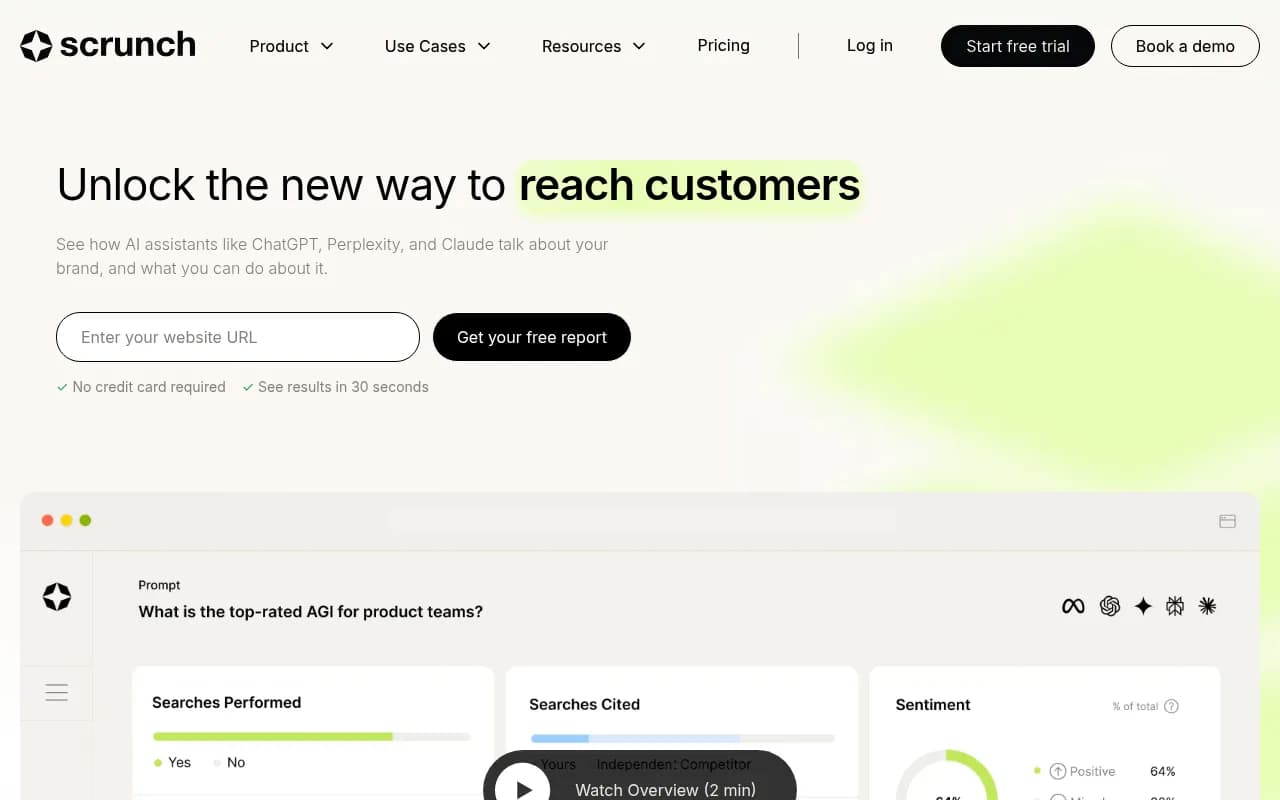
Scrunch has an interesting angle that most competitors don't: the "Agent Experience Platform" (AXP). The idea is that AI bots are now meaningful visitors to your website, and you should be able to serve them content optimized for machine consumption without disrupting the human experience. That's a genuinely different take on the problem.
Beyond AXP, Scrunch covers the standard monitoring territory -- brand presence tracking, citation analysis, competitor benchmarking, AI crawler logs, and error detection. The persona and geo-based tracking is more granular than most tools at this price point.
The client list includes Lenovo, Crunchbase, and Penn State, which suggests it works across different types of organizations. The 7-day free trial and transparent pricing (Explorer at $83/mo billed annually) make it easier to evaluate than some enterprise-only options.
Compared to Pendium, Scrunch is a full monitoring and optimization platform. Compared to Promptwatch, Scrunch's content generation capabilities are less developed, but the AXP layer for serving AI-optimized content directly is a unique differentiator.
Pricing: Explorer $83/mo (billed annually), Growth $417/mo, Enterprise custom. 7-day free trial.
Best for: Teams that want AI crawler monitoring plus the ability to actively shape how AI agents read their site content.
Search Party
Search Party
Search Party is a different kind of option -- it's not a SaaS platform you log into, it's an AI automation consultancy that embeds into your business and builds custom workflows. Their DOE Framework involves diagnosing bottlenecks, interviewing your team, and engineering AI agents to handle repetitive tasks across sales, marketing, and operations.
This is worth including because some teams looking for Pendium alternatives aren't just looking for a better dashboard -- they're looking for someone to actually implement AI-driven improvements for them. Search Party fills that role.
The obvious trade-offs: pricing is custom and likely starts in the $50K+ range for an engagement, there's no self-serve option, and the process is consultative rather than immediate. It's not a tool you can spin up in an afternoon.
Compared to Pendium, Search Party isn't really in the same category. Pendium is a visibility scanner; Search Party is a transformation engagement. If you're a well-funded company that wants AI expertise embedded in your team rather than another subscription, it's worth a conversation.
Pricing: Custom engagement pricing. No transparent tiers. Consultative sales process.
Best for: Larger organizations that want custom AI automation built and deployed by an external team, not a self-serve monitoring tool.
Which one should you pick?
The right choice depends on what you actually need after outgrowing Pendium's free scan.
If you want to go from "I have a visibility score" to "I know what content to create and I'm tracking whether it's working," Promptwatch is the most complete path. The combination of gap analysis, content generation, and crawler logs in one platform is hard to replicate by stitching together cheaper tools.
If you're already paying for Semrush and just want AI visibility data added to your existing workflow, the Semrush AI Visibility toolkit is the path of least resistance -- just don't expect the same depth as a dedicated GEO platform.
If budget is tight and you just need ongoing monitoring without the optimization layer, Otterly.AI at $29/mo or Peec AI at €89/mo are both solid. Otterly's GEO audit adds some actionability that Peec doesn't have.
If you're at an enterprise with compliance requirements and a real budget, Profound and AthenaHQ are both worth evaluating. Profound has the stronger brand recognition in enterprise circles; AthenaHQ has a more accessible self-serve entry point.
And if you want someone to build AI systems for you rather than hand you a dashboard, Search Party is in a category of its own.