Key Takeaways
- Promptwatch is the best choice if you need to optimize for AI search engines (ChatGPT, Claude, Perplexity) and want actionable content recommendations, not just monitoring dashboards
- Birdeye offers the strongest all-in-one reputation and social management with AI agents, ideal for brands prioritizing customer engagement over pure listings management
- SOCi delivers the most advanced AI automation for franchises and retail chains managing 100+ locations at scale
- Chatmeter provides the deepest analytics and sentiment analysis for brands that need to understand customer feedback patterns across locations
- Synup is the top agency-focused platform with white-label CRM and client management tools built in
Yext has been the enterprise standard for multi-location digital presence management since it pioneered centralized listings distribution in the early 2010s. But in 2026, the landscape has shifted dramatically. AI search engines like ChatGPT, Perplexity, and Google AI Overviews now drive a significant portion of local discovery traffic. Traditional listings management alone isn't enough anymore.
Brands are looking for alternatives to Yext for several reasons: the high cost (often $10K-$100K+ annually), limited AI search optimization capabilities, lack of deep social media management, and pricing that doesn't scale well for mid-market brands with 10-50 locations. Some teams also find Yext's interface complex and its review response tools less intuitive than newer competitors.
This guide compares the leading Yext alternatives across listings management, reputation monitoring, AI search visibility, social media automation, and pricing to help you find the right fit for your multi-location brand.
Promptwatch

Promptwatch takes a fundamentally different approach than Yext. While Yext focuses on traditional search engines and directories, Promptwatch is built specifically for AI search visibility -- tracking and optimizing how your brand appears in ChatGPT, Claude, Perplexity, Gemini, and other AI models that increasingly drive local discovery.
The core difference: Promptwatch doesn't just show you where you're invisible in AI search -- it helps you fix it. The platform combines AI visibility tracking with Answer Gap Analysis (showing exactly which prompts competitors rank for but you don't), an AI writing agent that generates content grounded in 880M+ real citations, and crawler logs that reveal when AI models are reading your website.
For multi-location brands, this means you can see which locations are being recommended by AI search engines, which prompts drive the most traffic, and what content you need to create to improve visibility. The platform tracks 10 AI models including ChatGPT, Perplexity, Google AI Overviews, Claude, Gemini, Meta AI, DeepSeek, Grok, Mistral, and Copilot.
Key features Yext doesn't offer: real-time AI crawler logs showing when ChatGPT/Claude/Perplexity read your pages, prompt volume estimates and difficulty scoring, Reddit and YouTube citation tracking (critical for AI recommendations), ChatGPT Shopping carousel monitoring, and AI-powered content generation based on actual citation data.
The platform also includes page-level tracking so you can see exactly which pages are being cited by AI models, competitive heatmaps comparing your visibility vs competitors across different LLMs, and traffic attribution through code snippets, Google Search Console integration, or server log analysis.
Best for: Brands that want to rank in AI search results and need actionable optimization tools, not just monitoring dashboards. Particularly strong for B2B SaaS, professional services, and any brand where AI-driven discovery is becoming a primary traffic source.
Pricing: Essential $99/mo (1 site, 50 prompts, 5 articles), Professional $249/mo (2 sites, 150 prompts, 15 articles, crawler logs), Business $579/mo (5 sites, 350 prompts, 30 articles). Agency and enterprise plans available. Free trial offered.
Trade-offs: Promptwatch focuses exclusively on AI search visibility and doesn't include traditional listings distribution to directories like Yelp or Apple Maps. If you need comprehensive directory management, you'll want to pair it with another tool or choose a different alternative. But if AI search optimization is your priority, no other platform comes close to Promptwatch's depth.
Birdeye
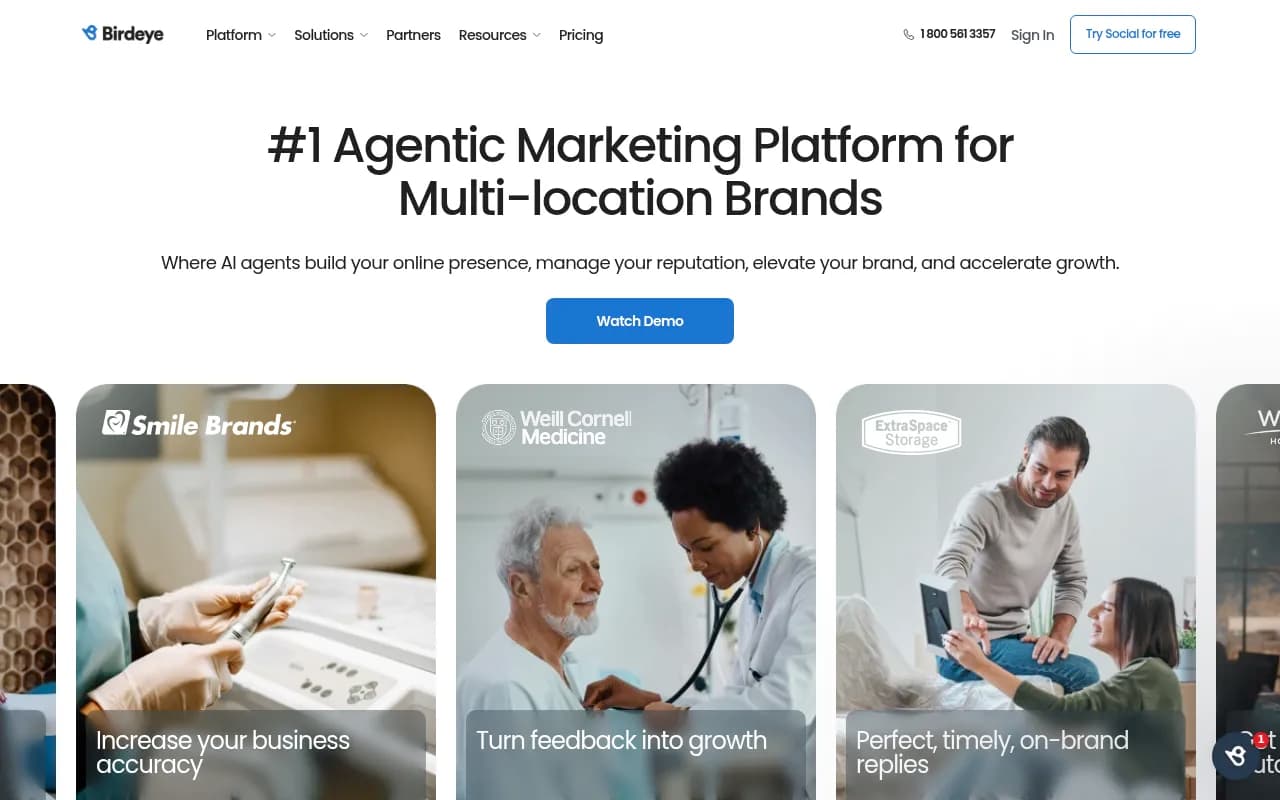
Birdeye positions itself as an "Agentic Marketing Platform" -- essentially an all-in-one suite where AI agents handle different aspects of your local marketing. The platform combines listings management, review monitoring, social media publishing and engagement, lead generation through messaging, and reporting in a single interface.
The standout feature is Birdeye's Search AI module, which tracks how your brand appears in AI-generated answers across ChatGPT, Gemini, and Perplexity. This puts it in direct competition with Promptwatch for AI visibility tracking, though Birdeye's AI search features are newer and less comprehensive (no crawler logs, no content gap analysis, no AI content generation).
Where Birdeye excels vs Yext is in customer engagement automation. The Social Engagement Agent monitors and responds to social media interactions, the Review Response Agent generates on-brand replies to reviews automatically, and the Lead Generation Agent handles customer messaging across multiple channels. For brands that struggle to keep up with customer interactions across dozens or hundreds of locations, these AI agents can save significant time.
The platform also includes a Listings Optimization Agent that maintains accuracy across directories (similar to Yext's core function), a Social Publishing Agent for content automation, and a Reporting Agent that surfaces insights without requiring manual dashboard digging.
Best for: Multi-location brands that need strong reputation management and social media automation alongside listings management. Particularly popular in healthcare, automotive, retail, and hospitality where customer engagement volume is high.
Pricing: From $299/mo (Standard), $399/mo (Professional), custom pricing for Premium. Pricing scales with number of locations. More affordable than Yext for brands with 10-50 locations.
Trade-offs: The AI search tracking is less mature than Promptwatch's dedicated platform. Birdeye's Search AI shows you visibility data but doesn't provide the optimization tools, content recommendations, or crawler logs needed to actually improve your AI search rankings. The platform also has a steeper learning curve due to the breadth of features.
Chatmeter
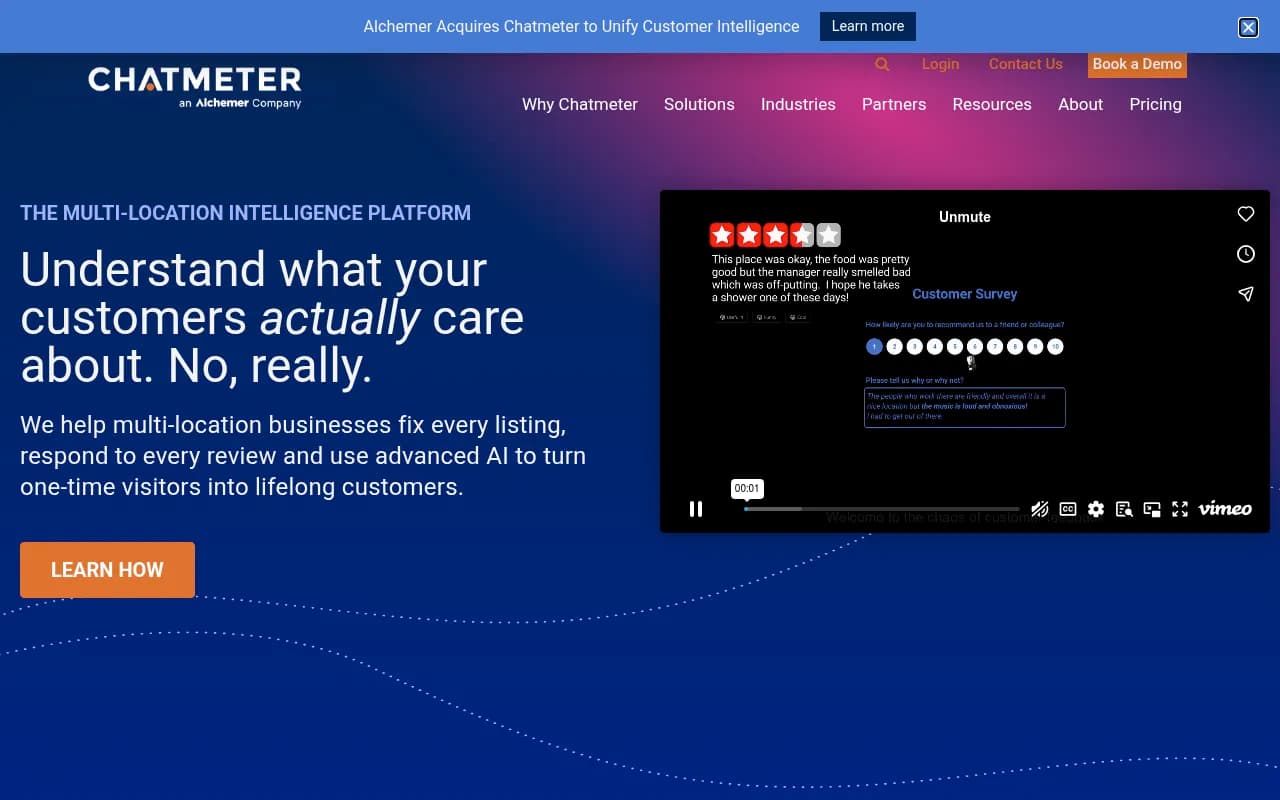
Chatmeter calls itself a "Multi-Location Intelligence Platform" and backs that up with some of the deepest analytics in the category. The platform's Pulse AI feature analyzes every customer interaction -- reviews, surveys, social comments -- to surface patterns and sentiment trends across your location network.
Compared to Yext, Chatmeter puts much more emphasis on understanding what customers actually care about. The platform doesn't just aggregate reviews; it uses AI to identify recurring themes, detect potential crises before they escalate, and compare location performance to help you understand why some locations outperform others.
For listings management, Chatmeter covers the basics well -- syncing business information across directories, monitoring for inconsistencies, and flagging errors. But the real value is in the intelligence layer on top. You can see which locations have listing issues impacting their search visibility, which review themes correlate with higher ratings, and how your locations compare to local competitors.
The platform also includes social media management (publishing and engagement), survey tools for gathering structured feedback, and competitive benchmarking that shows how you stack up against other brands in your category.
Best for: Multi-location brands that need deep analytics and sentiment analysis to drive operational improvements. Strong fit for QSR, retail chains, and automotive groups where understanding location-level performance differences is critical.
Pricing: Custom pricing based on number of locations. Typically $16,000-$42,000/year. Unlimited users included. No free tier. More expensive than Birdeye but less than Yext for most configurations.
Trade-offs: Chatmeter doesn't offer AI search visibility tracking at all -- no monitoring of ChatGPT, Perplexity, or other AI models. The platform is also heavily focused on reviews and sentiment analysis, so if your primary need is listings distribution or social media automation, other alternatives may be better fits.
Reputation
Reputation is one of the oldest players in the reputation management space and has evolved into a comprehensive platform for multi-location brands. The core strength is review management at scale -- monitoring reviews across 100+ sites, using AI to generate response drafts, and analyzing sentiment to identify trends.
The platform includes listings management (syncing business data across directories), social media monitoring and publishing, survey tools for collecting customer feedback, and competitive benchmarking. Reputation's AI analyzes all this data to surface insights about what's driving customer satisfaction or dissatisfaction across your location network.
Compared to Yext, Reputation puts more emphasis on customer experience and feedback analysis. The platform is designed to help you understand not just whether your listings are accurate, but whether customers are happy with the experiences they're having at your locations. This makes it particularly strong for brands in healthcare, automotive, retail, and real estate where reputation directly impacts conversion rates.
Reputation also offers industry-specific features -- for example, automotive dealers get integrations with DMS systems, healthcare providers get HIPAA-compliant review request workflows, and retail chains get store-level performance dashboards.
Best for: Enterprise brands in healthcare, automotive, retail, and real estate that need deep reputation management capabilities alongside listings management. Strong fit for brands managing 50+ locations where understanding location-level performance is critical.
Pricing: Custom pricing - Core from ~$80/mo per location, Professional $200-500/mo per location, Enterprise $500-2000+/mo per location. Annual contracts standard. Pricing comparable to Yext for large location counts.
Trade-offs: Like most traditional reputation platforms, Reputation doesn't track AI search visibility. The platform also skews expensive for mid-market brands with 10-50 locations. The interface can feel complex due to the breadth of features, and some users report that social media management features are less robust than dedicated social tools.
SOCi
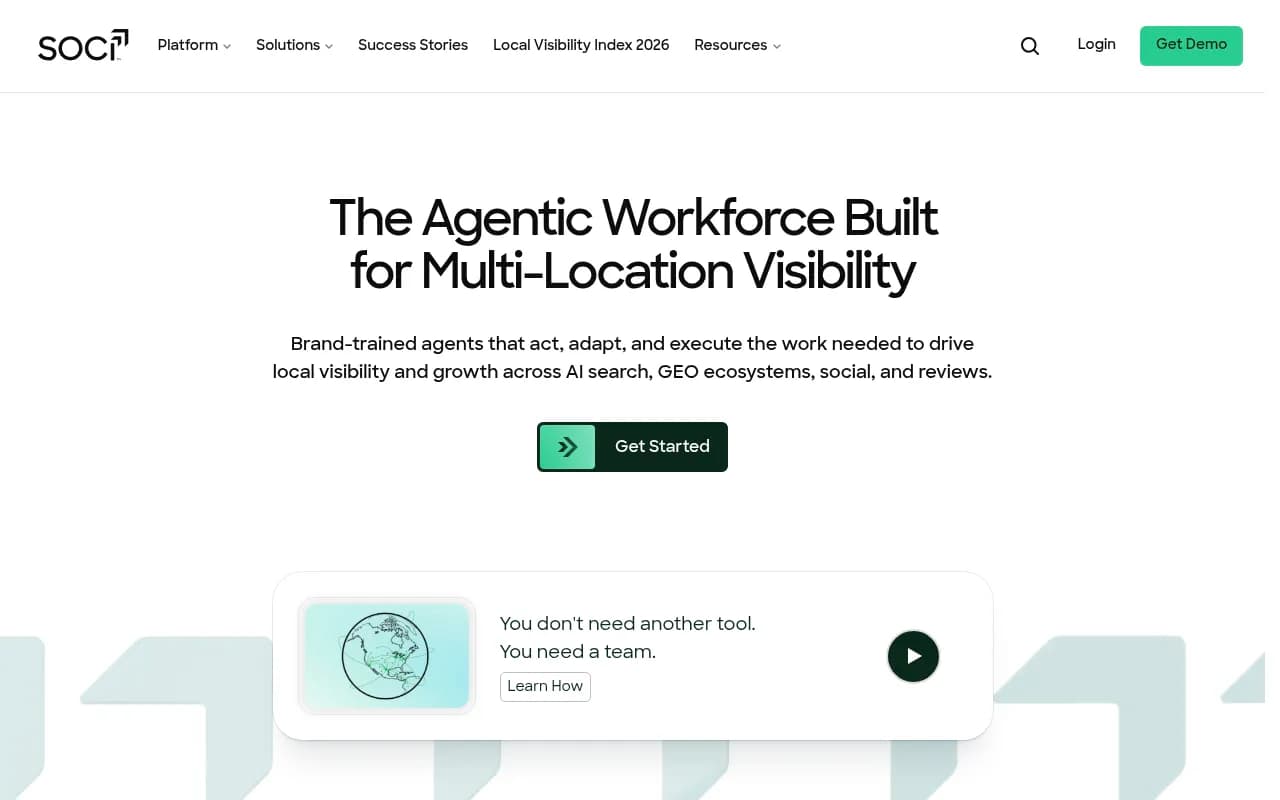
SOCi takes the AI agent approach even further than Birdeye, positioning itself as a team of AI agents rather than a traditional software platform. The Genius Search Agent handles listings optimization, the Genius Social Agent manages social media, and the Genius Reputation Agent handles review monitoring and responses.
The platform's strength is automation at massive scale. For franchises or retail chains managing 100+ locations, SOCi can automatically optimize listings, publish localized social content, respond to reviews, and even run local ad campaigns -- all with minimal manual intervention. The AI learns your brand voice and applies it consistently across locations.
SOCi also includes Pages (local landing page builder), Boost & Ads (local paid advertising management), Chat (customer messaging), Surveys & Forms (feedback collection), and Locator (store finder widget). This makes it one of the most comprehensive alternatives to Yext, covering not just listings and reputation but also local content and advertising.
The platform integrates with major directories, social networks, and review sites, and provides multi-language and multi-region support for global brands. The reporting is strong, with location-level dashboards that show how each site is performing across listings accuracy, review ratings, social engagement, and website traffic.
Best for: Large franchises, retail chains, and multi-location brands managing 100+ locations that need maximum automation. Particularly strong for QSR, retail, automotive, and hospitality brands where local marketing execution is a major operational challenge.
Pricing: From $119/mo (Individual) to $1,159/mo (Advanced). Enterprise pricing available for 500+ locations. More affordable than Yext for mid-market brands but can get expensive at scale.
Trade-offs: SOCi doesn't offer AI search visibility tracking. The platform is also heavily focused on automation, which means less manual control over individual location marketing. Some users report that the AI-generated content can feel generic and requires editing to match their brand voice perfectly.
Uberall
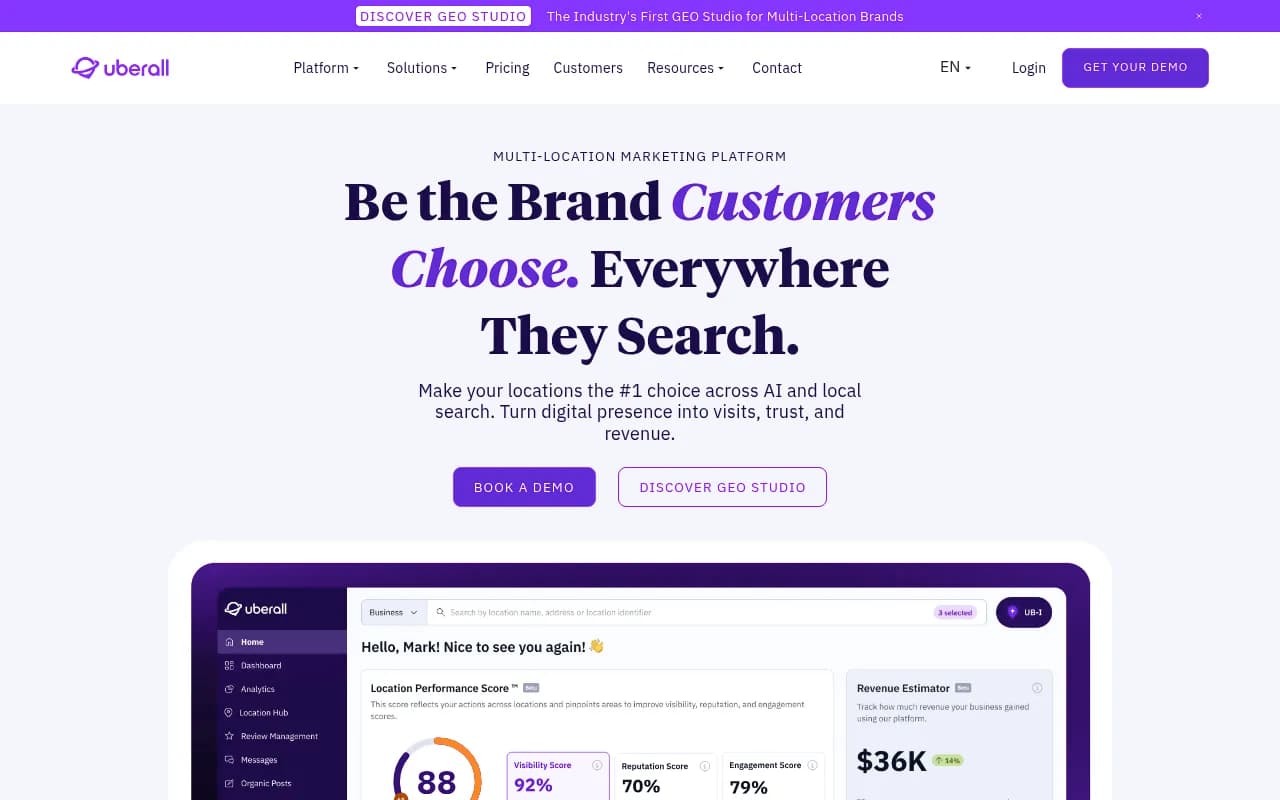
Uberall is a European-based platform that has expanded globally and now serves 1000+ brands including KFC, Puma, and Burger King. The platform's core strength is listings management across 150+ directories, with particularly strong coverage in European markets where Yext's directory network is less comprehensive.
In 2026, Uberall launched GEO Studio -- their answer to the AI search visibility challenge. GEO Studio tracks how brands appear in AI-generated answers and provides optimization recommendations. This puts Uberall in direct competition with Promptwatch for AI visibility tracking, though GEO Studio is newer and less feature-rich (no crawler logs, limited prompt tracking, no content generation).
The platform includes review monitoring and response tools, social media management, local pages (landing page builder), and analytics dashboards. Uberall also offers Near Me Brand Tracking, which shows how often your brand appears in "near me" searches across different locations and devices.
Compared to Yext, Uberall is generally more affordable for mid-market brands and offers stronger European directory coverage. The platform also has a simpler, more intuitive interface that requires less training for location managers.
Best for: European brands or global brands with significant European presence that need strong directory coverage outside the US. Also a good fit for mid-market brands (10-100 locations) looking for a more affordable Yext alternative.
Pricing: From $99/mo (Show Up tier) to custom enterprise pricing (Connect tier). Three main tiers: Show Up ($99/mo), Stand Out ($399/mo), Connect (custom). Annual discounts available. More affordable than Yext for most configurations.
Trade-offs: GEO Studio is still maturing and doesn't offer the depth of AI search optimization tools that Promptwatch provides. The platform's social media features are also less robust than Birdeye or SOCi. Some users report that customer support response times can be slow, particularly for lower-tier plans.
Synup
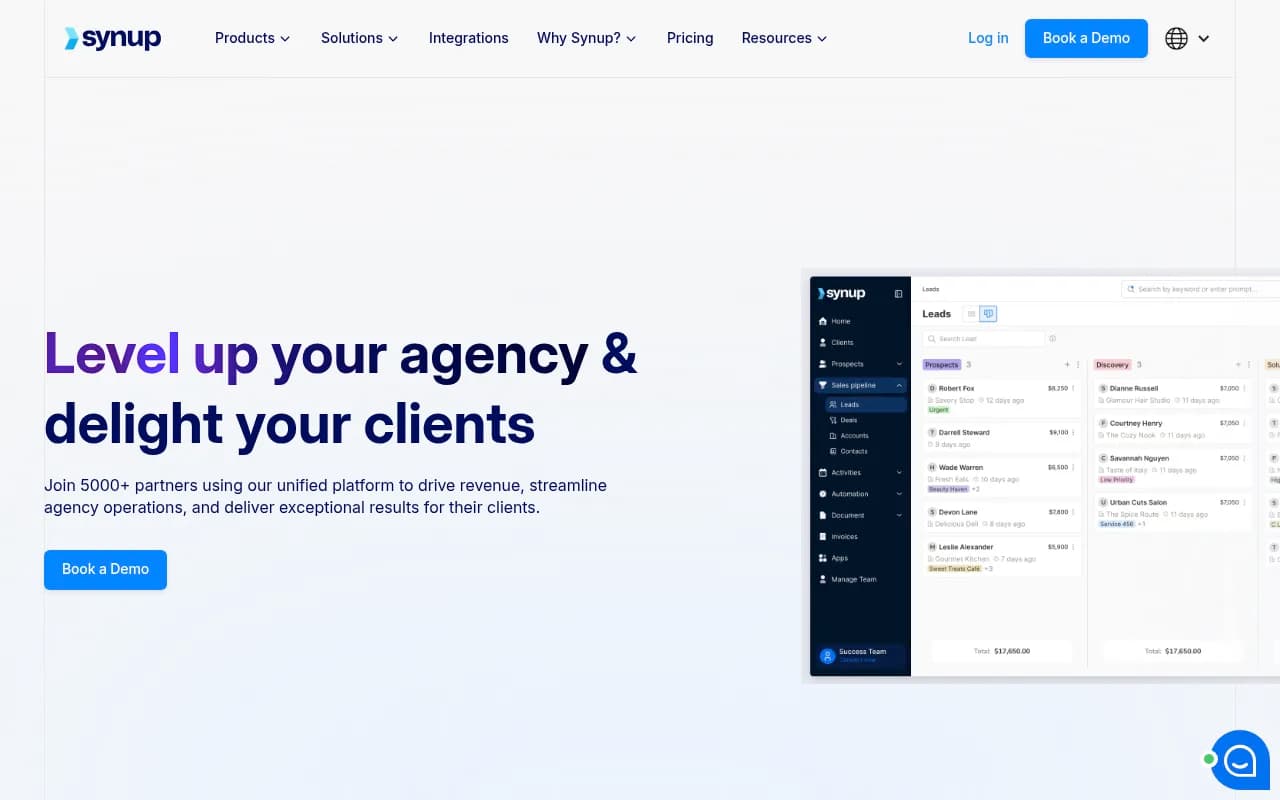
Synup takes a different approach than most Yext alternatives -- it's built specifically for digital marketing agencies managing multiple clients. The platform combines a CRM for lead management, listings management, reputation monitoring, social media scheduling, and SEO tools in a white-labeled interface that agencies can brand as their own.
For agencies, this is a game-changer. Instead of cobbling together separate tools for client acquisition (CRM), service delivery (listings/reputation/social), and reporting, Synup provides everything in one platform. You can manage your sales pipeline, onboard new clients, deliver local marketing services, and generate white-labeled reports -- all without switching tools.
The platform includes all the standard local marketing features: listings distribution to 100+ directories, review monitoring and response, social media publishing, local SEO audits, and competitive analysis. But the real value is in the agency-specific features: white-label branding, client portal access, automated reporting, and a CRM that tracks which prospects are most likely to close.
Synup also offers a reseller program where agencies can mark up the platform cost and bill clients directly, creating a recurring revenue stream.
Best for: Digital marketing agencies managing 10-500+ clients that need an all-in-one operating system for local marketing services. Also works for multi-location brands, but the feature set is clearly optimized for agencies.
Pricing: From $79/mo (Base plan) - Agency plan $199/mo, Scale plan $799/mo. Annual billing saves 20%. Free trial available. Much more affordable than Yext for agencies managing multiple clients.
Trade-offs: Synup doesn't offer AI search visibility tracking. The platform is also less feature-rich than enterprise solutions like Yext or Reputation for individual brands with complex needs. The CRM is basic compared to dedicated sales tools like HubSpot or Salesforce.
Moz Local
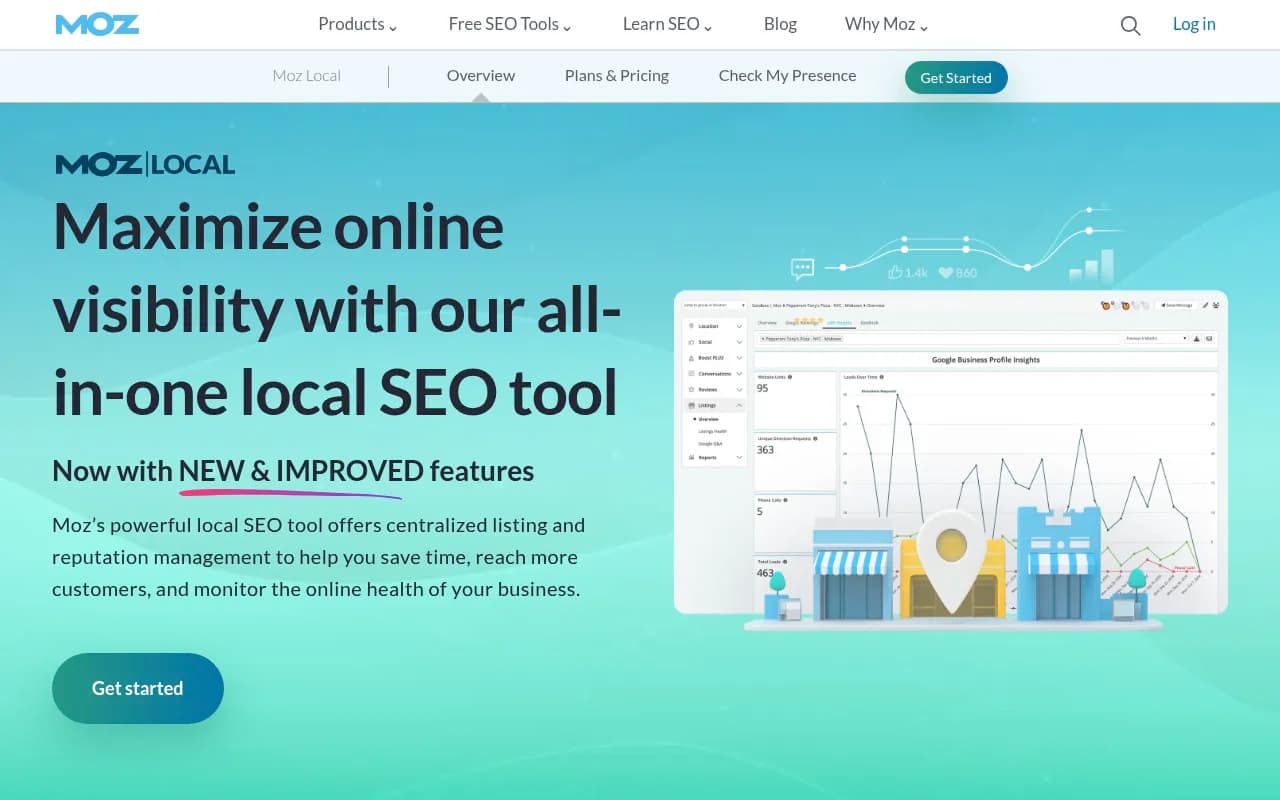
Moz Local is the local SEO offering from Moz, the company that pioneered many of the SEO metrics and tools marketers use today. The platform focuses on the fundamentals: accurate listings across 50+ directories, review monitoring and response, and local search performance tracking.
The standout feature is GeoRank, which tracks how your locations rank in local search results for target keywords. This gives you visibility into whether your listings optimization efforts are actually improving your search visibility. Moz Local also includes Google Business Profile performance analytics, showing how customers are finding and interacting with your GBP listings.
Compared to Yext, Moz Local is much more affordable and has a simpler, more focused feature set. You won't get social media management, AI search tracking, or advanced reputation analytics -- but you will get rock-solid listings management and local SEO tracking at a fraction of the cost.
The platform auto-syncs listings across directories, monitors for inconsistencies, and alerts you when action is needed. Review management is centralized in a single dashboard where you can read and respond to reviews from multiple sites. The interface is clean and intuitive, requiring minimal training.
Best for: Small to mid-market brands (1-50 locations) that need reliable listings management and local SEO tracking without the complexity and cost of enterprise platforms. Also a good fit for agencies managing clients with straightforward local marketing needs.
Pricing: From $14/mo per location (annual billing). Tiered plans: Lite (basic listings), Preferred (reviews + social + GeoRank), Elite (advanced features + API), Enterprise (custom pricing for 50+ locations). Free trial available. Significantly cheaper than Yext.
Trade-offs: Moz Local doesn't offer AI search visibility tracking, social media management, or advanced reputation analytics. The platform is also less suitable for large enterprises with complex workflows or hundreds of locations. Some users report that directory coverage is narrower than Yext or Uberall.
Rio SEO
Rio SEO (now part of InMoment) positions itself as a "Local Experience Platform" that combines local marketing with customer experience management. The platform includes listings management, local landing pages, review monitoring, and Voice of Customer surveys in an integrated suite.
The core strength is the local pages builder, which creates SEO-optimized landing pages for each location with customizable templates, schema markup, and local content. These pages are designed to rank in local search results and drive traffic to individual locations. Rio SEO also offers a store locator widget that can be embedded on your website.
For listings management, Rio SEO covers the basics -- syncing business data across Google, Bing, Yelp, Facebook, and 100+ other directories. The platform monitors for inconsistencies and provides bulk editing tools for updating information across locations.
The integration with InMoment's customer experience platform is unique among Yext alternatives. You can collect structured feedback through surveys, analyze sentiment across touchpoints, and connect customer experience data with local marketing performance. This makes it possible to see whether improving your listings accuracy or review ratings actually impacts customer satisfaction scores.
Best for: Enterprise brands that want to connect local marketing performance with customer experience metrics. Strong fit for retail, hospitality, and healthcare brands where CX measurement is a priority.
Pricing: Custom enterprise pricing (estimated $20K-$100K+ annually depending on location count). No free tier or public pricing available. Comparable to Yext for large deployments.
Trade-offs: Rio SEO doesn't offer AI search visibility tracking. The platform is also expensive for mid-market brands and requires annual contracts. Some users report that the interface feels dated compared to newer alternatives like Birdeye or SOCi. The customer experience integration is powerful but adds complexity that not all teams need.
How to Choose the Right Yext Alternative
The right platform depends on your specific needs:
If AI search visibility is your priority: Choose Promptwatch. It's the only platform built specifically for optimizing how AI models like ChatGPT, Claude, and Perplexity recommend your brand. The Answer Gap Analysis, AI content generation, and crawler logs provide actionable optimization tools that monitoring-only platforms can't match.
If you need all-in-one reputation and social management: Choose Birdeye or SOCi. Both offer comprehensive suites with AI agents that automate customer engagement at scale. Birdeye is stronger for brands prioritizing customer interaction quality, while SOCi is better for massive-scale automation across 100+ locations.
If you need deep analytics and sentiment analysis: Choose Chatmeter or Reputation. Both platforms excel at surfacing insights from customer feedback across locations. Chatmeter is stronger for operational intelligence, while Reputation offers more industry-specific features.
If you're an agency managing multiple clients: Choose Synup. The white-label CRM, client portal, and reseller program make it the clear winner for agencies that need an all-in-one operating system.
If you want simple, affordable listings management: Choose Moz Local. It covers the fundamentals without the complexity or cost of enterprise platforms.
If you need European directory coverage: Choose Uberall. Its directory network is stronger outside the US than most alternatives.
The local marketing landscape has evolved significantly since Yext established the category. In 2026, brands need more than just listings distribution -- they need AI search optimization, automated customer engagement, and actionable intelligence about what's working across their location network. The alternatives above each excel in different areas, so the right choice depends on which capabilities matter most for your business.