Key takeaways
- Promptwatch is the strongest all-around alternative -- it goes beyond monitoring to help you find content gaps, generate AI-optimized content, and track results with crawler logs and traffic attribution. Best for brands and agencies serious about improving AI search visibility, not just measuring it.
- Semrush suits teams that want one platform for everything -- traditional SEO, PPC, content, and AI visibility in a single subscription. The AI features are less specialized, but the breadth is unmatched.
- Profound is the enterprise pick -- deep prompt volume data, AI agents, and SOC 2 compliance, but pricing starts around $499/month and there's no free trial.
- Peec AI and Otterly.AI are solid monitoring-only options -- affordable entry points for teams that just want to track brand mentions across LLMs without the complexity of a full optimization platform.
- AthenaHQ sits in the middle -- more capable than basic trackers, used by brands like Coinbase and ZoomInfo, but still primarily a monitoring and recommendation tool rather than a full optimization loop.
- Zerply's agentic content calendar is genuinely interesting, but the platform is early-stage. If you need proven scale and deeper analytics, the alternatives below are worth a close look.
Zerply pitches itself as "SEO on autopilot" -- an agentic platform that monitors your AI visibility, builds a content calendar, and publishes articles to WordPress while you sleep. The concept is appealing, especially for lean marketing teams that don't have time to manually manage content pipelines. And the freemium entry point (500 credits/month free) makes it easy to try.
But there are real reasons people look elsewhere. Zerply is relatively new, which means the data infrastructure, citation analysis depth, and multi-model coverage aren't yet at the level of more established platforms. Teams that need to report AI visibility metrics to executives, run competitive analysis across 10+ LLMs, or connect AI citations to actual revenue will quickly hit the ceiling. The agentic content calendar is a differentiator, but if the underlying visibility data isn't comprehensive, the content strategy built on top of it is only as good as its inputs.
Here's how the main alternatives stack up.
The best Zerply alternatives in 2026
Promptwatch

Promptwatch is the alternative that most directly competes with what Zerply is trying to be -- and then goes further. Where Zerply focuses on automating content production, Promptwatch is built around a full optimization loop: find the gaps, create content that fixes them, then track whether it worked.
The Answer Gap Analysis is the clearest differentiator. It shows you exactly which prompts your competitors are visible for that you're not -- not just "you're missing visibility" but the specific questions and topics where AI models are citing other brands instead of yours. That's actionable in a way that a generic content calendar isn't.
From there, the built-in AI writing agent generates articles, listicles, and comparison pages grounded in real citation data (880M+ citations analyzed). This isn't a generic content tool -- it's generating content specifically engineered to get cited by ChatGPT, Claude, Perplexity, and other models. Zerply's Blog Agent does something similar, but without the citation data backbone, it's harder to know whether the output will actually move the needle in AI search.
Where Promptwatch really pulls ahead is in the analytics layer. AI Crawler Logs show you which pages ChatGPT, Claude, and Perplexity are actually crawling, how often, and what errors they're hitting. Page-level tracking shows which specific URLs are being cited and by which models. Traffic attribution (via code snippet, GSC integration, or server log analysis) connects AI visibility to actual website traffic and revenue. Zerply doesn't have any of this.
Coverage is also broader: 10 AI models including ChatGPT, Perplexity, Google AI Overviews, Google AI Mode, Claude, Gemini, Meta/Llama, DeepSeek, Grok, Mistral, and Copilot. Reddit and YouTube tracking surfaces discussions that influence AI recommendations -- a channel most competitors ignore. ChatGPT Shopping tracking monitors when your brand appears in product recommendation carousels.
Pricing starts at $99/month (Essential: 1 site, 50 prompts, 5 articles), $249/month (Professional: 2 sites, 150 prompts, crawler logs, state/city tracking), and $579/month (Business: 5 sites, 350 prompts, 30 articles). A 7-day free trial is available. Zerply's free plan gives you 500 credits/month, which is a lower barrier to entry -- but Promptwatch's paid tiers include substantially more capability per dollar once you're past the exploration phase.
Trusted by 6,700+ brands including Booking.com, Center Parcs, and Elaboratum, and rated as a "Leader" across all categories in a 2026 comparison of 12 GEO platforms.
Best for: Marketing teams and agencies that want to actually improve AI search visibility, not just monitor it. If you're ready to move from "we track this" to "we're winning this," Promptwatch is the right tool.
Semrush
Semrush is a different kind of alternative. It's not a pure-play AI visibility platform -- it's a full digital marketing suite that has added AI visibility tracking as one of eight toolkits. If you're already paying for Semrush for keyword research, backlink analysis, and site audits, the AI Visibility toolkit is a reasonable addition without buying a separate tool.
The AI Visibility features cover brand monitoring across ChatGPT, Perplexity, and Gemini, with sentiment analysis and competitive benchmarking. There's also an AI PR toolkit for finding media outlets trusted by LLMs and launching outreach campaigns. These are genuinely useful features, but they're not as deep as what you get from a specialized GEO platform. Semrush uses fixed prompt sets rather than letting you define your own prompt strategy, and there's no AI traffic attribution or crawler log analysis.
The trade-off is breadth. Semrush gives you traditional SEO (billions of keywords, backlink data, technical audits), PPC competitive intelligence, social media monitoring, local SEO, and content optimization -- all in one place. For a team that needs all of that, consolidating into Semrush makes sense. For a team whose primary concern is AI search visibility, paying $165-580/month for a platform where AI features are a secondary toolkit feels like the wrong fit.
Pricing: Starter at $165/month, Pro+ at $290/month, Advanced at $580/month. A 7-day free trial is available.
Best for: Teams already invested in traditional SEO who want to add AI visibility monitoring without adopting a new platform. Not the right choice if AI search is your primary focus.
Profound
Profound

Profound is the most enterprise-grade option on this list. Used by MongoDB, Ramp, and Mercury, it covers the full AEO workflow: prompt volume data (so you can see what millions of people are actually asking AI), answer engine insights, AI agent analytics, and content generation agents. SOC 2 compliance makes it viable for companies with strict data security requirements.
The Prompt Volumes feature is a genuine differentiator -- it shows real search demand data for AI queries, which helps prioritize which prompts to target. Profound also has AI agents that can generate AEO-optimized FAQ content and other page types, similar to what Zerply does with its Blog Agent but with more enterprise tooling around it.
The catch is pricing and access. Profound's Lite tier starts around $499/month, there's no free trial, and the sales process is consultative. For a startup or mid-market team, that's a significant commitment before you've validated the platform. Zerply's freemium model is the opposite extreme -- you can start for free and upgrade when you see value.
Compared to Promptwatch, Profound has strong monitoring and some content generation, but lacks crawler logs, Reddit/YouTube tracking, and the kind of traffic attribution that closes the loop between AI visibility and revenue.
Best for: Enterprise marketing and AEO teams at well-funded companies that need SOC 2 compliance, deep prompt volume data, and are willing to pay for a premium platform.
Peec AI

Peec AI is a clean, focused AI search analytics platform. It tracks visibility, position, and sentiment across ChatGPT, Perplexity, Claude, Gemini, and other LLMs, with competitive benchmarking built in. The interface is well-designed and the core metrics are easy to understand -- visibility (share of chats where your brand appears), position (where you rank within AI responses), and sentiment (how AI models characterize your brand).
Compared to Zerply, Peec AI is purely a monitoring tool. There's no content generation, no agentic content calendar, no crawler logs. What it does, it does well -- but it stops at the data layer. You'll know you have a visibility problem; you'll need other tools to fix it.
Pricing is reasonable: Starter at €89/month (~$103) for 50 prompts across 10 models, Growth at €199/month for 150 prompts and 2 workspaces, with enterprise custom pricing. Trusted by 2,000+ marketing teams.
Best for: Marketing teams that want solid AI visibility monitoring at a reasonable price point and are comfortable handling content strategy and optimization separately.
Otterly.AI
Otterly.AI

Otterly.AI covers six AI search engines (ChatGPT, Google AI Overviews, Perplexity, Google AI Mode, Gemini, and Copilot) and focuses on brand mention tracking, citation analysis, and competitive benchmarking. It also has a GEO Audit tool that analyzes 25+ on-page factors to identify what's holding your site back from earning more citations -- which is a step toward optimization that pure monitoring tools don't offer.
The pricing is the most accessible on this list for paid plans: $29/month for the Lite tier (15 prompts), $189/month for Standard (100 prompts), with a 14-day free trial and no credit card required. That makes it a low-risk way to start tracking AI visibility.
The limitations are real, though. No crawler logs, no content generation, no prompt volume data, no traffic attribution. The GEO Audit is useful for identifying on-page issues, but it doesn't generate the content fixes for you. Compared to Zerply's agentic approach, Otterly.AI is more manual -- it tells you what to fix, not how to fix it.
Best for: Small teams and individual marketers who want affordable AI visibility monitoring with a light optimization layer, without committing to a full-featured platform.
AthenaHQ

AthenaHQ positions itself as an "end-to-end AEO & GEO platform" and has a notable client list -- Coinbase, ZoomInfo, SoFi, Volkswagen. It covers 8+ LLMs with citation source analysis, content optimization recommendations, and an executive dashboard for reporting AI search ROI to leadership.
The platform is more capable than basic monitoring tools like Peec AI or Otterly.AI, but it's still primarily a monitoring and recommendation system. The content optimization is advisory -- it tells you what to improve -- rather than generative. There's no built-in content creation agent like Zerply's Blog Agent or Promptwatch's AI writing tool.
Pricing is $295/month for self-serve (with a discounted first month at $95), with enterprise custom pricing. Annual plans offer a 17% discount. The credit-based model (1 credit = 1 AI query) means costs can scale with usage in ways that aren't always predictable.
Featured in Forbes and the Wall Street Journal, and backed by Y Combinator, AthenaHQ has credibility. But the gap between "here are recommendations" and "here's the content that will fix this" is one that teams will need to bridge themselves.
Best for: Mid-market and enterprise teams that need a credible GEO platform with strong reporting and are comfortable implementing content recommendations without built-in generation tools.
Scrunch AI
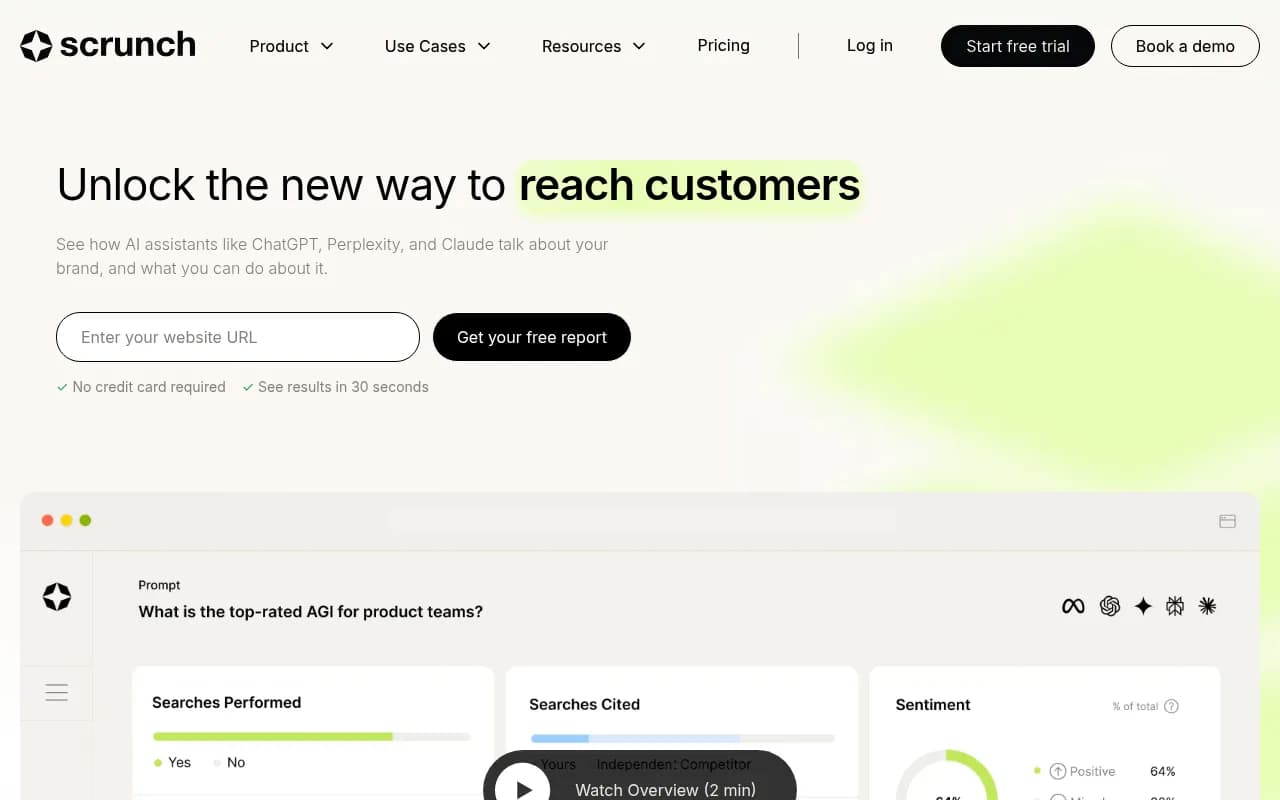
Scrunch AI is an AI-powered SEO tracking and visibility platform with plans starting at $83/month (billed annually). It covers brand monitoring across AI search engines and includes analysis features for tracking visibility trends over time.
One honest note: Scrunch's website was returning a 522 connection timeout error at the time of writing, which makes it harder to evaluate current features and positioning. That's not necessarily a dealbreaker, but it's worth keeping in mind when evaluating a platform you'd be relying on for ongoing monitoring.
Pricing: Explorer at $83/month, Growth at $417/month, Enterprise custom. 7-day free trial available.
Best for: Teams looking for a mid-range AI visibility platform -- worth evaluating if pricing and feature set align with your needs, but do your own due diligence given the limited current information.
Search Party
Search Party
Search Party is a different category entirely. It's not a SaaS platform -- it's an AI automation consultancy that builds custom workflows and AI agents for businesses. Their DOE Framework involves diagnostic analysis, bottleneck mining, and forward-deployed engineering teams that design and implement automation across sales, marketing, operations, and R&D.
If you're looking for a Zerply alternative because you want a tool to log into and track metrics, Search Party isn't it. It's a services engagement, with pricing estimated in the $50K-$500K+ range depending on scope. The value proposition is different: instead of giving you a dashboard, they build custom AI systems embedded in your business.
For a company that has identified specific, high-value workflows to automate and has the budget for a consultative engagement, Search Party could be compelling. For a marketing team that wants to track AI visibility and improve content strategy, it's the wrong fit.
Best for: Companies with complex, high-value automation problems that need custom engineering rather than an off-the-shelf monitoring platform.
Which alternative should you pick?
The right choice depends on what you actually need from Zerply -- and where it's falling short.
If the gap is depth of AI visibility data -- more models, crawler logs, citation analysis, traffic attribution -- Promptwatch is the clearest upgrade. It's the only platform that covers the full loop from gap identification to content creation to result tracking, and it does so across 10 AI models with more data infrastructure than any other specialized GEO tool.
If you need traditional SEO alongside AI visibility and don't want to manage two platforms, Semrush is the pragmatic choice -- just go in knowing the AI features are secondary.
If you're at an enterprise with strict compliance requirements and a budget to match, Profound is worth the sales conversation.
If you want affordable monitoring without complexity, Peec AI or Otterly.AI will get you tracking in an afternoon. Neither will help you fix what they find, but as a starting point they're solid.
If you're evaluating Zerply specifically because of the agentic content calendar, the honest comparison is Promptwatch's AI writing agent -- which generates content grounded in 880M+ real citations rather than general SEO signals. The output is more likely to actually get cited by AI models, which is the whole point.
Zerply's freemium model is a genuine advantage for experimentation. But once you're ready to treat AI search as a serious channel, the platforms above offer more proven infrastructure to build on.