Key takeaways
- Ahrefs is the better choice if traditional SEO (backlinks, rank tracking, site audits) is your core need. AirOps doesn't touch any of that.
- AirOps is purpose-built for AI search content engineering. If your main goal is getting cited by ChatGPT, Perplexity, or Google AI Overviews, it's the more focused tool.
- Ahrefs added AI search monitoring through Brand Radar, but it uses fixed prompts and has no AI traffic attribution -- it's a monitoring layer bolted onto an SEO platform, not a native AI search tool.
- AirOps has a free tier; Ahrefs' $29/month Starter plan is so limited it barely counts. Real access to Ahrefs starts at $83/month.
- These tools overlap less than you'd think. Many teams run both: Ahrefs for SEO intelligence, AirOps for AI content production.
- Neither tool is a complete AI search visibility platform on its own -- both have meaningful gaps in monitoring depth, citation tracking, and traffic attribution.
Overview
Ahrefs
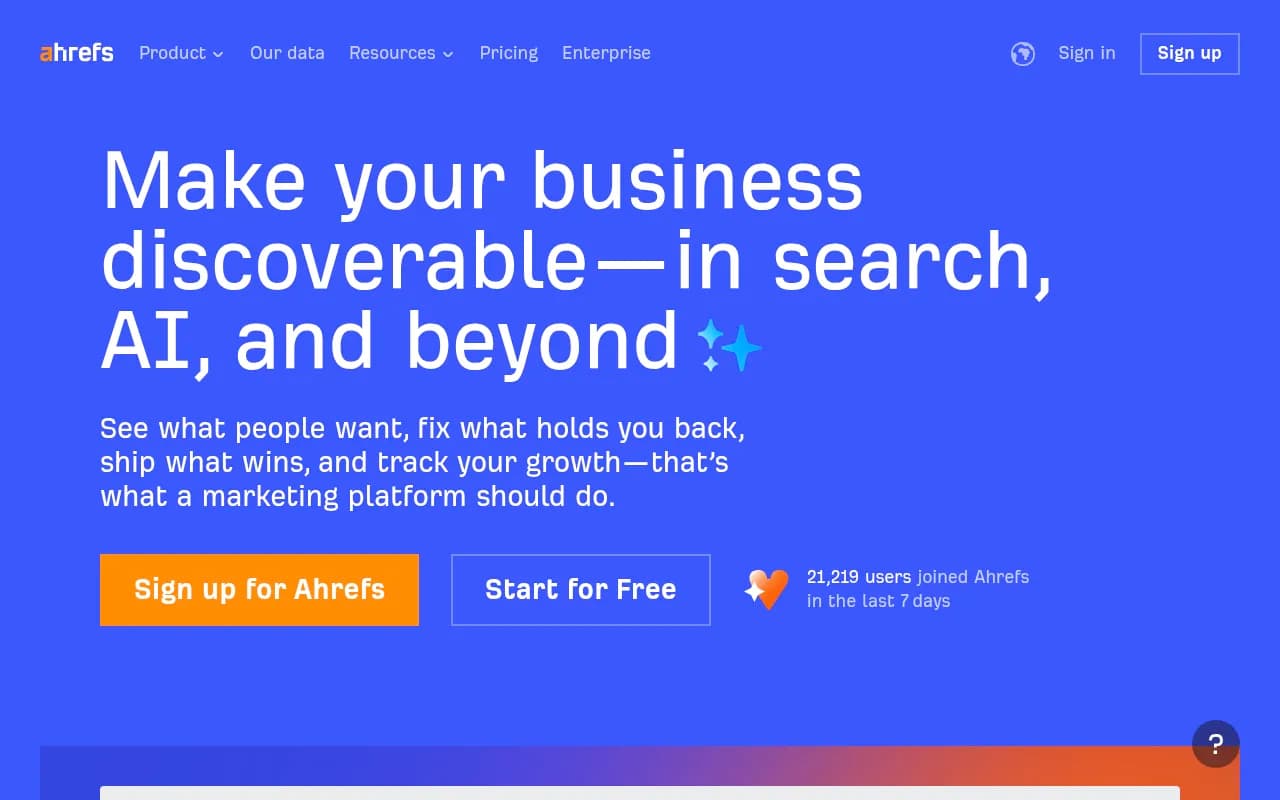
Ahrefs has been the go-to SEO platform for serious marketers for over a decade. It's built on what is genuinely one of the largest backlink indexes and keyword databases available, and 44% of Fortune 500 companies use it. The core product covers site audits, backlink analysis, keyword research, rank tracking, and competitive intelligence -- all the things SEO teams have relied on since before AI search was a thing.
More recently, Ahrefs has been expanding into AI search territory with Brand Radar, which monitors how your brand appears in AI-generated responses. It's also added content tools and social media management features, positioning itself as a broader "AI marketing platform." Whether that expansion is deep enough to compete with purpose-built AI search tools is the central question of this comparison.
AirOps
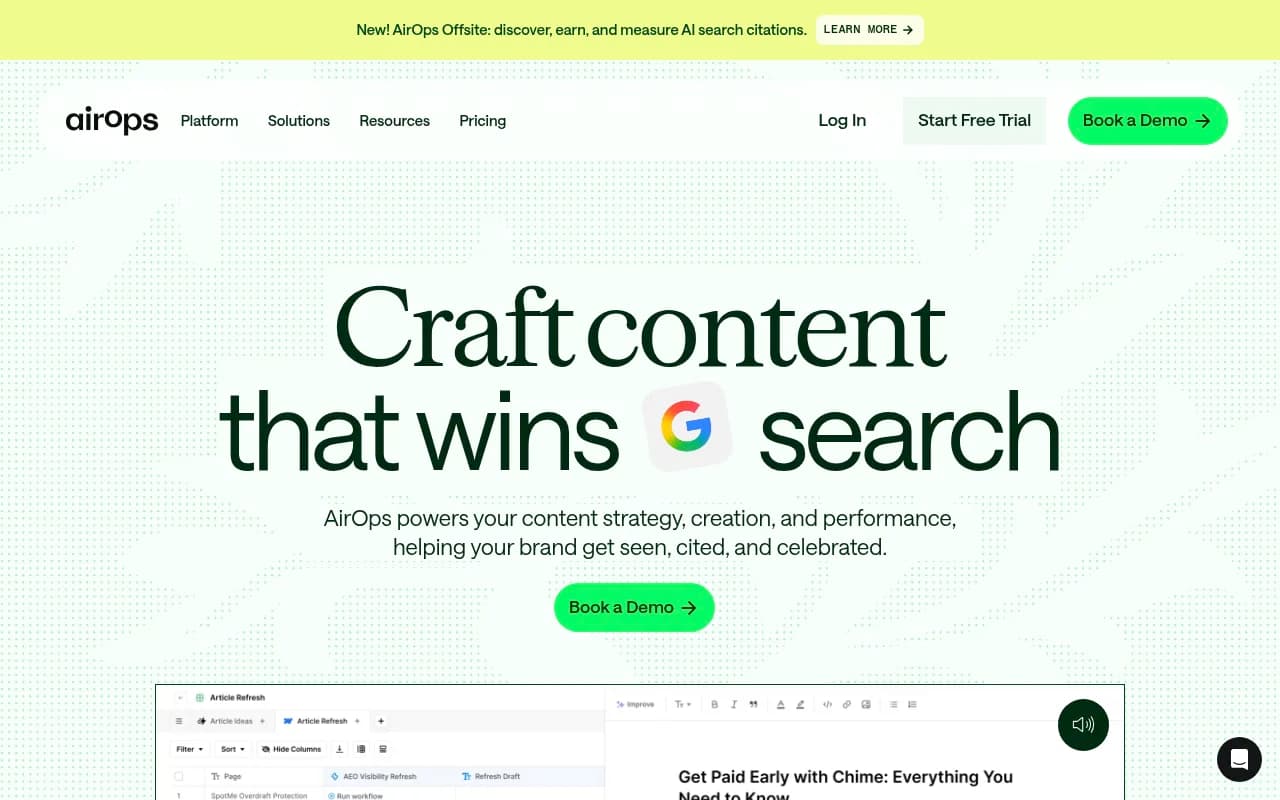
AirOps came at this from the opposite direction. It's not an SEO tool that added AI features -- it was built from the ground up to help brands win in AI search. The pitch is "content engineering": a workflow that takes you from identifying what AI models are citing, to creating content designed to get cited, to scaling that production across your team.
Customers like Webflow, Chime, Ramp, and Carta have published case studies with specific numbers -- Chime went from being cited in 24 to 68 priority questions after using AirOps, and Webflow 5x'd its content refresh velocity. Those are the kinds of results that make AI-search-focused teams pay attention.
Side-by-side comparison
| Feature | Ahrefs | AirOps |
|---|---|---|
| Pricing (entry) | $83/mo (Lite) | Free tier available; $199/mo (Starter) |
| Free tier | No (Starter $29/mo is very limited) | Yes, 1,000 tasks/month |
| Traditional SEO (backlinks, audits, rank tracking) | Full suite, best-in-class | Not available |
| AI search monitoring | Brand Radar (fixed prompts, limited) | Yes, with content gap analysis |
| Content gap analysis | Limited | Core feature |
| AI content creation/writing | Basic AI writing tools | Full content engineering workflows |
| Brand Kit / governance | No | Yes (recently launched) |
| AI traffic attribution | No | Yes |
| Prompt customization | Fixed prompts only | Flexible |
| Reddit/YouTube tracking | No | Partial (Reddit workflows via AirOps) |
| Backlink index | Yes (largest available) | No |
| Keyword database | Yes (10B+ keywords) | No |
| Site audit | Yes | No |
| Social media management | Yes | No |
| API access | Yes (Enterprise) | Yes |
| Target user | SEO teams, digital marketers | Content teams, AI search marketers |
Head-to-head feature deep-dive
AI search monitoring
This is where the gap between the two tools is most telling.
Ahrefs Brand Radar tracks brand mentions across AI responses, but it works with fixed prompts -- you can't define your own questions or track specific topics relevant to your business. There's also no AI traffic attribution, meaning you can see that you're being mentioned but can't connect that to actual website visits or conversions. For a platform that charges $166-333/month for plans where Brand Radar is actually useful, that's a real limitation.
AirOps approaches AI search monitoring as the foundation of a content workflow rather than a standalone dashboard. It identifies which questions AI models are answering, which sources they're citing, and where your brand is missing. The content gap analysis is genuinely actionable -- you get specific topics and angles to write about, not just a visibility score.
Verdict: AirOps wins for AI search optimization. Ahrefs Brand Radar is fine for basic brand monitoring but isn't built for teams trying to systematically improve AI citations.
Content creation and engineering
Ahrefs has added AI writing tools and content workflows, but they're built on top of an SEO research foundation. You can use keyword data to inform content briefs, run content gap analysis against competitors, and use AI to help draft or optimize pages. It works, but the AI search angle is secondary.
AirOps calls itself a "content engineering platform" and means it. The workflow is designed specifically around AI search: identify what AI models want to cite, create content that matches that, publish at scale, and track whether citations improve. The Brand Kit feature (launched in 2026) adds brand governance so AI-generated content stays on-voice across a large team.
For teams producing high volumes of content aimed at AI search, AirOps' workflow is more purpose-fit. For teams that need content tools as part of a broader SEO workflow, Ahrefs is more integrated.
Verdict: Depends on your goal. AirOps for AI search content production. Ahrefs for SEO-informed content strategy.
Traditional SEO capabilities
No contest here. Ahrefs has one of the best backlink indexes in the industry, a keyword database covering 10B+ keywords across 170+ countries, a site audit tool that catches technical SEO issues, and rank tracking that most SEO teams consider essential.
AirOps doesn't do any of this. It's not trying to. If you need to know why a competitor is outranking you on Google, analyze your link profile, or find keyword opportunities for traditional search, AirOps won't help.
Verdict: Ahrefs wins decisively. This isn't even a comparison -- it's a different category.
Pricing and value
| Plan | Ahrefs | AirOps |
|---|---|---|
| Free | No (very limited $29/mo Starter) | Yes, 1,000 tasks/month |
| Entry paid | $83/mo (Lite) | $199/mo (Starter, 10,000 tasks) |
| Mid-tier | $166/mo (Standard) | Scale (custom pricing) |
| Advanced | $333/mo (Advanced) | Enterprise (custom pricing) |
| Enterprise | Custom | Custom |
| Annual discount | 20% | Available |
AirOps' free tier is genuinely useful for small teams or individuals testing the platform. Ahrefs' $29/month Starter is so restricted (no rank tracking, limited crawl credits, no full keyword data) that most users end up on the $83/month Lite plan at minimum.
For AI search-focused work specifically, AirOps at $199/month competes with Ahrefs Standard at $166/month. If you're only buying Ahrefs for the AI search features, that's hard to justify -- you're paying for a lot of traditional SEO tooling you may not need.
Verdict: AirOps is cheaper for AI search-only use cases. Ahrefs offers better value if you need the full SEO toolkit.
Integrations and workflow
Ahrefs integrates with Google Search Console, Google Analytics, and various reporting tools. Its API is available on Enterprise plans. The platform is fairly self-contained -- most users do their research inside Ahrefs and export data elsewhere.
AirOps is built around workflow integration. It connects to CMS platforms, has API access, and is designed to fit into a content production pipeline rather than exist as a standalone research tool. The task-based pricing model (1,000 to 10,000+ tasks per month) reflects that it's meant to be running continuously as part of your content operations.
Verdict: AirOps is more workflow-native. Ahrefs is more of a research hub.
Ease of use
Ahrefs has a well-documented interface that most SEO professionals know well. That said, it's a complex platform with a lot of features -- new users face a real learning curve, and the AI search features are scattered across the product rather than presented as a cohesive workflow.
AirOps has a more focused interface because it does fewer things. The content engineering workflow is relatively linear: research, create, publish, track. Teams new to AI search optimization will find the structure helpful. The Brand Kit feature also reduces the overhead of maintaining consistency across AI-generated content.
Verdict: AirOps is easier to get started with for AI search work. Ahrefs requires more investment to use well.
Pros and cons
Ahrefs
Pros:
- Best-in-class backlink index and keyword database
- Full traditional SEO suite in one platform
- Trusted by 44% of Fortune 500 companies -- deep documentation and community
- Brand Radar gives basic AI search monitoring without needing a separate tool
- Social media management and PPC research included on higher plans
Cons:
- Brand Radar uses fixed prompts -- you can't track custom queries
- No AI traffic attribution
- No content gap analysis specifically for AI search
- Expensive for teams that only need AI search features
- AI search capabilities feel bolted on rather than native
AirOps
Pros:
- Purpose-built for AI search content engineering
- Free tier available for testing
- Strong case study results (Chime 3x citations, Webflow 5x content velocity)
- Brand Kit for AI content governance
- Task-based pricing scales with actual usage
- AI traffic attribution included
Cons:
- No traditional SEO tools at all (no backlinks, no rank tracking, no site audit)
- $199/month Starter is a meaningful jump from the free tier
- Newer platform with less established track record than Ahrefs
- Scale and Enterprise pricing is opaque (custom only)
- Less useful if your audience still primarily uses Google traditional search
Who should pick which tool
Pick Ahrefs if:
- Traditional SEO is your primary channel and AI search is a secondary concern
- You need backlink analysis, technical site audits, or keyword rank tracking
- You want one platform that covers SEO, content, social, and PPC research
- You're an SEO agency or consultant who needs to serve clients across multiple channels
- You want AI search monitoring as a "nice to have" alongside your existing SEO workflow
Pick AirOps if:
- AI search visibility is your primary focus, not traditional SEO
- You're a content team that needs to produce and optimize content at scale for AI citations
- You want a structured workflow from gap analysis to content creation to performance tracking
- You're at a brand that's already seeing meaningful traffic from ChatGPT, Perplexity, or Google AI Overviews and wants to grow it
- You want a free tier to test before committing
Use both if:
- You have the budget and need serious traditional SEO alongside a dedicated AI search content workflow
- Your team has separate SEO and content functions that can own each tool independently
A note on AI search visibility tracking
Worth knowing: if you're evaluating tools specifically for tracking how your brand appears across AI models like ChatGPT, Claude, Gemini, Perplexity, and others, both Ahrefs and AirOps have gaps. Ahrefs Brand Radar is limited to fixed prompts with no traffic attribution. AirOps is strong on content creation but lighter on multi-model monitoring depth.
Promptwatch covers that angle more completely -- it monitors 10 AI models, tracks AI crawler activity on your site, and connects AI visibility to actual traffic through GSC integration and server log analysis. Worth looking at if comprehensive AI search monitoring is what you're after.

Final verdict
Ahrefs and AirOps are solving different problems, which makes this comparison less of a head-to-head and more of a "what do you actually need?" question.
If your marketing is still primarily SEO-driven and you want to add AI search awareness without switching platforms, Ahrefs is the practical choice. It's not the deepest AI search tool, but it's good enough for monitoring and you're already paying for a lot of other useful things.
If AI search is your main channel or you're building a content operation specifically to win citations in ChatGPT and Perplexity, AirOps is the more purpose-fit tool. The free tier makes it easy to test, and the case study results from Chime and Webflow are specific enough to take seriously.
The honest answer for most teams with real AI search ambitions: use Ahrefs for SEO intelligence and AirOps (or a dedicated AI visibility platform) for the AI search layer. Trying to do both jobs with one tool means compromising on at least one of them.