Key takeaways
- Ahrefs is a full SEO platform that added AI search monitoring; Bear AI is a purpose-built AI traffic and lead generation tool. They're solving different problems.
- Ahrefs is significantly cheaper at the entry level ($83/mo vs $199/mo) and covers traditional SEO, backlinks, content, and PPC -- Bear AI covers none of that.
- Bear AI's lead generation angle is genuinely unique: it identifies high-intent visitors arriving from AI agents and provides tools to convert them. Ahrefs doesn't do this at all.
- Ahrefs Brand Radar uses fixed prompts; Bear AI lets you track custom prompts. For teams that want to monitor specific queries relevant to their business, that matters.
- Bear AI covers fewer AI models at the Basic tier (2 models); Ahrefs Brand Radar covers ChatGPT, Copilot, Gemini, Google AI Overviews, and AI Mode out of the box.
- If you're a growth team that lives and dies by AI traffic conversion, Bear AI is purpose-built for you. If you need one tool to cover all of search marketing, Ahrefs wins by default.
Overview
Ahrefs
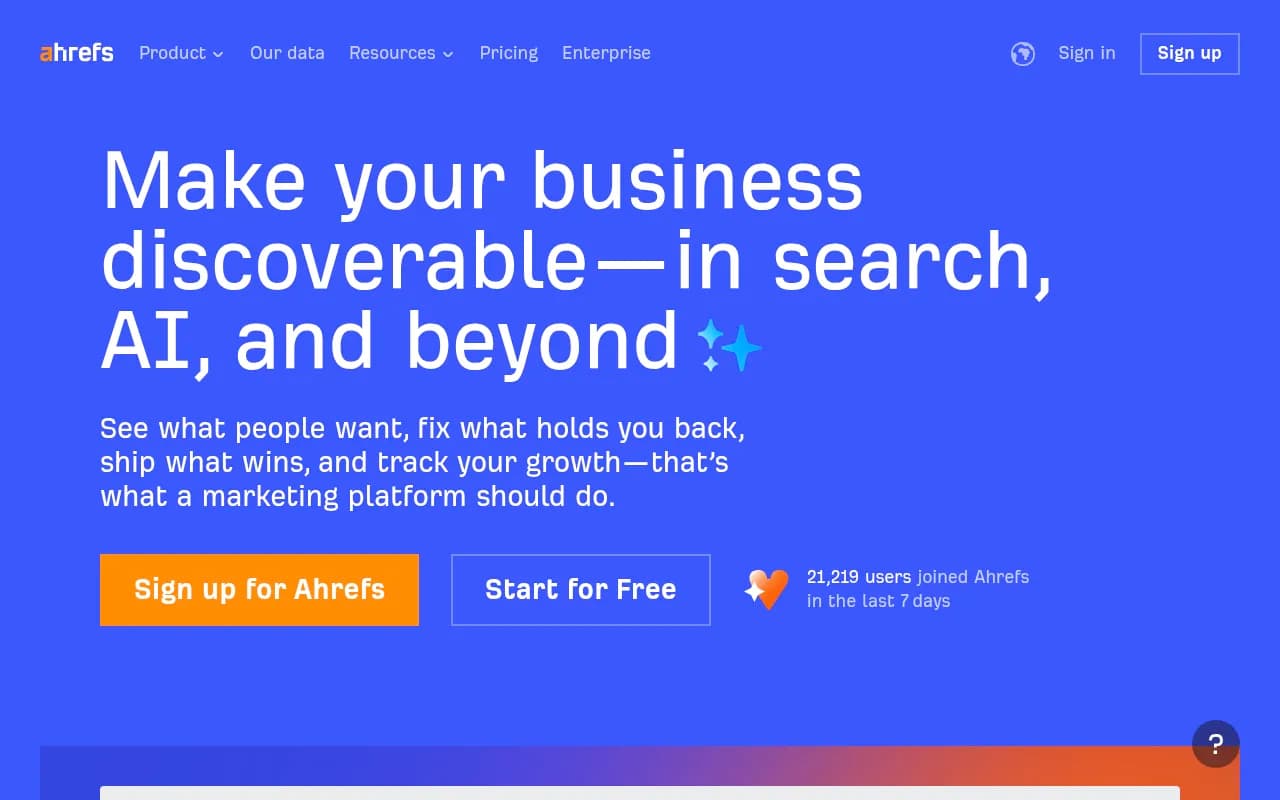
Ahrefs has been the go-to SEO platform for serious marketers for years. It built its reputation on the world's largest backlink index and a keyword database that covers billions of queries. Over time it expanded into site auditing, rank tracking, content analysis, and PPC research. More recently, it added Brand Radar -- its AI search monitoring module -- to track brand mentions across ChatGPT, Gemini, Google AI Overviews, Copilot, and AI Mode.
The honest way to describe Ahrefs in 2026: it's a traditional SEO powerhouse that has bolted on AI search tracking. The core product is excellent. The AI monitoring layer is functional but not deep -- fixed prompts, no traffic attribution, no content gap analysis tied to AI citations.
Bear AI
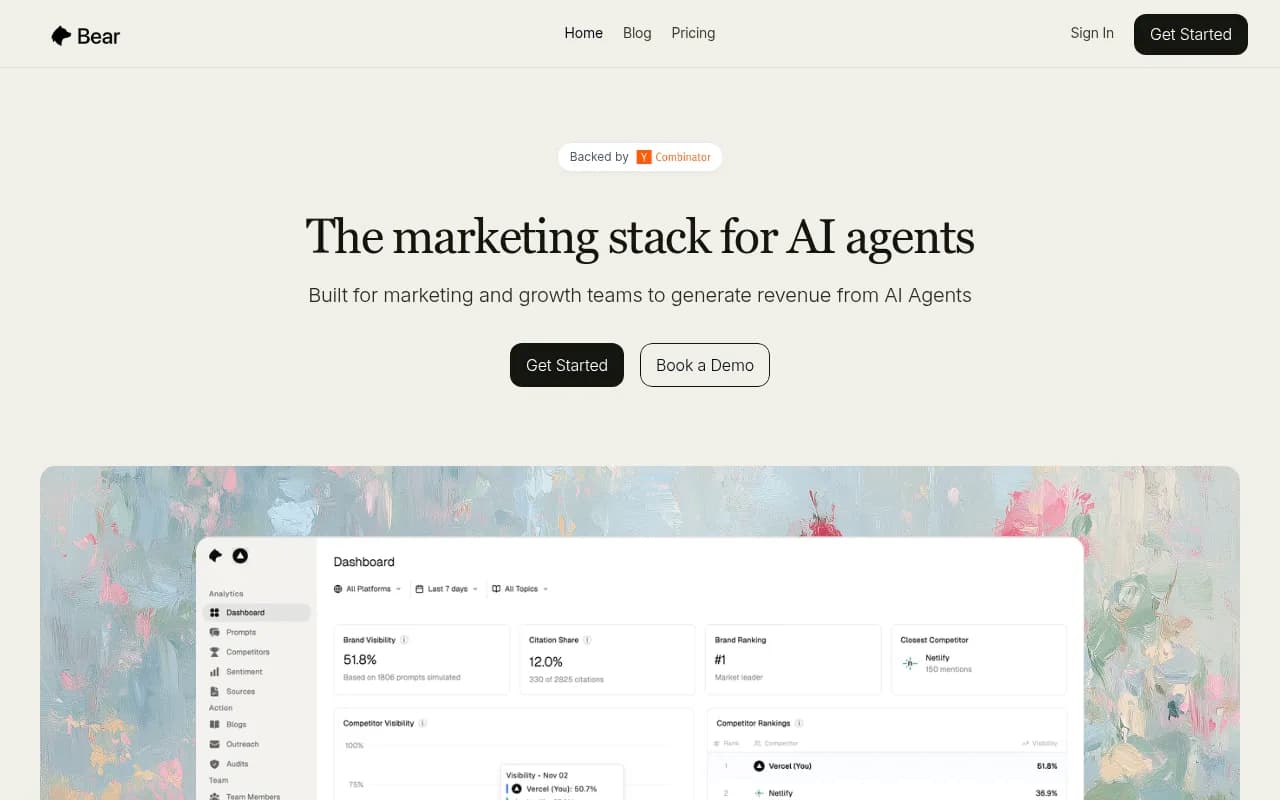
Bear AI is a Y Combinator-backed startup that takes a different angle entirely. Rather than starting from SEO and adding AI, it starts from the question: "How do we turn AI agent traffic into revenue?" The platform tracks how AI models discover and recommend your brand, identifies visitors who arrive from AI sources, and gives you tools to convert them into leads.
It's a narrower product than Ahrefs by design. Bear AI doesn't do backlinks, keyword research, or traditional rank tracking. What it does -- AI traffic attribution and lead generation from AI channels -- it does in a focused way that Ahrefs simply doesn't attempt.
Side-by-side comparison
| Feature | Ahrefs | Bear AI |
|---|---|---|
| Starting price | $83/mo (Lite) | $199/mo (Basic) |
| Free tier | Free Webmaster Tools (limited) | No |
| Traditional SEO tools | Full suite (backlinks, keywords, audits, rank tracking) | None |
| AI search monitoring | Yes (Brand Radar) | Yes (core feature) |
| AI models covered | ChatGPT, Gemini, Copilot, Google AI Overviews, AI Mode | ChatGPT, Claude, Gemini, Perplexity (2 on Basic, 6+ on Enterprise) |
| Custom prompts | No (fixed prompts) | Yes |
| AI traffic attribution | No | Yes |
| Lead generation from AI traffic | No | Yes |
| Content generation | Yes (AI writing tools) | Limited (2 blogs/mo on Basic) |
| Backlink analysis | Yes (largest index) | No |
| Keyword research | Yes | No |
| Site audit | Yes | No |
| PPC / paid search research | Yes | No |
| Social media management | Yes | No |
| Competitor analysis | Yes (full) | Partial (AI visibility only) |
| API access | Yes (Enterprise) | Yes (Enterprise) |
| Target audience | SEO teams, agencies, marketers | Growth teams, marketing teams focused on AI channel |
Head-to-head feature deep-dive
AI search monitoring
This is where the comparison gets interesting, because both tools claim to do it but approach it very differently.
Ahrefs Brand Radar monitors your brand's appearance in AI-generated responses across Google AI Overviews, AI Mode, ChatGPT, Copilot, and Gemini. The data is solid and the coverage is broad. The limitation is that Ahrefs uses fixed, pre-defined prompts -- you can't track the specific queries that matter to your business. You also get no insight into what's driving the citations or what content changes would improve your visibility.
Bear AI lets you define custom prompts, which is a meaningful advantage for teams that know exactly what their customers are asking AI models. You can monitor "best project management tool for remote teams" instead of a generic category query. The platform also surfaces trending prompts -- queries where AI models are actively recommending brands in your space -- which helps you discover opportunities you didn't know to look for.
Verdict: Bear AI wins on prompt flexibility and discovery. Ahrefs wins on breadth of AI model coverage and integration with the rest of your SEO workflow.
AI traffic attribution and lead generation
Bear AI's real differentiator is what happens after the AI model mentions your brand. It tracks visitors who arrive from AI sources, identifies high-intent signals, and provides tools to capture those visitors as leads. This is a conversion layer that no traditional SEO tool has built.
Ahrefs has no equivalent. It can tell you that your brand appeared in a ChatGPT response, but it can't tell you whether anyone clicked through, who they were, or whether they converted.
For growth teams that are starting to see meaningful traffic from AI referrals, this matters a lot. The question isn't just "are we visible?" -- it's "is that visibility generating pipeline?"
Verdict: Bear AI wins clearly. Ahrefs doesn't compete here.
Traditional SEO capabilities
Ahrefs is one of the two or three best SEO platforms in the world. Its backlink index is the largest available. Its keyword database covers billions of queries across dozens of countries. Site Audit catches technical issues that other crawlers miss. Rank Tracker handles large-scale monitoring with precision.
Bear AI has none of this. It's not trying to. If you need to understand why a competitor outranks you in Google, analyze your link profile, or find keyword gaps in your content strategy, Bear AI is the wrong tool.
Verdict: Ahrefs wins by a wide margin. This isn't a close call.
Content tools
Ahrefs has built out a content workflow that includes AI writing assistance, content gap analysis (for traditional search), and a content explorer that surfaces high-performing content in any niche. The AI writing tools are competent but not the main reason anyone buys Ahrefs.
Bear AI includes blog generation -- 2 articles per month on the Basic plan -- but it's a minor feature, not a core capability. The content it generates is presumably oriented toward AI citation optimization, but the volume is low.
Verdict: Ahrefs wins on content tooling depth. Bear AI's blog generation is more of a checkbox than a workflow.
Pricing and value
This depends entirely on what you need. Ahrefs at $83/mo gives you a full SEO platform with AI monitoring included. Bear AI at $199/mo gives you AI visibility tracking and lead generation, with nothing else.
If you're already paying for an SEO tool and want to add AI traffic conversion on top, Bear AI's $199/mo is a reasonable additional spend. If you're choosing between the two as your only marketing tool, Ahrefs delivers far more for less money -- unless your entire focus is the AI channel.
| Plan | Ahrefs | Bear AI |
|---|---|---|
| Entry/Starter | $29/mo (very limited) | -- |
| Basic/Lite | $83/mo | $199/mo |
| Standard/Mid | $166/mo | -- |
| Advanced/Pro | $333/mo | -- |
| Enterprise | Custom | Custom (unlimited prompts, 6+ models, lead gen) |
| Free tier | Free Webmaster Tools | No |
| Annual discount | 20% | Not specified |
Ease of use and onboarding
Ahrefs has a learning curve. There's a lot of product here, and getting value from all of it takes time. That said, the interface is well-designed and the documentation is excellent. Most users find their footing within a week or two.
Bear AI is a simpler product by design. Fewer features means less to learn. The dashboard is focused on AI visibility and traffic metrics, which makes it easier to get oriented quickly. For a team that just wants to understand their AI channel, that simplicity is a genuine advantage.
Verdict: Bear AI is easier to get started with. Ahrefs has more depth but takes longer to master.
Integrations and ecosystem
Ahrefs integrates with Google Search Console, Google Analytics, and various reporting tools. It has an API on Enterprise plans. The ecosystem around Ahrefs is mature -- there are agencies, consultants, and workflows built around it.
Bear AI is newer and has a smaller integration footprint. Enterprise plans include API access. The ecosystem is still developing.
Verdict: Ahrefs wins on integrations and ecosystem maturity.
Pricing comparison
| Plan | Ahrefs price | Bear AI price |
|---|---|---|
| Starter / entry | $29/mo (very limited) | N/A |
| Lite / Basic | $83/mo | $199/mo |
| Standard | $166/mo | N/A |
| Advanced | $333/mo | N/A |
| Enterprise | Custom | Custom |
| Prompts included | Fixed (not disclosed) | 75 (Basic), unlimited (Enterprise) |
| Sites included | 5 (Lite), 20 (Standard) | Not specified |
| Content generation | AI writing tools included | 2 blogs/mo (Basic) |
Pros and cons
Ahrefs
Pros:
- Best-in-class backlink analysis and keyword research
- Full SEO platform -- one tool covers most of your search marketing needs
- AI search monitoring included across major models
- Significantly cheaper entry price than Bear AI
- Mature product with strong documentation and community
- Content tools, PPC research, and social media management included
Cons:
- Brand Radar uses fixed prompts -- no custom query tracking
- No AI traffic attribution or lead generation
- AI monitoring is an add-on to the core product, not a deep capability
- No insight into what's driving AI citations or how to improve them
- Can feel overwhelming for teams that only need AI channel monitoring
Bear AI
Pros:
- Purpose-built for AI traffic and lead generation
- Custom prompt tracking -- monitor the queries that actually matter to your business
- Identifies high-intent visitors from AI sources
- Lead capture and conversion tools for AI traffic
- Simpler, more focused interface
- Y Combinator backing suggests active development
Cons:
- No traditional SEO capabilities whatsoever
- Expensive entry point ($199/mo) for what is still a narrow feature set
- Only 2 AI models on the Basic plan
- Small customer base and ecosystem compared to Ahrefs
- Limited content generation (2 blogs/mo on Basic)
- Newer product with less proven track record
Who should pick which tool
Pick Ahrefs if:
- You need a full SEO platform and want AI monitoring included
- You're an agency or consultant managing multiple clients
- Traditional search (Google, Bing) is still your primary channel
- You want backlink analysis, keyword research, and site auditing
- Budget is a consideration and you want maximum coverage per dollar
Pick Bear AI if:
- AI agent traffic is already a meaningful part of your acquisition mix
- You want to track specific custom prompts relevant to your business
- Lead generation from AI sources is a priority
- You already have an SEO tool and want to add an AI-specific layer
- Your team is focused exclusively on the AI search channel
Worth noting: if you're serious about optimizing for AI search -- not just monitoring it -- tools like Promptwatch go further than either option here, with content gap analysis, AI-optimized content generation, and crawler log monitoring that shows exactly how AI models are reading your site.

Final verdict
These tools aren't really competing for the same job. Ahrefs is a full SEO platform with AI monitoring bolted on. Bear AI is an AI traffic and lead generation tool with no SEO capabilities. The question isn't which is better -- it's which one matches what you actually need.
If you're building a search marketing stack from scratch in 2026, Ahrefs is the more complete investment. If you already have SEO covered and want to specifically monetize your AI channel, Bear AI's lead generation angle is genuinely differentiated. Most serious teams will end up using both -- or adding a dedicated GEO platform on top of either one.