Key takeaways
- Ahrefs is a full-stack SEO platform that added AI search monitoring as a feature. Gauge was built from day one specifically for AI visibility and GEO. That difference shapes everything.
- Ahrefs Brand Radar uses fixed prompts and has no AI traffic attribution -- two real limitations if AI visibility is your main concern. Gauge goes deeper on both citation analysis and actionable recommendations.
- Gauge does not do traditional SEO. No backlink analysis, no keyword research, no site audits. If you need those, Ahrefs is the only option here.
- Pricing is closer than you'd expect at entry level: Ahrefs Lite at $83/mo vs Gauge at $95/mo (annual). But Ahrefs gives you a lot more tools for that price -- just not AI-specific ones.
- Teams already paying for Ahrefs can use Brand Radar as a starting point, but serious AI visibility work will push you toward a dedicated platform.
- These tools are more complementary than competitive -- the real question is whether you need AI visibility tracking at all, and how seriously.
Overview
Ahrefs
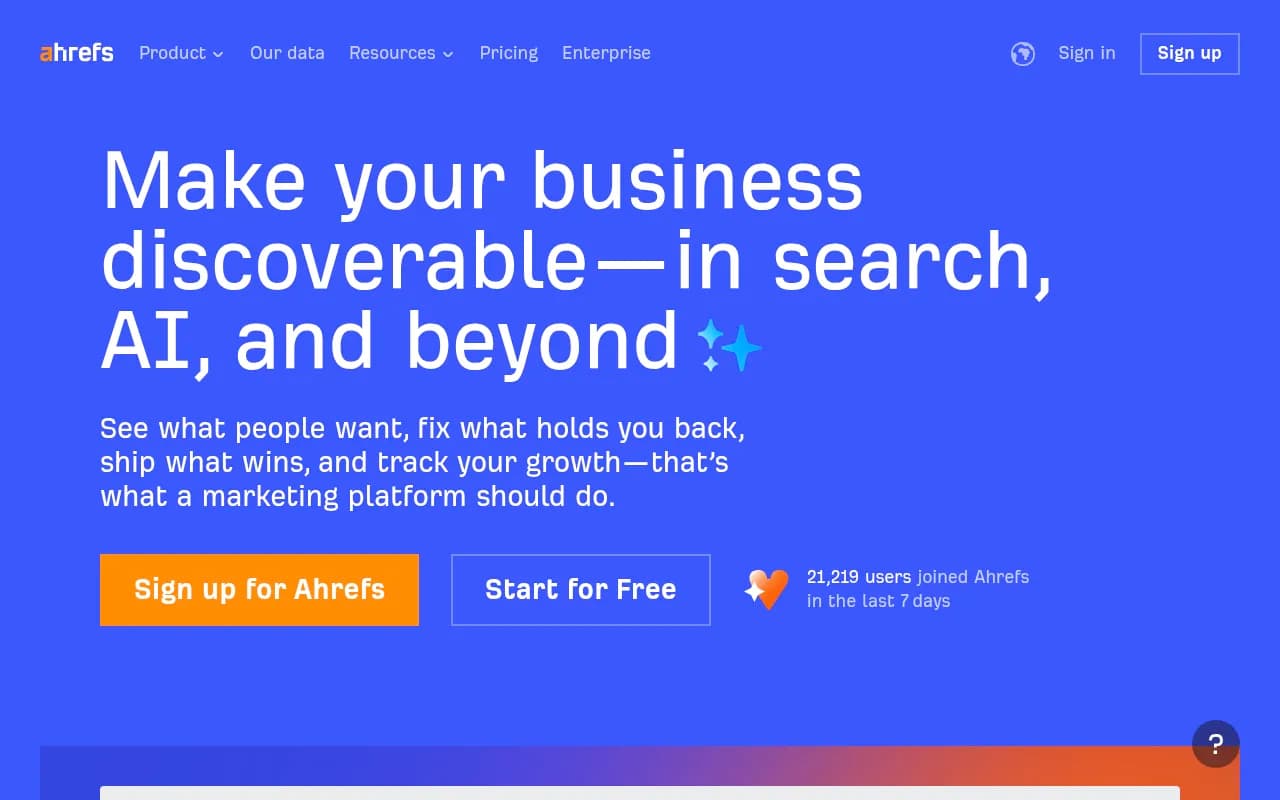
Ahrefs has been the go-to SEO toolkit for serious marketers since around 2011, and it's earned that reputation. The backlink index is genuinely the largest available, the keyword database covers billions of queries, and the site audit tool is one of the most thorough on the market. In 2024-2025, Ahrefs started expanding into AI search territory with Brand Radar -- a feature that monitors how your brand appears in AI-generated responses. More recently, the platform has been positioning itself as a broader "AI marketing platform," adding content tools, social media management, and PPC research alongside its core SEO capabilities. It's used by 44% of Fortune 500 companies, which tells you something about its enterprise credibility.
The honest framing: Ahrefs is an SEO company that is adapting to the AI search world. Brand Radar is a real feature, not vaporware, but it's not the heart of the product.
Gauge
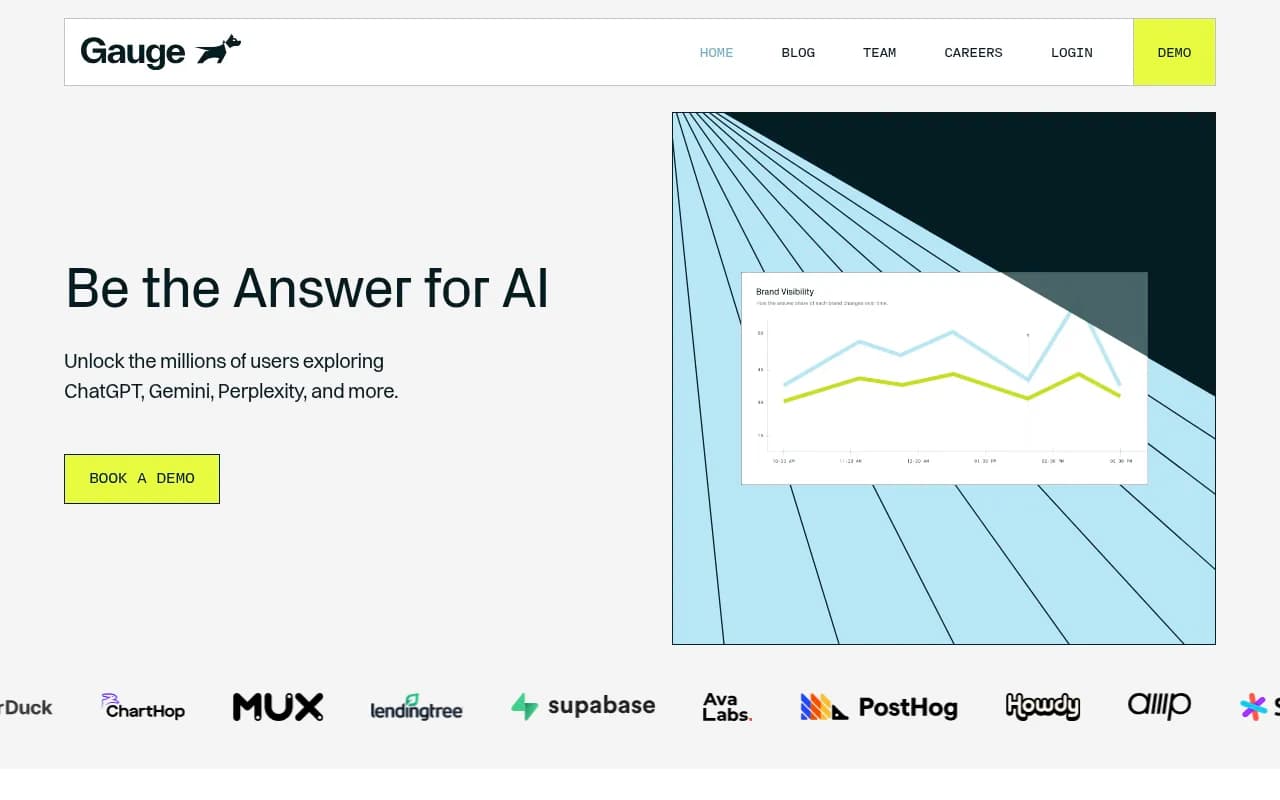
Gauge is a newer entrant, purpose-built for the question: "How does my brand appear when someone asks ChatGPT or Perplexity about my category?" It monitors AI-generated answers across ChatGPT, Claude, Gemini, Perplexity, Copilot, Google AI Mode, and AI Overviews, tracking brand mentions, citation patterns, and competitive visibility. The platform also surfaces content gaps -- places where competitors are getting cited but you aren't -- and provides recommendations for both on-site and off-site improvements.
Gauge is a specialist. It doesn't try to be Ahrefs. That focus means it goes deeper on AI visibility than Ahrefs does, but it won't help you with a technical SEO audit or a backlink gap analysis.
Side-by-side comparison
| Feature | Ahrefs | Gauge |
|---|---|---|
| Primary focus | Full-stack SEO + AI monitoring | AI visibility / GEO only |
| AI models monitored | ChatGPT, Perplexity, Google AI Overviews (Brand Radar) | ChatGPT, Claude, Gemini, Perplexity, Copilot, AI Mode, AI Overviews |
| Backlink analysis | Yes (largest index available) | No |
| Keyword research | Yes (billions of keywords) | No |
| Site audit | Yes | No |
| Rank tracking (traditional) | Yes | No |
| AI brand mention tracking | Yes (Brand Radar) | Yes (core feature) |
| Citation analysis | Limited | Yes |
| Content gap analysis (AI) | No | Yes |
| AI traffic attribution | No | Partial |
| Custom prompts | Limited (fixed prompts in Brand Radar) | Yes |
| On-site/off-site recommendations | No | Yes |
| Reddit/social source tracking | No | Yes (mentioned as feature) |
| Content creation tools | Yes (AI writing assistant) | No |
| PPC research | Yes | No |
| Social media management | Yes | No |
| API access | Yes (Enterprise) | Yes |
| Free trial | Yes | Yes |
| Starting price | $29/mo (Starter, very limited) | $95/mo (annual) |
Head-to-head feature deep-dive
AI search monitoring
This is where the comparison gets interesting, because it's the only area where both tools overlap.
Ahrefs Brand Radar tracks brand mentions in AI-generated responses and shows you where competitors appear. The limitation that comes up consistently: it uses fixed prompts rather than letting you define the specific queries your customers are actually asking. There's also no AI traffic attribution -- you can see that your brand appeared in an AI response, but you can't connect that to actual website visits or revenue. For a platform that charges $83-333/mo, that's a meaningful gap.
Gauge was designed around this exact problem. You can define custom prompts that match real customer queries in your category. Citation analysis shows which specific pages and sources AI models are pulling from. The platform surfaces content gaps -- prompts where competitors are visible but you aren't -- and gives you recommendations on what to create or optimize to close those gaps. The "Track, Understand, Act" framework isn't just marketing copy; it reflects a more complete workflow than Ahrefs offers on the AI side.
Verdict: Gauge wins on AI monitoring depth. Ahrefs Brand Radar is a useful starting point but hits real limits for serious AI visibility work.
Traditional SEO capabilities
This isn't really a competition. Ahrefs has spent 15 years building one of the most comprehensive SEO toolsets available. The backlink index is the largest in the industry. The keyword explorer covers billions of queries with accurate volume estimates and difficulty scores. Site Audit catches technical issues that other tools miss. Rank tracker handles large-scale monitoring across geographies.
Gauge has none of this. It's not trying to. If you need traditional SEO tools, Gauge is not an option.
Verdict: Ahrefs wins by default. Gauge doesn't compete here.
Content tools
Ahrefs has been building out content capabilities -- there's an AI writing assistant, content gap analysis for traditional search, and workflows for planning and creating SEO content. These are genuinely useful, though they're not as specialized as dedicated content tools.
Gauge mentions content recommendations as part of its workflow -- specifically, identifying what content to create to improve AI visibility. But it doesn't appear to have a built-in content generation tool in the same way Ahrefs does.
Worth noting: if you're specifically trying to create content that gets cited by AI models (not just ranked in Google), tools like Promptwatch take this further with an AI writing agent trained on citation data from 880M+ analyzed citations -- engineered specifically for AI search visibility rather than traditional SEO.

Verdict: Ahrefs has more content tooling. Gauge focuses on recommendations rather than generation. Neither is the deepest option for AI-optimized content creation.
Competitive intelligence
Ahrefs is excellent for competitive SEO analysis -- you can see any competitor's backlink profile, top-ranking pages, keyword gaps, and traffic estimates. It's one of the most-used features on the platform.
Gauge approaches competitive intelligence from the AI angle: which competitors are being cited in AI responses for your target prompts, how often, and what content is driving those citations. That's a genuinely different data set from what Ahrefs provides, and increasingly important as AI search captures more of the discovery journey.
Verdict: Depends entirely on what you're competing for. Traditional search? Ahrefs. AI search? Gauge.
Ease of use and learning curve
Ahrefs has improved its UX significantly over the years, but it's still a complex platform with a lot of features. New users typically spend weeks getting comfortable with all the tools. The depth is the point, but it does mean onboarding takes time.
Gauge is more focused, which makes it easier to get started. You set up your brand, define your prompts, and start seeing data. The narrower scope means less to learn.
Verdict: Gauge is faster to get value from. Ahrefs takes longer but rewards the investment for teams doing comprehensive SEO work.
Integrations and reporting
Ahrefs integrates with Google Search Console, has an API (Enterprise tier), and exports data in various formats. Reporting is solid for SEO workflows.
Gauge has API access and agency-oriented reporting features. The platform is newer, so the integration ecosystem is less mature than Ahrefs.
Verdict: Ahrefs has a more mature integration story, particularly for teams already in the Google ecosystem.
Pricing comparison
| Plan | Ahrefs | Gauge |
|---|---|---|
| Entry / Starter | $29/mo (very limited -- no full tool access) | -- |
| Lite / Starter | $83/mo (annual) | $95/mo (annual) |
| Standard / Growth | $166/mo (annual) | $399/mo (annual) |
| Advanced / Pro | $333/mo (annual) | -- |
| Enterprise | Custom | Custom |
| Free trial | Yes | Yes |
| Annual discount | ~20% | Yes (prices above are annual) |
A few things worth noting on pricing:
The Ahrefs $29 Starter plan is genuinely limited -- it's more of a taste than a real subscription. The $83 Lite plan is where you get actual utility.
Gauge's Growth plan at $399/mo is a significant jump from the entry tier. For smaller teams, the entry plan at $95/mo may cover basic monitoring needs, but agencies or brands tracking multiple competitors across many prompts will likely need Growth.
For teams that only need AI visibility monitoring (not traditional SEO), Gauge's pricing is reasonable for what it delivers. For teams that need both, Ahrefs at $166-333/mo covers more ground even if the AI features are shallower.
Pros and cons
Ahrefs
Pros:
- Best-in-class backlink analysis and keyword research
- Comprehensive platform -- one tool for most SEO needs
- Strong track record and enterprise credibility
- AI writing assistant and content tools included
- PPC and social media management on top of SEO
- Large user community and extensive documentation
Cons:
- Brand Radar uses fixed prompts -- limited customization for AI monitoring
- No AI traffic attribution (can't connect AI visibility to actual visits/revenue)
- AI monitoring is a secondary feature, not the core product
- Expensive at higher tiers for what you get on the AI side
- Complex platform with a real learning curve
- Starter plan is misleadingly limited
Gauge
Pros:
- Purpose-built for AI visibility -- goes deeper where it counts
- Custom prompt tracking (not fixed prompts)
- Citation analysis shows exactly what content AI models are pulling from
- Content gap analysis specific to AI search
- On-site and off-site recommendations
- Faster to set up and get initial insights
- Monitors more AI models (Claude, Copilot, AI Mode included)
Cons:
- No traditional SEO tools whatsoever
- Newer platform -- less proven at scale
- Smaller user community and fewer third-party resources
- Integration ecosystem is less mature
- Growth plan pricing ($399/mo) is a significant step up
- Less enterprise credibility than Ahrefs currently
Who should pick which tool
Choose Ahrefs if:
- Traditional SEO is your primary focus and AI monitoring is a nice-to-have
- You need backlink analysis, keyword research, and site audits in one platform
- You're already paying for Ahrefs and want to explore AI visibility without adding another tool
- You need PPC research or social media management alongside SEO
- You're at an enterprise level and need the credibility and integrations Ahrefs provides
- Budget is a constraint and you need one tool to cover multiple marketing channels
Choose Gauge if:
- AI search visibility is a primary business priority, not an afterthought
- You need custom prompt tracking rather than fixed prompts
- You want to understand specifically which content is driving competitor citations in AI
- You're a marketing team or agency focused on GEO/AEO as a distinct discipline
- You already have an SEO tool and need AI visibility on top of it
- You want actionable recommendations, not just monitoring data
Consider both if:
- You're a larger team or agency where different people own traditional SEO vs AI visibility
- Your clients or stakeholders are asking serious questions about AI search performance
- You have budget for a dedicated AI visibility tool alongside your existing SEO stack
Final verdict
These tools solve different problems. Ahrefs is the right choice if you need a comprehensive SEO platform and want basic AI monitoring included. Gauge is the right choice if AI search visibility is a genuine priority and you need a tool that was actually designed for it.
The honest answer for most teams in 2026: if you're already using Ahrefs, start with Brand Radar to get a baseline. If you find yourself frustrated by fixed prompts, missing citation data, or the inability to connect AI visibility to traffic, that's your signal to add a dedicated AI visibility tool. Gauge is a reasonable candidate for that role -- it goes deeper on the AI side than Ahrefs does, and it's priced accessibly enough that running both isn't unreasonable for teams where AI search is becoming a real channel.
What you shouldn't do is assume Ahrefs Brand Radar is "good enough" just because you're already paying for it. The gap between a monitoring-only feature and a purpose-built AI visibility platform is real, and it's growing as AI search captures more of how people discover products and brands.