Key takeaways
- Geostar is not a live product. Its website says "Launching Soon" with no public pricing, no confirmed features, and only a contact form. This comparison is necessarily lopsided.
- Ahrefs is a mature, full-featured SEO platform used by 44% of Fortune 500 companies, with AI search monitoring bolted on via Brand Radar.
- Ahrefs' Brand Radar uses fixed prompts and has no AI traffic attribution -- so its GEO capabilities are real but limited compared to dedicated platforms.
- If you need traditional SEO (backlinks, rank tracking, site audits) plus basic AI monitoring, Ahrefs is a solid all-in-one choice right now.
- If you specifically want deep GEO capabilities -- content gap analysis, AI crawler logs, content generation for AI search -- neither Ahrefs nor Geostar fully delivers that today.
- Choosing Geostar over Ahrefs at this point isn't really a choice you can make. There's no product to sign up for.
Overview
Ahrefs

Ahrefs has been a staple of SEO teams for over a decade. It started as a backlink analysis tool and grew into one of the most comprehensive SEO platforms on the market, covering keyword research, site audits, rank tracking, content explorer, and competitive intelligence. More recently, Ahrefs has been pushing into AI search territory with Brand Radar, which tracks how brands appear in AI-generated responses. It also added social media management and PPC research tools, making a genuine play to be an all-in-one marketing platform rather than just an SEO tool.
The user base is enormous -- Adobe, eBay, IBM, Shopify, Uber, and LinkedIn are all listed as customers. That kind of adoption means the product is battle-tested, well-documented, and actively developed.
Geostar
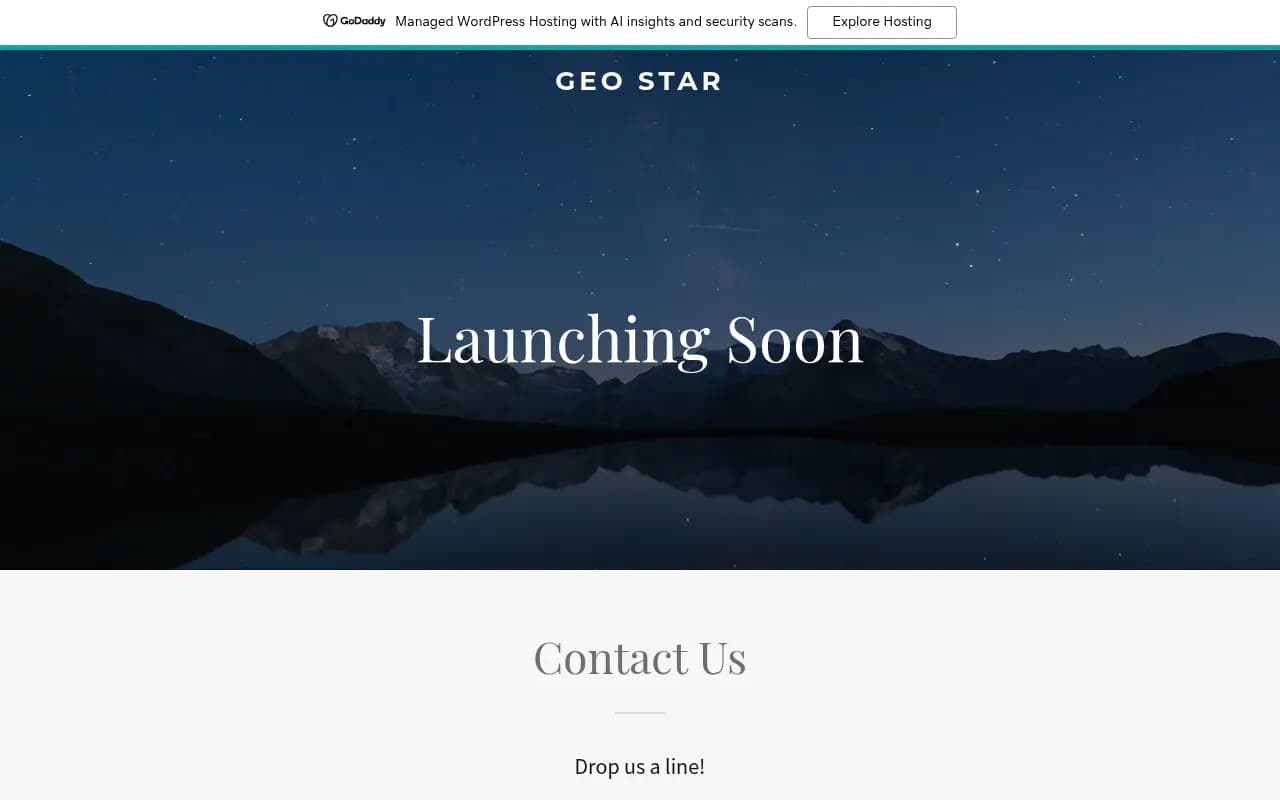
Geostar describes itself as a GEO (Generative Engine Optimization) platform for AI search visibility. The pitch is monitoring brand visibility across AI models and helping teams find content opportunities to improve LLM citation rates. That sounds useful. The problem: as of March 2026, geostar.io shows a "Launching Soon" page. There's a contact form, a logo, and a GoDaddy parking ad. No live product, no pricing page, no feature documentation, no screenshots.
This makes a head-to-head comparison genuinely difficult. We can compare what Ahrefs does against what Geostar claims to be building -- but that's not the same as comparing two live tools.
Side-by-side comparison
| Feature | Ahrefs | Geostar |
|---|---|---|
| Product status | Live, fully operational | Pre-launch ("Launching Soon") |
| Pricing | From $29/mo (Starter), $83/mo (Lite) | Not publicly confirmed |
| Free tier | Free Webmaster Tools (limited) | Unknown |
| Traditional SEO tools | Yes -- full suite | Unknown / not confirmed |
| AI search monitoring | Yes -- Brand Radar | Claimed but not live |
| Number of AI models tracked | Not publicly specified | Not publicly specified |
| Content gap analysis | Limited | Claimed |
| AI content generation | Basic AI writing tools | Unknown |
| AI crawler logs | No | Unknown |
| Backlink analysis | Yes -- industry-leading | Not confirmed |
| Rank tracking | Yes | Unknown |
| Site audit | Yes | Unknown |
| API access | Yes (higher plans) | Unknown |
| Integrations | Google Search Console, Looker Studio, more | Unknown |
| Customer base | 44% of Fortune 500 | Not disclosed |
| Support | Docs, chat, email | Contact form only |
Head-to-head feature deep-dive
Product availability
This is the most important thing to say upfront: Geostar does not exist as a usable product right now. The website is a pre-launch placeholder. There's no trial, no demo, no pricing, and no way to evaluate features firsthand.
Ahrefs, on the other hand, has been live for years. You can sign up today, run a site audit, pull backlink data, and start tracking keywords within minutes. The gap here isn't about features -- it's about whether there's a product at all.
Verdict: Ahrefs wins by default. There's nothing to compare against on Geostar's side.
AI search monitoring (GEO)
Ahrefs added Brand Radar to address the growing need for AI search visibility tracking. It monitors how your brand appears in AI-generated responses across major models. The limitation is that Brand Radar uses fixed prompts -- you can't customize the queries it tracks, and there's no AI traffic attribution to connect AI visibility to actual site traffic. It's a monitoring layer, not an optimization workflow.
Geostar's stated purpose is exactly this space: monitoring brand visibility in AI models and surfacing content opportunities. If the product launches and delivers on that promise, it could be a focused alternative. But "if" is doing a lot of work in that sentence.
Worth noting: if AI search visibility is your primary concern, dedicated platforms like Promptwatch go considerably further than either tool here -- with customizable prompts, content gap analysis, AI crawler logs, and built-in content generation to actually act on what you find.

Verdict: Ahrefs has a live (if limited) AI monitoring feature. Geostar has a concept.
Traditional SEO capabilities
Ahrefs is one of the two or three best traditional SEO platforms available. Its backlink index is the largest in the industry. Keyword Explorer covers billions of keywords across 170+ countries. Site Audit catches technical issues with depth that rivals enterprise tools. Rank Tracker handles large-scale position monitoring. Content Explorer surfaces high-performing content ideas based on real traffic data.
Geostar has not confirmed any traditional SEO features. Its positioning is purely GEO-focused, which suggests it won't compete here at all -- but without a live product, that's speculation.
Verdict: Ahrefs, clearly. This isn't a close call.
Content tools
Ahrefs has been building out content workflows -- there's a Content Grader, AI writing assistance, and integration with its keyword and competitor data to inform content strategy. It's not a dedicated content platform, but it's genuinely useful for SEO-driven content planning.
Geostar's description mentions "identifying content opportunities to improve LLM citation rates," which implies some kind of content gap or recommendation feature. That's a compelling idea. But again, no live product means no way to evaluate it.
Verdict: Ahrefs has real, usable content tools today.
Pricing and value
| Plan | Ahrefs | Geostar |
|---|---|---|
| Free / entry | Free Webmaster Tools | Unknown |
| Starter | $29/mo (very limited) | -- |
| Lite / Basic | $83/mo | -- |
| Standard | $166/mo | -- |
| Advanced | $333/mo | -- |
| Enterprise | Custom | Unknown |
Ahrefs is not cheap. The Lite plan at $83/mo is the minimum for anything resembling real usage, and teams doing serious SEO work typically end up on Standard or above. The Starter plan at $29/mo is genuinely limited -- it's more of a taste than a working plan.
Geostar has no public pricing. The "Lite, Enterprise, and Full-Service tiers" mentioned in descriptions haven't been confirmed on the live site.
Verdict: Ahrefs is expensive but transparent. Geostar has no pricing to evaluate.
Integrations and ecosystem
Ahrefs integrates with Google Search Console, supports Looker Studio for reporting, has an API on higher plans, and connects with various workflow tools. It's a mature ecosystem.
Geostar: unknown.
Verdict: Ahrefs.
Pros and cons
Ahrefs
Pros:
- One of the best backlink and keyword databases available
- Solid traditional SEO suite covering audits, rank tracking, and competitive research
- Brand Radar adds basic AI search monitoring
- Well-documented, large user community, reliable uptime
- Actively developed -- new features ship regularly
- Used by major enterprises, so it scales
Cons:
- Brand Radar uses fixed prompts -- you can't customize AI monitoring queries
- No AI traffic attribution (can't connect AI visibility to actual revenue)
- No AI crawler logs to see how AI bots interact with your site
- Pricing gets expensive fast for teams needing multiple seats or sites
- The Starter plan is too limited to be genuinely useful
- AI search features feel like an add-on rather than a core capability
Geostar
Pros:
- Focused positioning on GEO and AI search visibility (if it launches)
- Potential to be a lightweight, purpose-built alternative to heavier platforms
Cons:
- Not a live product as of March 2026
- No confirmed pricing, features, or launch date
- No track record, no customer reviews, no case studies
- Impossible to evaluate or recommend for actual use
- High uncertainty -- pre-launch tools frequently pivot or disappear
Who should pick which tool
Pick Ahrefs if:
- You need a traditional SEO platform with strong backlink analysis, keyword research, and site audits
- You want basic AI search monitoring alongside your existing SEO workflow
- You're working at a mid-size to enterprise company that needs a proven, scalable tool
- You want something you can actually use today
Pick Geostar if:
- You're willing to wait for a product that hasn't launched yet
- You want a GEO-focused tool and are comfortable with significant uncertainty about features and pricing
Honestly, there's no scenario right now where choosing Geostar over Ahrefs makes practical sense. If Geostar launches and delivers on its GEO positioning, that calculus might change -- but "might, eventually" isn't a purchasing decision.
If your primary need is deep AI search visibility -- not just monitoring, but actually improving how AI models cite your content -- the more honest recommendation is to look at dedicated GEO platforms that are live and proven. Ahrefs covers the basics, but it wasn't built for this.
Final verdict
Ahrefs is the obvious choice here, not because it's perfect for GEO, but because it's an actual product you can use today. Geostar is a pre-launch placeholder with no confirmed features, no pricing, and no launch date -- comparing it to Ahrefs is like comparing a restaurant to a sign that says "restaurant opening soon."
If you need traditional SEO with some AI monitoring on the side, Ahrefs delivers that well. If you need a serious GEO platform built around the full optimization loop -- finding gaps, generating content, tracking results -- neither of these tools is the right answer right now.