Key takeaways
- Ahrefs has the larger backlink index and keyword database -- if raw data depth is your priority, it wins.
- Moz Pro is meaningfully cheaper at every tier and is easier to get started with, making it the better fit for smaller teams or solo SEOs.
- Both tools have added AI search monitoring, but it's shallow in both cases: fixed prompts, no content gap analysis, no help acting on what you find.
- Ahrefs is the stronger choice for agencies and power users doing competitive research, technical audits, and link building at scale.
- Moz Pro's On-Page Grader and search intent grouping are genuinely useful for content optimization -- a small edge over Ahrefs in that specific workflow.
- Neither tool is built around helping you rank in AI search engines. If that's a priority, you'll need something purpose-built alongside either of these.
Overview
Ahrefs
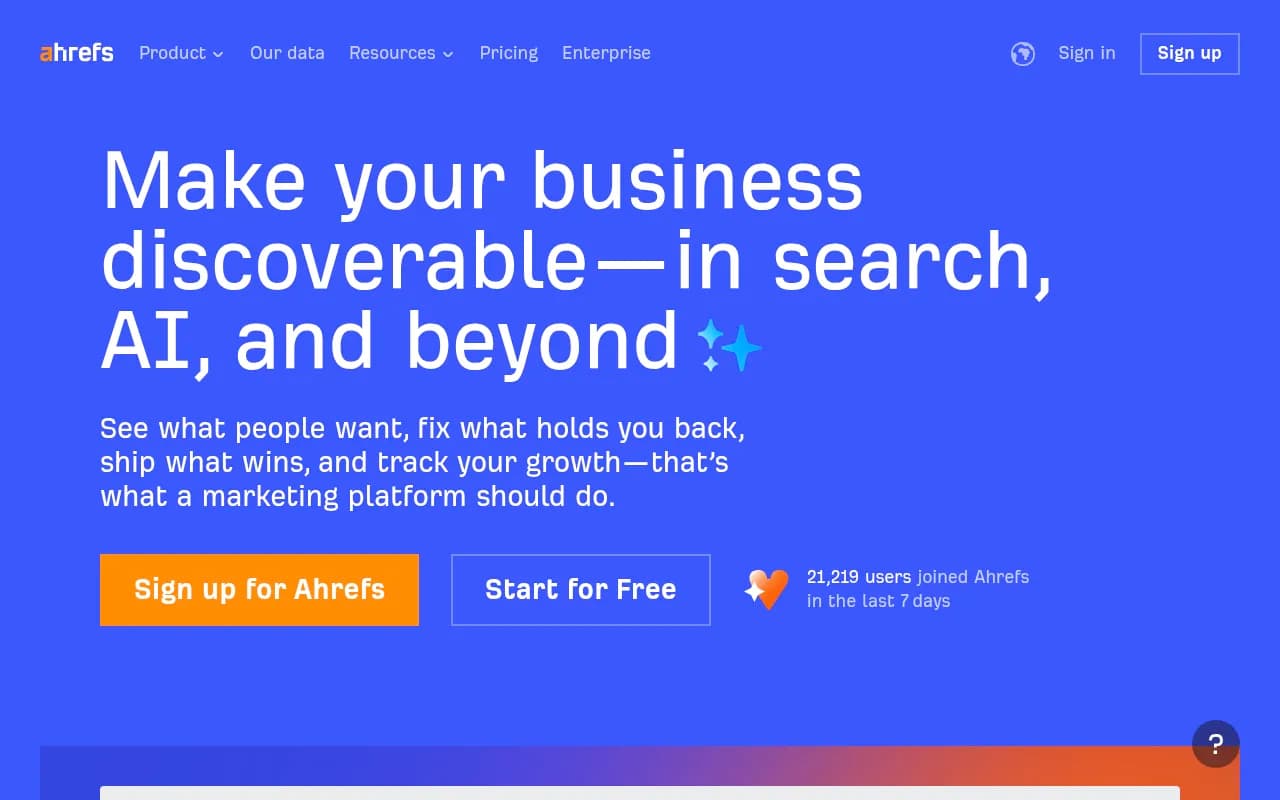
Ahrefs started as a backlink analysis tool and grew into one of the most comprehensive SEO platforms available. It's used by 44% of Fortune 500 companies, and that adoption makes sense -- the data is deep, the crawl frequency is high, and the toolset covers almost everything a serious SEO team needs. Site Explorer, Keywords Explorer, Content Explorer, Site Audit, and Rank Tracker are all mature, well-developed products. More recently, Ahrefs has pushed into AI search monitoring (Brand Radar), content creation workflows, PPC research, and even social media management. It's clearly trying to become a full marketing intelligence platform, not just an SEO tool.
The tradeoff: Ahrefs is expensive, and the interface rewards people who already know what they're doing. New users often feel overwhelmed by the volume of data.
Moz Pro
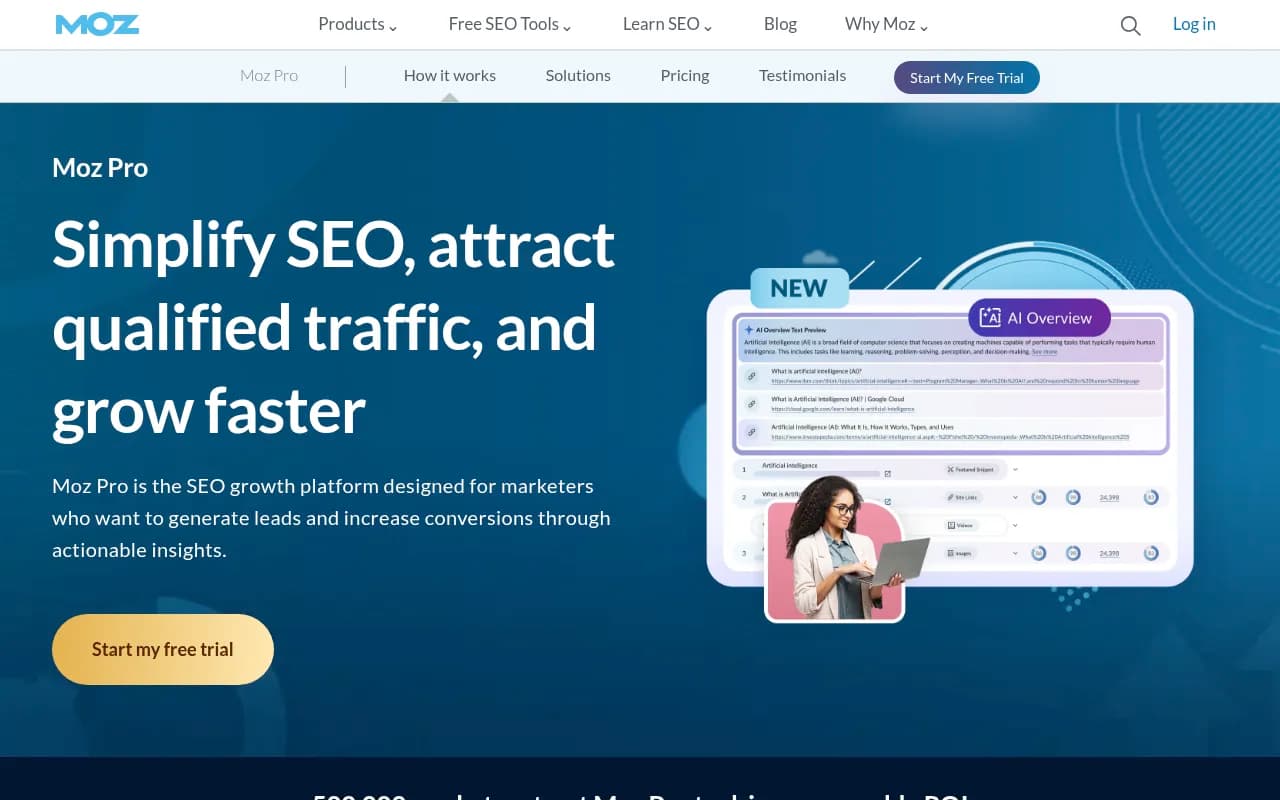
Moz has been around since 2004 and invented several metrics the SEO industry still uses daily -- Domain Authority and Page Authority being the most obvious. Moz Pro is the company's core product: a full SEO toolkit with keyword research, rank tracking, site audits, link analysis, and on-page optimization. It's more approachable than Ahrefs, with cleaner UI and guided recommendations that help less experienced users know what to do next.
Moz has also recently added AI visibility features -- LLM brand presence tracking and mention depth monitoring -- though these are still in beta and relatively limited compared to dedicated GEO platforms.
The tradeoff: Moz's data depth doesn't match Ahrefs, and the platform has historically been slower to ship new features.
Side-by-side comparison
| Feature | Ahrefs | Moz Pro |
|---|---|---|
| Starting price | $83/mo (Lite) | $49/mo (Starter) |
| Free tier | No (limited $29 Starter) | 30-day free trial |
| Backlink index | Largest on the web | Smaller, less frequent updates |
| Keyword database | Very large, global | Large, solid for US/UK |
| Rank tracking | Yes, all plans | Yes, all plans |
| Site audit | Yes | Yes |
| On-page optimization | Basic | On-Page Grader (stronger) |
| AI search monitoring | Brand Radar (fixed prompts) | LLM brand presence (beta) |
| Content gap analysis | Yes (keyword gaps) | Limited |
| PPC research | Yes | No |
| Social media tools | Yes (newer feature) | No |
| API access | Advanced+ plans | Large plan and above |
| Learning curve | Steep | Moderate |
| Best for | Agencies, power users | SMBs, beginners, content teams |
Head-to-head feature deep-dive
Backlink analysis
This is where the gap between the two tools is most obvious.
Ahrefs crawls the web constantly and has built what is widely considered the largest third-party backlink index available. You get detailed link data: anchor text, link type, first seen/last seen dates, traffic estimates for linking pages, and historical charts going back years. The data refreshes frequently, so you're not looking at stale information.
Moz's Link Explorer is functional but consistently shows fewer backlinks than Ahrefs for the same domain. Update frequency is lower, and the historical data isn't as granular. For basic link audits and finding obvious toxic links, it works fine. For serious link prospecting or competitive backlink analysis, Ahrefs is the better tool.
Verdict: Ahrefs wins clearly.
Keyword research
Ahrefs' Keywords Explorer covers over 100 countries, shows keyword difficulty, click-through rate estimates, traffic potential, and parent topic grouping. The SERP overview for any keyword is detailed -- you can see exactly what's ranking and why. Content Explorer lets you find top-performing content for any topic, which is genuinely useful for ideation.
Moz's Keyword Explorer is solid. The search intent grouping (powered by Moz AI) is a real differentiator -- it automatically groups keyword suggestions by intent, which saves time when building content plans. Keyword difficulty scores are reliable, and the interface is cleaner. The database is smaller than Ahrefs', though, and SERP analysis is less detailed.
Verdict: Ahrefs wins on data depth; Moz wins on ease of use and intent grouping.
Rank tracking
Both tools track rankings across search engines and locations. Ahrefs supports more granular location tracking (down to city level on higher plans) and handles large keyword sets well. Moz's Rank Tracker is clean and easy to read, with good visualization of ranking trends over time. Neither has a significant edge here for most use cases.
Verdict: Roughly equal. Ahrefs has an edge for enterprise-scale tracking.
Site audit
Ahrefs' Site Audit is thorough -- it checks for technical issues across hundreds of criteria, prioritizes them by severity, and gives you clear explanations of what each issue means. The crawl speed is fast even for large sites.
Moz's site audit is competent but less detailed. It covers the main technical issues and presents them clearly, which is good for teams that don't have a dedicated technical SEO person. But for complex sites with deep technical problems, Ahrefs gives you more to work with.
Verdict: Ahrefs wins for technical depth; Moz is fine for straightforward audits.
On-page optimization
This is one area where Moz has a genuine edge. The On-Page Grader analyzes a specific page against a target keyword and gives you a scored report with specific recommendations: what to add, what to change, how you compare to top-ranking pages. It's actionable in a way that Ahrefs' on-page tools aren't quite.
Ahrefs has content gap analysis and can show you what keywords a page ranks for vs competitors, but it doesn't give you the same page-level optimization workflow.
Verdict: Moz wins for on-page optimization guidance.
AI search monitoring
Both tools have added AI visibility features, but neither is a serious GEO platform.
Ahrefs' Brand Radar shows how your brand appears in AI-generated answers, but it uses fixed prompts -- you can't customize what questions you're tracking. There's no AI traffic attribution, no content gap analysis for AI search, and no help creating content that gets cited by AI models.
Moz Pro's LLM brand presence tracking (currently in beta) monitors how often your brand appears across tracked prompts and measures "mention depth." It's a similar monitoring-only approach.
If AI search visibility is a meaningful priority for your business, both tools will show you data but leave you without a clear path to improving it. Tools purpose-built for GEO -- like Promptwatch -- go further by combining visibility tracking with content gap analysis and AI-optimized content generation.

Verdict: Both are limited. Neither is a real AI search optimization tool.
Pricing and value
| Plan | Ahrefs | Moz Pro |
|---|---|---|
| Entry/Starter | $29/mo (very limited) | $49/mo |
| Lite/Standard | $83/mo | $99/mo |
| Standard/Medium | $166/mo | $179/mo |
| Advanced/Large | $333/mo | $299/mo |
| Enterprise | Custom | Custom |
| Annual discount | 20% | 20% |
| Free trial | No (Starter plan only) | 30 days |
Moz Pro is cheaper at the entry and mid-tier levels. The $49/mo Starter plan is a real product -- not a crippled teaser like Ahrefs' $29 Starter. For small businesses or solo SEOs, Moz Pro gives you more usable functionality per dollar at the lower price points.
At the higher tiers ($166-$333/mo), Ahrefs delivers more data and more features, so the price difference becomes easier to justify for teams that use the platform heavily.
Verdict: Moz Pro wins on value for smaller budgets; Ahrefs wins on value for power users.
Pros and cons
Ahrefs
Pros:
- Best-in-class backlink data -- more links, more frequent updates, better historical coverage
- Largest keyword database with detailed SERP analysis
- Strong competitive research tools (Content Explorer, keyword gap, traffic estimates)
- Covers PPC research and social media management -- genuinely broad platform
- Fast, reliable site audit even on large sites
- Trusted by enterprise teams and agencies worldwide
Cons:
- Expensive, especially for small teams
- Steep learning curve -- new users often feel lost
- AI search monitoring (Brand Radar) uses fixed prompts with no customization
- No AI traffic attribution or content generation for AI search
- $29 Starter plan is too limited to be genuinely useful for most people
Moz Pro
Pros:
- More affordable at every tier, especially for smaller teams
- Cleaner, more approachable interface
- On-Page Grader is one of the best page-level optimization tools available
- Search intent grouping saves real time in keyword research
- Domain Authority and Page Authority are still widely used industry benchmarks
- 30-day free trial gives you real time to evaluate the product
Cons:
- Smaller backlink index than Ahrefs -- noticeable gap for serious link analysis
- No PPC research tools
- No social media management
- AI visibility features are still in beta and monitoring-only
- Slower to ship new features historically
- Less useful for large agencies managing many clients
Who should pick which tool
Pick Ahrefs if:
- You're an agency or in-house SEO team doing serious competitive research
- Backlink analysis and link building are core to your strategy
- You need PPC data alongside SEO data in one platform
- You're managing large sites with complex technical SEO needs
- You can justify the higher price with heavy daily use
Pick Moz Pro if:
- You're a small business, solo SEO, or content marketer without a big budget
- You want a tool that's easier to learn and get value from quickly
- On-page content optimization is a bigger priority than link building
- You value the 30-day free trial to properly evaluate before committing
- Domain Authority is a metric your clients or stakeholders already understand and trust
Final verdict
Ahrefs is the more powerful tool. If you're doing SEO seriously -- competitive analysis, link building, technical audits at scale -- it's hard to argue against it despite the price. Moz Pro is the smarter choice for teams that don't need that depth and would rather spend less on a tool that's easier to use and still covers the fundamentals well. Neither tool is where you'd go if AI search visibility is your main concern in 2026 -- both are still primarily traditional SEO platforms with AI monitoring bolted on.