Key takeaways
- Ahrefs is a full SEO platform first, with AI search monitoring added on. Omnia is built from the ground up for AI visibility tracking -- that focus shows in the depth of its AI-specific features.
- Omnia is meaningfully cheaper for teams that only need AI monitoring: from €63/mo vs Ahrefs' $83/mo entry point (and Ahrefs' useful plans start at $166/mo).
- Ahrefs' Brand Radar uses fixed prompts with no AI traffic attribution -- a real limitation if you want to understand how AI search drives actual visits. Omnia offers a visibility roadmap with content recommendations.
- If you need backlinks, keyword research, site audits, or traditional rank tracking, Omnia simply doesn't do those things. Ahrefs does all of them.
- For teams that want one tool to cover everything, Ahrefs wins on breadth. For teams that want to go deep on AI search specifically, Omnia is the sharper instrument.
- Neither tool generates AI-optimized content or provides crawler logs showing how AI bots interact with your site -- capabilities that matter if you want to move beyond monitoring into actually improving your AI visibility.
Overview
Ahrefs
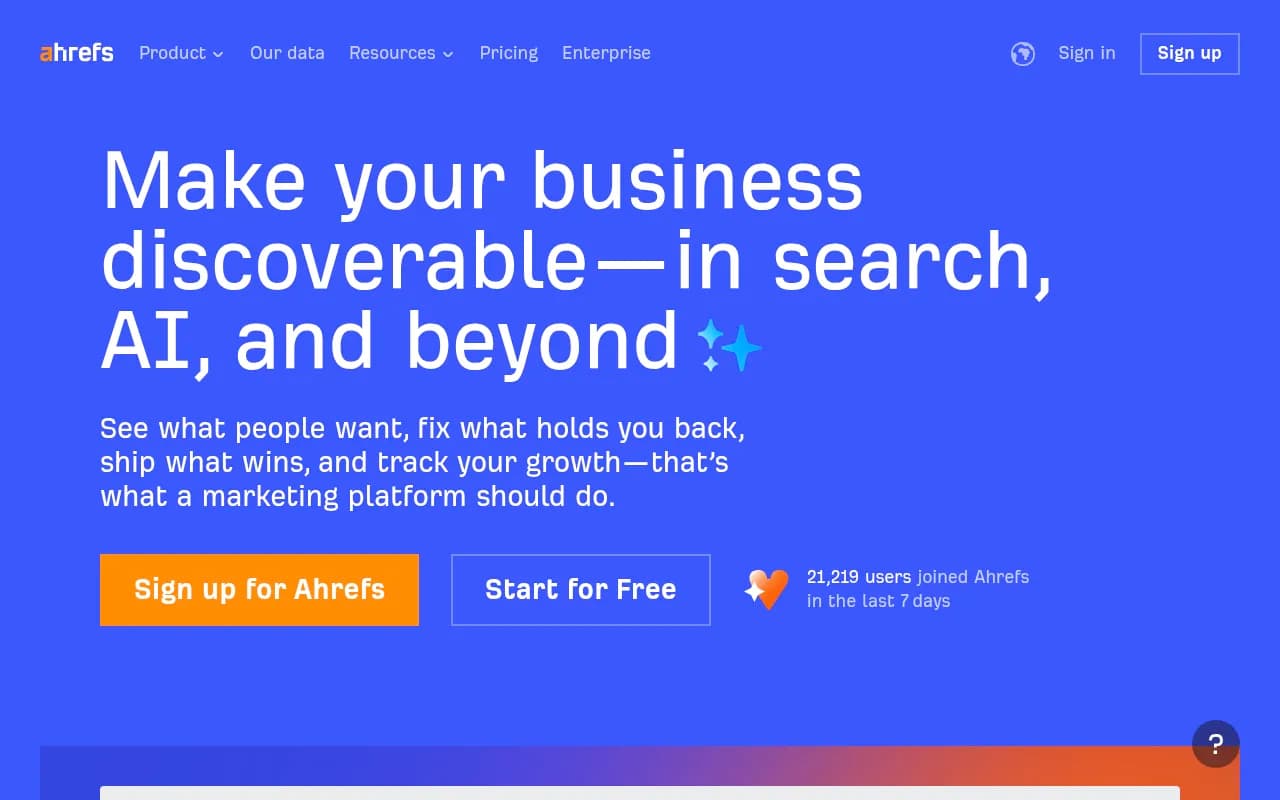
Ahrefs started as a backlink analysis tool and grew into one of the most widely used SEO platforms in the world -- used by 44% of Fortune 500 companies according to the company. Today it covers keyword research, site audits, rank tracking, content analysis, PPC research, social media monitoring, and, more recently, AI search visibility through its Brand Radar feature. It's the kind of tool that a full SEO team can live inside all day.
The AI search monitoring piece is newer and, honestly, still catching up to dedicated tools. Brand Radar tracks brand mentions across AI platforms but works with fixed prompts rather than custom ones, and there's no traffic attribution connecting AI visibility to actual site visits.
Omnia
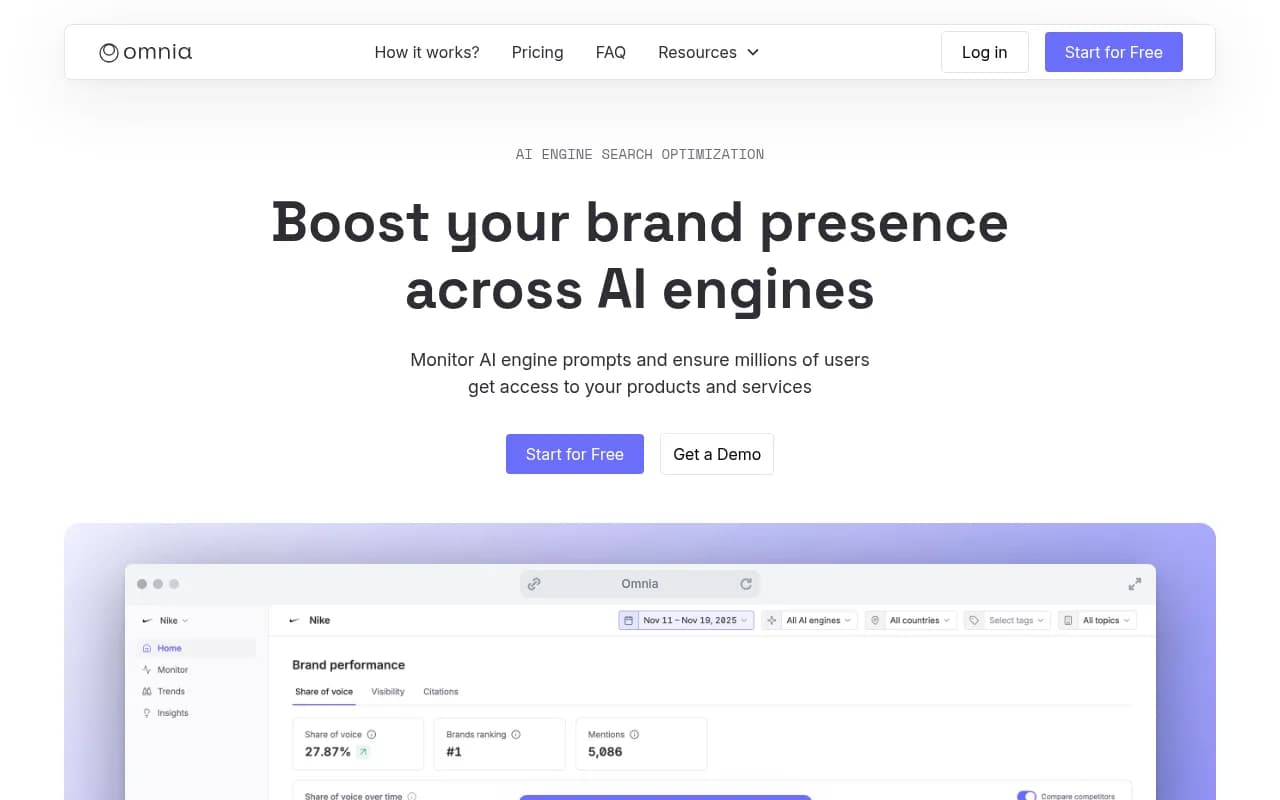
Omnia is a newer, purpose-built AI visibility platform aimed at SEO and marketing teams who want to understand how their brand shows up in AI-generated answers. It monitors citations and mentions across ChatGPT, Gemini, Perplexity, Copilot, and others, and translates that data into a step-by-step visibility roadmap covering content creation, technical SEO, and content placement.
It's a focused tool. You won't find backlink analysis or keyword research here. What you will find is a cleaner, more opinionated approach to the specific problem of AI search visibility -- including prompt discovery (what questions people are actually asking AI about your industry) and competitor benchmarking within AI results.
Side-by-side comparison
| Feature | Ahrefs | Omnia |
|---|---|---|
| Primary focus | Full-stack SEO platform | AI search visibility |
| AI search monitoring | Yes (Brand Radar) | Yes (core feature) |
| Custom prompt tracking | No (fixed prompts) | Yes |
| AI models tracked | Limited | ChatGPT, Gemini, Perplexity, Copilot |
| Competitor benchmarking in AI | Basic | Yes |
| Visibility roadmap / recommendations | No | Yes |
| Backlink analysis | Yes (industry-leading) | No |
| Keyword research | Yes | No |
| Site audit | Yes | No |
| Traditional rank tracking | Yes | No |
| AI traffic attribution | No | Partial |
| Content generation | Basic AI writing tools | No |
| Free tier | Free tools (limited) | Free trial |
| Starting price | $83/mo (Lite) | €63/mo (yearly) |
| Best for | SEO teams needing everything | Teams focused on AI visibility |
Head-to-head feature deep-dive
AI search monitoring
This is where the comparison gets interesting, because it's the one area where both tools overlap.
Ahrefs' Brand Radar monitors how brands appear in AI-generated responses. The problem is the fixed-prompt limitation: you can't define your own prompts or track the specific questions your customers are actually asking. You're working with whatever Ahrefs has decided to monitor. There's also no connection between AI visibility data and actual traffic -- you can see that you're being mentioned, but you can't tell if those mentions are driving visits.
Omnia was built specifically for this use case. It lets you discover real prompts people are asking about your industry, track your brand's appearance in AI answers across multiple platforms, benchmark against competitors, and get a prioritized roadmap of what to fix. The "act on your data" framing is genuine -- it doesn't just show you a score, it tells you what content to create or optimize.
Verdict: Omnia wins on AI monitoring depth. Ahrefs covers the basics, but if AI visibility is your primary concern, Omnia's purpose-built approach gives you more to work with.
Traditional SEO capabilities
This isn't even a close comparison. Ahrefs has spent over a decade building what many consider the best backlink index on the web, a keyword database covering billions of queries, a site audit tool, rank tracking across traditional search engines, and competitive analysis tools that SEO professionals rely on daily.
Omnia has none of this. It doesn't track Google rankings, analyze backlinks, or audit your site for technical SEO issues. It's not trying to -- but it's worth being clear about the gap.
Verdict: Ahrefs wins decisively. If traditional SEO is part of your workflow, Omnia can't replace it.
Pricing
| Plan | Ahrefs | Omnia |
|---|---|---|
| Free / trial | Free tools (very limited) | Free trial available |
| Entry paid | $29/mo (Starter, very restricted) | €63/mo (yearly) |
| Core plan | $83/mo (Lite) | €79/mo (monthly) |
| Mid-tier | $166/mo (Standard) | Custom / higher tiers |
| Advanced | $333/mo (Advanced) | -- |
| Enterprise | Custom | Custom |
Ahrefs' Starter plan at $29/mo is quite restricted -- it's more of a taste than a working plan. The Lite plan at $83/mo is the real entry point, and most teams doing serious SEO work end up on Standard ($166/mo) or higher.
Omnia's pricing is more straightforward for what it does. At €63/mo on annual billing, it's accessible for smaller teams or companies that want AI visibility tracking without committing to a full SEO platform budget.
Verdict: Omnia is cheaper for AI-only monitoring. Ahrefs costs more but covers far more ground.
Ease of use and interface
Ahrefs is powerful but has a learning curve. There are a lot of tools, a lot of data, and a lot of ways to get lost if you're new to SEO. The interface has improved over the years, but it's still a tool built for people who know what they're doing.
Omnia is simpler by design. Fewer features means fewer decisions. The roadmap-style output -- here's what to fix, in this order -- is genuinely useful for teams that don't want to stare at raw data and figure out what to do next.
Verdict: Omnia is easier to get started with. Ahrefs rewards the investment in learning it.
Competitor analysis
In traditional SEO, Ahrefs is one of the best tools for competitive analysis: you can see any competitor's backlinks, their top-ranking pages, their keyword gaps, and their traffic estimates. It's deep and reliable.
In AI search, Omnia lets you benchmark your brand's AI visibility against competitors -- seeing who gets cited more often, for which prompts, and on which platforms. Ahrefs' Brand Radar has some competitor comparison but it's less granular.
Verdict: Depends on the context. Ahrefs for traditional SEO competitive analysis; Omnia for AI-specific competitor benchmarking.
Content and optimization guidance
Ahrefs has content tools -- a Content Explorer for finding popular content in your niche, and some AI writing assistance. But it doesn't generate content specifically optimized for AI citation, and it doesn't tell you which content gaps are causing you to lose AI visibility.
Omnia's roadmap feature translates monitoring data into specific content recommendations: what to write, what to optimize, where to get your content placed. It's not a content generation tool, but it's more actionable than Ahrefs on the AI optimization side.
Worth noting: if you want to go further and actually generate content engineered to get cited by AI models -- not just know what to write but have a tool help you write it -- Promptwatch covers that angle with a built-in AI writing agent grounded in citation data.

Verdict: Omnia gives better AI-specific content guidance. Ahrefs has broader content research tools for traditional SEO.
Pros and cons
Ahrefs
Pros:
- Best-in-class backlink index and keyword database
- Covers the full SEO workflow in one platform
- Trusted by large enterprises and agencies worldwide
- Solid content research and competitive analysis tools
- Regular feature updates and strong documentation
Cons:
- AI search monitoring (Brand Radar) uses fixed prompts -- no customization
- No AI traffic attribution connecting visibility to actual visits
- Expensive for teams that only need AI monitoring
- Learning curve for new users
- AI features feel like additions rather than core capabilities
Omnia
Pros:
- Purpose-built for AI visibility -- the focus shows
- Custom prompt tracking across major AI platforms
- Actionable roadmap output, not just raw data
- Competitor benchmarking within AI results
- More affordable entry point for AI-only use cases
- Free trial available
Cons:
- No traditional SEO capabilities whatsoever
- Smaller customer base and less established track record than Ahrefs
- No content generation -- recommendations stop at "what to create"
- No AI crawler logs or traffic attribution
- Limited to AI monitoring; can't replace a full SEO stack
Who should pick which tool
Pick Ahrefs if:
- You need a full SEO platform covering backlinks, keywords, audits, and rank tracking
- Your team already uses Ahrefs and wants AI monitoring included without adding another tool
- You're at an enterprise or agency that needs comprehensive SEO data
- Traditional search visibility is still your primary channel
Pick Omnia if:
- AI search visibility is your primary focus and you don't need traditional SEO tools
- You want more granular AI monitoring than Ahrefs' Brand Radar provides
- Budget is a constraint and you only need the AI visibility piece
- You want a roadmap-style output that tells you what to do, not just what's happening
Use both if:
- You're running a full SEO program and want deeper AI visibility tracking than Ahrefs provides on its own
- Your team has separate people handling traditional SEO (Ahrefs) and AI search strategy (Omnia)
Final verdict
These two tools are solving different problems. Ahrefs is a mature, comprehensive SEO platform that has added AI search monitoring as a feature. Omnia is a focused AI visibility tool that doesn't pretend to be anything else.
If you're choosing between them purely on AI monitoring capability, Omnia is the better tool -- more flexible prompts, clearer competitor benchmarking, and more actionable output. If you need a full SEO stack and want AI monitoring included, Ahrefs is the practical choice even if its AI features aren't best-in-class.
The honest answer for most teams: if you're already paying for Ahrefs, the Brand Radar feature is a reasonable starting point for AI visibility. If you're serious about AI search and want to go deeper, Omnia is worth the additional cost -- and the two tools don't really step on each other.