Key takeaways
- Ahrefs is a full SEO platform that happens to include AI search monitoring (Brand Radar). Peec AI is an AI search analytics tool and nothing else. These are solving different problems.
- Peec AI lets you set custom prompts from the Starter plan; Ahrefs Brand Radar uses fixed prompts, which limits how precisely you can track your specific brand queries.
- For traditional SEO -- backlinks, keyword research, rank tracking, site audits -- Ahrefs has no competition here. Peec AI doesn't touch any of that.
- Peec AI tracks 10 AI models on its Starter plan. Ahrefs Brand Radar covers a narrower set and doesn't publish a clear model list the way Peec AI does.
- Neither tool helps you act on what you find. Both are monitoring dashboards -- they show you where you're invisible but don't help you fix it. If closing that loop matters to you, you'll want to look at platforms built around content gap analysis and AI content generation.
- Peec AI is cheaper for pure AI monitoring. Ahrefs is better value if you need a complete marketing intelligence stack.
Overview
Ahrefs
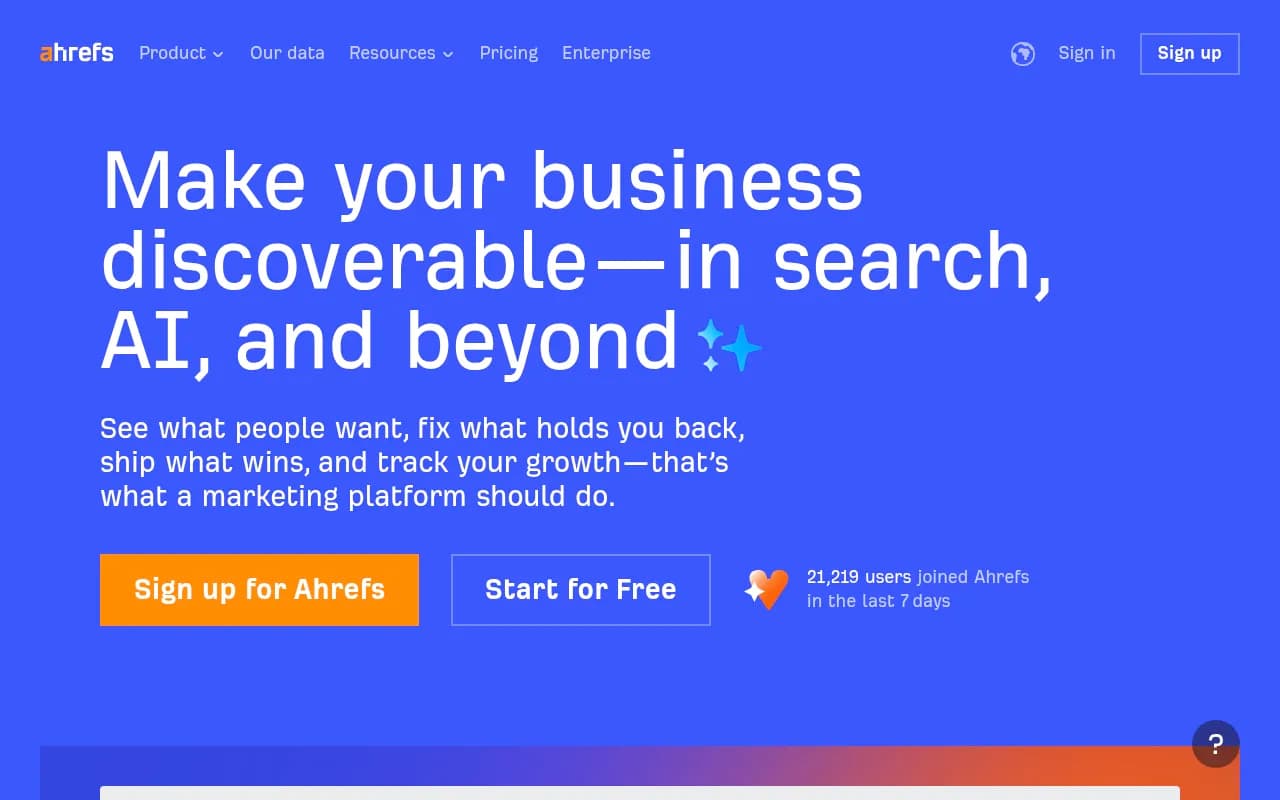
Ahrefs has been a staple of SEO teams for over a decade. It built its reputation on the world's largest backlink index and a keyword database that covers billions of queries. Over the past couple of years it's expanded aggressively into content tools, social media management, PPC research, and -- most relevant here -- AI search monitoring through Brand Radar. It's used by 44% of Fortune 500 companies, which tells you something about its depth and reliability.
The honest framing: Ahrefs is a platform where AI search monitoring is one feature among dozens. If you're already an Ahrefs customer, Brand Radar is a useful add-on. If AI visibility tracking is your primary need, you're paying for a lot of tools you won't use.
Peec AI

Peec AI is a purpose-built AI search analytics platform aimed at marketing teams who want to understand how their brand shows up in ChatGPT, Perplexity, Claude, Gemini, and other LLMs. It tracks three core metrics -- visibility, position, and sentiment -- and lets you benchmark against competitors. The interface is clean and focused. There's no backlink index, no keyword research, no site audit. Just AI search data.
Trusted by 2,000+ marketing teams according to their site, Peec AI is clearly finding an audience among teams that want dedicated AI monitoring without the complexity of a full SEO suite.
Side-by-side comparison
| Feature | Ahrefs | Peec AI |
|---|---|---|
| Primary focus | Full SEO + AI monitoring platform | AI search analytics only |
| AI models tracked | Brand Radar (limited, fixed prompts) | ChatGPT, Perplexity, Claude, Gemini + more (10 models on Starter) |
| Custom prompts | No (fixed prompts only) | Yes, from Starter plan |
| Traditional SEO tools | Yes (backlinks, keywords, audits, rank tracking) | No |
| Content creation tools | Yes (AI writing, content gap) | No |
| Competitor benchmarking | Yes | Yes |
| Sentiment tracking | No | Yes |
| Position tracking in AI | Basic | Yes (dedicated metric) |
| AI traffic attribution | No | No |
| Crawler logs | No | No |
| Reddit/YouTube tracking | No | No |
| Free tier | Very limited Starter ($29/mo) | Free trial available |
| Starting price | $83/mo (Lite) | €89/mo (~$103) |
| Multi-workspace/agency | Yes (Enterprise) | Growth plan (2 workspaces) |
| API access | Yes (higher tiers) | Not prominently advertised |
| Looker Studio integration | No | No |
Head-to-head feature deep-dive
AI search monitoring
This is where the comparison gets interesting, because it's the only area where both tools actually overlap.
Peec AI was built from the ground up for this. You get visibility scores (share of AI conversations where your brand appears), position data (where you rank within AI responses), and sentiment analysis (how AI models describe your brand). You can add custom prompts from day one, organize them with tags, track across countries, and benchmark up to a handful of competitors depending on your plan.
Ahrefs Brand Radar is newer and feels like it. The core limitation is fixed prompts -- Ahrefs decides which queries to track, not you. That's a real constraint if your brand operates in a niche or if you want to track very specific buying-intent queries. On the upside, Ahrefs has a massive data infrastructure behind it, and Brand Radar benefits from that scale.
Verdict: Peec AI wins on flexibility and depth for AI monitoring specifically. Custom prompts matter a lot in practice -- you want to track the questions your actual customers are asking, not a generic set.
Traditional SEO capabilities
There's no contest here. Ahrefs has one of the largest backlink indexes on the web, a keyword database covering billions of queries across 170+ countries, a site audit tool, rank tracker, content gap analysis for traditional search, and competitive research tools that SEO teams have relied on for years.
Peec AI has none of this. It's not trying to compete here.
Verdict: Ahrefs by a wide margin. If you need traditional SEO alongside AI monitoring, Peec AI can't replace Ahrefs.
Content tools
Ahrefs has been building out content creation features -- AI-assisted writing, content briefs, and workflows that connect keyword research to content production. It's not a dedicated writing tool, but it's genuinely useful for teams that want to go from keyword research to draft without switching platforms.
Peec AI has no content tools. You get analytics, not creation.
Verdict: Ahrefs wins. Though worth noting: neither tool is built around creating content specifically optimized to get cited by AI models -- that's a different capability entirely.
Competitor benchmarking
Both tools let you benchmark against competitors in AI search. Peec AI's dashboard shows competitor visibility scores side by side, which is clean and easy to read. You can see how Salesforce, HubSpot, and Attio compare on visibility, position, and sentiment in a single view.
Ahrefs Brand Radar offers competitive comparisons too, but the fixed-prompt limitation applies here as well -- you're comparing brands on Ahrefs' chosen queries, not necessarily the ones most relevant to your market.
Verdict: Peec AI has a slight edge for AI-specific competitor benchmarking. Ahrefs is stronger for broader competitive SEO analysis.
Ease of use and onboarding
Peec AI is genuinely easy to get started with. The interface is focused, the metrics are clearly defined, and you can be tracking your brand across AI models within minutes. The narrow scope is actually an advantage here -- there's less to learn.
Ahrefs is a powerful platform, but it takes time to learn. The sheer number of tools and data points can be overwhelming for new users. That said, Ahrefs has excellent documentation, tutorials, and a large community. Once you're comfortable, it's fast to use.
Verdict: Peec AI for quick onboarding. Ahrefs for long-term power users.
Reporting and data export
Ahrefs has more mature reporting infrastructure -- PDF exports, API access on higher plans, and integrations with broader marketing stacks. It's been around longer and has had time to build these out.
Peec AI has CSV exports and a reasonably clean dashboard, but it's not as feature-rich on the reporting side. The Growth plan adds multi-workspace support, which helps agencies manage multiple clients.
Verdict: Ahrefs has more reporting depth. Peec AI is sufficient for most marketing teams but may feel limited for agencies managing many clients.
Pricing comparison
| Plan | Ahrefs | Peec AI |
|---|---|---|
| Entry-level | Starter $29/mo (very limited) | Free trial |
| Starter/Lite | Lite $83/mo | €89/mo (~$103) -- 50 prompts, 10 models |
| Mid-tier | Standard $166/mo | Growth €199/mo (~$230) -- 150 prompts, 2 workspaces |
| Advanced | Advanced $333/mo | -- |
| Enterprise | Custom | Custom |
| Annual discount | 20% | Not publicly specified |
| Free trial | Yes | Yes |
A few things worth noting on pricing:
Peec AI's Starter plan at ~$103/month is actually more expensive than Ahrefs Lite at $83/month -- but you're comparing very different things. Ahrefs Lite gives you traditional SEO tools with Brand Radar as a feature. Peec AI Starter gives you 50 custom prompts and dedicated AI monitoring across 10 models.
If you only need AI search monitoring, Peec AI's pricing is reasonable for what you get. If you need a full SEO platform, Ahrefs is better value even at higher price points because you're getting so much more.
Pros and cons
Ahrefs
Pros:
- Industry-leading backlink index and keyword database
- Comprehensive platform covering SEO, content, PPC, social, and AI monitoring
- Strong documentation and learning resources
- Trusted by large enterprises with proven reliability
- Better value if you need traditional SEO tools alongside AI monitoring
Cons:
- Brand Radar uses fixed prompts -- you can't track custom queries
- AI monitoring feels like an add-on, not a core product
- No sentiment tracking for AI responses
- Expensive if you only need AI search monitoring
- No AI traffic attribution or crawler logs
- Steep learning curve for new users
Peec AI
Pros:
- Purpose-built for AI search analytics -- cleaner, more focused experience
- Custom prompts from the entry plan
- Tracks visibility, position, and sentiment across 10 AI models
- Easier to onboard and get value from quickly
- Competitor benchmarking is clean and intuitive
Cons:
- No traditional SEO tools whatsoever
- Monitoring-only -- no content generation, no gap analysis, no action tools
- No AI traffic attribution (can't connect AI visibility to revenue)
- No crawler logs to understand how AI bots index your site
- Limited workspace support on lower plans (agencies will feel constrained)
- Smaller company with less proven track record than Ahrefs
Who should pick which tool
Choose Ahrefs if:
- You need a full SEO platform and want AI monitoring included
- You're already an Ahrefs customer -- Brand Radar is worth exploring at no extra cost
- Traditional SEO (backlinks, keywords, audits) is still your primary channel
- You work at a large enterprise that needs a proven, scalable platform
- You want content creation tools alongside your analytics
Choose Peec AI if:
- AI search monitoring is your primary or only need right now
- You want custom prompt tracking from day one
- You need sentiment analysis on how AI models describe your brand
- You're a smaller marketing team that doesn't need a full SEO suite
- You want a focused tool that's fast to set up and easy to explain to stakeholders
Consider neither if:
- You want to actually act on your AI visibility data -- both tools are monitoring dashboards. They'll tell you where you're invisible, but they won't help you fix it. If you need content gap analysis, AI content generation, and traffic attribution in one platform, you'll want to look at tools built around that full optimization loop. Promptwatch is worth a look here -- it's one of the few platforms that goes from identifying gaps to generating content to tracking whether it worked.

Final verdict
These two tools are solving different problems, which makes the "vs" framing a little awkward. Ahrefs is a comprehensive marketing platform where AI monitoring is one feature. Peec AI is a dedicated AI search analytics tool with no traditional SEO capabilities.
If you're an SEO team that wants everything in one place, Ahrefs is the obvious choice -- and Brand Radar is a reasonable starting point for AI visibility even with its fixed-prompt limitations. If you're a marketing team that specifically wants to understand and improve your brand's presence in ChatGPT, Perplexity, and Claude, Peec AI gives you a more focused and flexible experience for that specific job.
The honest limitation of both: they show you the problem but don't help you solve it. Monitoring your AI visibility is step one. The harder question is what you do with that data.