Key takeaways
- Ahrefs is a full-stack SEO and marketing intelligence platform. Rankshift does one thing: AI visibility monitoring. These tools are not direct substitutes -- they solve different problems.
- If you need backlink analysis, keyword research, site audits, or Google rank tracking, Rankshift can't help you. Ahrefs handles all of that.
- For pure AI search visibility (tracking how your brand appears in ChatGPT, Perplexity, Gemini, Claude), Rankshift is more focused and purpose-built. Ahrefs Brand Radar exists but is limited -- fixed prompts, no AI traffic attribution, no content gap analysis.
- Rankshift starts at €69/mo (~$75) after a 30-day free trial. Ahrefs starts at $83/mo, but meaningful AI monitoring features live on higher plans.
- Rankshift offers unlimited users and projects across plans -- a real advantage for agencies. Ahrefs charges per seat.
- Most teams will end up using both: Ahrefs for traditional SEO, a dedicated AI visibility tool for the AI search layer.
Overview
Ahrefs
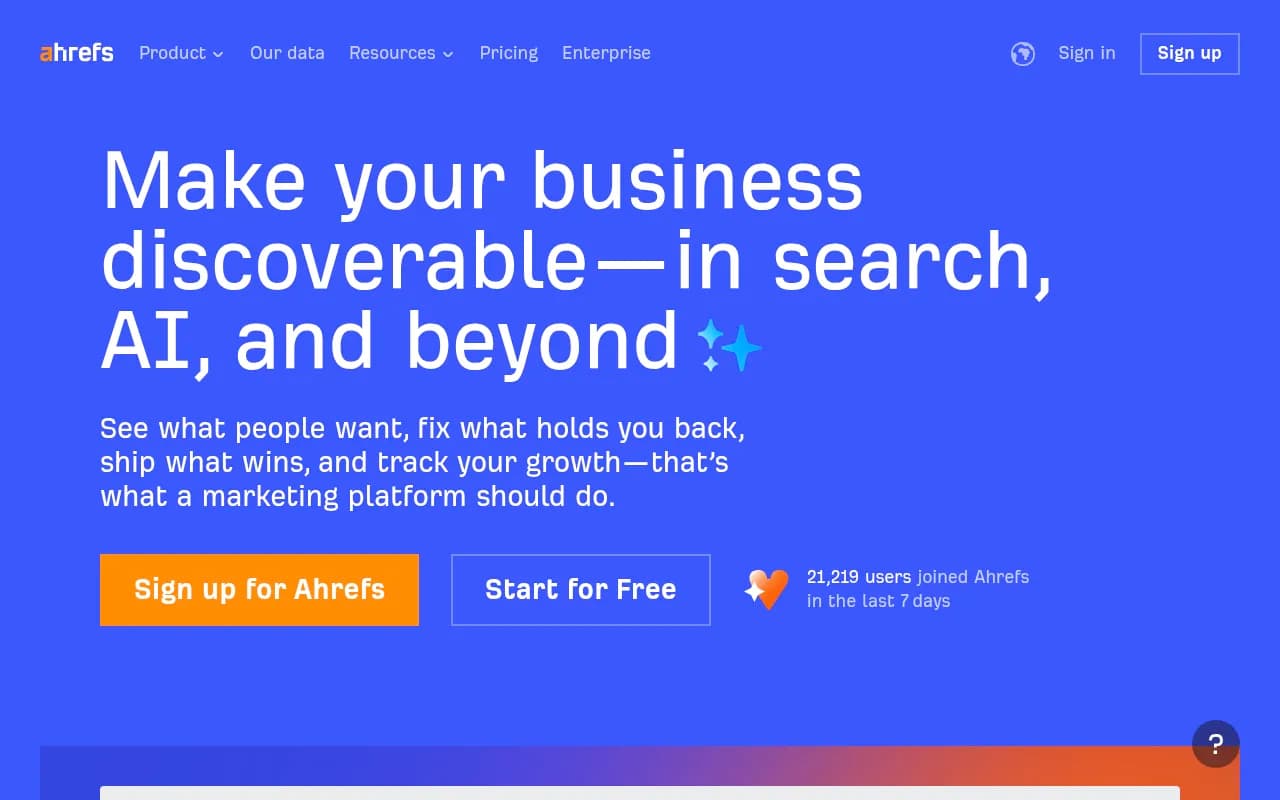
Ahrefs has been a staple in SEO toolkits for over a decade. It built its reputation on the world's largest backlink index, then expanded into keyword research, site audits, content explorer, rank tracking, and more recently, AI search monitoring through Brand Radar. Today it positions itself as an "AI marketing platform" -- though that framing is a stretch. The core product is still very much a traditional SEO suite with AI monitoring bolted on.
Used by 44% of Fortune 500 companies and trusted by teams at Adobe, Shopify, IBM, and LinkedIn, Ahrefs has serious credibility. The data depth is hard to match. But it's a complex, expensive platform, and the AI visibility features are not its strongest suit.
Rankshift

Rankshift is a newer, focused player in the AI visibility space. It tracks how your brand appears in AI-generated answers across ChatGPT, Perplexity, Gemini, Claude, and Google AI Overviews -- monitoring prompt performance, citation rates, sentiment, and share of voice against competitors. Trusted by 850+ brands including Coolblue and Unive, it's built specifically for the "zero-click era" where AI answers replace traditional search results.
Setup takes about three minutes: add your prompts, pick your brands, choose your AI models, and you're tracking. That simplicity is intentional. Rankshift doesn't try to be an SEO platform -- it tries to be the best tool for understanding your AI search presence.
Side-by-side comparison
| Feature | Ahrefs | Rankshift |
|---|---|---|
| Primary use case | Full-stack SEO + AI monitoring | AI visibility monitoring only |
| AI models tracked | Limited (Brand Radar) | ChatGPT, Perplexity, Gemini, Claude, Google AI Overviews |
| Traditional SEO tools | Yes (backlinks, keywords, audits, rank tracking) | No |
| Prompt-level tracking | Fixed prompts only | Custom prompts, flexible |
| Citation analysis | Basic | Yes, with source-level detail |
| Sentiment monitoring | No | Yes |
| Competitor benchmarking | Yes (SEO-focused) | Yes (AI visibility-focused) |
| Content gap analysis | Partial (SEO content gap) | Limited |
| AI traffic attribution | No | Limited |
| Crawler log analysis | No | No |
| Free trial | $29/mo Starter (very limited) | 30-day free trial |
| Starting price | $83/mo (Lite) | €69/mo (~$75) |
| Unlimited users | No (per-seat pricing) | Yes |
| Agency/Enterprise plans | Yes (custom) | Yes (custom) |
| API access | Yes (Advanced+) | Yes |
| Integrations | Google Search Console, GA4, and more | Limited |
Head-to-head feature deep-dive
AI search visibility tracking
This is where the comparison gets most interesting, because both tools claim to do this -- but they do it very differently.
Ahrefs Brand Radar monitors brand mentions in AI-generated answers, but it uses fixed prompts. You can't define your own prompt set, which means you're tracking what Ahrefs decides to track, not the specific queries your customers are actually using. There's no AI traffic attribution (you can't connect AI visibility to actual site visits), and no content gap analysis to tell you what you're missing.
Rankshift is built entirely around this problem. You define your own prompts, track citation rates per model, monitor sentiment (is the AI saying positive or negative things about your brand?), and benchmark your share of voice against competitors. The prompt-level granularity is genuinely useful -- you can see that you rank well in Perplexity but poorly in ChatGPT for the same query, and act on that.
Verdict: Rankshift wins clearly for AI visibility tracking. Ahrefs Brand Radar is a monitoring add-on; Rankshift is a dedicated platform.
Traditional SEO capabilities
Ahrefs has no real competition from Rankshift here. It has:
- Site Explorer: backlink analysis with the web's largest index
- Keywords Explorer: keyword research across Google, YouTube, Amazon, and more
- Site Audit: technical SEO crawling and issue detection
- Rank Tracker: daily Google ranking updates
- Content Explorer: content research and link prospecting
Rankshift has none of this. It doesn't track Google organic rankings, doesn't analyze backlinks, and doesn't audit your site. If traditional SEO is part of your workflow, Rankshift is not a replacement.
Verdict: Ahrefs wins by default -- Rankshift doesn't compete in this category.
Pricing and value
Ahrefs pricing is tiered and gets expensive fast. The $29/mo Starter plan is so limited it's barely useful for professional work. The Lite plan at $83/mo is the real entry point, but Brand Radar (the AI monitoring feature) requires higher tiers. For a team that wants both SEO and AI monitoring, you're likely looking at $166-$333/mo.
Rankshift is more straightforward. €69/mo gets you real AI visibility tracking. The unlimited users policy is a meaningful advantage -- with Ahrefs, adding team members costs extra.
| Plan | Ahrefs | Rankshift |
|---|---|---|
| Entry/free tier | Ahrefs Webmaster Tools (free, limited) | 30-day free trial |
| Starter | $29/mo (very limited) | €69/mo (~$75) |
| Mid-tier | $83/mo (Lite), $166/mo (Standard) | €159/mo (~$173) |
| Professional/Advanced | $333/mo | €359/mo (~$390) |
| Enterprise | Custom | Custom |
| Annual discount | 20% | 10% |
| Per-seat pricing | Yes | No (unlimited users) |
Verdict: For AI visibility only, Rankshift is better value. For a full SEO stack, Ahrefs justifies its price. Paying for Ahrefs just to get Brand Radar is hard to justify.
Ease of use and setup
Rankshift claims a 3-minute setup, and that's roughly accurate. You add your brand, define prompts, pick models, and you're tracking. The interface is clean and focused -- there's not much to get lost in.
Ahrefs has a steeper learning curve. The platform is deep, with dozens of tools and reports. New users often spend weeks figuring out which reports to prioritize. That depth is a feature for power users, but it's friction for teams that just want to know how they're showing up in AI answers.
Verdict: Rankshift is faster to get value from. Ahrefs rewards investment but takes time to master.
Competitor analysis
Both tools offer competitor benchmarking, but from different angles.
Ahrefs competitor analysis is SEO-focused: compare backlink profiles, keyword overlap, content gaps, and organic traffic estimates. It's excellent for understanding why a competitor ranks higher in Google.
Rankshift's competitor benchmarking is AI-focused: compare share of voice across AI models, see which brands get cited more often for specific prompts, and track sentiment differences. This is the data you need to understand why a competitor gets recommended by ChatGPT more than you do.
Verdict: Depends on your goal. For Google SEO competition, Ahrefs. For AI search competition, Rankshift.
Integrations and reporting
Ahrefs integrates with Google Search Console, Google Analytics 4, and has an API on Advanced and Enterprise plans. It also has a Looker Studio connector. Reporting is solid, though not the most flexible.
Rankshift's integrations are more limited. The focus is on its own dashboard. API access is available, but the ecosystem around it is smaller.
Verdict: Ahrefs has a more mature integration story. Rankshift is catching up.
Pros and cons
Ahrefs
Pros:
- Best-in-class backlink index and keyword data
- Comprehensive SEO suite covering every major workflow
- Trusted by large enterprises with serious data depth
- Strong integrations (GSC, GA4, Looker Studio)
- Content Explorer is genuinely useful for content research
Cons:
- AI visibility features (Brand Radar) are limited and use fixed prompts
- No AI traffic attribution
- Gets expensive quickly, especially for teams
- Per-seat pricing adds up for agencies
- Learning curve is real -- not a quick-start tool
Rankshift
Pros:
- Purpose-built for AI visibility -- the focus shows
- Custom prompt tracking across ChatGPT, Perplexity, Gemini, Claude, and Google AI Overviews
- Sentiment monitoring is a differentiator
- Unlimited users on all plans -- great for agencies
- 30-day free trial with no credit card friction
- Fast setup, clean interface
Cons:
- No traditional SEO capabilities whatsoever
- Content gap analysis and AI traffic attribution are limited
- Smaller integration ecosystem
- Smaller customer base and less proven at enterprise scale
- Annual discount is only 10% vs Ahrefs' 20%
Who should pick which tool
Pick Ahrefs if:
- You need a full SEO platform and AI monitoring is a secondary concern
- Backlink analysis, keyword research, and site audits are core to your workflow
- You're at a large enterprise that needs deep data and established integrations
- You want one tool that covers most of your marketing intelligence needs (even if imperfectly)
Pick Rankshift if:
- AI search visibility is your primary focus and you already have an SEO tool
- You want to track exactly how your brand appears in ChatGPT, Perplexity, and Gemini with custom prompts
- You're an agency with multiple clients -- unlimited users and projects make this much more cost-effective
- You want to monitor sentiment and share of voice in AI-generated answers
- You want to get started quickly without a steep learning curve
Use both if:
- You're serious about both traditional SEO and AI search visibility
- Your team is large enough that the combined cost is justifiable
- You want Ahrefs for Google and Rankshift for AI models -- this is actually a common setup
A note on the broader AI visibility space
If you're evaluating tools in this category, it's worth knowing that the AI visibility monitoring space has matured quickly. Platforms like Promptwatch go beyond monitoring to include content gap analysis, AI-native content generation, and crawler log tracking -- features that neither Ahrefs nor Rankshift fully cover. Worth exploring if you want to move from tracking to actually improving your AI search presence.

Final verdict
These two tools aren't really competing for the same buyer. Ahrefs is for teams that need a comprehensive SEO platform and are willing to accept a limited AI monitoring add-on. Rankshift is for teams that have decided AI search visibility is a priority and want a focused tool built specifically for that job.
If you're currently using Ahrefs and wondering whether to add Rankshift: the answer depends on how seriously you're taking AI search. If it's a "nice to have," Ahrefs Brand Radar is probably enough. If AI visibility is a real business priority, Rankshift's custom prompt tracking and sentiment monitoring justify the additional cost.
If you're starting fresh and only care about AI visibility, Rankshift is the cleaner, cheaper, faster choice. Just don't expect it to replace your SEO stack.