Key Takeaways
- Amionai targets agencies with multi-client plans ($375-$670/mo for 5-10 clients) and white-label solutions, while Ansehn uses custom enterprise pricing requiring a demo
- Amionai offers a free AI visibility report to get started; Ansehn requires booking a 30-minute demo before you see pricing or trial the platform
- Both platforms track the same core AI models (ChatGPT, Perplexity, Claude, Google AI), but neither publishes detailed feature comparison data
- Ansehn emphasizes "AI-generated content actions" and closing performance gaps, suggesting more optimization features; Amionai focuses on weekly action plans and competitor benchmarking
- For agencies managing multiple clients, Amionai's transparent pricing and white-label options make it the clearer choice; for enterprises wanting custom workflows, Ansehn may offer more flexibility
- Neither platform comes close to the action loop that tools like Promptwatch provide -- content gap analysis, AI writing agents, and crawler logs that help you actually fix visibility issues instead of just tracking them
Overview
Amionai
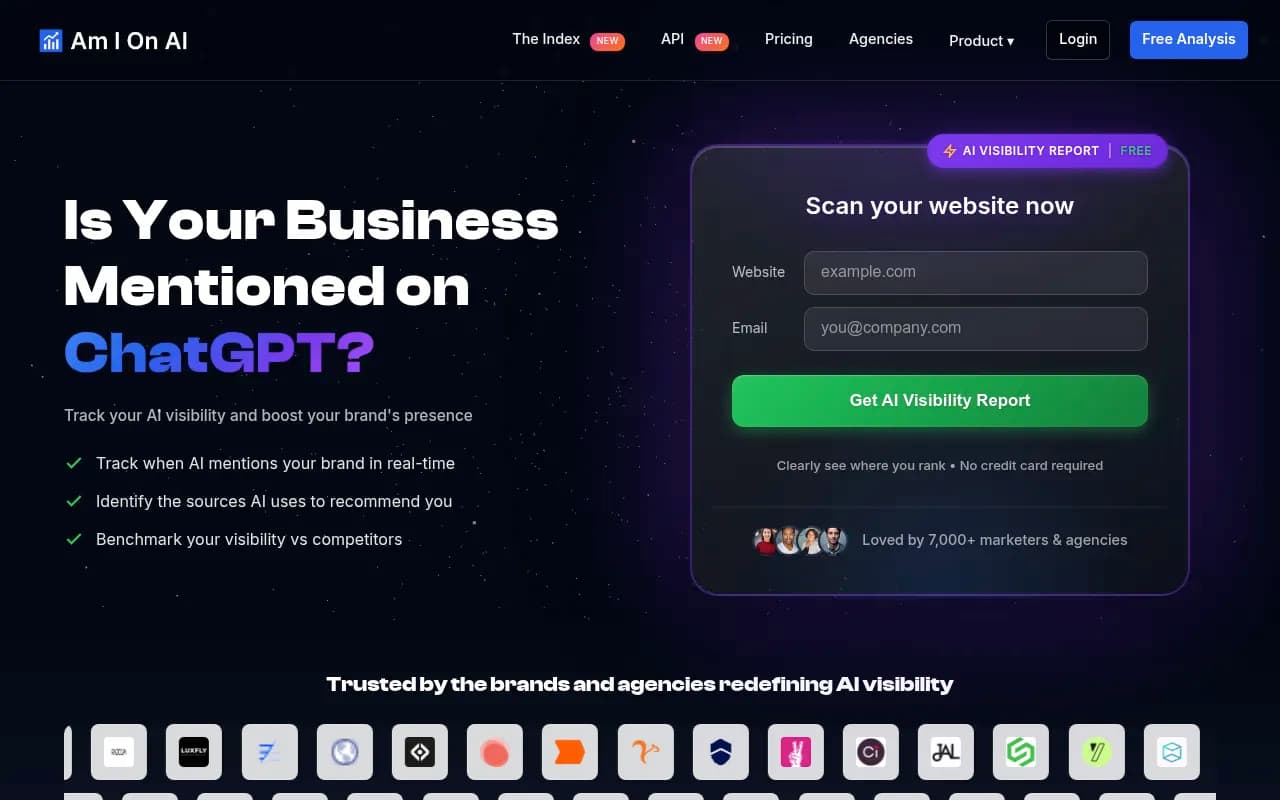
Amionai positions itself as an AI visibility monitoring platform built for brands and agencies. The core pitch: track how your brand appears when people ask ChatGPT, Perplexity, Claude, and other LLMs for recommendations. The platform provides weekly action plans, competitor analysis, and white-label solutions for agencies managing multiple clients. Pricing is transparent and agency-focused, starting at $375/mo for 5 clients and scaling to $670/mo for 10 clients. No free trial, but they offer a free AI visibility report to get you started.
Ansehn
Ansehn
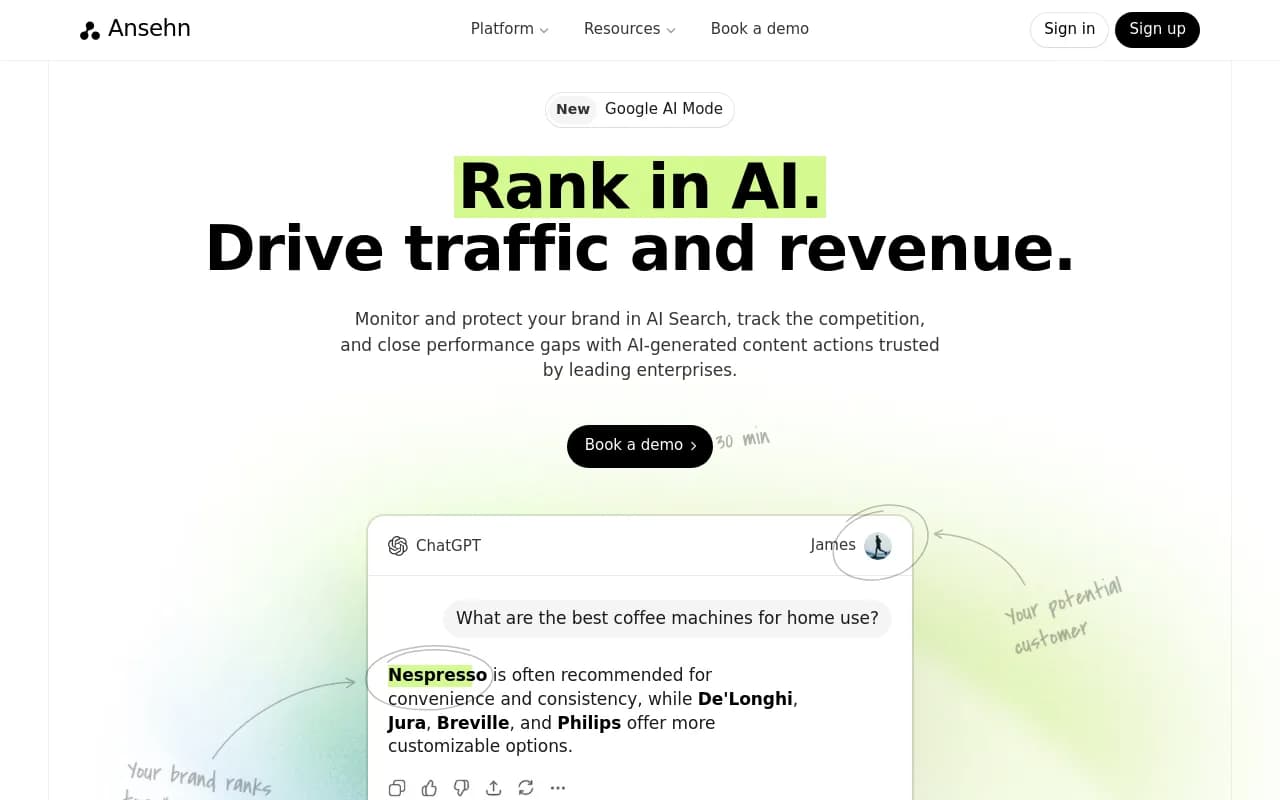
Ansehn describes itself as an AI search visibility platform that monitors brand mentions across ChatGPT, Perplexity, Google AI Mode, and Claude. The platform tracks rankings, benchmarks competitors, and provides content recommendations to improve visibility in AI-generated answers. Built for marketing teams and agencies managing AI search optimization (GEO/AEO) for B2B and B2C brands. Pricing is custom -- you have to book a demo to find out what it costs. No free trial or public pricing tiers disclosed.
Side-by-side comparison
| Feature | Amionai | Ansehn |
|---|---|---|
| Pricing model | Fixed agency tiers ($375-$670/mo) | Custom enterprise (demo required) |
| Free trial | No (free visibility report available) | No |
| AI models tracked | ChatGPT, Perplexity, Claude, others | ChatGPT, Perplexity, Google AI Mode, Claude |
| Agency features | White-label solutions, multi-client plans | Multi-client management (details unclear) |
| Competitor analysis | Yes (weekly benchmarking) | Yes (benchmarking mentioned) |
| Content recommendations | Weekly action plans | AI-generated content actions |
| Onboarding | Free visibility report, self-serve | 30-minute demo required |
| Target audience | Agencies, brands (SMB to mid-market) | Enterprises, marketing teams |
| Transparency | Public pricing, clear tiers | No public pricing |
| Documentation | Not mentioned | Comprehensive guides and API reference |
| API access | Not mentioned | Yes (documented) |
| Clients mentioned | 7,000+ marketers and agencies | Bosch, Teachly, Quirion, Zutacore, Pixum, Aurubis |
Pricing: Transparent tiers vs custom enterprise
This is the biggest difference between the two platforms.
Amionai pricing
Amionai publishes its pricing openly:
| Plan | Price | Clients |
|---|---|---|
| Agency Starter | $375/mo | 5 clients |
| Agency Pro | $670/mo | 10 clients |
No free trial, but you can get a free AI visibility report by entering your website and email. The pricing is clearly aimed at agencies managing multiple clients -- you're paying per client seat, not per prompt or per user.
Ansehn pricing
Ansehn doesn't publish pricing. You have to book a 30-minute demo to find out what it costs. The website mentions "custom pricing" and shows enterprise logos (Bosch, Aurubis), which suggests higher price points and annual contracts. No free trial or starter tier mentioned.
Verdict: If you want to know what you're paying before committing to a sales call, Amionai wins. If you're an enterprise with budget for custom solutions, Ansehn's demo-first approach might work for you.
AI models and tracking coverage
Both platforms track the major AI models that matter in 2026:
- ChatGPT (OpenAI)
- Perplexity
- Claude (Anthropic)
- Google AI (Ansehn specifies "Google AI Mode"; Amionai mentions "AI platforms" more broadly)
Ansehn explicitly lists Google AI Overview and Google AI Mode as separate tracking targets, which suggests more granular tracking of Google's AI features. Amionai's website is less specific about which Google AI products it monitors.
Neither platform mentions tracking DeepSeek, Grok, Mistral, Meta AI, or Copilot -- models that broader platforms like Promptwatch cover.

Verdict: Roughly equivalent for the core models (ChatGPT, Perplexity, Claude). Ansehn seems slightly more detailed about Google AI tracking.
Agency and multi-client features
Amionai is explicitly built for agencies:
- White-label solutions (rebrand the platform for your clients)
- Multi-client plans with per-client pricing
- Weekly action plans that you can deliver to clients
- 7,000+ marketers and agencies mentioned as users
Ansehn mentions "agencies managing AI search optimization" in its description, but the website doesn't detail white-label options or multi-client workflows. The enterprise logos and custom pricing suggest it's built for in-house teams at larger companies, not agencies juggling 5-10 clients.
Verdict: Amionai is the clear winner for agencies. White-label and transparent per-client pricing are exactly what agencies need.
Content optimization and action plans
Both platforms claim to go beyond monitoring and provide actionable recommendations.
Amionai's approach
- Weekly action plans
- Competitor analysis and benchmarking
- Identifies "sources AI uses to recommend you"
The website doesn't specify what the action plans contain or how they're generated. It's unclear if there's AI-generated content, manual recommendations, or just data dashboards.
Ansehn's approach
- "AI-generated content actions" to close performance gaps
- Content recommendations to improve visibility
- "Understand what drives AI search" and "Improve: Grow with AI search" as core platform pillars
Ansehn's language suggests more automation around content generation, but again, no specifics on what the content actions actually look like.
Verdict: Both platforms are vague about what "actions" and "recommendations" mean in practice. Neither appears to offer the depth of content gap analysis, AI writing agents, or crawler log insights that optimization-focused platforms provide. If you want to actually create content that ranks in AI search, you'll need to supplement either tool with something like Promptwatch's content generation and gap analysis features.
Competitor benchmarking
Both platforms mention competitor analysis:
- Amionai: "Benchmark your visibility vs competitors" and weekly competitor analysis
- Ansehn: "Track the competition" and competitor benchmarking
No details on how many competitors you can track, how the benchmarking works, or what metrics you get. This is table stakes for any AI visibility tool in 2026 -- you need to know where you rank relative to competitors for the same prompts.
Verdict: Tie. Both claim competitor tracking, neither provides enough detail to differentiate.
Onboarding and ease of getting started
Amionai offers a free AI visibility report. You enter your website and email, and you get a report showing where you rank. No credit card required. This is a low-friction way to see if the platform is worth paying for.
Ansehn requires booking a 30-minute demo. You can't try the platform or see pricing without talking to sales first. This is a higher barrier to entry.
Verdict: Amionai is easier to test. The free report gives you a taste of the platform without committing to a sales call.
Documentation and API access
Ansehn explicitly mentions:
- Comprehensive guides and API reference
- Documentation site (docs.ansehn.com)
- API access for custom workflows
Amionai doesn't mention API access or documentation on its website.
Verdict: Ansehn wins for developers and teams that need API access or want to build custom integrations.
Target audience and positioning
Amionai is aimed at:
- Agencies managing multiple clients (white-label, per-client pricing)
- SMB to mid-market brands (pricing starts at $375/mo)
- Marketers who want a simple, transparent tool
Ansehn is aimed at:
- Enterprises (custom pricing, demo-first sales process)
- In-house marketing teams at larger companies (Bosch, Aurubis logos)
- Teams that need API access and custom workflows
Verdict: Different audiences. Amionai for agencies and smaller brands; Ansehn for enterprises.
What's missing from both platforms
Neither Amionai nor Ansehn appears to offer:
- AI crawler logs (track which AI models are crawling your site and when)
- Prompt intelligence (volume estimates, difficulty scores, query fan-outs)
- Deep citation and source analysis (which pages, Reddit threads, YouTube videos AI models cite)
- Reddit and YouTube insights (discussions that influence AI recommendations)
- ChatGPT Shopping tracking (product recommendations and shopping carousels)
- Multi-language and multi-region tracking at scale
- Traffic attribution (connect AI visibility to actual revenue)
These are capabilities that more comprehensive platforms like Promptwatch provide. Amionai and Ansehn are monitoring tools -- they show you where you rank, but they don't help you understand why or give you the data to fix it.
Pros and cons
Amionai pros
- Transparent pricing with clear agency tiers
- White-label solutions for agencies
- Free AI visibility report to test before buying
- Weekly action plans and competitor benchmarking
- 7,000+ users suggests proven track record
Amionai cons
- No free trial (only a one-time report)
- Limited details on what "action plans" actually contain
- No API access mentioned
- Unclear which AI models beyond ChatGPT, Perplexity, Claude are tracked
- No content generation or optimization features detailed
Ansehn pros
- API access and comprehensive documentation
- Enterprise-grade (trusted by Bosch, Aurubis)
- Emphasis on "AI-generated content actions" suggests optimization features
- Tracks Google AI Mode and Google AI Overview explicitly
Ansehn cons
- No public pricing (requires demo)
- No free trial or free tier
- 30-minute demo required to see the platform
- Unclear if white-label or multi-client features exist
- Vague about what "content actions" actually deliver
Who should pick Amionai
Pick Amionai if:
- You're an agency managing 5-10 clients and need white-label solutions
- You want transparent pricing without a sales call
- You prefer a low-friction onboarding (free visibility report)
- You're a smaller brand or mid-market company with a clear budget
- You don't need API access or custom integrations
Who should pick Ansehn
Pick Ansehn if:
- You're an enterprise with budget for custom pricing
- You need API access and want to build custom workflows
- You're managing AI search optimization in-house (not as an agency)
- You want comprehensive documentation and developer resources
- You're okay with a 30-minute demo before seeing pricing
Final verdict
Amionai is the better choice for agencies and smaller brands that want transparent pricing, white-label options, and a simple onboarding process. The free visibility report and per-client pricing make it easy to test and scale.
Ansehn is better for enterprises that need API access, custom workflows, and are willing to go through a sales process to get pricing. The emphasis on "AI-generated content actions" suggests more optimization features, but without seeing the platform, it's hard to verify.
Both platforms are monitoring-first tools -- they show you where you rank in AI search, but they don't give you the depth of insights or content generation capabilities to actually fix visibility gaps. If you're serious about ranking in AI search, you'll need to supplement either tool with a platform that provides content gap analysis, AI writing agents, crawler logs, and traffic attribution. That's where tools like Promptwatch come in -- they close the loop between monitoring and optimization.