Key takeaways
- Bear AI and AirOps both start at $199/mo, but they solve different problems: Bear AI is about converting AI-driven traffic into revenue, AirOps is about creating content that earns AI citations in the first place.
- AirOps has a free tier (1,000 tasks/month); Bear AI has no free plan at all.
- AirOps has significantly stronger content production capabilities -- AI writing workflows, content gap analysis, and a task-based system used by Webflow, Ramp, and Carta. Bear AI's blog generation is limited to 2 posts/month on its Basic plan.
- Bear AI's lead generation and visitor identification features are unique -- no other tool in this space focuses specifically on converting AI agent traffic into pipeline. That's genuinely differentiated.
- AirOps is the better fit for content-heavy marketing teams. Bear AI is the better fit for growth teams who already have content and want to monetize the AI traffic it generates.
- Neither tool covers the full picture on its own. They're more complementary than competitive.
Overview
Bear AI
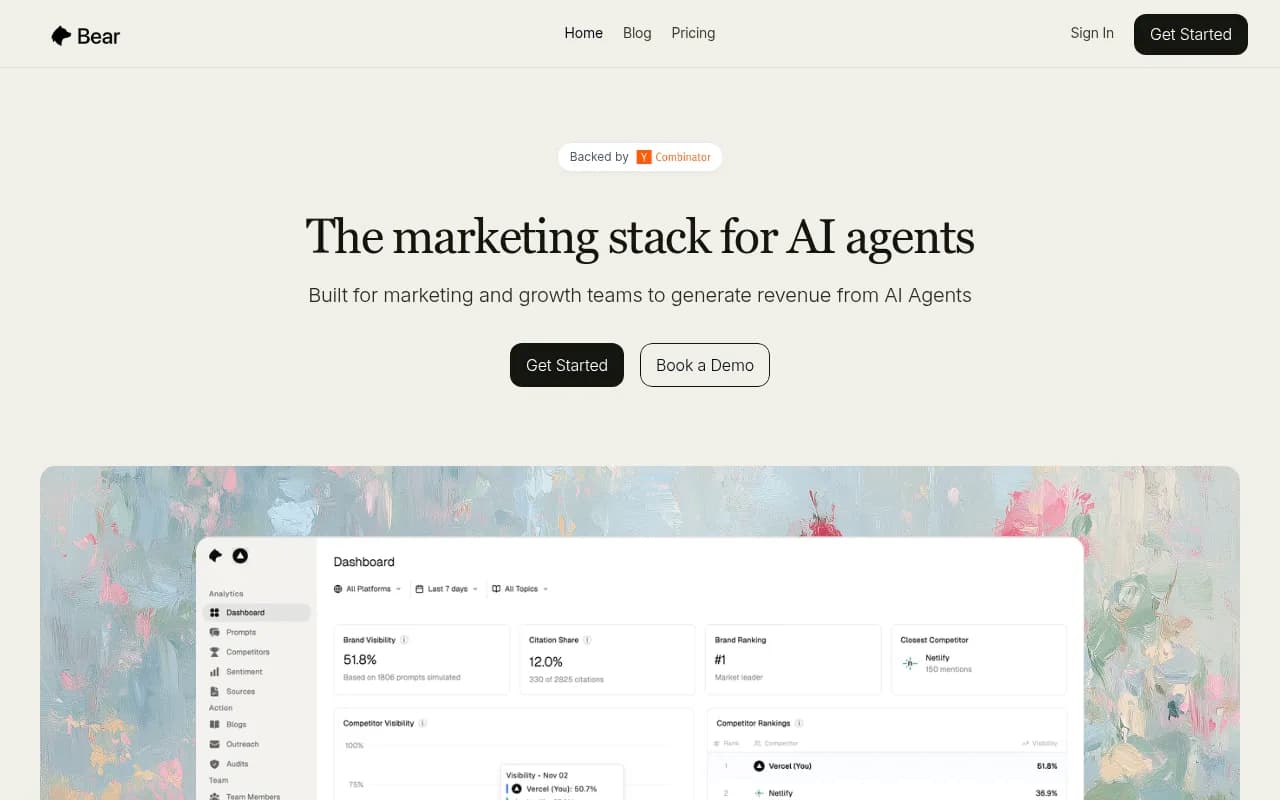
Bear AI is a YC-backed marketing platform built around a specific thesis: AI agents are sending high-intent traffic to websites, and most companies have no idea how to identify or convert it. The platform tracks how AI models like ChatGPT, Claude, and Google AI Overviews discover and recommend your brand, then gives you tools to turn that visibility into actual leads and revenue. It's less about content creation and more about what happens after someone arrives from an AI recommendation.
The feature set includes brand mention tracking across major LLMs, trending prompt analysis, and -- most distinctively -- lead generation tools that identify visitors coming from AI sources. That last piece is rare in this space.
AirOps
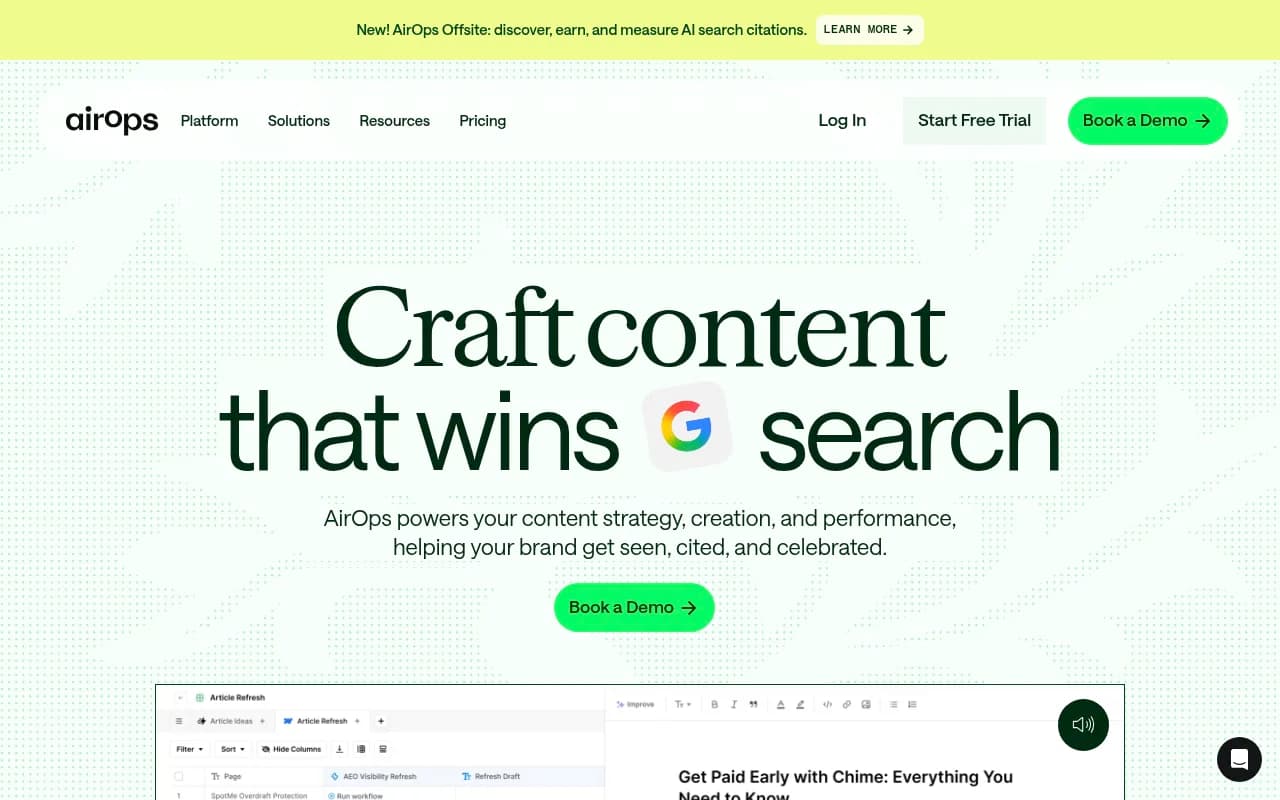
AirOps positions itself as a "content engineering platform" for AI search. The idea is that winning in AI search is fundamentally a content problem: AI models cite brands that have the right content, structured the right way, answering the right questions. AirOps helps you figure out what content you're missing, then build it at scale using AI-powered writing workflows.
It's used by some well-known brands -- Webflow, Chime, Ramp, Carta -- and the case study numbers are concrete: Chime went from being cited in 24 to 68 priority questions after using AirOps. Webflow 5x'd its content refresh velocity. That's the kind of outcome AirOps is optimized for.
Side-by-side comparison
| Feature | Bear AI | AirOps |
|---|---|---|
| Primary focus | AI traffic conversion & lead gen | Content creation for AI search |
| Free tier | No | Yes (1,000 tasks/mo) |
| Starting price | $199/mo | $199/mo (Starter) |
| AI models monitored | 2 (Basic), 6+ (Enterprise) | ChatGPT, Perplexity, Google AI Overviews |
| Prompt tracking | 75 prompts (Basic) | Query/gap analysis (task-based) |
| Content generation | 2 blogs/mo (Basic) | Core feature, task-based at scale |
| Content gap analysis | Limited | Yes, central feature |
| Lead generation / visitor ID | Yes (Enterprise) | No |
| AI crawler logs | Not mentioned | Not mentioned |
| Competitor tracking | Yes | Yes |
| Agency/multi-client support | Enterprise custom | Scale/Enterprise plans |
| Integrations | Not publicly listed | Webflow, CMS integrations |
| Free trial | Not confirmed | Yes |
| Backed by | Y Combinator | Series B funded |
Head-to-head feature deep-dive
AI visibility monitoring
Bear AI tracks brand mentions and recommendations across ChatGPT, Claude, Google AI Overviews, Perplexity, and Gemini. The Basic plan covers 2 models with 75 prompts -- which is pretty thin if you're trying to get a real picture of your AI search presence. Enterprise unlocks 6+ models and unlimited prompts.
AirOps approaches monitoring differently. Rather than tracking a fixed set of prompts, it focuses on identifying which questions and topics in your space are driving AI citations, then showing you where you're missing. It's less "here's your visibility score" and more "here's the content gap causing your invisibility."
Verdict: Bear AI is better for raw brand mention tracking across specific models. AirOps is better for understanding why you're not visible and what to do about it.
Content creation and optimization
This is where the gap between the two tools is most obvious.
Bear AI includes blog generation, but it's capped at 2 posts/month on the Basic plan. That's more of a feature checkbox than a real content engine. The platform's DNA is in traffic analysis and conversion, not content production.
AirOps is built around content at its core. The task-based system lets teams run AI writing workflows at scale -- content briefs, drafts, optimization passes, refreshes. Brands like Ramp and Carta use it specifically because it maintains brand voice while scaling output. The content gap analysis feeds directly into the writing workflow, so you're not just generating content randomly -- you're filling specific holes that AI models are looking for.
| Capability | Bear AI | AirOps |
|---|---|---|
| Blog/article generation | 2/mo (Basic) | Task-based, scalable |
| Content gap analysis | Basic | Core feature |
| Brand voice preservation | Not specified | Yes (noted by Carta CMO) |
| Content refresh workflows | Not mentioned | Yes |
| Reddit content strategy | Not mentioned | Yes (LegalZoom webinar) |
Verdict: AirOps wins this category decisively.
Lead generation and traffic conversion
This is Bear AI's most distinctive capability and the one that has no real equivalent in AirOps.
Bear AI identifies high-intent visitors arriving from AI sources and provides tools to convert them into leads. The idea is that someone who found you through a ChatGPT recommendation is already pre-qualified -- they asked an AI for a recommendation and it pointed to you. Bear AI tries to capture that intent before it evaporates.
AirOps doesn't do this. Its job ends at getting you cited. What happens to the traffic after that is outside its scope.
Verdict: Bear AI wins this category outright. It's the only tool in this comparison that addresses the conversion side of AI traffic.
Pricing and value
Both tools start at $199/mo, but the value proposition is different enough that the price comparison is almost misleading.
Bear AI's $199 Basic plan gives you 75 prompts, 2 blogs, and 2 AI models. That's a fairly limited monitoring setup, and the lead generation features are locked behind Enterprise (custom pricing). You're paying $199/mo mostly for visibility tracking with minimal content support.
AirOps's $199 Starter plan gives you 10,000 tasks/month, which is a much more generous allocation for content-focused teams. The free tier (1,000 tasks/month) also means you can test it meaningfully before committing.
Pricing comparison
| Plan | Bear AI | AirOps |
|---|---|---|
| Free | Not available | 1,000 tasks/mo |
| Entry paid | $199/mo (75 prompts, 2 blogs, 2 models) | $199/mo (10,000 tasks/mo) |
| Mid-tier | Not publicly listed | Scale (custom pricing) |
| Enterprise | Custom (unlimited prompts, lead gen, 6+ models) | Enterprise (custom pricing) |
| Annual discount | Not confirmed | Not confirmed |
The task-based model AirOps uses is worth understanding. A "task" is a single AI operation -- generating a paragraph, running an analysis, refreshing a section. 10,000 tasks/month is a lot for a small team, but a high-volume content operation could burn through it. The free tier is genuinely useful for evaluation.
Bear AI's pricing structure is more opaque. The jump from $199/mo Basic to Enterprise custom pricing is a big gap, and the lead generation features -- arguably the most interesting part of the platform -- are only available at Enterprise.
Pros and cons
Bear AI
Pros:
- Unique lead generation and visitor identification for AI-sourced traffic
- YC-backed with a clear, differentiated thesis
- Covers ChatGPT, Claude, Gemini, Perplexity, Google AI Overviews
- Trending prompt analysis shows what's driving AI recommendations in your space
- Good fit for growth teams focused on pipeline, not just visibility
Cons:
- No free tier -- $199/mo minimum with limited features
- Blog generation is capped at 2/mo on Basic, which is almost unusable for content teams
- Lead generation (the most interesting feature) is Enterprise-only
- Fewer AI models on entry plans (only 2 on Basic)
- Relatively new and smaller customer base than AirOps
- Pricing structure has a large gap between Basic and Enterprise
AirOps
Pros:
- Free tier available for testing
- Strong content production capabilities at scale
- Proven results with recognizable brands (Webflow, Ramp, Chime, Carta)
- Content gap analysis feeds directly into writing workflows
- Task-based pricing is flexible for content-heavy teams
- Reddit content strategy support (unusual in this space)
- Series B funded -- more mature product
Cons:
- No lead generation or visitor identification features
- Monitoring capabilities are less granular than dedicated tracking tools
- Task-based pricing can be confusing to evaluate upfront
- Less focused on the "conversion" side of AI traffic
- Mid-tier pricing isn't publicly listed, making it hard to plan budget
Who should pick which tool
Pick Bear AI if:
- Your primary goal is converting AI-sourced traffic into leads and revenue
- You already have solid content and want to understand and monetize the AI traffic it generates
- You're a growth or demand gen team, not a content team
- You want to track brand mentions across multiple LLMs with a focus on high-intent visitor identification
- You're willing to invest at Enterprise level to access the lead generation features
Pick AirOps if:
- Content production is your main bottleneck -- you need to create more content that gets cited in AI search
- You want to identify content gaps and fill them systematically
- You're a content team, SEO team, or agency managing content at scale
- You want a free tier to test before committing
- You're working with recognizable brands that need to maintain voice while scaling output
Consider both if:
- You want to cover the full funnel: AirOps to earn AI citations, Bear AI to convert the traffic those citations send. They don't overlap much, so running both is a legitimate strategy for teams with budget.
If you're also thinking about tracking how your brand appears across AI search engines more broadly -- including prompt-level analytics, AI crawler logs, and citation data -- Promptwatch is worth a look as a complementary layer that sits between visibility tracking and content optimization.

Final verdict
Bear AI and AirOps are solving adjacent problems, not the same one. AirOps helps you earn AI citations through better content; Bear AI helps you capture value from the citations you already have. If you're early in building AI search visibility and need to create content that gets cited, AirOps is the stronger tool. If you already have decent AI visibility and want to turn that traffic into pipeline, Bear AI's lead generation angle is genuinely unique. Most teams will eventually need both -- but if you can only pick one, start with AirOps to build the visibility foundation first.