Key takeaways
- Bear AI starts at $199/mo with a public pricing page and self-serve signup. Ansehn has no public pricing -- you need to book a demo just to find out what it costs.
- Bear AI explicitly targets revenue conversion from AI traffic (lead gen, high-intent visitor identification). Ansehn is more focused on monitoring, ranking, and content optimization.
- Both cover the major AI models (ChatGPT, Claude, Perplexity, Google AI), but Promptwatch monitors 10+ models and has a significantly larger dataset (1.1B+ citations) if you need deeper coverage.
- Ansehn has documented enterprise clients like Bosch and Aurubis. Bear AI is backed by Y Combinator and has a smaller but growing customer base.
- Bear AI includes blog content generation at every paid tier. Ansehn offers content "actions" but the actual generation depth is unclear from public information.
- If you need to move fast without a sales process, Bear AI wins on accessibility. If you're a large enterprise willing to go through procurement, Ansehn may fit better.
Overview
Bear AI
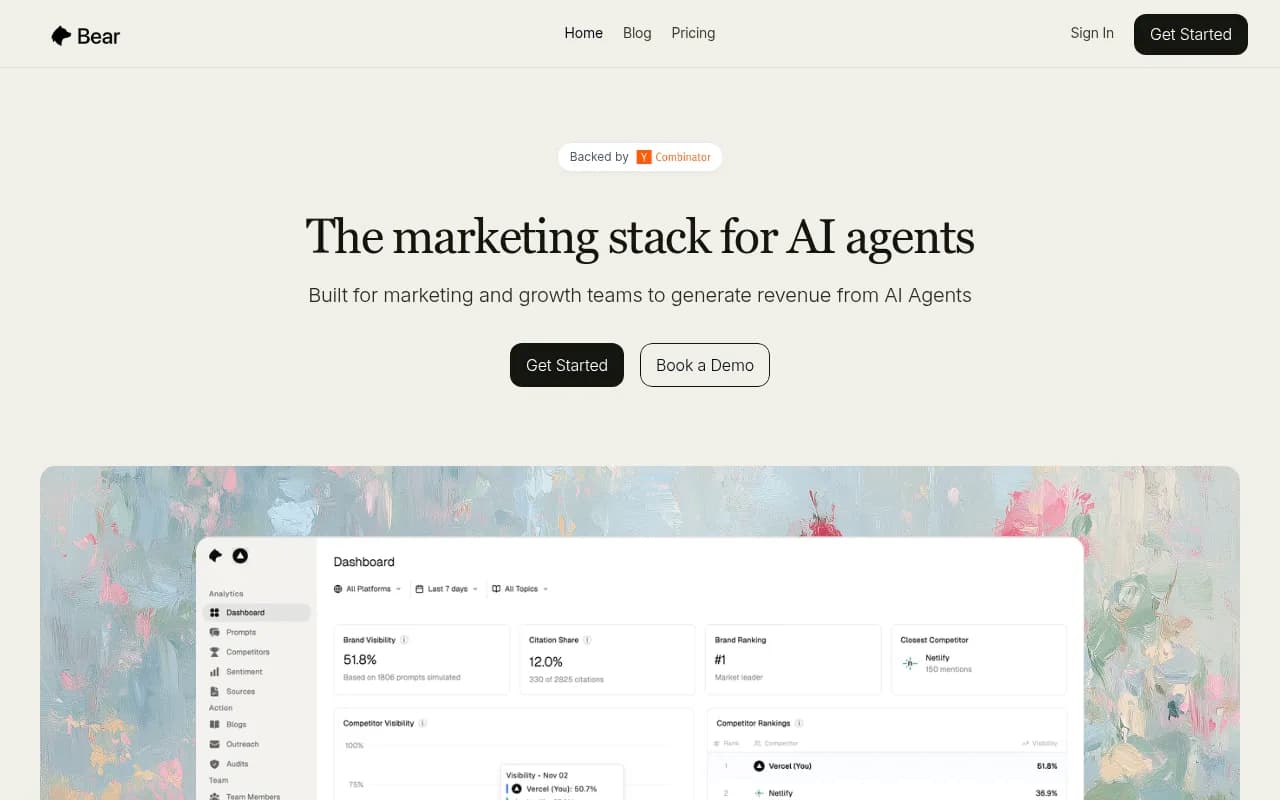
Bear AI is a YC-backed platform that positions itself as "the marketing stack for AI agents." The core pitch is straightforward: AI models are sending traffic to websites, and most marketing teams have no idea how to track or convert it. Bear AI tries to fix both sides of that problem -- visibility tracking and revenue conversion. It monitors how ChatGPT, Claude, Perplexity, and Google AI Overviews discover and recommend your brand, then gives you tools to identify high-intent visitors from those sources and turn them into leads.
The product is clearly aimed at growth-focused marketing teams who want to treat AI search as a revenue channel, not just a monitoring exercise