Key takeaways
- Bear AI starts at $199/month with self-serve access; Bluefish AI requires a sales call and is estimated at $4,000+/month for enterprise plans -- these tools are not competing for the same budget.
- Bear AI is built around converting AI traffic into leads and revenue; Bluefish AI is built around brand authority, influence, and enterprise-scale monitoring.
- Bluefish AI targets Fortune 500 marketing teams with custom audiences and deep infosec compliance; Bear AI targets growth and marketing teams at scaling companies.
- Neither tool offers the depth of content gap analysis or AI writing capabilities found in more comprehensive GEO platforms -- both lean toward monitoring over optimization.
- Bear AI covers 2 AI models on its entry plan (up to 6+ on Enterprise); Bluefish AI's model coverage is customized per client but not publicly specified.
- If you're a mid-market company trying to act on AI visibility data, neither tool is a perfect fit -- Bear AI gets you started faster, but its feature set is still maturing.
Overview
Bear AI
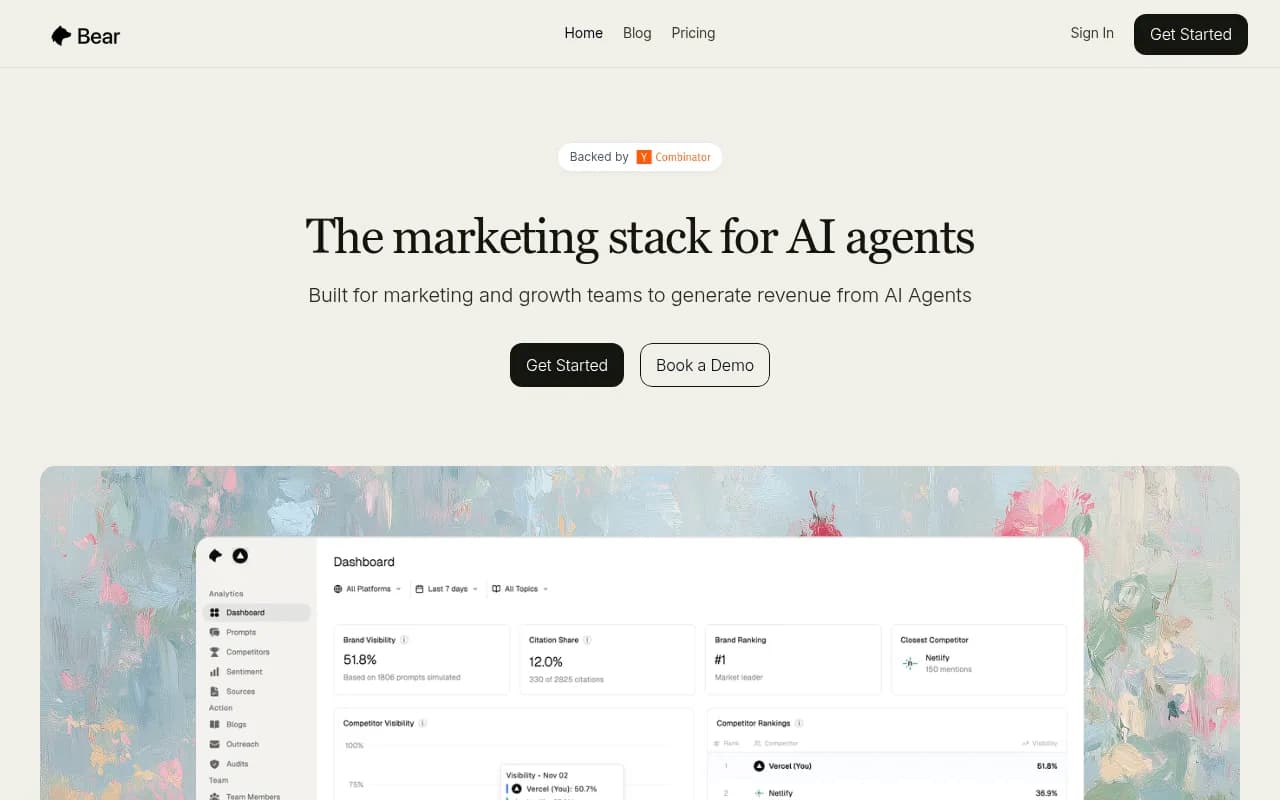
Bear AI is a YC-backed startup positioning itself as "the marketing stack for AI agents." The pitch is straightforward: AI models like ChatGPT, Claude, and Perplexity are sending traffic to websites, and most marketing teams have no idea it's happening or how to act on it. Bear AI wants to fix that by tracking which AI models mention your brand, identifying high-intent visitors arriving from those mentions, and giving you tools to convert them.
It's a growth-team product at heart. The dashboard shows trending prompts, brand mentions across AI models, and traffic attribution. The Enterprise tier adds lead generation features -- identifying specific companies or visitors coming from AI sources. Bear AI is backed by Y Combinator and has customers including Peerspace, Wispr Flow, and Groww.
Bluefish AI
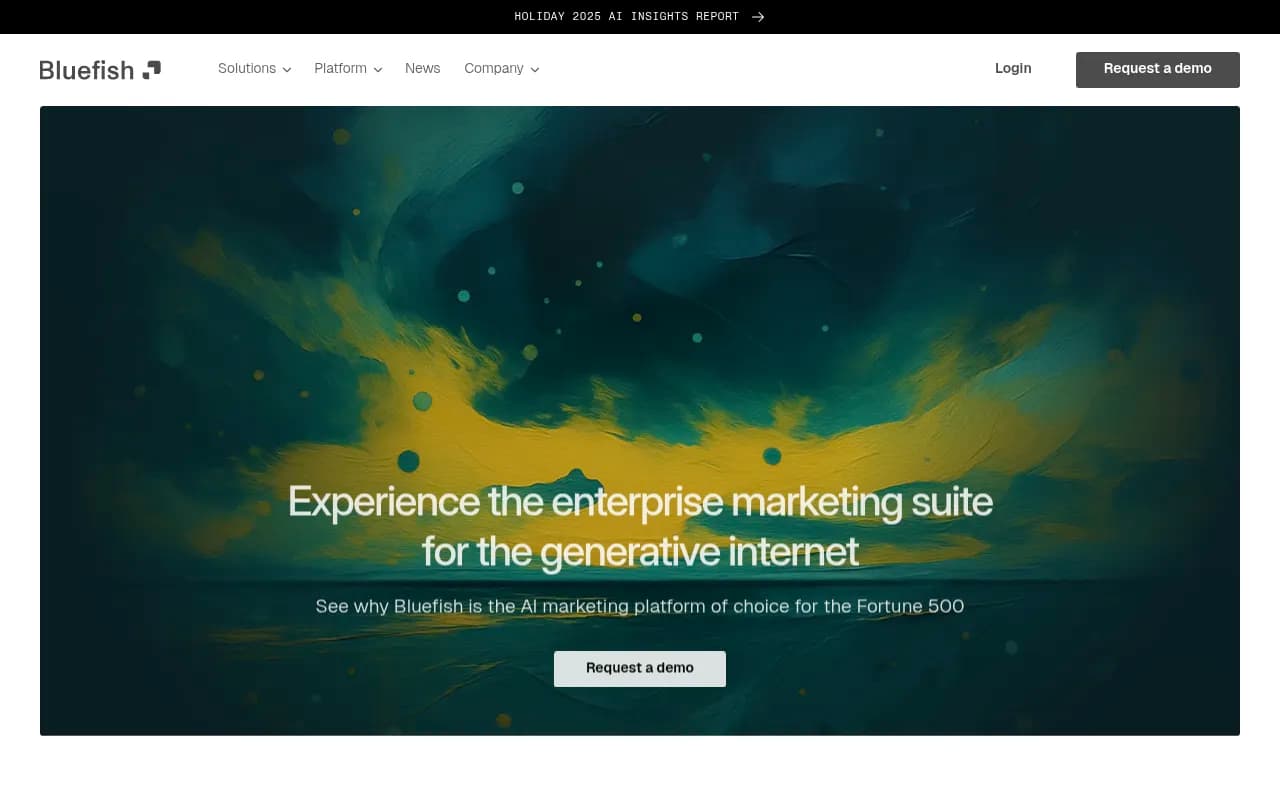
Bluefish AI takes the opposite approach to market positioning. Where Bear AI says "growth teams," Bluefish says "Fortune 500." Where Bear AI shows you a self-serve pricing page, Bluefish shows you a "Request a demo" button and a reference to enterprise infosec reviews.
The platform covers AI monitoring, GEO measurement, and AI commerce tracking. Its differentiator is depth over breadth -- custom audiences, tailored prompt sets, and what it calls understanding how AI "thinks" about your brand. A February 2026 study they published on Super Bowl ads influencing AI recommendations gives a sense of the research-heavy angle they're taking. In April 2026, they also announced AI-optimized content capabilities, suggesting they're moving toward optimization rather than pure monitoring.
Side-by-side comparison
| Feature | Bear AI | Bluefish AI |
|---|---|---|
| Starting price | $199/month | Custom (est. $4,000+/month) |
| Free tier | No | No |
| Self-serve signup | Yes | No (demo required) |
| Target audience | Growth & marketing teams | Fortune 500 enterprise |
| AI models tracked | 2 (Basic) to 6+ (Enterprise) | Custom per client |
| Prompt tracking | 75 (Basic) to unlimited (Enterprise) | Custom |
| Content generation | 2 blogs/month (Basic) | Limited (announced Apr 2026) |
| Lead generation / visitor ID | Enterprise only | Not a focus |
| AI commerce tracking | Not specified | Yes |
| Custom audiences | No | Yes |
| Crawler logs | Not specified | Not specified |
| Infosec / enterprise compliance | Not specified | Strong (passes enterprise reviews) |
| API access | Not specified | Not specified |
| Pricing transparency | Yes (public tiers) | No (quote-based) |
Head-to-head feature deep-dive
Pricing and accessibility
This is where the two tools diverge most sharply. Bear AI publishes three tiers:
| Plan | Price | Prompts | Blogs | AI models |
|---|---|---|---|---|
| Basic | $199/month | 75 | 2 | 2 |
| Enterprise | Custom | Unlimited | More | 6+ |
Bluefish AI has no public pricing. Based on the enterprise positioning and comparable tools in the space, estimates put it at $4,000/month or higher. There's no trial, no self-serve, and no way to start without talking to sales.
Verdict: Bear AI wins on accessibility. If you want to start tracking AI visibility this week without a procurement process, Bear AI is the only option here.
AI model coverage
Bear AI's Basic plan covers just 2 AI models -- which is genuinely limiting if you care about the full picture. The Enterprise tier gets you 6+, but the specific models aren't listed publicly. From the homepage, ChatGPT, Claude, Google AI Overviews, and Perplexity are shown.
Bluefish AI covers "all major AI channels" according to their site, with coverage tailored to each enterprise client. They mention AI search and agentic commerce channels specifically. The lack of a public model list makes it hard to compare directly.
For context, platforms like Promptwatch monitor 10 AI models including DeepSeek, Grok, Mistral, and Meta AI -- which gives a sense of what comprehensive coverage looks like in 2026.

Verdict: Bluefish AI likely covers more ground at the enterprise level, but Bear AI's Basic plan is notably thin at just 2 models.
Monitoring and visibility tracking
Both tools track brand mentions and visibility across AI models. Bear AI shows trending prompts, how AI agents are discovering your brand, and what they're saying. The dashboard appears clean and growth-team friendly.
Bluefish AI goes deeper on the analytics side -- custom audiences, segmented data, and what they describe as understanding the "why" behind AI recommendations. Their Super Bowl study (showing that TV ad spend influenced AI recommendations) suggests they're doing more sophisticated analysis than simple mention counting.
Bluefish also covers AI commerce specifically, which Bear AI doesn't explicitly address. If your brand sells products and you care about appearing in AI shopping recommendations, that's a meaningful gap in Bear AI's offering.
Verdict: Bluefish AI has more analytical depth. Bear AI is more accessible but less sophisticated on the monitoring side.
Content optimization and generation
Bear AI includes blog generation -- 2 posts per month on Basic, more on higher tiers. It's a start, but 2 blogs a month is a fairly thin content operation for any serious SEO or GEO effort.
Bluefish AI announced "A Better Approach to AI-Optimized Content" in April 2026, suggesting they're building in this direction. But historically, Bluefish has been a monitoring platform, and content generation isn't a core part of their pitch.
Neither tool has a strong content optimization story compared to platforms that have built this from the ground up. The gap analysis, prompt-level content recommendations, and AI-grounded writing that more comprehensive GEO platforms offer isn't really present in either tool here.
Verdict: Bear AI has a slight edge because it at least ships content. Bluefish is catching up but isn't there yet.
Lead generation and revenue attribution
This is Bear AI's most distinctive angle. The platform explicitly promises to identify high-intent visitors arriving from AI sources and convert them into leads. On Enterprise plans, this includes company-level identification -- knowing that a visitor from a ChatGPT recommendation works at a specific company.
Bluefish AI doesn't focus on this at all. Their value proposition is brand authority and influence, not pipeline generation. If you're a B2B company trying to attribute revenue to AI visibility, Bear AI has a clearer story.
Verdict: Bear AI wins clearly. Lead generation from AI traffic is a core feature; Bluefish doesn't compete here.
Enterprise features and compliance
Bluefish AI is built for enterprise procurement. They explicitly mention passing infosec reviews, custom data segmentation, and tailored measurement frameworks. For a Fortune 500 brand with strict vendor requirements, this matters a lot.
Bear AI doesn't speak to enterprise compliance in any detail. It's a YC startup with a self-serve product -- which is fine for its target audience, but means it probably won't pass a rigorous enterprise security review without significant effort.
Verdict: Bluefish AI wins for enterprise requirements. Bear AI isn't built for that environment.
Ease of use and time to value
Bear AI: sign up, connect your site, start seeing data. The self-serve model means you can be running within a day.
Bluefish AI: request a demo, go through a sales process, get a custom implementation. Time to value is measured in weeks, not hours.
Verdict: Bear AI wins on speed. Bluefish AI's onboarding is a feature for enterprises that want hand-holding, but it's a barrier for everyone else.
Pricing comparison
| Plan | Bear AI | Bluefish AI |
|---|---|---|
| Entry-level | $199/month (Basic) | Not available |
| Mid-tier | Not published | Not available |
| Enterprise | Custom pricing | Custom (est. $4,000+/month) |
| Free trial | Not specified | No |
| Self-serve | Yes | No |
The pricing gap here is enormous. Bear AI is accessible to startups and mid-market companies. Bluefish AI is priced for companies with dedicated marketing technology budgets.
Pros and cons
Bear AI
Pros:
- Transparent, accessible pricing starting at $199/month
- Self-serve -- no sales process required
- Lead generation and visitor identification from AI traffic
- YC-backed with active product development
- Clear focus on revenue attribution, not just vanity metrics
Cons:
- Basic plan covers only 2 AI models -- thin for comprehensive monitoring
- 2 blogs/month is a very limited content operation
- Relatively new product; feature set is still maturing
- No public information on crawler logs, API, or advanced integrations
- Enterprise features require custom pricing with no published details
Bluefish AI
Pros:
- Built for enterprise scale with strong infosec compliance
- Custom audiences and tailored prompt sets for competitive markets
- AI commerce tracking for brands selling products through AI channels
- Research-backed approach (e.g., Super Bowl ad influence study)
- Moving toward content optimization capabilities (April 2026 announcement)
Cons:
- No transparent pricing -- requires a sales demo to get started
- Estimated $4,000+/month puts it out of reach for most companies
- Historically monitoring-focused with limited optimization tools
- No lead generation or visitor identification features
- No self-serve option for teams that want to move quickly
Who should pick which tool
Pick Bear AI if:
- You're a startup or mid-market company with a $200-$500/month budget for AI visibility
- Your primary goal is identifying and converting visitors who arrive from AI recommendations
- You want to get started quickly without a procurement process
- You're a B2B company trying to build a pipeline from AI search traffic
- You want a growth-team tool, not an enterprise analytics platform
Pick Bluefish AI if:
- You're at a Fortune 500 company with an enterprise marketing technology budget
- You need a vendor that can pass rigorous infosec and compliance reviews
- You sell products and want to track AI commerce channels specifically
- You need custom audience segmentation and tailored prompt sets for competitive markets
- You have a dedicated team to work with a high-touch vendor relationship
Consider neither if:
- You need comprehensive coverage of 10+ AI models out of the box
- Content gap analysis and AI-grounded content generation are priorities
- You want crawler logs showing how AI bots interact with your site
- You need Reddit and YouTube citation tracking to understand where AI gets its information
- You're an agency managing multiple client brands under one platform
Final verdict
Bear AI and Bluefish AI are solving adjacent problems for very different customers. Bear AI is a scrappy, accessible tool for growth teams who want to turn AI traffic into revenue -- the lead generation angle is genuinely differentiated and the pricing is reasonable. Bluefish AI is a premium enterprise platform for brands that need depth, compliance, and custom analytics, and are willing to pay for it.
The honest answer is that neither tool is a complete GEO platform in 2026. Bear AI's Basic plan is thin on model coverage, and Bluefish AI still leans heavily toward monitoring over optimization. If converting AI traffic into leads is your primary goal and you're not an enterprise, Bear AI is the practical choice. If you're a Fortune 500 brand that needs a vendor who can survive your procurement process, Bluefish AI is built for you.
For teams that want the full picture -- monitoring, content gap analysis, AI writing, crawler logs, and traffic attribution -- the gap between what these two tools offer and what the category's best platforms deliver is worth investigating before committing.